
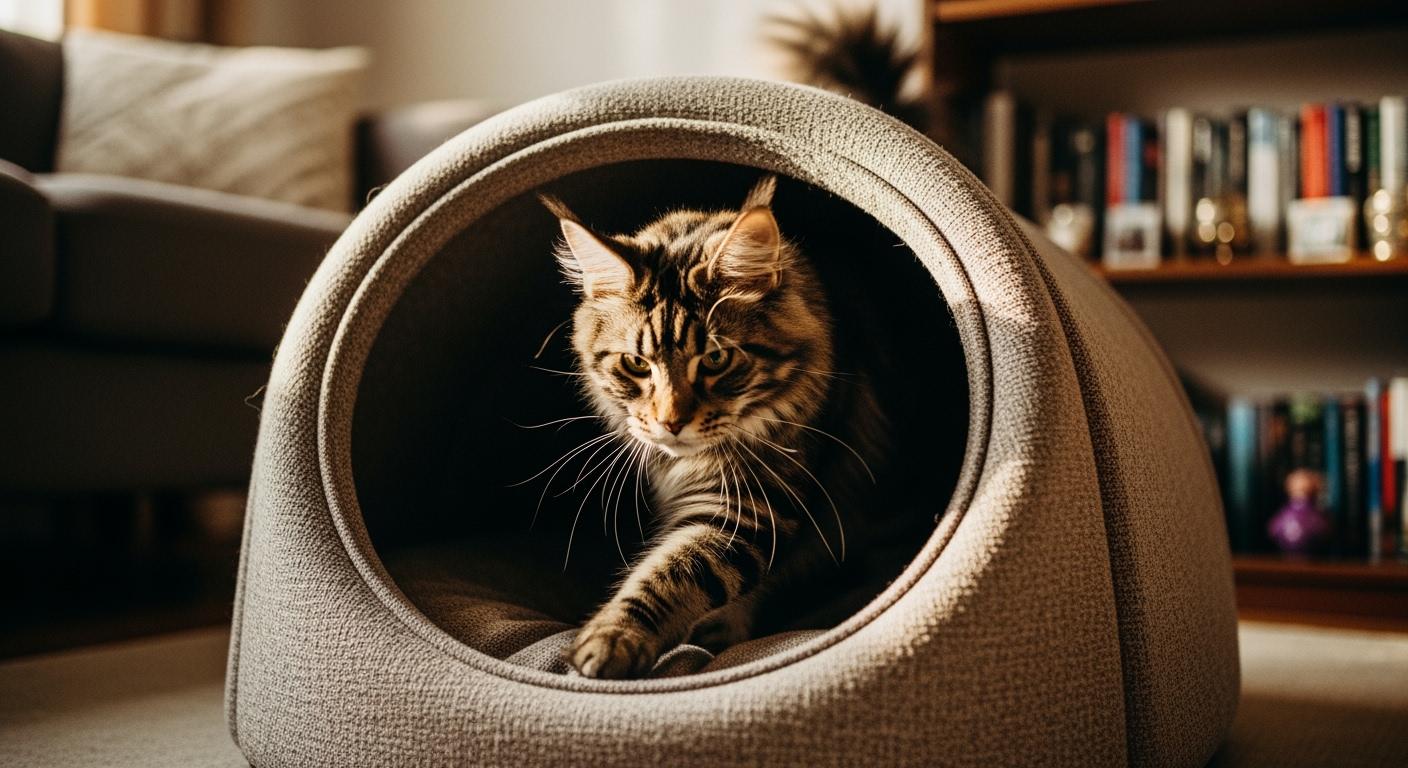
Most cat cave beds fail large cats before the cat ever steps inside. The problem is not the bed’s softness or its color. It is the entrance. A cat approaching a cave bed judges the opening first — its width, its stability, whether it looks like a path or a trap. Standard entrances measure around 14–15 inches across. A Maine Coon’s shoulders span 18–20 inches. The math fails before the cat does.
But a wide entrance alone does not fix the problem. If the rim lacks internal support, it folds inward the moment the cat pushes through. The opening collapses. The cat backs away. A large cat cave bed with wide entrance must do two things at once: offer enough clearance for shoulders and hips, and resist the pressure those shoulders apply during every entry and exit.
That combination — width plus structural support — is what separates a bed a cat uses daily from one that sits untouched in the corner.
Why Narrow or Collapsing Entrances Make a Cave Bed Unusable for Large Cats
How Cats Judge an Entrance Before Entering
Cats assess an opening visually before committing their body to it. If the entrance appears too narrow or its rim looks unstable, hesitation becomes refusal. This is not shyness. It is a predation-survival instinct: a small or shifting opening in the wild means a den that could collapse or a predator that could follow. A cat that sniffs the entrance and walks away is not being difficult. It is reading the structure correctly.
A wide entrance removes the visual barrier. The cat sees open space, not a constriction point. But the rim must also stay put under pressure. When a 15-pound cat pushes its shoulders through an opening, the force concentrates at the contact point between the cat’s body and the rim. If the rim is nothing more than two layers of felt sewn together — no internal cord, no denser foam strip — that force is not distributed around the circumference. It stays local. The fabric buckles inward. The cat feels the rim collapse against its shoulder and retreats. Size and shape drive more of the experience than the material tag alone.
Shoulder Width and Body Angle Problems
The mismatch is measurable. Large cat breeds carry shoulder widths of 18–20 inches. Standard cave bed entrances run 14–15 inches. The cat cannot walk straight through. It must angle its body, dip one shoulder, or crouch. Each adjustment adds friction and uncertainty.
| Category | Measurement (inches) | Measurement (cm) |
|---|---|---|
| Large Cat Breeds (shoulder width) | 18-20 | 45-50 |
| Standard Cat Cave Entrances | 14-15 | 35-38 |
Even if the cat squeezes through once, the experience registers as stressful. Cats learn from a single negative entry. A bed that required twisting or forcing becomes a bed the cat avoids. You see the pattern: one hesitant entry, then the cat sleeps next to the bed instead of inside it.
Low Roofs and Pressing Backs
Entry height matters as much as entry width. A cave with a low ceiling forces a large cat to flatten its body or duck its head during entry. This compresses the spine and triggers the same avoidance response. The cat feels exposed — it cannot see what is ahead while its head is down. An entrance that is at least 10 inches tall lets the cat walk in head-up, maintaining visual awareness of the interior.
Rim Support — What Keeps a Wide Entrance from Folding Under Pressure
The Mechanics of a Collapsing Rim
The entrance rim is the most mechanically stressed part of any cat cave. Every entry and exit applies lateral force. The cat’s shoulder presses outward and downward against the rim’s edge. What happens next depends entirely on rim construction.
In an unsupported rim — two layers of felt or fabric sewn flat — the force from the shoulder has nowhere to go. It pushes the fabric inward, deforming the opening. The rim folds. Worse, once the fabric creases along a fold line, it loses what little structural memory it had. The entrance stays partially collapsed even when the cat is not touching it. The bed looks closed.
An internally supported rim changes the force path. A continuous cord stitched into the rim’s circumference, or a denser foam strip running through the opening edge, distributes shoulder pressure around the entire ring. The force does not stay at the contact point — it travels. The rim flexes slightly and returns to shape. The opening stays open.
To verify this difference, press down on the rim’s top edge with your hand and release. A supported rim springs back to its original form. An unsupported rim stays dented.
Materials That Hold Shape Under Repeated Load
High-density felt — typically 3–5 mm thick with a density above 400 g/m² — resists creasing better than thin polyester fleece. It has internal fiber entanglement that acts like a micro-scale truss: individual wool or synthetic fibers interlock at multiple angles, so bending the material requires breaking those bonds across a wider area. Thin fleece, by contrast, has fibers aligned predominantly in one plane, so it folds cleanly along that plane after minimal cycles.
Denser foam inserts inside the rim add recovery speed. Foam compresses under load but rebounds when the load is removed. This matters because cats do not enter once per day. They enter and exit repeatedly — to investigate a sound, to stretch, to reposition. Each cycle tests the rim’s ability to return to form. Fit checks that translate measurements into real-world comfort apply to cave beds too: a bed that fits on paper but collapses under use is not a fit.
Entrance Dimensions That Match Large Cat Bodies
| Measurement Type | Minimum for Large Cats |
|---|---|
| Entry Width | At least 8 inches |
| Entry Height | At least 10 inches |
| Interior Depth | At least 18 inches for full-body stretching |
These numbers assume a rim that holds its shape. A 10-inch entrance that collapses to 6 inches under pressure is not a 10-inch entrance in practice. Measure the opening when the cat is not present, then measure again while pressing inward on the rim with moderate hand pressure. The difference tells you how much of the advertised clearance disappears under real use. Tunnel-style beds share the same structural demands as cave beds — a collapsible opening fails both designs equally.
Interior Volume and Body Structure — Why the Cave Has to Hold Its Shape
Turning Room and the One-Entry Problem
A cat that enters a cave bed and cannot turn around will exit and not return. Cats want to orient themselves to face the entrance after settling. This requires the interior to accommodate the cat’s body length plus a turning radius. For a Maine Coon at 30–40 inches nose-to-tail, that means 18–20 inches of usable interior space in both width and depth.
The observation is straightforward: after your cat has used the bed for a week, check whether the interior walls show compression marks where the cat’s body pressed against them during turns. Continuous contact marks along the same section of wall indicate the cat is hitting the boundary during rotation — the space is too tight.
Roof Sag and the Loss of Perceived Safety
A cave body that loses its dome over time creates two problems. First, the interior volume shrinks — what was a 12-inch cavity becomes 8 inches. Second, and more important for cat behavior, a sagging roof signals structural instability. Cats read visual cues of collapse the same way they read an unstable surface underfoot. The den no longer looks like a den.
Semi-rigid construction methods — a denser felt shell, internal batting that maintains loft under compression, or a structured frame sewn into the body panels — prevent this sag. The test: run your hand along the interior roof after two weeks of daily use. If you feel the fabric dipping more than half an inch below its original arc, the structure is losing its ability to hold interior volume. Large-breed cats need interior dimensions that accommodate full body length plus turning radius, and a cave that shrinks over time fails that requirement progressively.
Base Stability and Non-Slip Foundations
| Use Problem | Why it Happens | Better Cave Bed Design |
|---|---|---|
| Bed slides or tips on entry | Thin or soft base with no grip layer | Weighted or non-slip bottom panel |
| Entrance shifts angle during use | Unstructured floor panel that warps | Reinforced base that stays flat |
| Cave body collapses inward | No internal structure in walls or roof | Semi-rigid shell with shape-memory materials |
A shifting base changes the entrance angle with every entry. If the bed slides forward when the cat steps onto the floor panel, the entrance tilts downward — making the opening effectively smaller and forcing the cat to step up while ducking. Place the bed on a rug or add a rubber grip pad beneath it. If the bed still shifts, the base lacks sufficient structure regardless of the surface underneath.
When a Wide-Entrance Cat Cave Bed Is Not the Right Fit
Not every large cat wants a cave. Some cats prefer open sightlines — they want to see the room while resting. A wide-entrance cave bed encloses the cat on three sides with a roof overhead. For a cat that startles easily or prefers to monitor doorways and foot traffic, that enclosure may increase vigilance rather than reduce it. Whether a covered cave suits your cat better than an open donut style depends on the cat’s resting posture and alertness pattern, not just its size.
Cats that run hot — particularly long-haired breeds in warm climates — may find a fully enclosed cave too warm, even with breathable materials. The same enclosure that blocks drafts also traps body heat. A bolsters-style bed with raised edges but no roof can offer partial enclosure without the thermal buildup.
Multi-cat households present a different challenge. A single-entrance cave gives the cat inside no exit route if another cat blocks the opening. For homes with territorial dynamics, an open bed or a cave with dual entrances reduces the risk of a trapped cat escalating to conflict.
Disclaimer: This fit guidance assumes cats of typical large-breed proportions — Maine Coons, Ragdolls, Norwegian Forest Cats, and similar builds. Brachycephalic breeds or cats with orthopedic conditions may show different entry behavior even with a properly sized and supported entrance. If the cat’s chest shape falls outside the breed norms these dimensions are patterned for — particularly cats with a barrel chest, very deep keel, or restricted shoulder mobility — the clearance checks described here may not catch every pressure point. Hand-check the rim contact area after the first few entries by running your fingers along the shoulder line for any signs of friction or compression.
The placement of the bed also shapes the outcome. A cave bed tucked into a corner may feel more secure to one cat and more confining to another. How the bed is positioned within the room affects entry behavior as much as the entrance dimensions themselves — a well-designed cave placed in a high-traffic hallway will underperform a simpler bed set in a quiet corner.
A large cat cave bed with wide entrance succeeds or fails on two structural details: whether the rim resists folding under shoulder pressure, and whether the body retains its interior volume after repeated use. Width without support is a promise the materials cannot keep. Support without sufficient width is a barrier the cat reads before entering. When both are present — a supported rim that stays open at 8+ inches wide, a semi-rigid body that holds 18+ inches of interior space, and a stable base that does not shift — the cat walks in, turns around, and settles. That is the only performance test that matters.
FAQ
How do I measure my cat to check if a cave bed will fit?
Measure shoulder width across the widest point of the chest with the cat standing. Measure body length from shoulder to base of tail for turning clearance. Compare both numbers to the entrance width and interior depth of the bed. The entrance should exceed shoulder width by at least 2 inches, and interior depth should match or exceed body length for comfortable turning.
What materials hold entrance shape best over time?
| Material | Shape Retention Under Repeated Load |
|---|---|
| High-density wool felt (400+ g/m²) | Resists creasing; fiber entanglement distributes bending force |
| Reinforced foam inserts | Compresses and rebounds; needs at least 1-inch thickness in rim |
| Thin polyester fleece (unsupported) | Creases after minimal cycles; loses structural memory at fold lines |
Will a wide entrance help a cat that already avoids its current bed?
It can, but only if the avoidance is driven by entry difficulty rather than location preference or territorial factors. Move the current bed to a different spot first. If the cat still refuses to enter, the entrance design is the more likely cause. A cat that approaches, sniffs the opening, and turns away is signaling an entry problem specifically.






