
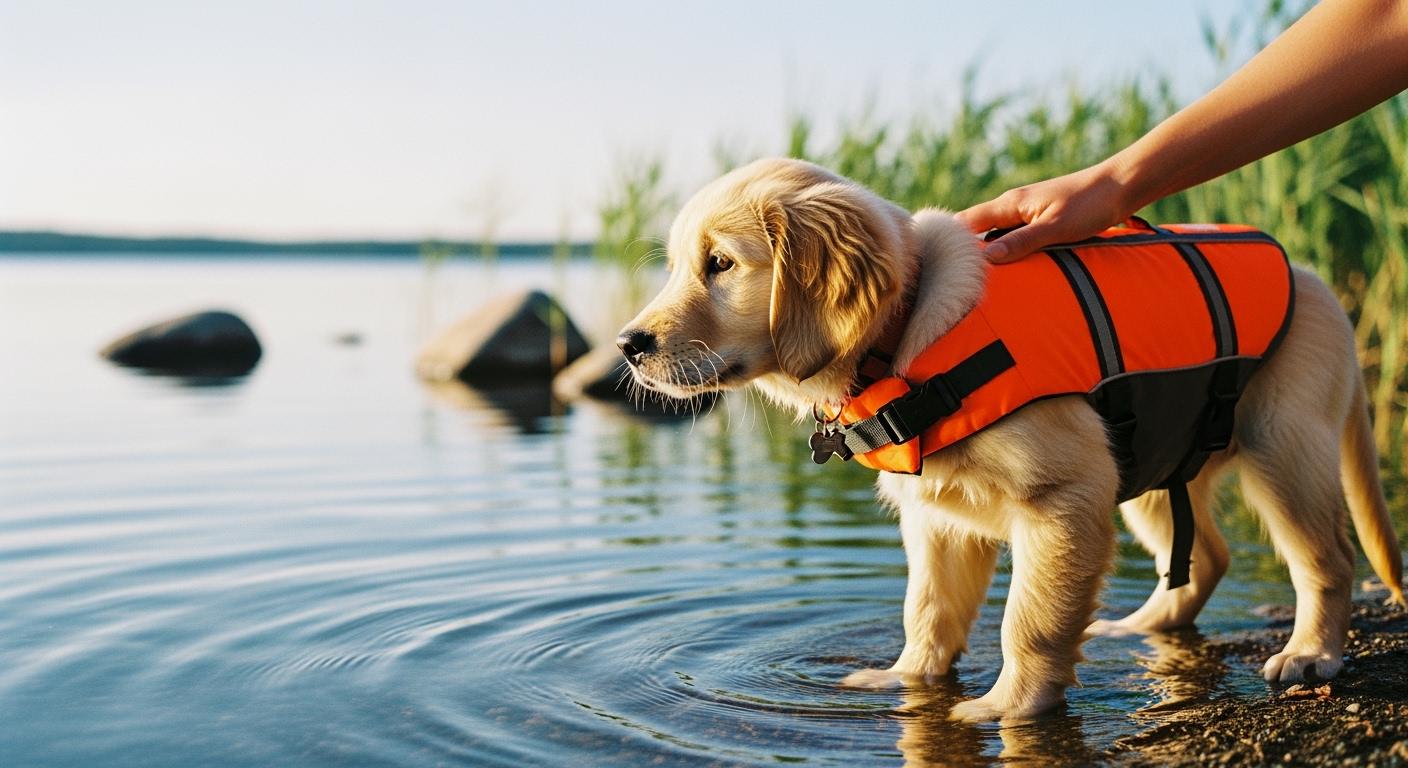
Most people assume a dog life jacket works because it adds flotation. That is half of it. For a dog entering water for the first time, flotation without balance creates a new set of problems — ones that can make panic worse, not better. The design variable that separates a vest that calms a first-timer from one that feeds their fear is buoyancy distribution: where the foam sits relative to the dog’s center of mass, and whether the fit system keeps it there when the dog starts paddling.
A vest with foam concentrated in one zone floats the front half while the rear sinks. The dog feels their hindquarters drop, paddles harder with only the front legs, and goes vertical. From vertical, every stroke fights gravity instead of moving forward. Exhaustion follows in minutes. This is not a training issue. It is a buoyancy placement issue.
Why a Flotation Vest Alone Does Not Stop First-Swim Panic
A dog that has never swum before does not know that kicking the back legs helps. Instinct drives front-leg-only paddling. If the vest’s buoyancy is biased toward the chest, the rear end drops, and the body tilts toward vertical. Once vertical, the dog’s head barely clears the water surface. Breathing becomes labored. The paddling gets faster, less coordinated. The dog is not learning to swim — they are fighting to stay above water.
The causal chain is straightforward physics. Foam creates upward force proportional to the volume of water it displaces. When most of that foam sits forward of the dog’s center of mass, the front lifts more than the rear. The body becomes a lever with the center of mass as the pivot — too much upward force forward, and the rear rotates downward. The dog compensates by paddling only with the front legs, which adds forward thrust but no rear lift. That thrust pushes the chest higher, rotating the body further toward vertical. The cycle tightens. Within 30 to 60 seconds, a dog that entered the water calmly can be gasping and clawing at the surface.
This is why buoyancy distribution matters more than total buoyancy rating. A vest that spreads foam panels evenly from chest to belly keeps the spine closer to horizontal. From horizontal, paddling moves the dog forward instead of upward. Less energy waste. Less panic.
You can verify this without waiting for a full panic response. After the dog has been in the water for 60 seconds, note the angle of their spine relative to the water surface. A dog floating near horizontal — spine within roughly 20 degrees of parallel — has balanced buoyancy under them. A dog whose rear sits visibly lower than the chest, or whose shoulders ride high while the hind legs dangle, is fighting unbalanced flotation. Pull them out, adjust strap tension, and check whether the foam panels have shifted inside their fabric compartments.
Where Poor Fit Turns the Vest Against the Dog
Balanced buoyancy only works if the vest stays where it was designed to sit. Loose straps undo balanced design in seconds.
When belly straps are too loose, water pressure pushes the chest panel upward as the dog enters. The foam that should sit against the sternum rides up toward the throat. The dog’s center of mass now sits below the buoyancy zone. The vest rotates forward, pulling the neck opening tight against the underside of the jaw. The dog feels pressure on the throat and instability in the body — two signals that trigger panic in any animal. A vest that shifts even an inch during paddling changes the dog’s relationship to the water. What was a stable platform becomes an unpredictable force tugging them in directions they did not choose. First-time swimmers have no context for this. They cannot distinguish between “the vest moved” and “I am sinking.” Their response is the same: paddle harder, breathe faster, look for an exit.
Loose belly straps let the chest panel ride up, and once the foam sits higher than the dog’s center of mass, the vest rotates in the same way that leads to chafing and ride-up in open water. Fit checks before every swim catch the problems that sizing charts alone miss.
The handle is part of the fit system, not just an emergency grab point. A handle stitched along the spine, with reinforcement that distributes lifting force across multiple panels, lets a handler provide a brief steadying input without twisting the vest. A narrow handle attached only at the rear shifts the vest sideways when pulled — exactly the wrong input for a dog already struggling with balance.
In practice: Before entering the water, put the vest on, tighten the three straps until you can slide two fingers flat between each strap and the dog’s body, then lift gently by the handle. The dog’s body should rise evenly. If the vest slides forward, the chest panel tilts, or a belly strap gap opens, the fit is not secure enough. A vest that shifts on land will shift more once submerged, where every surface is lubricated and forces come from unpredictable angles.
Design Features That Support a Confident First Swim
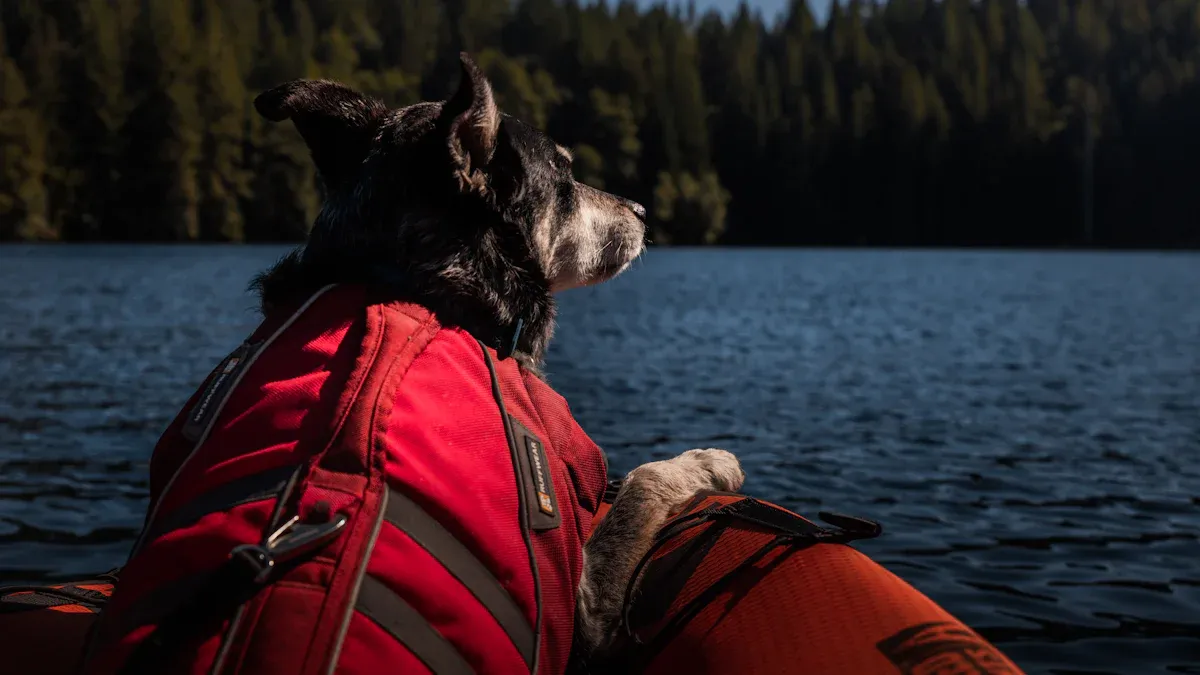
A vest built for a first-time swimmer needs to do three things that generic flotation gear does not prioritize: stay put under chaotic movement, keep the dog horizontal without handler correction, and give the handler a way to offer support that does not make the dog feel trapped.
Balanced buoyancy starts with foam panel placement. Multi-panel designs — separate foam inserts for the chest, each side rib, and the belly — let buoyancy be tuned per zone rather than dumped into one cavity. This zoning matters for short-muzzled breeds in particular. Bulldogs and Pugs carry weight forward and have minimal natural buoyancy in the rear. A vest that lifts the chest aggressively while leaving the hindquarters unsupported exacerbates their existing front-heaviness. A zoned design shifts more flotation to the belly and side panels, compensating for the imbalance.
The adjustment system determines whether that zoned buoyancy actually reaches the dog. Three independent straps — chest, belly, and often a third at the rear — each with a side-release buckle, let you set different tensions for different body zones. A deep-chested dog needs more tension on the belly strap to prevent the vest from riding forward on a narrow waist. A barrel-chested breed needs even chest-panel contact without over-compressing a broad ribcage. The same vest, adjusted differently, serves both shapes — provided the straps are independent and the buckles hold their setting when wet.
Side-release buckles made from acetal resin resist corrosion and hold tension more reliably than metal hardware after repeated saltwater exposure and sun drying — a material distinction that separates life jackets built for repeated water use from casual flotation aids.
The grab handle deserves more attention than it typically receives. A handle positioned along the spine, with bar-tack reinforcement at both attachment points, lets the handler provide support without twisting the vest. A spine-length design distributes lift along the dog’s body axis — the same principle that makes grab handles critical for quick retrieval in boating conditions. This matters most in the first five minutes of swimming, when the dog is calibrating how much they can trust the vest’s ability to keep them stable without constant handler correction.
Visibility features serve a function beyond aesthetics. A handler watching a first-time swimmer needs to read body position at a glance. Dark or muted vest colors blend with water and make it harder to spot a shift from horizontal to vertical paddling. High-contrast panels along the spine and sides create reference lines: if the bright panel tilts, the dog is tilting.
Zoned buoyancy compensates for breed-specific weight distribution — an approach that becomes clearer when examining how life jacket fit builds water confidence across different activities and water conditions.
| Design Feature | Why It Matters for First Swims | Main Limitation |
|---|---|---|
| Zoned foam panels (chest + sides + belly) | Prevents rear-sinking by distributing lift along body length instead of concentrating it forward | Requires correct strap tension per zone; one loose strap unbalances all panels |
| Three-point adjustable straps with side-release buckles | Allows different tension per body zone so the same vest works for a deep-chested Greyhound and a barrel-chested Bulldog | Acetal buckles can degrade under prolonged UV exposure if not rinsed and dried between uses |
| Spine-length reinforced grab handle | Lets handler steady the dog without twisting the vest sideways, distributing lift along the body axis | Handle lift only works if vest fit is already secure; cannot compensate for loose belly straps |
| High-contrast colors with wide reflective strips | Creates visible reference lines so the handler can spot a body tilt at a glance before it becomes panic | Reflective material loses reflectivity when fully submerged; useful mainly for surface visibility |
When the Design Alone Is Not Enough
A well-designed vest reduces the mechanical problems that trigger panic — rear-sinking, rotation, head-dipping. It does not eliminate the need for gradual introduction. A dog that has never felt water under their paws still needs short sessions, shallow entry points, and a handler who reads stress signals before they become panic.
These design features assume the dog’s chest and body proportions fall within the range the vest’s pattern was graded for. Dogs with extreme builds may need more careful strap tuning than a standard three-point adjustment can provide. The fit checks described here assume a short-coated dog where panel shift is visible from above; double-coated breeds need hand-checking under the vest rather than visual inspection alone.
Disclaimer: If the dog’s chest shape falls outside the breed norms this vest was patterned for — particularly dogs with a barrel chest or an unusually deep keel — the fit checks described here may not catch every pressure point. Double-coated breeds may show subtler rub marks that need hand-checking rather than visual inspection.
FAQ
How does buoyancy distribution affect a first-time swimmer differently than an experienced dog?
An experienced dog adjusts their paddling to compensate for minor buoyancy imbalances — they have learned which leg movements keep them level. A first-time swimmer has no such calibration. If the vest tilts them, they tilt with it. Their instinctive front-leg-only paddling amplifies the tilt rather than correcting it. Balanced buoyancy matters more for the novice because the dog brings no self-correcting skill to the water.
What should I check on the vest after each swim?
Rinse the buckles with fresh water and work them open and closed a few times — grit in the mechanism can cause a buckle to slip under load during the next swim. Check that the foam panels have not shifted within their fabric pockets; panel migration inside a stitched compartment changes buoyancy distribution without any visible external sign. Run your thumb along the handle stitching and look for frayed threads at the attachment points.
Can a life jacket make a nervous dog more anxious?
Yes — when the vest shifts, rotates, or presses against the throat. A nervous dog is already hyper-aware of unfamiliar sensations. A shifting vest adds unpredictable tactile input to an already stressful situation. The design solution is not more straps but better strap placement: independent adjustment points that let tension vary by body zone so the vest moves with the dog rather than against it.






