
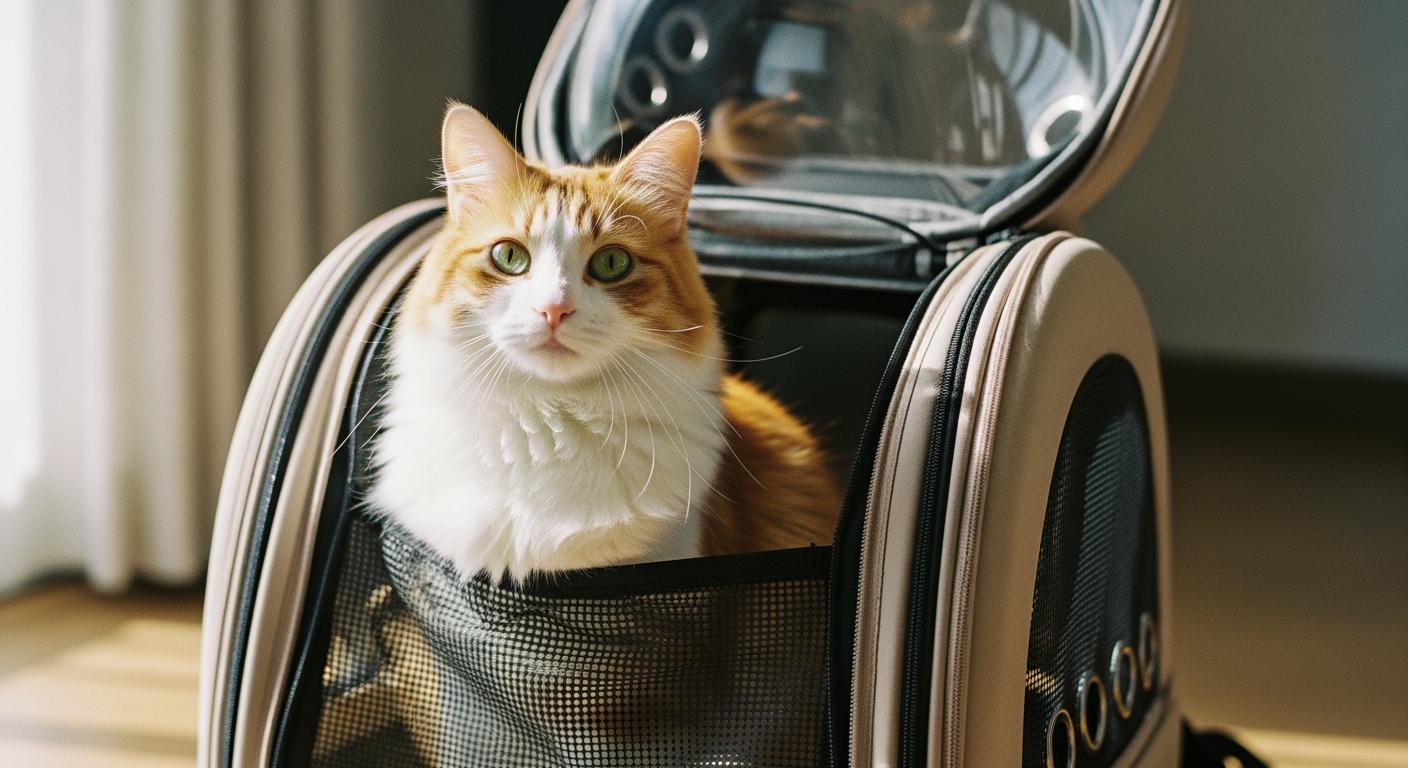
A mesh panel on a pet backpack carrier looks breathable from the outside. Inside, the story changes the moment a dog curls up, leans, or redistributes weight. The body presses against the mesh, and airflow stops — not because the panel failed, but because posture blocked it. The design variable that determines whether mesh stays open is not the mesh itself. It is what sits underneath: the base structure and how it resists collapse under shifting load.
| Base Type | Effect on Airflow When Posture Shifts |
|---|---|
| Structured, rigid base | Resists outward swing during turns, maintains carrier shape, and keeps mesh panels clear of the body even when the dog repositions. |
| Flexible, unstructured base | Sags under weight, allows lateral shift that pulls side walls inward, pressing mesh against the dog and cutting airflow. |
Why Mesh Alone Fails — Posture as the Hidden Variable
The Mechanics of Posture-Driven Mesh Blockage
When a dog stands or sits upright inside a carrier, mesh panels have clearance — air moves freely across both sides. The problem starts with instability underfoot. A soft base sags as weight settles into it. The sag pulls the fabric side walls inward because the base perimeter shortens under tension — the same mechanism that makes a hammock narrow when you sit in it. As the walls collapse inward, interior cross-section shrinks. The dog compensates by curling tighter. That curled posture presses the dog’s flank or back directly against the mesh from the inside.
Now the mesh is not a vent. It is a contact surface. The pressure of body against fabric seals the pores. Airflow drops not because the panel quality changed, but because posture closed the gap between dog and carrier wall.
What Blocked Airflow Looks Like in Practice
You can spot the problem before the dog shows obvious stress. After 15 minutes of carrying, open the carrier and feel the mesh on both sides. One side warm and damp while the other stays cool — that is a posture block, not just warm weather. The dog may pant harder than the walking effort would predict, or fidget every few minutes trying to find a position where the wall is not pressed against its ribs.
Other signs accumulate over repeated trips: the mesh holds a musty smell even after short outings, or the dog hesitates at the carrier opening — not from fear, but from learned discomfort with a space that got stuffy last time.
Why the Problem Hides in Plain Sight
A carrier with mesh panels on all sides can still trap heat. The panels are there — visible, countable, marketing-checkbox present. But mesh placement below the dog’s shoulder line contributes little when the dog’s body mass sits against it. What matters is whether the carrier structure keeps those panels away from the dog when posture shifts. That is a base-and-frame problem, not a mesh-count problem.
Where Posture-Related Airflow Problems Start
Interior Space That Forces Curling
A carrier can measure wide enough on the spec sheet and still force the dog into a tight curl once worn. The issue is usable interior volume — the space that remains after the base flexes, the side walls tension inward, and the wearer’s back contour presses into the rear panel. A carrier with generous flat dimensions but no structural frame loses much of that volume under real load.
When the dog cannot extend its spine or turn its head without pressing against a wall, it curls. Curling brings the largest body surfaces — flank and back — flush against the mesh. That is not a sizing error. It is a structure problem. Carriers that hold their shape under load give the dog room to choose a posture other than the tightest possible curl.
Soft Walls and the Collapse Cascade
A weak base does not fail alone. It triggers a cascade. Base sags → side walls lose vertical tension → walls collapse inward → mesh contacts the dog → dog curls tighter → more body surface contacts mesh → ventilation drops further. Each step amplifies the next.
Note: This cascade accelerates in warm weather. Higher ambient temperature raises the dog’s respiratory rate, which increases heat output inside the carrier. If the mesh is already partially blocked, the heat buildup reinforces the cycle — the dog pants more, generates more moisture, and the damp mesh clings tighter.
Here is what the collapse cascade looks like across different carrier designs:
| Failure Signal | Design Cause | What a Better Design Does Differently |
|---|---|---|
| Dog pants heavily or pushes at side mesh | Base sag pulls walls inward, closing air gap between body and mesh | Rigid or reinforced base holds its plane under load, walls stay vertical, air gap remains |
| Dog cannot settle, shifts position constantly | Unstable floor makes every posture feel precarious | Flat, non-deforming base gives the dog a predictable platform to stand or sit on |
| Side mesh feels warm and damp against the dog’s flank | Single mesh zone on one side, no cross-flow path | Mesh on both sides creates a pressure differential — air enters one side, exits the other |
Single-Zone Ventilation Versus Cross-Flow
Mesh on one side creates a dead-end air path. Air can enter but has nowhere to exit unless the carrier has an opening on the opposite side. The result is stagnant air that heats up and saturates with moisture. Two mesh panels placed on opposite walls create a cross-flow path — the carrier becomes a short duct rather than a closed pouch. This works because walking motion generates small pressure differences between the front and back of the carrier. Air moves from the higher-pressure side to the lower-pressure side, but only if both sides are open.
Cross-flow is not about having the most mesh. It is about having mesh in the right spatial relationship — opposing panels that let air enter and exit, with a clear path between them that the dog’s body does not fully occupy. With cross-flow ventilation configured properly, even a carrier used for larger dogs on extended hikes can maintain airflow through most posture changes.
Three Design Features That Keep Airflow Open Regardless of Posture
A Base That Holds Its Shape Under Load
The base is the foundation of every airflow path inside the carrier. When it stays flat and rigid under the dog’s weight, the side walls remain tensioned and vertical. That vertical wall position creates an air gap — a buffer zone between the dog’s body and the mesh. The dog can shift, lean, or curl without automatically pressing against a panel.
You can verify base performance with a simple check. Load the carrier with weight equivalent to the dog and wear it for 10 minutes. Then set it on a flat surface and look at the base from the side. If it bows downward more than roughly an inch from its original plane, the base is flexing enough to pull the side walls inward under real use. A carrier built for hiking and longer carries needs a base that resists this deformation across the full carry duration, not just the first five minutes.
Multiple Ventilation Zones That Do Not All Block at Once
Even with a stable base, a dog may press against one panel — leaning into a turn, shifting to look at something, or settling into a preferred side. That is normal. The failure happens when the blocked panel is the only panel. With mesh on the front, top, and both sides, blocking one or even two panels still leaves air paths open.
The features that improve ventilation reliability in multi-panel designs include raised floor vents that draw cooler air from below, mesh positioned near the dog’s nose level for direct respiratory exchange, and panels of different sizes — larger mesh on the sides for cross-flow, smaller vents on the front and top for exhaust. The design logic is not “more mesh is better.” It is “no single posture can block all paths.”
| Design Difference | Why It Matters | Main Limitation |
|---|---|---|
| Opposing side mesh panels | Creates a cross-flow duct — walking motion drives air from one side to the other | Requires both sides to have at least partial clearance; a dog pressed evenly against both still blocks flow |
| Elevated floor with bottom venting | Draws cooler air from below the carrier, adds a third flow path independent of side panels | Less effective when the carrier sits on a hot surface like asphalt; works best when carried on the back with airflow underneath |
| Reinforced mesh material | Resists tearing at attachment points when the dog’s weight pulls against it during shifts | Thicker mesh trades some porosity for durability; the weave pattern must balance tear resistance against open area |
Side Clearance and an Upright Frame
Side clearance is the distance between the dog’s body at rest and the inner surface of the mesh panel. It is created by two things: a base wide enough that the dog does not fill the full width, and side walls that stay vertical rather than sloping inward. A carrier with a structured frame — rigid piping in the seams, reinforced corners, tensioned fabric panels — maintains this clearance passively. The dog does not need to hold a perfect posture; the carrier holds its shape around the dog.
Check this by observing the carrier after a walk. If the side walls show a visible inward lean, or if the mesh has a permanent crease where the dog’s body pressed against it, the frame is losing its shape under repeated load. That crease is the structural memory of blocked airflow. A well-built carrier returns to its original dimensions each time, and the mesh shows no contact impression after use.
When Base Support Matters Most — and Where It Reaches Its Limit
Structured base support makes the largest difference on longer outings — hikes over 30 minutes, warm-weather walks, and any scenario where the dog is inside the carrier for an extended period. Under these conditions, a flexible base has time to progressively deform, and the collapse cascade has time to fully play out. The first 10 minutes may feel fine. By minute 40, the carrier interior has shrunk and the mesh panels have tightened against the dog.
The advantage narrows on very short trips — under 15 minutes in moderate temperatures. A soft base may not sag enough in that window to fully close the air gap. The dog may also tolerate a slightly compressed posture for a brief carry without showing heat stress. But the design question is not “does it work for 10 minutes.” It is “does the structure hold under sustained load.”
Fit still interacts with base design. A carrier that measures correctly for the dog’s length and height but has a soft base will still collapse. A carrier with a rigid base but too little interior length forces the dog into a curl regardless. Both problems produce the same outcome — body against mesh. The difference is that a stable base combined with adequate interior dimensions solves for the structural half of the equation. Carriers designed for trail stability tend to prioritize both variables together, which reduces the number of trips where the dog comes out panting and damp.
Disclaimer: Dogs with naturally curled resting postures — particularly brachycephalic breeds that tend to tuck — may press against mesh more often regardless of base rigidity. These breeds already have reduced respiratory efficiency, making ventilation redundancy more critical. In such cases, multiple opposing mesh panels and an elevated floor vent tend to matter more than base stiffness alone. This fit guidance assumes a carrier worn on the back in standard walking posture; front-carry positions shift the center of gravity and can change how the base distributes load, which may alter the airflow dynamics described here.
FAQ
How can I tell if my carrier’s base is too soft?
Load the carrier with weight matching your dog and wear it for 10 minutes. Set it down and sight along the base from the side. A downward bow of more than an inch means the base is flexing enough to pull the side walls inward under real load. The same check after the carrier has been used for several weeks can reveal progressive base fatigue — some materials soften with repeated loading.
Why does my carrier have mesh on three sides but still feel stuffy?
Mesh count matters less than mesh placement and structural clearance. If the side walls collapse inward, even four mesh panels sit flush against the dog’s body. The mesh itself is open, but there is no air gap behind it. What feels like a ventilation failure is often a structure failure — the panels are present but pressed closed from the inside.
Does a rigid base make the carrier too heavy for hiking?
The weight trade-off depends on the base material. A molded EVA or PE board adds a few ounces over a fabric-only floor, but those ounces replace the weight of heat stress management — a dog that overheats needs more frequent stops, carries less comfortably, and drinks more water, all of which have their own weight and time costs on a trail. The net system weight often favors a structured base once trip duration passes about 30 minutes.
Are expandable carriers better for preventing mesh blockage?
Expandable sections can help by increasing interior volume, which gives the dog more room to find a posture that does not press against mesh. But expansion does not fix a weak base. If the base still sags when the carrier is expanded, the extra volume partially fills with collapsed fabric rather than usable space. Choosing a carrier by activity type and load duration means evaluating the base first; expansion adds value on top of that foundation, not instead of it.






