
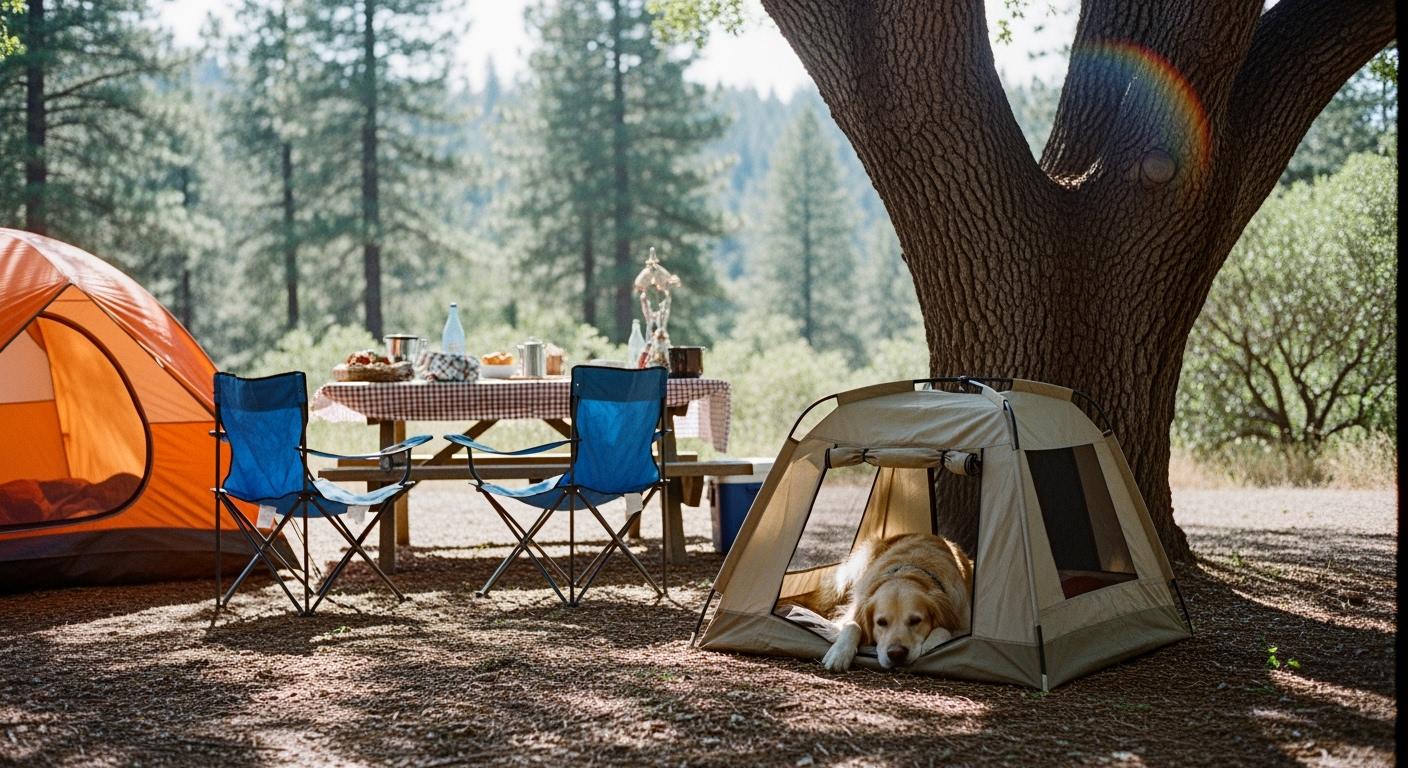
Set up a portable pet shelter at the campsite. Your dog steps in. Thirty seconds later, she walks back out and lies in the dirt next to the tent. The canopy is blocking direct sun. So why is she leaving?
The answer sits at the intersection of two design features most budget shelters treat as afterthoughts: airflow path geometry and the floor-to-ground thermal bridge. Shade stops radiant heat. It does not stop convective heat buildup. Without a designed path for air to enter low and exit high, a canopy tent becomes a still-air pocket. Inside temperatures can climb above ambient within 15 minutes of direct sun exposure. That fails fast.
A pet tent that actually keeps a dog at the campsite needs more than a roof. It needs mesh positioned to create a pressure differential, an entrance wide enough to function as an intake, and a floor layer that interrupts conductive heat transfer from the ground. When a foldable pet tent gets all three right, the interior stays measurably cooler. When it misses even one, the dog votes with her feet.
Why Shade Alone Makes a Shelter Hotter, Not Cooler
The Still-Air Problem Inside a Closed Canopy
A canopy roof blocks solar radiation. That part works. The problem is what happens next. Sunlight hits the fabric. The fabric absorbs energy and radiates heat downward into the enclosed space. If the side panels are solid or the mesh sits only at the roofline, that heated air has no exit path.
Hot air rises. In a shelter with mesh only at the peak, the rising hot air reaches the mesh and stalls — there is no low intake to create cross-flow. The result is a thermal cap: the top third of the tent traps heat while the bottom stays stagnant. The dog lies in still, warming air. Within minutes, the interior becomes less comfortable than the shaded ground outside.
The causal chain is straightforward: sun energy → fabric absorption → radiative re-emission downward → no low-to-high airflow path → heat accumulation. Mesh placed at dog height on two opposing sides breaks this chain. Air enters through one panel, warms as it rises, and exits through the opposite high vent. This is not about “more mesh.” It is about mesh positioned to create a pressure gradient — something you can verify at the campsite by holding a lightweight strip of fabric near each panel and watching whether it moves inward on one side and outward on the other.
Dark Fabric and the Solar Oven Effect
Dark canopy fabric absorbs more solar energy than light fabric. That is physics, not opinion. A black or navy roof under direct midday sun can reach surface temperatures 20 to 30 degrees higher than a light-colored equivalent. When that hot fabric sits inches above a dog, it radiates heat directly onto the animal.
This is where the design of a camping shelter matters more than the shade percentage on the label. A shelter with a light-colored, UV-reflective canopy and dark mesh side panels uses two different material behaviors in the right places: reflection overhead, absorption-and-ventilation at the sides. The roof deflects. The mesh breathes. That combination works. A single dark fabric used everywhere works against itself — blocking light while baking the interior.
Note: An observable check takes 30 seconds. After the tent has been in sun for 15 minutes, place your hand on the inside of the canopy fabric, then on the mesh panel. If the canopy surface is noticeably hotter than the mesh, the roof material is radiating heat into the shelter rather than reflecting it.
Design Features That Separate a Cooling Shelter From a Solar Oven
Mesh Height, Panel Placement, and the Cross-Ventilation Path
Not all mesh placement cools equally. Mesh at the roofline vents hot air that has already risen — it is an exhaust, not a cooling system. Mesh at ground level scoops in dust and debris. The effective zone sits between the two: panels positioned roughly at the height of a lying dog, on opposing sides of the shelter.
This layout creates a cross-ventilation path. Moving air enters through the windward panel, passes across the dog, and exits through the leeward panel. The dog sits in the airflow, not beneath it. She gets convective cooling — moving air stripping heat from her body — not just shade. This is the same principle that makes a canopy dog bed designed for outdoor shade perform differently from a solid-sided pop-up: the mesh is doing thermal work, not just providing a view.
One observable test: after the dog has rested inside for 10 minutes, run your hand along her coat. If her fur feels warm to the touch and the air inside feels still, the shelter lacks a working cross-ventilation path. If her coat feels neutral or cool and you feel air movement across the interior, the mesh placement is doing its job.
| Design Difference | Why It Matters | Where It Falls Short |
|---|---|---|
| Mesh at lying-dog height, opposing sides | Creates cross-ventilation path; moving air strips body heat | In still-air conditions with zero breeze, even well-placed mesh cannot drive airflow without a fan |
| Light-colored reflective canopy + dark mesh sides | Roof reflects solar energy; mesh vents absorbed heat at sides where it does not re-radiate onto the dog | Reflective coatings degrade over UV exposure; effectiveness drops after extended outdoor storage in direct sun |
| Wide entrance with no door flap during use | Functions as a large low intake; increases total air exchange rate | In heavy wind or blowing rain, an open entrance exposes the interior to the elements |
| Raised or insulated floor panel | Breaks conductive heat path from hot ground to dog; keeps underside cooler | Adds weight and pack volume; insulated floors are harder to fold compactly |
Roof Height and Entrance Width as Airflow Components
A low roof is not just a comfort problem — it is a ventilation problem. When the canopy sits close to the ground, the total air volume inside the shelter is small. That small volume heats up fast. A taller roof increases interior air volume, which takes longer to saturate with heat. It also creates more vertical distance for the thermal gradient to establish, giving hot air room to rise away from the dog before exiting.
Entrance width matters for the same reason. A narrow opening restricts the intake side of the airflow equation. A wide entrance — ideally spanning most of one wall — functions as a large low-pressure intake. Combined with high mesh exhaust panels, it forms a complete low-to-high airflow circuit. The dog can walk in without hesitation, which matters because a dog that finds the entrance awkward will not use the shelter regardless of how cool it stays inside.
For a deeper look at how pet tent sizing and feature selection affect real-world use, the breakdown in pet tent sizing and fit checks walks through the measurements that determine whether a shelter works for a given dog and campsite setup.
Stability, Floor Design, and Why Dogs Reject Unstable Shelters
The Frame-to-Ground Connection Under Side Load
A lightweight frame is a portability win. It is also a stability risk. The trade-off lives in the corner connection: how the frame legs meet the ground and how much resistance they generate against lateral force.
When a dog enters a tent, she pushes against the entrance fabric. That push translates into a side load on the frame. If the corner stakes are thin wire pegs driven into loose soil, the leg lifts. The canopy shifts. The dog feels the structure move and associates it with instability. A single shift can make a dog refuse the shelter for the rest of the trip.
The design fix is not heavier materials — it is better force distribution at the corners. Reinforced stake loops that spread tension across a wider fabric patch, sand pockets that use the shelter’s own footprint weight as ballast, and cross-truss frame geometries that convert lateral force into downward pressure all address the same problem from different angles. The design choices behind a canopy bed for a dog follow the same logic: stability is a geometry problem more than a weight problem.
Tip: Before leaving for a trip, set up the shelter on the surface type you expect at the campsite — grass, sand, or gravel. Push sideways against one corner leg with about the force of a medium-sized dog leaning into fabric. If the leg lifts or the corner shifts more than an inch, the anchoring method is insufficient for that surface.
The Floor as a Thermal Barrier, Not Just a Ground Cover
Thin shelter floors fail in two ways. First, they conduct heat: hot sand or sun-baked dirt transfers thermal energy directly through a single fabric layer into the dog’s underside. Second, they telegraph ground texture: rocks, roots, and uneven terrain press through, making the surface uncomfortable even if the temperature is tolerable.
A raised floor — whether a separate insulated mat or a built-in elevated panel — breaks the conductive path. The air gap between the ground and the floor surface acts as an insulator. This is the same principle used in camping gear designed for dogs in outdoor conditions: separation from the ground matters more than padding thickness.
An observable check: after the shelter has been set up on warm ground for 20 minutes, place your palm flat on the interior floor for 10 seconds. If the floor surface feels warm — not neutral, not cool, but warm — it is conducting ground heat into the shelter. An effective floor feels roughly ambient, and on hot ground that means the insulation layer is doing thermal work.
When a Portable Pet Shelter Is Not the Right Solution
A canopy tent works when the primary challenge is direct sun exposure on warm days with at least light breeze. It stops working — or becomes the wrong tool entirely — under a few specific conditions.
In still, windless heat, even a perfectly vented shelter cannot drive airflow without external pressure. The mesh becomes decorative. On days like that, no passive shelter can outperform deep natural shade — a dense tree canopy or a shaded rock overhang will stay cooler than any fabric structure.
For dogs with thick double coats — huskies, malamutes, shepherds — the shelter only addresses radiant heat. It does not address the dog’s internal heat generation. These breeds may still overheat inside a well-vented tent if the ambient temperature is high enough. The shelter helps. It is not a cooling system.
In heavy sustained wind above roughly 20 mph, even a well-anchored lightweight shelter can deform. Fabric flaps. Frame joints stress. The noise and motion can spook a dog more than lying in the open. In those conditions, a hard-sided crate or keeping the dog in the vehicle with windows cracked is often the safer choice.
Disclaimer: The airflow checks described here assume a smooth-coated dog and a shelter set up on reasonably level ground in warm, breezy conditions. Double-coated breeds may show subtler overheating signals — panting rate, gum color, and reluctance to settle are more reliable indicators than coat temperature. If the dog’s chest shape is unusually deep or barrel-shaped, the fit and comfort observations described here may not capture every pressure point; monitor the dog’s willingness to re-enter the shelter as the primary pass/fail signal.
| Condition | Shelter Performance | Better Alternative |
|---|---|---|
| Sunny, light breeze, warm ground | Works as designed — shade + cross-ventilation keeps interior cooler than ambient | — |
| Still air, high heat, no wind | Mesh cannot drive airflow without external pressure; interior heats up | Deep natural shade, wet cooling mat, or keep dog indoors during peak heat |
| Sustained wind above ~20 mph | Frame deformation risk; fabric noise can spook dogs; anchoring may fail in soft ground | Hard-sided crate in a sheltered spot or vehicle with partial window ventilation |
| Double-coated breed in high ambient heat | Shelter addresses radiant heat only; internal body heat still accumulates | Combine shelter with a cooling vest or damp towel, limit outdoor rest to cooler hours |
FAQ
Why does my dog leave the tent even though it is in full shade?
Shade stops direct sunlight but does not stop the air inside from heating up. If the shelter lacks low-to-high airflow — mesh panels on opposing sides at dog height — the interior becomes a still-air pocket that feels hotter than the shaded ground outside. Your dog’s exit is a reliable sensor: she is telling you the shelter is accumulating heat, not shedding it.
How do I check whether the shelter floor is transferring ground heat?
After 20 minutes of setup on warm ground, place your palm on the interior floor and hold for 10 seconds. If the floor feels warm rather than neutral or cool, it is conducting ground heat. A floor that stays neutral has adequate insulation or an air gap breaking the thermal bridge.
Does a darker canopy keep the interior cooler or hotter?
Hotter. Dark fabric absorbs more solar radiation and re-radiates it downward. A light-colored or reflective canopy surface deflects more energy before it enters the shelter. The roof should reflect; the side mesh should vent. Using dark fabric in both positions works against the airflow design.
Are lightweight frames stable enough in wind?
It depends on the corner anchoring, not the frame weight. Reinforced stake loops, sand pockets, and cross-truss geometry can make a lightweight frame stable in moderate wind. The test: push sideways against a corner leg with moderate force. If the leg lifts or shifts, anchoring is insufficient for that surface.






