
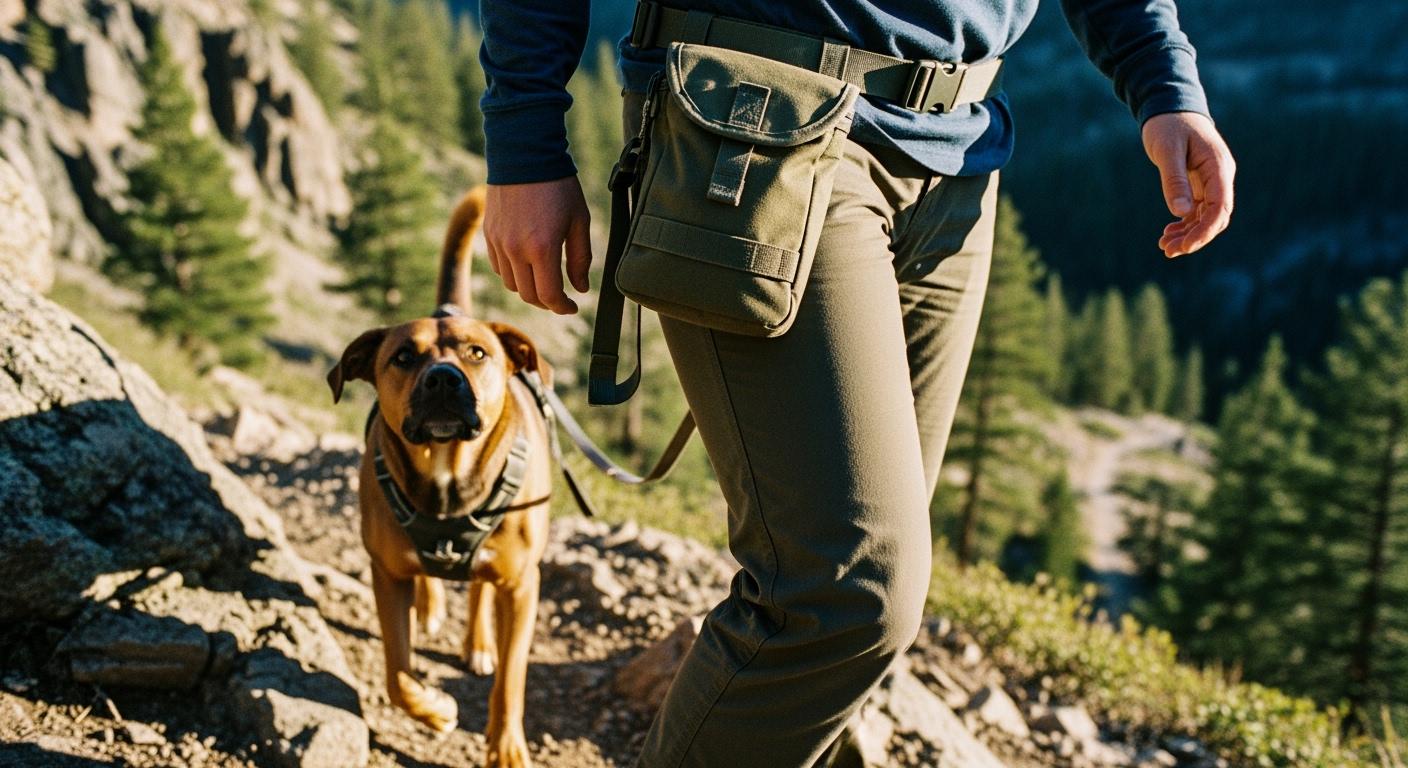
A treat pouch that works on a flat sidewalk can fail within the first ten minutes of a real hike. The slope changes everything. When the trail tilts upward, the pouch body tilts with it — and a closure that relied on gravity to stay shut suddenly finds gravity working against it. The design questions that matter are not about capacity or pocket count. They are about whether the closure holds when the pouch tilts past 45 degrees, whether the attachment keeps the pouch close when the trail demands a high step, and whether the opening stays accessible when one hand is already occupied with a leash.
Most pouches are built for the geometry of a level walk: vertical hang, predictable sway, two hands available. Hiking strips those assumptions away fast.
Where Trail Movement Breaks a Pouch Design That Works on Sidewalks
Incline Shifts and Lateral Swing
On a sidewalk, the pouch hangs roughly vertical and sways in a narrow arc — maybe 10 to 15 degrees side to side with each step. On a trail, the arc widens. A high step over a fallen log forces the hip to lift unevenly. The pouch swings out past 30 degrees, then snaps back. Over the course of a mile, that cycle repeats hundreds of times.
Each swing loads the attachment point — a belt clip, a carabiner, a fabric loop — with a force that alternates direction. A clip designed for vertical static load now faces cyclic lateral force it was never engineered to handle. The result is not always a sudden failure. More often, the clip rotates incrementally, the pouch drifts rearward around the waist, and the opening that was facing forward at the trailhead is now facing backward. Reaching it requires twisting, which on uneven ground means a stumble risk.
The closure faces a related problem. A drawstring that stays cinched under vertical hang can loosen when the pouch tilts forward on a climb. The fabric around the opening deforms, the cord relaxes, and the gap widens — just as the treat pieces inside shift toward the opening under gravity. Spills on steep sections are the predictable outcome of that combination.
| Failure during hiking | Likely pouch design cause | Better design direction |
|---|---|---|
| Treats fall out on slopes | Loose closure or tilted pouch | Secure drawstring, magnetic flap, or covered opening |
| Pouch swings while walking | Weak clip or low-hanging position | Stable belt loop, waist strap, or close-body attachment |
| Hard to grab treats fast | Collapsed or narrow opening | Structured opening for one-hand access |
| Treat crumbs build up | Poor lining or deep corners | Wipeable inner surface and easy-clean shape |
Why One-Hand Access Becomes Non-Negotiable
On a neighborhood walk, stopping to use both hands on a pouch is an inconvenience. On a trail, it can be a safety problem. One hand holds the leash. The other reaches for a treat. If the opening collapses under its own fabric weight — as unstructured pouches tend to do — you either let go of the leash or fumble with two hands while the dog reacts to a trail distraction. Neither is acceptable on a narrow path with a drop on one side.
A reward system that works on the trail depends on access speed. When opening the pouch takes more than a couple of seconds, the reward arrives late — after the dog has already lost focus or, worse, lunged at whatever caught its attention. The timing gap is not a training failure. It is a design failure.
Closure Stability and Attachment — Why Some Designs Stay Put and Others Drift
Two forces determine whether a pouch stays in place on a hike: the closure’s resistance to opening under tilt, and the attachment’s resistance to rotation under cyclic load. They interact. A pouch with a superb closure but a loose belt clip still twists out of reach. A pouch with a rigid waist mount but a weak closure still spills on climbs.
Here is the chain that matters: when the user leans forward on an incline, body weight shifts ahead of the hips. The belt line tilts. The pouch, suspended from a single clip point, pivots around that point — the bottom swings forward, the top tilts away from the body. The closure now faces partly downward. If it is a simple drawstring, the fabric tension that held it shut in vertical hang is reduced by the changed angle. The cord loosens enough to create a gap. Gravity pulls treats toward that gap. Spill.
A magnetic flap closure breaks this chain differently. The flap closes against the pouch body itself — the steeper the forward tilt, the more the flap presses down under its own small weight. It does not rely on cord tension or user action. The closure force increases in the exact scenario where a drawstring loses it. That is the mechanical difference that separates a hiking-ready pouch from one designed for flat ground.
In practice: after a 10-minute section with steep climbs, check whether the pouch has drifted more than two inches from its starting position on your belt. If the opening has rotated past your hip bone, the attachment point is not handling lateral swing.
Attachment design follows a similar logic. A single plastic clip threaded onto a thin belt distributes all swing force through a contact area roughly the width of the clip jaw — maybe half an inch. A fabric waist strap 1.5 inches wide spreads the same force across three times the contact area. The pouch resists rotation not because the strap is tighter, but because a wider force distribution means friction holds across a larger surface. Comparing pouch access and spill control designs tends to reveal the same pattern: the differences that matter are mechanical, not aesthetic.
One-Hand Access and What an Opening Has to Do on Rough Ground
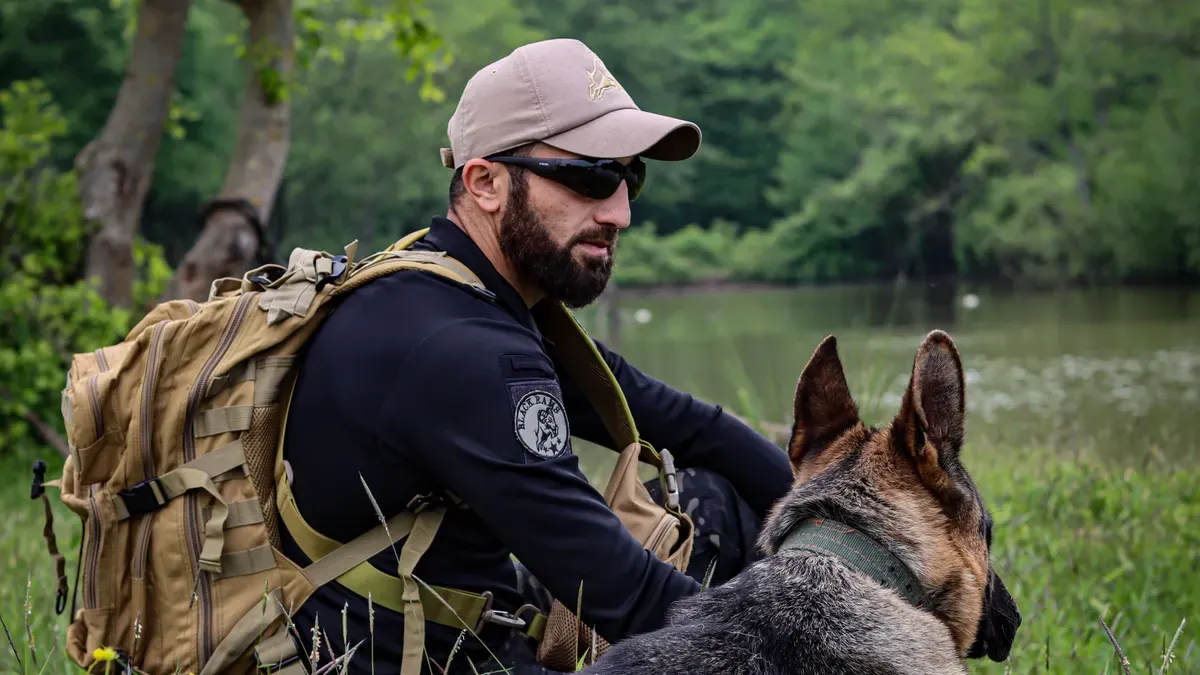
A pouch opening that works in the kitchen — unroll, reach in, pull treat, roll shut — fails on a trail for one reason: the second hand is not available. The leash hand is committed. The treat hand must execute the full sequence alone: locate the opening by feel, penetrate it, find a treat without looking, and withdraw cleanly. Each step is a design constraint.
The common failure mode is the collapsed opening. Unstructured pouches rely on the fabric’s own stiffness to hold shape, but soft nylon or canvas loses that shape after a few hours of body heat and movement. The opening sags inward. Reaching in becomes a blind dig — fingers searching, treat crumbs collecting under nails, the dog losing patience. The reward moment, which should be near-instant, stretches into a multi-second struggle.
| Closure Type | Advantages | Disadvantages |
|---|---|---|
| Magnetic snap | Quick one-handed access; closes on contact | May separate under hard jostling |
| Drawstring | Adjustable tension; secure when cinched | Slow to reopen; often requires two hands |
| Zipper | Full seal against spills | Slowest to operate; can jam with treat dust |
| Hinge/spring frame | Stays open for access; snaps shut reliably | Adds weight; hinge can wear over extended use |
A structured opening — whether held open by a spring frame, a stiffened rim, or a hinge mechanism — solves the blind-dig problem. The opening stays defined. The hand learns its position after a few repetitions and can find it without looking. The treat retrieval becomes a single fluid motion rather than a two-step fumble. A treat pouch built around access speed prioritizes this mechanical sequence over extra pockets or decorative features.
In practice: on a trail section with mild distractions, time how long it takes to open the pouch, grab a treat, and close it with one hand. If the sequence consistently takes more than three seconds, the opening design is working against the reward timing your dog depends on.
What makes a pouch opening stay accessible is not a single feature but how the rim resists deformation. A sew-in stiffener — a thin plastic or metal band inside the fabric channel around the opening — costs almost nothing in weight but keeps the mouth from collapsing even when the pouch body is half-empty and the fabric has softened from body heat. A purpose-built treat pouch includes this detail. A repurposed fanny pack does not.
Moisture, Materials, and When the Design Hits Its Limit
Hiking introduces moisture that a flat walk does not: wet grass brushing the pouch at waist height, unexpected rain, condensation from body heat against the pouch back on humid days. The material that lines the pouch determines whether that moisture becomes a persistent problem.
| Material | Properties |
|---|---|
| Nylon | Resists abrasion, holds shape, but traps fine treat dust in the weave. |
| Canvas | Durable but absorbent; treat oils soak in and can turn rancid over repeated use. |
| Silicone | Non-porous, easy to clean, but adds noticeable weight and feels stiff against the body. |
| Coated Nylon | Sews like fabric, cleans close to silicone, resists oil absorption better than uncoated nylon. |
Canvas absorbs. That is its fundamental limitation for a treat pouch — not a quality issue, but a material property. When treat oils penetrate the fibers, they oxidize. The resulting odor compounds do not wash out with water alone, because they have bonded below the surface. Each subsequent hike warms the fabric with body heat and releases those compounds again. A pouch that smelled neutral on the first outing smells like old treats on the fifth, regardless of how thoroughly it was rinsed.
Coated nylon avoids this path. The coating — typically a thin polyurethane or silicone layer applied to the inner face — creates a barrier that oil molecules cannot penetrate. Crumbs wipe off the surface rather than embedding in fibers. A washable treat bag with wipeable lining resets to neutral between hikes in the time it takes to turn it inside out and wipe it with a damp cloth. No soaking, no detergent, no odor accumulation across multiple outings.
Balanced capacity matters here too. A pouch that holds three cups of treats weighs heavy on the belt after an hour of climbing — the leverage of that weight against a single attachment point increases lateral swing. A pouch that holds only a half-cup runs empty before the turnaround point. The right capacity sits between one and two cups for most half-day hikes — enough for frequent rewarding without the weight penalty that accelerates attachment fatigue. Spill control and access design interact with capacity: the fuller the pouch, the more the contents press against the closure from inside, and the more a weak closure design reveals itself.
Disclaimer: this material and capacity analysis assumes hiking on maintained trails in conditions ranging from dry to light rain. If you hike in sustained heavy rain or cross streams where the pouch may be submerged, even coated nylon may eventually allow moisture through seams — a fully waterproof roll-top dry bag may be the more appropriate tool for those conditions. Similarly, dogs on a raw or fresh-food treat regimen produce more residue inside a pouch than dogs on dry biscuit treats, and will need more frequent wipe-downs regardless of lining material.
FAQ
Why does my treat pouch swing more on trails than sidewalks?
Trail movement forces the hip through a wider range of motion — high steps, lateral shifts around rocks, uneven foot placement. A single-point belt clip allows the pouch to pivot freely around that point, converting hip motion into a wider swing arc. A waist strap or wide belt loop distributes the attachment force across a broader contact area and reduces free pivot, keeping the pouch closer to the body.
Which closure type stays secure on steep climbs?
Magnetic flaps and hinged frames tend to hold better on inclines than drawstrings, because they close against the pouch body rather than relying on cord tension. The steeper the forward lean, the more a flap presses shut under its own weight. Drawstrings can loosen when the fabric around the opening deforms under tilt.
How do I prevent odors from building up in a hiking treat pouch?
Use a pouch with a coated nylon or wipeable lining rather than absorbent canvas. After each hike, turn the pouch inside out and wipe the interior with a damp cloth. Let it dry completely before storing. Absorbent fabrics trap oils below the surface where water alone cannot reach them.
What capacity works for a half-day hike?
Between one and two cups of treats covers most half-day hikes with frequent rewarding. Larger capacities add belt weight that increases swing on climbs. Smaller capacities may run out before the turnaround point, especially if the hike includes training intervals or multiple dogs.






