
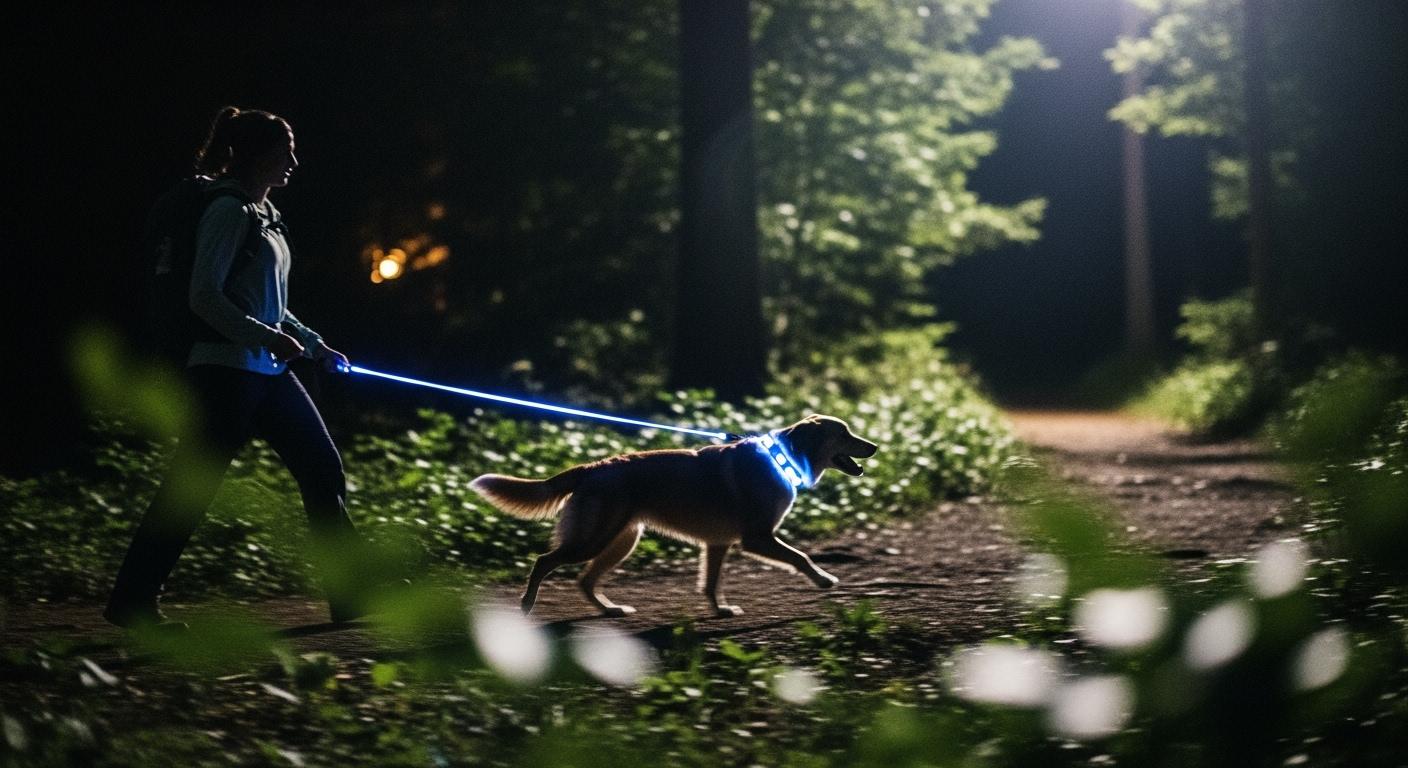
On a dark trail, the leash line itself is the one connection everyone else needs to see. Not just the dog. Not just the collar. The line that stretches between you and your dog. When that line vanishes into shadows, a cyclist rounding a bend has no way to judge where your dog is about to move. A runner coming up from behind sees a person, sees a dog — and misses the five-foot tether cutting across the path. That is the problem a dog leash for night hiking visibility needs to solve. And the design choices that solve it are more specific than “add a reflective patch.”
The core visibility difference comes from two design decisions that interact: webbing width and where the reflective material sits along the leash body. A narrow cord-style leash — even one with a reflective logo near the handle — disappears as soon as the dog moves off-angle. A wide leash with full-length reflective stitching or strips stays legible as a line from nearly any viewing position. Add a controlled bungee section that absorbs shock without stretching into a delay, plus hardware you can find by touch in the dark, and the leash shifts from a visibility liability to a predictable control line.
What Makes a Leash Invisible on a Dark Trail
The Material Problem: Thin, Dark, and Directional
Most everyday leashes are built for daylight use. Nylon webbing dyed black, navy, or brown absorbs light rather than returning it. That is fine on a sunny sidewalk. On a trail after dusk, the same leash blends into dirt, leaf litter, and shadow within a few feet of the handler. The thinner the webbing, the faster it drops below the angular size a headlamp or bike light can resolve at distance.
Material choice sets the baseline, but the physics of visibility depends on surface area facing the light source. A 1-inch-wide strap presents roughly four times the reflective target of a quarter-inch cord when viewed straight-on — and the gap widens sharply as the viewing angle moves off perpendicular. This is why wider webbing with embedded reflective elements tends to outperform narrow leashes even when both use the same base material:
| Design Difference | Why It Matters | Main Limitation |
|---|---|---|
| Wide (1 in.) webbing with retroreflective stitching | Larger surface catches light from headlamps and bike lights at steeper off-angles; the stitching returns light directly to the source, making the line readable even when the dog pulls sideways | Adds weight; wide webbing can feel bulky on very small dogs |
| Narrow cord with reflective patch at handle | Lightweight, packs small | Patch only works when the handle faces the light source; the cord line itself remains invisible at distance, especially at night |
| Dark nylon webbing, no reflective elements | Familiar feel, wide color range | Absorbs light; the leash becomes invisible against trail surfaces within 10–15 feet of a standard headlamp |
The failure mode here is not cosmetic. When a leash line disappears, other trail users cannot read the dog’s range of motion. A dog that steps two feet to the right can pull an invisible line directly across a bike’s path. The cyclist sees the dog and the handler — not the connection between them — and has no way to adjust.
In practice: Walk 15 feet ahead of someone holding your leash at night with a headlamp. If you cannot trace the full line from handle to clip in one glance, the leash design is failing the visibility test.
Why Patch Reflectors Leave Most of the Leash Invisible
Some leashes include a reflective logo or a small strip near the handle. This works when the leash is held straight ahead at chest height and the light source is directly in front. But dogs do not walk in a fixed position. They pull to the side, drop behind, cross the trail, or veer into brush. Each movement changes the angle between the leash, the light source, and the viewer.
Retroreflective material — the kind used in traffic signs and safety vests — returns light most efficiently when the incoming beam hits near perpendicular. A small reflective patch near the handle may return light brilliantly when the handler faces an oncoming headlamp and holds the leash forward. Rotate the leash 30 degrees because the dog pulled left, and that same patch may catch zero light. The line between handler and dog goes dark.
Full-length reflective stitching solves this differently. Instead of concentrating reflectivity at one point, it distributes glass-bead or prismatic elements along the entire leash body. As the leash arcs and angles through a dog’s movement, some segment of the stitching is always near-perpendicular to any approaching light source. The eye reads this as a continuous visible line rather than a disconnected bright spot. This is the same design principle that makes a reflective bungee dog leash stand out against dark trail backgrounds — the stitching keeps returning light no matter how the leash flexes.
Visibility Alone Is Not Control — Why Stretch and Hardware Matter After Dark
Controlled Bungee: Shock Absorption Without Delayed Response
On a dark, uneven trail, the handler needs to feel a pull and react immediately. A sudden lunge toward a sound in the brush, a stumble on loose rock — these moments demand near-instant feedback through the leash. Overly stretchy bungee leashes insert a delay between the dog’s movement and the handler’s sensation of it. The leash extends, the force builds gradually, and by the time the handler registers the pull, the dog may have moved another two feet toward a drop-off or into the path of a bike.
The mechanical trade-off is straightforward: more elastomer length and lower durometer (softer compound) produces gentler shock absorption but longer stretch-to-response time. A controlled bungee section — shorter elastic segment, slightly firmer compound — limits total elongation. The leash still takes the edge off a sudden lunge, but it transmits enough force quickly enough that the handler can correct within half a stride. This is not about comfort. It is about keeping the reaction window short enough to matter on a narrow trail in the dark.
After a 20-minute night hike, check whether the bungee section has stretched permanently past its resting length. If it has, the elastomer is fatiguing and the response delay will lengthen over time. This is a pass/fail observation anyone can make at home.
Hardware You Can Operate Without Looking
Clips and buckles that work fine in daylight become fumble points in the dark. Small lobster-claw clasps, dark-finished metal, and stiff spring mechanisms force the handler to stop, look down, and use both hands — often while holding a flashlight. On a trailhead or road crossing, those seconds matter.
The hardware design that works for night hiking shares traits with cold-weather gear: large enough to grasp with gloves, shaped so the thumb finds the gate by feel, and finished in a color or coating that reflects headlamp light. A clip that can be opened and closed one-handed lets the handler keep a light in the other hand and maintain awareness of the surroundings. Several bungee leash designs pair controlled stretch with oversized hardware for exactly this reason — the combination addresses both the dynamic load problem and the low-light usability problem in a single product.
A close-control handle positioned near the clip adds a second grab point for high-traffic moments. When approaching a trailhead, campground, or road crossing, the handler can choke up on the leash without reaching for the clip itself. If the handle includes reflective stitching or a light-colored panel, a quick sweep of the headlamp confirms its position in under a second.
Here is how the control features compare under real night-use conditions:
| Design Difference | Why It Matters | Main Limitation |
|---|---|---|
| Controlled bungee (short section, firm elastomer) | Absorbs shock without creating a lag between dog movement and handler sensation; keeps the reaction window under half a stride | Transmits more force than a full-length bungee; not as soft for dogs that pull steadily rather than lunging |
| Large, light-colored clip with one-hand gate | Operable by feel with gloves on; visible under headlamp sweep | Heavier than a standard small clip; bulk may be unnecessary for daytime-only use |
| Close-control handle with reflective panel | Second grab point for crowded areas; headlamp finds it fast | Handle placement that works for one handler’s height may sit awkwardly for another |
A running leash setup that prioritizes predictable response works on the same principle — the design difference between a bungee that helps and one that delays comes down to elastomer length and durometer, not just the presence of stretch.
Where the Visibility Advantage Holds, and Where It Narrows
Where Wide Reflective Webbing Excels
Full-length reflective stitching and wide webbing perform best when the light source and the viewer are close together — a headlamp on the handler’s own head, a bike light approaching from ahead, or a car’s headlights on a road-adjacent trail. The retroreflective glass beads or prismatic elements return light most efficiently back toward the source, which means the person holding the light sees the leash at its brightest. This is exactly the scenario where the visibility gain matters most: an approaching cyclist or driver whose headlamp needs to catch the line in time to react.
The advantage also holds strong on open trails without ambient light. Street-lit urban paths already provide enough scattered light that even non-reflective leashes may remain partially visible. On an unlit trail under tree cover, the contrast between a reflective leash and the dark background is at its maximum — and that is where wide reflective webbing provides the largest safety margin. A reflective leash used on unlit trails can be the difference between a near miss and a collision that no one sees coming.
Where the Advantage Narrows
In heavy fog or rain, retroreflective performance degrades. Water droplets on the reflective surface scatter incoming light rather than returning it to the source. The leash remains more visible than a non-reflective one, but the visibility distance shrinks. A wide webbing design still helps here because the larger surface area catches more scattered light than a narrow cord — but the gain is incremental, not dramatic.
Hands-free waist attachments work well on steady, open terrain where the dog’s pace is predictable. On technical trails with frequent stops, rock scrambles, or moments that require immediate hands-on control, a waist attachment can delay the handler’s response by the time it takes to reach for a secondary handle. The same walking control solution that works on groomed paths may need a different configuration on rocky singletrack after dark.
Fit considerations for any leash used with a harness matter here too. A harness that shifts during movement changes the leash attachment point, which changes the angle at which reflective stitching faces approaching light. If the harness rotates under side load, the leash may angle in a way that reduces the effective reflective surface. Checking harness stability before a night hike is part of the visibility equation.
Disclaimer: Retroreflective stitching visibility assumes a light source within typical headlamp or vehicle headlight range (roughly 100–500 feet for glass-bead retroreflective material under clear conditions). In fog, rain, or heavy dust, effective visibility distance may drop by half or more. This check also assumes a smooth-coated dog; double-coated breeds may accumulate debris against the leash that partially covers reflective elements, requiring occasional hand-clearing on the trail.
FAQ
Does leash material type affect how reflective stitching performs?
It can. Reflective stitching bonded to a stiff, coated webbing may crack or delaminate after repeated flexing, reducing the glass beads’ ability to return light. Stitching on a more pliable nylon or polyester webbing tends to survive bending cycles longer because the base material flexes with the thread rather than working against it.
Can a reflective collar replace a reflective leash for night hiking?
No. A reflective collar shows where the dog’s neck is. It does not show the line connecting the dog to the handler. Trail users reacting to a dog need to see the leash path to judge whether they can pass, stop, or need to adjust speed.
What leash length works best for night hiking on narrow trails?
Between 4 and 6 feet. Shorter than 4 feet crowds the dog on uneven ground and can unbalance both handler and dog on steep sections. Longer than 6 feet creates enough slack that the reflective line can dip below the sightline of oncoming headlamps. A 5-foot leash with a close-control handle at roughly 18 inches from the clip gives two usable lengths without switching gear.
How do you verify a bungee leash is still safe to use?
Mark the bungee section’s resting length with a small piece of tape. After a hike, check whether it returns to that mark. Permanent elongation beyond roughly half an inch means the elastomer core is fatiguing. Also run your thumb along the bungee sheath — any thin or flat spots indicate the internal elastic is bunching or breaking, which changes the stretch response under load.






