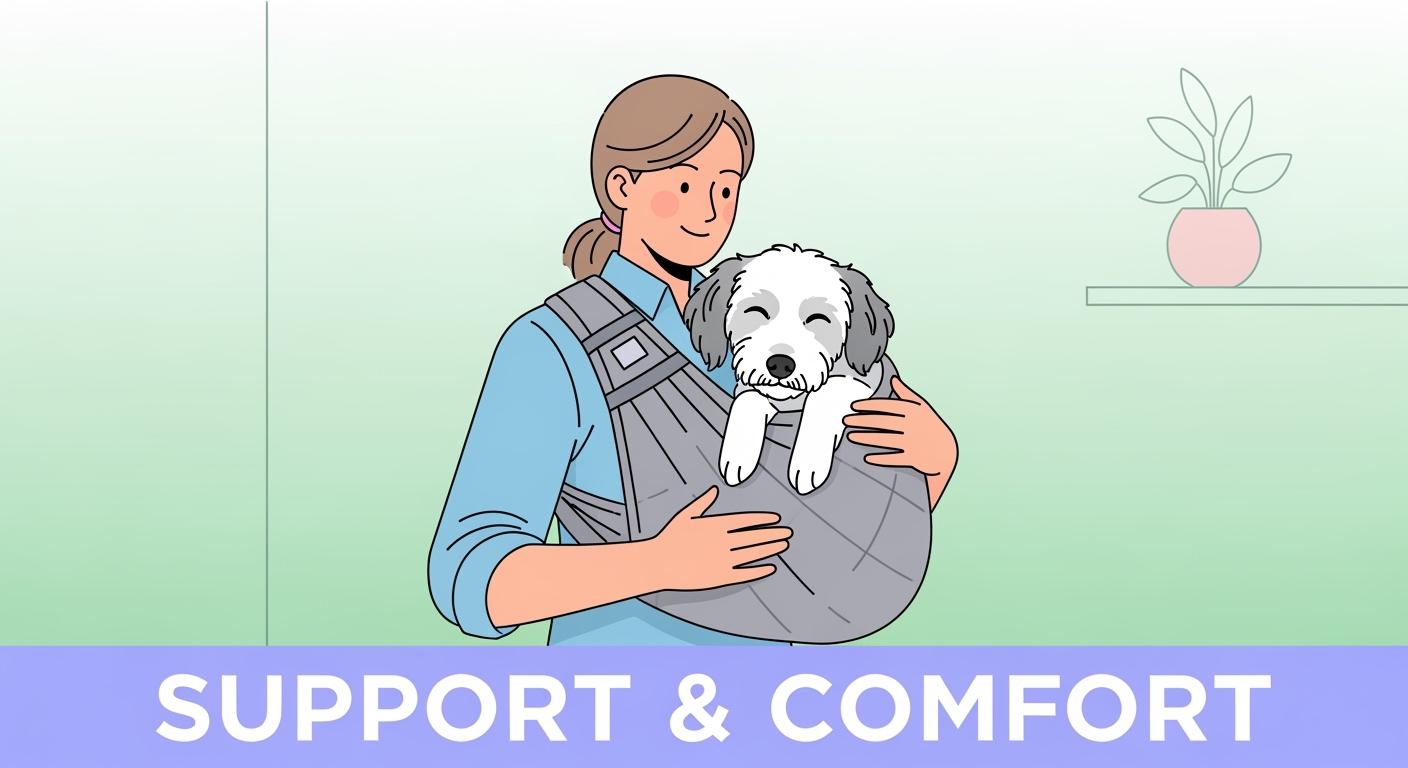
A senior small dog slows down mid-walk. You reach for the carrier. The opening sits at chest height. Your dog stares at it, shifts weight onto the back legs, and freezes. The problem is not the dog. It is the entry height. A dog sling carrier for senior small dog that opens low eliminates this standoff — the dog steps or is guided in without the hip-and-shoulder gymnastics a tall opening demands. Two design decisions control whether carrying actually works: how low the entry sits relative to the dog’s natural step height, and how the base holds its shape once weight settles in. A sling carrier with the right sizing and materials starts with those two variables — get them wrong and the rest does not matter.
Why Entry Height Decides Whether a Senior Dog Gets In or Gives Up
Tired Legs After Walking
Senior dogs tire on a predictable curve. The first 10 minutes look fine. By minute 15, stride shortens, the hindquarters drop, and the dog starts scanning for a place to stop. This is the exact moment a carrier gets used — and the exact moment entry height becomes a pass/fail test.
A tall carrier opening demands the dog recruit hip flexors and shoulder elevators simultaneously. Those are the same muscle groups already fatigued from the walk. The mechanical ask is simple but unforgiving: lift one front paw to step height, transfer weight forward onto a stiff joint, then repeat with the opposite side while balancing on tired hind legs. A dog with arthritic hips or mild patellar laxity can manage this sequence for roughly one attempt before bracing or refusing. That refusal is not stubbornness. It is a biomechanical veto.
After a 15-minute walk, place the carrier on the ground and watch whether your dog voluntarily shifts weight toward the opening. A hesitation longer than 3 seconds — or a weight shift backward instead of forward — signals the entry height exceeds what the hips can comfortably manage at that fatigue level.
Stiff Hips and the Geometry of a Tall Opening
Stiffness does not distribute evenly across a senior dog’s joints. Hip osteoarthritis typically narrows the comfortable range of flexion before it limits extension. A tall carrier opening forces flexion at the hip while simultaneously demanding shoulder elevation — a compound movement that multiplies the discomfort at each joint. The dog braces. The owner, reading this as reluctance, bends down and lifts.
What happens next is where the design dominoes fall. An armpit lift concentrates force through the shoulder capsule and the cervicothoracic junction of the spine. In a young dog with elastic connective tissue, this is tolerated. In a senior dog with reduced synovial fluid and stiffened ligaments, the same lift can trigger a pain response that associates the carrier with discomfort. After two or three repetitions across separate outings, the dog learns to avoid the carrier entirely. The entry height did not just make loading harder. It trained the dog to refuse.
Reluctance Is a Fit Signal, Not a Behavior Problem
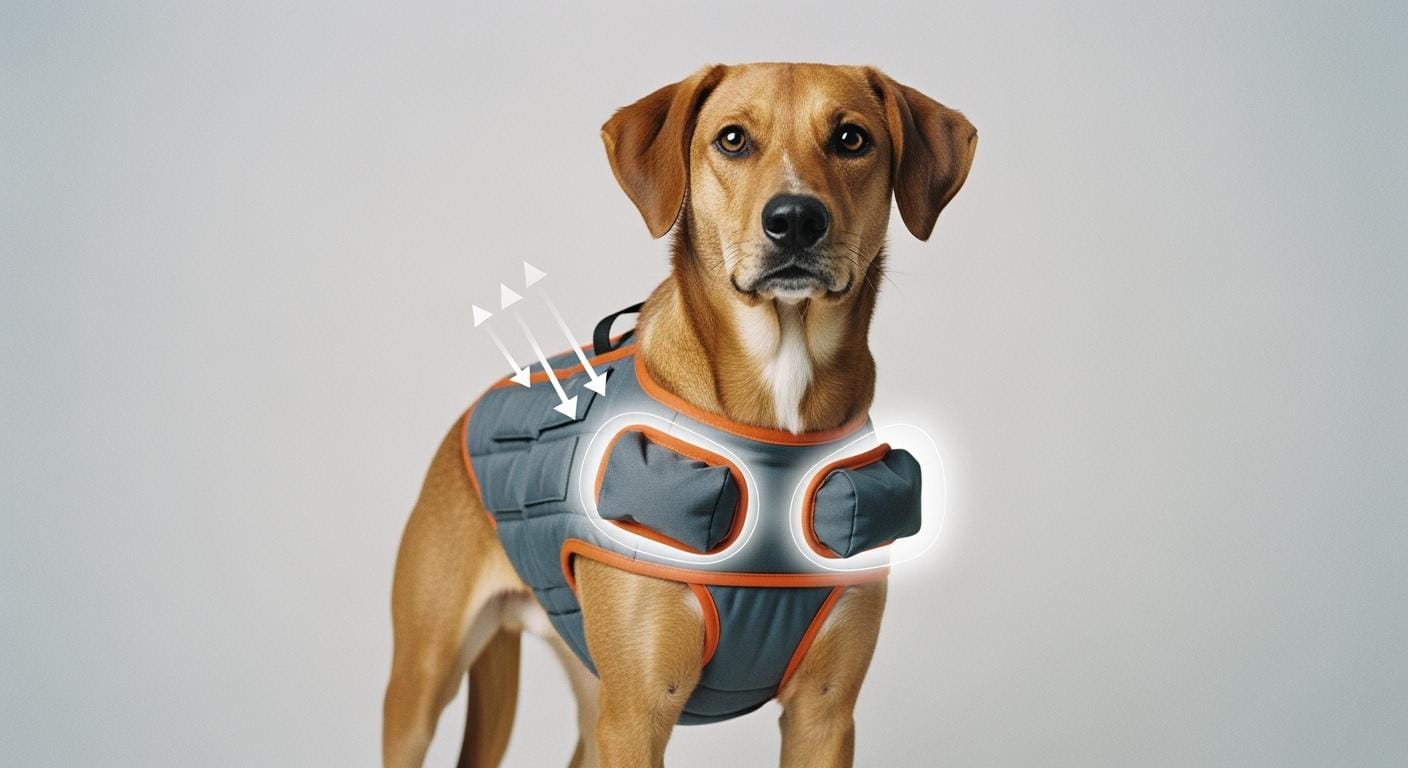
When a senior dog backs away from a carrier opening, owners often interpret it as anxiety. In most cases it is a rational response to a physical demand the dog cannot meet without pain. A low-entry sling carrier changes this equation by dropping the entry point to roughly the dog’s carpal height — the natural step-up range a small dog uses for a curb or a low stair. No hip hyperflexion. No shoulder elevation. The dog steps forward, the sling wraps, and the lift transfers to the carrier structure rather than the dog’s joints.
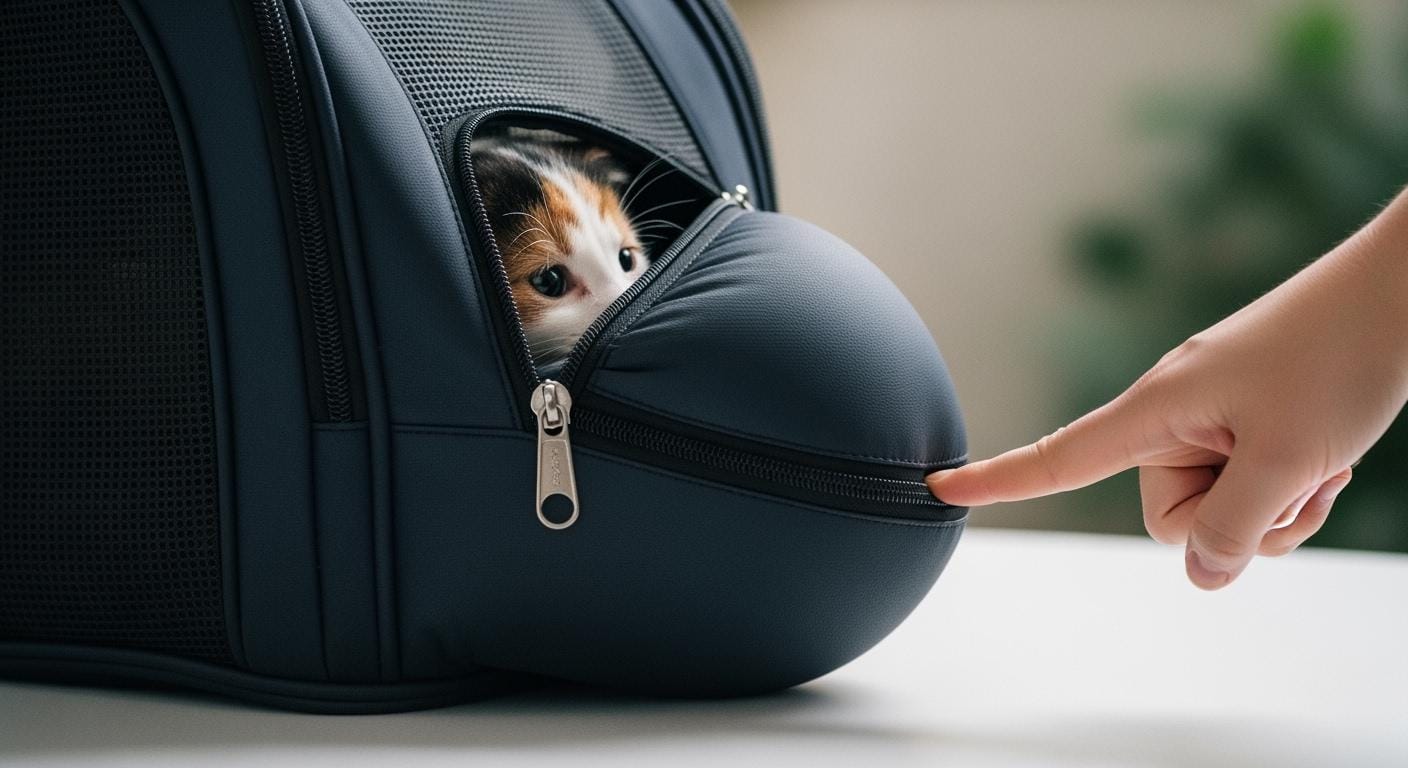
Carriers with a wide opening amplify this effect. A narrow mouth forces the dog to align precisely before entry — fine when fresh, punishing when tired. A wider aperture forgives approach angle. This matters more than it sounds: a tired senior dog’s proprioception is dulled, and a narrow target adds cognitive load to a body already at its physical limit. The same logic applies across sling carriers for small dogs — entry geometry, not padding thickness, is what determines whether the dog loads willingly.
What Awkward Lifting Does to a Senior Spine
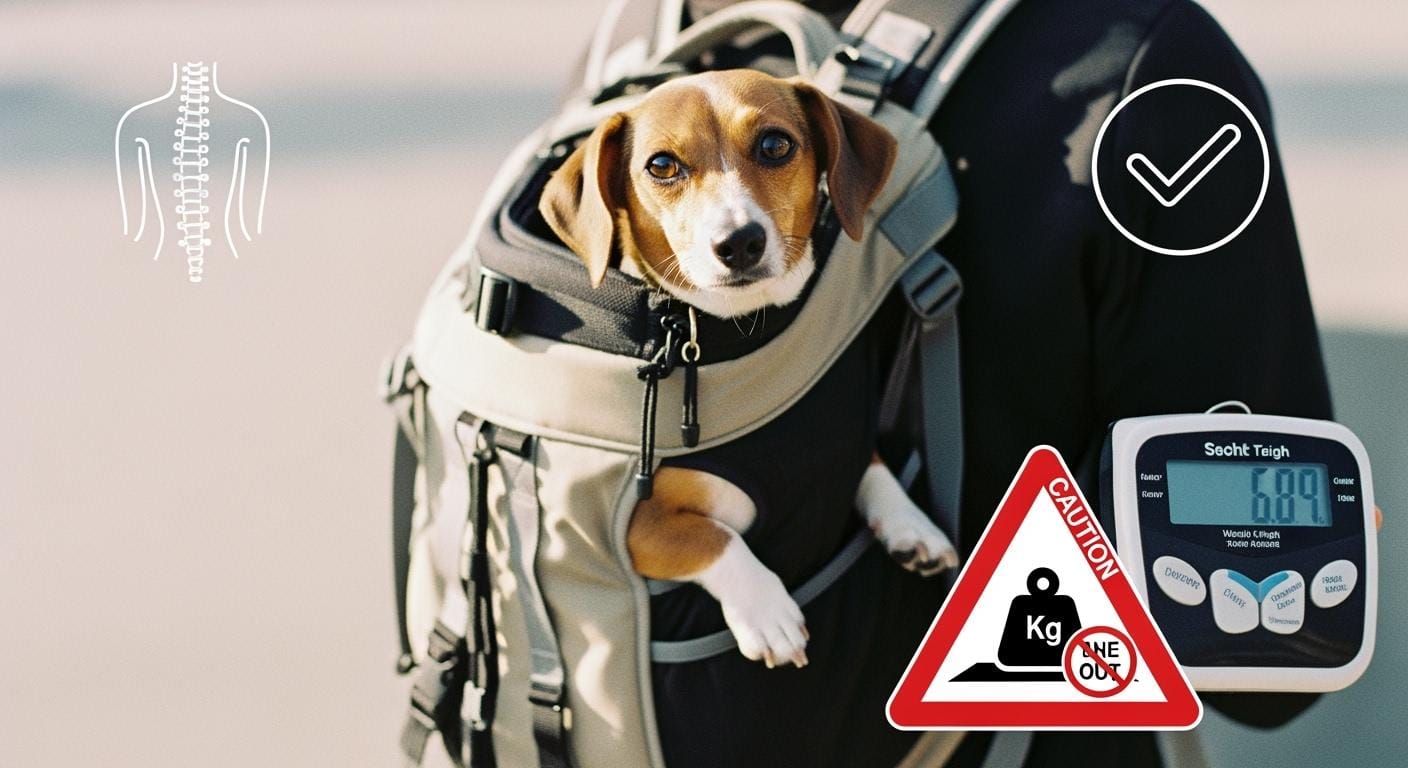
Lifting a dog from the armpits loads the spine in a way no quadruped is built to absorb. The thoracic vertebrae rotate slightly under the uneven pull, and the lumbosacral junction — already a common site of age-related narrowing in small breeds — takes compression it was not designed to handle. A sling carrier that opens low shifts the lift point from the dog’s body to the carrier fabric. The owner still lifts, but the load distributes across the dog’s torso through the sling body rather than concentrating at two shoulder joints.
Tip: A reinforced base that stays flat under body weight is what makes the low-entry advantage stick. If the bottom sags, the dog still ends up in an unsupported curl regardless of how easy entry was.
| Problem during loading | Likely carrier design issue | Better sling design direction |
|---|---|---|
| Dog resists stepping in | Opening too high or narrow | Low-entry, wide sling opening |
| Dog feels unstable or slides | Soft, sagging bottom | Reinforced, stable sling base |
| Awkward lifting for owner | Poor shoulder balance | Crossbody, close-to-body support |
Base Stability and Close-to-Body Support — The Underrated Difference
When a Soft Bottom Folds Under the Dog
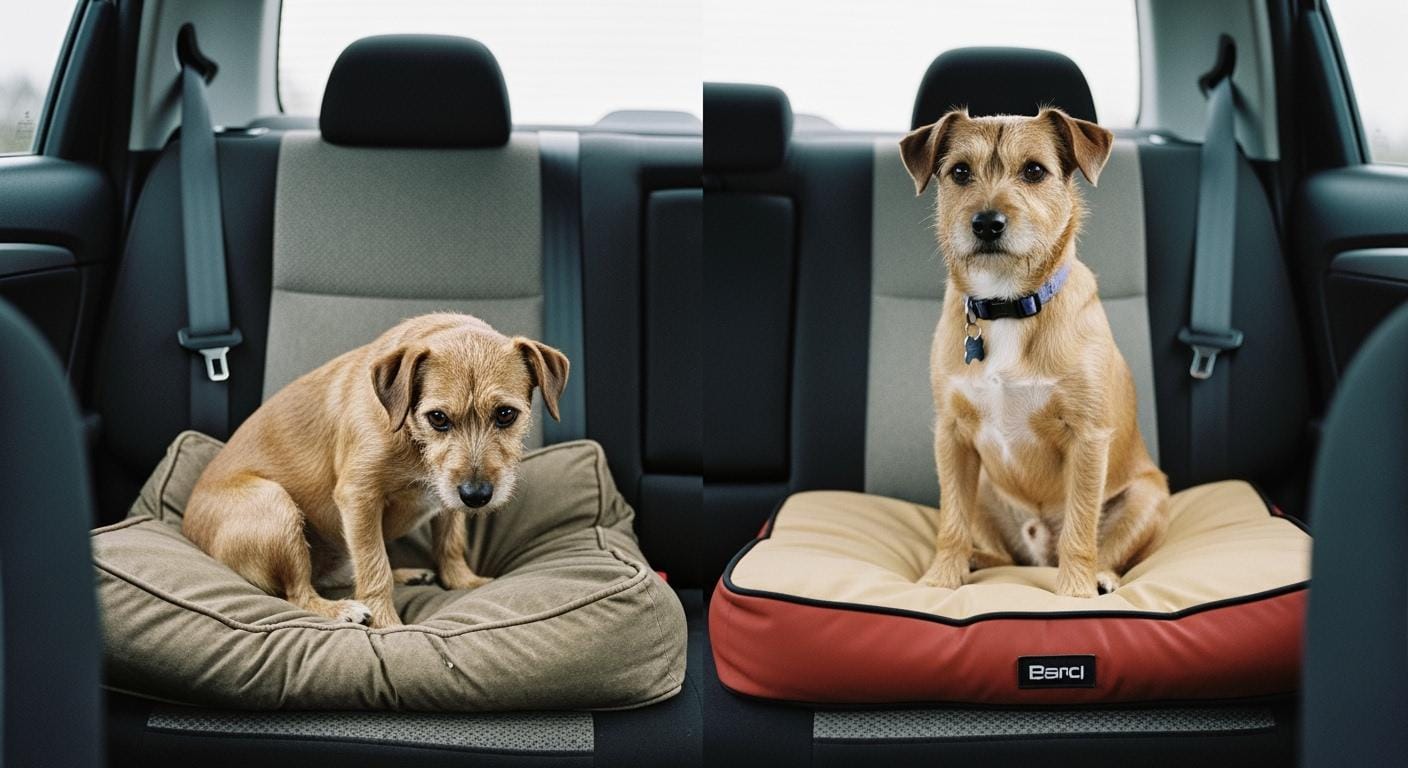
A sling carrier’s base is its load-bearing surface. When that surface is a single layer of unsupported fabric, body weight concentrates at the lowest point. The fabric deforms. The dog sinks. What started as a flat sitting platform becomes a V-shaped trough within the first few minutes of carrying.
The physics is straightforward: fabric under tension distributes force along the tension line. A sling without a reinforced base has only two tension paths — the front and rear edges. Weight between them creates a catenary curve, and the dog slides to its lowest point. A reinforced base — whether through a rigid insert, double-layer stitching, or a structural panel — adds a third tension path across the bottom plane. That third path resists the V-shape deformation and keeps the sitting surface approximately flat.
Check this yourself: after 10 minutes of carrying, remove the dog and hold the empty sling at carrying height. If the base holds its original shape, the reinforcement is working. If it hangs in a visible dip, the fabric alone is carrying the load — and the dog spent those 10 minutes in a progressively deepening slump. A sling carrier with a reinforced base panel prevents this deformation cycle from starting at all.
Why Dogs Slide to One Side in an Unbalanced Sling
A dog sliding to one side is rarely about the dog moving. It is about the sling rotating around its suspension point. When a single-shoulder strap carries the full weight, the carrier’s center of mass seeks the lowest position relative to that strap. If the dog shifts even slightly, the sling tilts, the dog slides toward the low side, and the tilt worsens. The feedback loop is self-reinforcing.
A crossbody strap interrupts this loop. Weight splits across two anchor points — the opposite shoulder and the hip — creating a broader base of suspension. The sling’s center of mass now has a wider stability zone. The dog can shift slightly without the whole carrier tilting. This is why a sling that stays centered during a walk is usually a sling with crossbody geometry, not just one with more padding. As covered in the breakdown of sling carriers for short errands, crossbody designs consistently outperform single-shoulder styles once a dog weighs more than about 8 pounds.
| Problem during loading | Likely carrier design issue | Better sling design direction |
|---|---|---|
| Dog slides to one side | Poor shoulder balance | Crossbody, close-to-body support |
| Dog sinks or feels unstable | Sagging bottom | Reinforced, stable sling base |
| Dog resists stepping in | Opening too high or narrow | Low-entry, wide sling opening |
Crossbody Weight Distribution — What Changes for the Person Carrying
Shoulder strain during carrying is not about how much the dog weighs. It is about how that weight distributes across time and surface area. A single-shoulder sling places the full load on one trapezius and one clavicular attachment. After 8 to 10 minutes, localized muscle fatigue sets in, the shoulder drops slightly, and the carrier tilts. The dog feels the tilt and shifts. The owner compensates by hiking the shoulder. The cycle continues until someone calls it quits.
A crossbody strap changes the load path. Weight transfers diagonally across the torso, engaging the contralateral latissimus and the ipsilateral shoulder girdle together. The load per square inch of strap contact drops because the contact area effectively doubles. Fatigue onset pushes past the window most short trips take. Walk 15 minutes with a single-shoulder sling, then 15 with a crossbody — the difference in shoulder fatigue at the end tells you whether the geometry works. For dogs near a sling’s upper weight range, weight limits and strap design become the deciding factors, not just carrier dimensions.
Close-to-Body Carrying and Why Distance Magnifies Instability
The farther a load sits from the body’s center of mass, the more leverage it exerts. A sling that hangs loosely away from the torso acts on a longer moment arm. Every step the owner takes becomes a small pendulum swing for the dog. Senior dogs, especially those with reduced core strength, cannot brace against this oscillation. They tense up. Tension leads to fatigue. Fatigue leads to squirming, which amplifies the swing.
A close-to-body sling shortens the moment arm. The dog’s weight stays inside the owner’s base of support. Steps translate mostly as gentle vertical motion rather than side-to-side sway. This is why a sling that fits snugly against the torso tends to produce a calmer dog — not because of emotional comfort, but because the physics of being carried change. Less sway means less muscular bracing. Less bracing means the dog can actually rest. The same principle shows up across urban-carrying solutions for short trips and crowded spaces — close carry reduces the instability that makes a dog restless.
Room for a Natural Sitting Position
A sling carrier needs enough interior width for the dog to tuck its hind legs without curling the spine into a forced C-shape. Too narrow, and the dog’s pelvis tilts posteriorly, flattening the lumbar curve and compressing the intervertebral discs that are already thinning with age. Too wide, and the dog cannot brace against the sides, losing the lateral support that makes close-to-body carrying feel secure rather than confining.
Tip: Before heading out, place the dog in the sling at home and check the spine profile from the side. A gentle, natural curve from neck to tail base — without a sharp bend at the lower back — means the interior dimensions match the dog’s seated posture.
When a Sling Carrier Works — and When It Does Not
Suitable Use Cases
A sling carrier with a low entry, reinforced base, and crossbody support is designed for short-distance carrying — the last half-mile home when a senior small dog runs out of steam, the stretch through a crowded farmers market, the stairs at a rest stop during a road trip. It works because the conditions match the design: the dog can sit upright without medical support, the duration stays under the point where even a well-distributed load becomes tiring for the owner, and the environment benefits from the dog being close to the body rather than on the ground.
- Short-distance carrying during walks or errands
- Senior small dogs that tire mid-outing but can still sit upright
- Crowded areas or stairs where ground-level navigation is risky
- Travel breaks that need quick loading and unloading
Unsuitable Use Cases
A sling carrier stops being the right tool when the dog cannot maintain a seated posture. If the dog needs to lie flat — whether due to spinal instability, post-surgical restrictions, or severe arthritis that makes any vertical spinal loading painful — a flat-bottom carrier with horizontal support is the correct choice. Sling carriers are also not built for full-day carrying without breaks. The owner’s shoulder fatigue accumulates, posture degrades, and the dog feels the resulting instability.
- Dogs that cannot sit upright or need horizontal positioning
- Dogs with acute spinal injury or post-surgical immobilization requirements
- Long-distance, full-day carrying without rest intervals
- Large or heavy dogs that exceed the sling’s load distribution capacity
| Suitable Use Cases | Unsuitable Use Cases |
|---|---|
| Short trips and errands | Dogs needing horizontal positioning |
| Tired senior small dogs | Dogs with acute spinal injury |
| Crowded areas or stairs | Full-day carrying without breaks |
| Travel breaks | Dogs exceeding weight capacity |
Disclaimer: The fit checks described here assume a senior dog that can sit upright without pain and has no acute spinal condition. Dogs with barrel chests, very deep keels, or breed-conformation extremes may present pressure points that visual inspection does not catch — hand-check along the sling edges after loading to confirm even contact. If the dog cannot maintain a stable seated posture for more than 2 minutes outside the carrier, a flat-bottom carrier with horizontal support is the safer choice.
FAQ
How do you know if your senior small dog needs a sling carrier?
Watch for the walk-to-stop transition. If your dog goes from walking to standing still or lying down within 15 minutes — and this repeats across multiple outings — the dog is self-limiting due to fatigue or joint discomfort. A sling carrier extends the outing by removing the walking load while keeping the dog in the environment. The test is not whether the dog “looks tired” but whether outings consistently end because the dog stops moving.
Can a sling carrier be used for a dog with arthritis?
Yes, provided the dog can sit upright without visible pain. The entry height matters more here than for any other condition — an arthritic dog that must flex stiff hips to step into a tall carrier will associate the carrier with discomfort and may refuse future use. A carrier that the dog can step or be guided into at near-ground level removes that negative association. If the dog vocalizes, pants heavily, or shifts constantly while seated in the sling, the sitting position itself may be the problem — switch to a flat carrier.
How long can you carry a senior dog in a sling?
Most crossbody sling designs stay comfortable for the owner in the 15-to-25-minute range. Beyond that, even well-distributed weight produces cumulative shoulder fatigue. Give the dog ground breaks at regular intervals — a sling carrier is a rest tool, not a substitute for mobility. Signs you have pushed past the comfortable window: the shoulder you carry on feels noticeably lower than the other when you stop, or the dog starts repositioning more than twice in a 5-minute span.
Does a sling carrier replace a stroller or a flat carrier for senior dogs?
No single carrier type covers every condition. A sling excels at short, active-carry situations where you need hands free and the dog benefits from body contact. A stroller handles longer durations and dogs that need to lie down. A flat carrier is the choice for dogs that cannot sit upright. The question is not which carrier is “best” overall — it is which design matches the specific limitation your dog faces on a given outing.
A low-entry sling carrier with a reinforced base and crossbody support solves a specific problem: the senior small dog whose legs give out before the walk is over. Entry height determines whether the dog gets in willingly. Base stability determines whether the dog stays comfortable once inside. Crossbody geometry determines whether the owner can carry long enough for it to matter. Each design decision traces back to a real-world failure mode — and each failure mode has a mechanical fix that does not require a different product category, just a more deliberate version of this one.