
A dog car seat that tips during a turn is not a seat. It is a sliding platform the dog braces against. Three design decisions separate a seat that stays planted from one that does not: how wide the base spreads across the vehicle seat, how the foam inside responds to compression, and where the tether anchor sits relative to the dog’s center of mass. These choices matter more than padding thickness. A seat that moves under the dog has already failed.
Why Small Dog Car Seats Tip During Braking or Turns
What Destabilizes the Seat in a Moving Car
Under braking, every object in the car keeps moving forward until something stops it. A small dog car seat resists that momentum through two contact points: friction between its base and the vehicle seat, and the anchor straps tying it to the LATCH points or seatbelt. When either grip fails, the seat slides. When both fail at once, it tips.
Most instability begins at the base. A narrow base concentrates the dog’s weight onto a small footprint. During a turn, that footprint becomes a pivot point. The taller the side walls relative to base width, the more leverage the dog’s body mass has to start a roll. This is why a tall, narrow booster rocks more than a low, wide bucket — the height-to-base-width ratio sets the tipping threshold. A wider base that extends across the seat cushion uses the vehicle seat itself as a stabilizer, distributing lateral force across a larger contact patch rather than concentrating it at a single edge.
| Failure Signal | Likely Design Cause | Better Design Direction |
|---|---|---|
| Seat tips or slides sideways | Narrow base, weak anti-slip bottom | Wide, flat base with grip fabric across the full contact patch |
| Cushion flattens under the dog | Low-density foam that bottoms out | High-resilience foam that recovers shape after compression |
| Tether pulls unevenly | High or off-center anchor point | Low, centered tether anchor aligned with the dog’s spine |
How the Dog’s Movement Creates Instability Inside the Seat
A small dog does not sit motionless. It shifts forward to see out the window, turns around to settle, braces a paw against the side wall when the car corners. Each of these actions generates a lateral force. If the seat base cannot resist that force — because it is too narrow or the anti-slip material has lost grip — the seat moves with the dog instead of anchoring it.
The dog’s weight matters less than how that weight gets distributed. A 12-pound dog leaning against one side wall exerts more rotational force on the base than a 20-pound dog sitting centered. Seats with a deep bucket shape funnel the dog toward the middle, reducing off-center leverage. Shallow, flat-bottomed seats offer no centering effect. The dog drifts sideways, and the seat follows.
After a 10-minute drive, check whether the seat’s back edge has shifted more than an inch from where it started against the vehicle seatback. That gap is the first sign the base is losing its hold. A well-designed seat with correct base dimensions matched to the vehicle seat stays put — no gap, no drift.
How Tether Height, Cushion Density, and Base Contact Decide Stability
Tether Anchor Position Changes the Pull Direction
The tether connects the dog’s harness to an anchor point on the car seat. Where that anchor sits determines whether the tether pulls the dog straight back or at an angle. A high anchor point — mounted near the top of the seat back — pulls upward and backward during braking. The upward component lifts the dog slightly, reducing the downward force pressing the seat into the vehicle cushion. A low, centered anchor pulls horizontally and keeps the dog’s weight driving through the base.
The angle matters even more during cornering. A high tether anchor offset to one side creates a diagonal pull vector. The dog gets twisted toward the anchor point, and the seat rotates around its narrowest edge. A centered, low anchor keeps the pull straight along the dog’s spine regardless of which direction the car turns.
| Problem Type | How It Affects Stability |
|---|---|
| Tether too long | Lets the dog shift far enough to reach the front seat or fall off the cushion edge |
| Tether too short | Prevents the dog from settling into a natural sitting or lying position |
| Anchor point too high | Pulls upward during braking, unweighting the seat base and encouraging tip |
| Anchor point off-center | Twists the dog sideways during cornering, rotating the seat |
The tether should be short enough to keep the dog within the seat perimeter but long enough for the dog to sit and lie down. The anchor should sit low and centered — aligned with the dog’s spine, not the seat’s top edge.
What Soft Foam Does Under Load
A plush, pillow-like cushion looks comfortable. Under braking, it becomes a problem. When the dog’s weight shifts forward against the tether, the force concentrates at the front edge of the cushion. Low-density foam compresses under that concentrated load and stays compressed. The front of the cushion collapses, the seat tilts forward, and the dog now sits on a slope.
This is not about thickness. It is about how the foam responds to force. High-resilience foam stores and returns energy — push it down, and it pushes back. Low-resilience foam absorbs energy and stays deformed. Under repeated braking cycles, the difference compounds. The soft cushion gets progressively thinner at the front edge, tilting the seat more each time. A dense, high-resilience foam cushion maintains its thickness across the entire contact surface, keeping the seat level regardless of how many times the car brakes.
To check whether a cushion is doing its job, press your palm into the center of the seat for five seconds and release. Watch how fast the surface recovers. A cushion that rebounds in under a second retains its support structure. One that stays dimpled for several seconds will collapse under sustained load during a drive.
Side Wall Rigidity and Base Contact Patch
Side walls brace the dog during turns. But they only work if they are rigid enough to resist the dog’s weight without flexing outward. A side wall that bends under pressure transfers that force to the base at a single hinge point, concentrating stress and encouraging rotation.
The base contact patch matters just as much. The bottom of the seat must sit flat against the vehicle seat across its entire surface. If the base only touches at a few points — because it is curved, warped, or sits on a contoured car seat — the seat rocks on those points.
The seat cover sits on a near-frictionless surface, and every time the dog shifts weight, turns around, or braces against a turn, the cover wants to move with the dog rather than stay anchored to the seat. A dog turning around does not just sit. It plants a paw, pushes off, and creates a lateral force vector that peaks at roughly the angle of the turn. On fabric, the cover’s textile backing distributes that force across hundreds of contact points. On leather, the same force meets a single plane of low friction. The result is predictable: the cover slides in the direction of the push, bunches at the far edge, and leaves the near side of the seat exposed.
On leather vehicle seats, the problem worsens. Leather offers almost no grip for standard anti-slip backing. Fabric seats hold better because the textile surfaces interlock. When the base slides, the cushion bunches up or shifts out of position, exposing the hard frame beneath. A seat that works on fabric may fail entirely on leather.
Design features that counteract this:
- A base with a full-coverage non-slip bottom — not just corner pads
- A shape matched to the vehicle seat profile (flat for bench seats, contoured for bucket seats)
- Enough base width to prevent side-to-side rocking on the vehicle cushion
A LATCH strap or seatbelt routed through the base — not just the backrest — anchors the seat as a single unit, preventing the base from rotating forward independently during hard braking. Run your hand under the seat after installing it. If the base lifts at any corner when you push sideways, the contact patch is incomplete and the seat will rock under load.
What Keeps a Small Dog Steady — and When Design Falls Short
Design Features That Resist Instability
Seats that stay put under a moving dog share a set of structural choices:
- A rigid or semi-rigid base panel spreads the dog’s weight across the full seat footprint. Without it, the cushion conforms to the car seat contour and the base contact becomes uneven under load.
- Anti-slip fabric across the entire underside — not just silicone dots at the corners — maintains grip even when the dog leans to one side.
- Raised side walls with internal reinforcement hold their shape when the dog braces against them, rather than flexing outward and dumping the dog toward the edge.
- A low, centered tether anchor keeps the restraint force horizontal and aligned with the dog’s spine.
- High-resilience foam resists permanent compression, so the seat stays level after repeated braking cycles.
These features do not work in isolation. A wide base with soft foam still tips because the cushion collapses unevenly. A dense cushion on a narrow base still rocks because the footprint is too small. The seat earns its stability from the combination — base width resisting roll, foam density resisting collapse, tether position resisting twist. Understanding how these elements interact matters more than comparing spec sheets, because a seat can list all the right materials and still fail if the proportions are off.
Safety-Oriented vs. Comfort-Oriented Construction
Seats fall roughly into two design philosophies: those that prioritize structural restraint and those that prioritize cushion comfort. Neither is wrong. They serve different dogs and different driving conditions.
| Design Feature | Safety-First Approach | Comfort-First Approach | Trade-off |
|---|---|---|---|
| Base construction | Rigid panel, wide footprint | Semi-flexible, conforming base | Rigidity improves stability but adds weight and bulk |
| Cushion foam | High-density, thinner profile | Thicker, plusher foam | Denser foam resists collapse but feels firmer to the touch |
| Side walls | Tall, internally reinforced | Moderate height, softer padding | Tall rigid walls contain better but reduce the dog’s outward visibility |
| Tether system | Low centered anchor, short tether | Adjustable-height anchor, longer tether | Tighter restraint limits the dog’s movement range inside the seat |
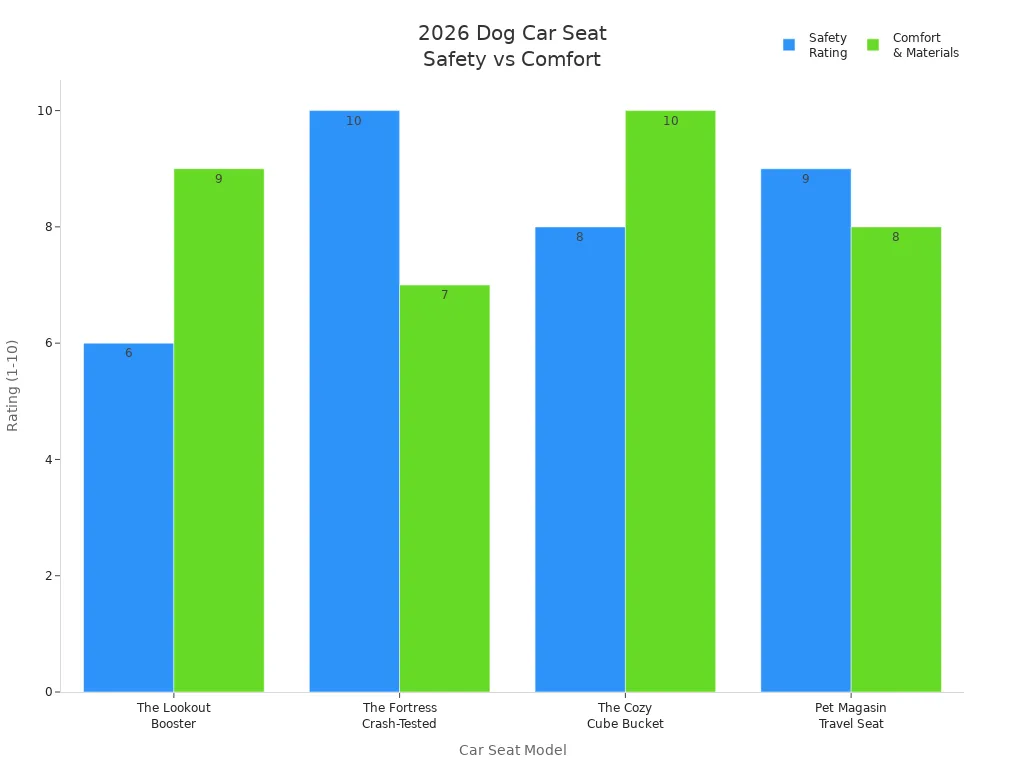
The design tension is real. A seat optimized purely for safety — with a rigid shell, tight tether, and firm cushion — keeps the dog planted through aggressive braking. It may also feel confining and make the dog restless on long drives. A seat built for comfort gives the dog more room and a softer surface. It sacrifices some stability in exchange. The right choice depends on driving conditions: short city trips with frequent stops reward safety-oriented design; long highway drives reward comfort-oriented design with adequate baseline stability.
A small dog car seat with a foldable rigid base can offer both — structural support when deployed, compact storage when not in use. But the core trade-off between motion restriction and comfort remains. Understanding it helps match the seat to the dog and the driving pattern, rather than chasing a single “best” spec.
Fitting the Seat to the Dog and the Car
The most stable design fails if the seat does not fit the dog that sits in it. A seat too large lets the dog slide from side to side. Too small, and the dog cannot settle, so it keeps shifting, generating the very instability the design was meant to prevent.
| Fit Criterion | What to Check |
|---|---|
| Seat width vs. dog width | The dog should sit centered with roughly 2 inches of space on each side. More room allows lateral drift. |
| Side wall height | Walls should reach at least the dog’s shoulder when sitting. Lower walls let the dog lean over the edge. |
| Base flatness on vehicle seat | No gaps under the base corners. Press each corner — if any lifts, the contact patch is incomplete. |
| Tether length after adjustment | Short enough to prevent the dog from climbing out; long enough for sitting and lying down. |
Vehicle seat shape changes the equation. A bench seat provides a flat mounting surface — the ideal condition for stability. Bucket seats create a curved surface that can rock a flat-bottomed car seat. Contoured rear seats with bolsters may leave the car seat base perched on a ridge. Checking fit in the specific vehicle before relying on the seat reveals these mismatches. What tests well on a showroom bench may wobble on a sculpted rear seat.
Installation That Preserves Design Intent
A well-designed seat installed incorrectly behaves like a poorly designed one. The most common installation mistakes defeat the features that the design invested in:
- Route the anchor straps through the base, not just the backrest. Straps anchored only to the backrest let the base rotate forward under braking. The base lifts, the dog slides forward, and the seat tilts.
- Remove all slack from every strap. Even a half-inch of slack lets the seat gather momentum before the strap catches. That momentum turns a controlled stop into a jerk that shifts the seat.
- Check that the seat sits level. A tilted seat funnels the dog to the low side. The cushion compresses unevenly from the start, and the dog’s weight amplifies the tilt.
Tip: Before every trip, press down firmly on the center of the seat and tug sideways. The seat should not shift or lift. If it does, tighten the anchors or try a different seating position. A 10-second check catches most installation drift before it becomes a mid-drive failure.
| Installation Error | What Happens |
|---|---|
| Anchoring only to the backrest | The base rotates forward during braking, lifting the rear of the seat |
| Base too narrow for the vehicle seat | The seat rocks on its edges during cornering, amplifying the dog’s lean |
| Tether not adjusted to the dog’s size | Excess slack lets the dog climb or fall off the cushion edge |
When a Well-Designed Seat Is Not the Right Tool
There are conditions where even a correctly installed, well-built seat cannot deliver the stability expected of it.
Dogs that panic during car rides — panting, pacing, trying to escape — generate forces that exceed what any booster-style seat can contain. The design assumes a dog that settles. A panicked dog will find the weak point.
Very small dogs under roughly 5 pounds may not weigh enough to keep the anti-slip base engaged. The seat relies on the dog’s weight pressing down to activate the friction surface. Below a threshold, the base grip is inconsistent.
Cars with aggressively sculpted rear seats — deep bolsters, steep side angles — may not present a flat enough surface for any base to sit flush. In these vehicles, a carrier-style restraint anchored directly to the LATCH system may provide more reliable stability than a booster seat.
Disclaimer: The stability checks described here assume a calm dog that can sit or lie down during a drive. A dog that paces, lunges, or attempts to exit the seat during motion can defeat even a correctly installed restraint. If the dog shows signs of car-related panic — rapid panting, trembling, attempts to climb out — addressing the anxiety is a prerequisite. No seat design can fully compensate for a dog that will not stay in it. Similarly, dogs with body shapes far outside the breed norms these seats are patterned for — particularly barrel-chested breeds or dogs with a very deep keel — may not center reliably in a bucket-shaped seat. In those cases, fit should be verified with the dog in the seat, in the car, before relying on it for a trip.
For dogs that do settle and for vehicle seats that are reasonably flat, a seat built around a wide rigid base with a low tether anchor tends to stay planted through most everyday driving conditions. The design earns its stability from the base, not from the straps alone.
FAQ
Why does the car seat slide more on leather seats?
Leather is a low-friction surface. Standard anti-slip backing relies on textile-to-textile interlock, which does not engage on smooth leather. A non-slip mat placed between the car seat base and the leather seat adds the missing friction layer. Check by pushing the installed seat sideways — if it slides with less than 10 pounds of lateral force, the grip is inadequate.
How do I know if the foam is dense enough?
Press your palm into the center of the cushion for five seconds and release. A cushion that rebounds fully within one second has the resilience to maintain support during a drive. One that stays dimpled will progressively collapse under repeated braking loads. If after a week of use the cushion is visibly thinner at the front edge, the foam is not recovering between trips.
Can any harness work with a car seat tether?
Not all harnesses distribute restraint force the same way. A harness designed for walking may concentrate crash force on a single strap, while a harness built for vehicle restraint spreads it across the chest and shoulders. The tether should attach to a point on the harness that aligns with the dog’s center of mass — typically a rear D-ring positioned between the shoulder blades.
How often should the installation be rechecked?
Before every trip. Press down on the base, tug sideways, and check that the anchor straps have not loosened. Temperature changes can cause strap webbing to expand and contract, gradually introducing slack over multiple days. A seat that was tight on Monday may have half an inch of play by Friday.
Does a heavier dog always need a wider base?
Not necessarily. A heavier dog that sits still and stays centered may be stable on a moderate base. A lighter dog that shifts and leans can destabilize a narrow seat faster. The base width needed depends more on the dog’s movement pattern than its weight alone. A dog that leans against the side wall during every turn needs a wider base than a dog that braces low and stays centered.






