
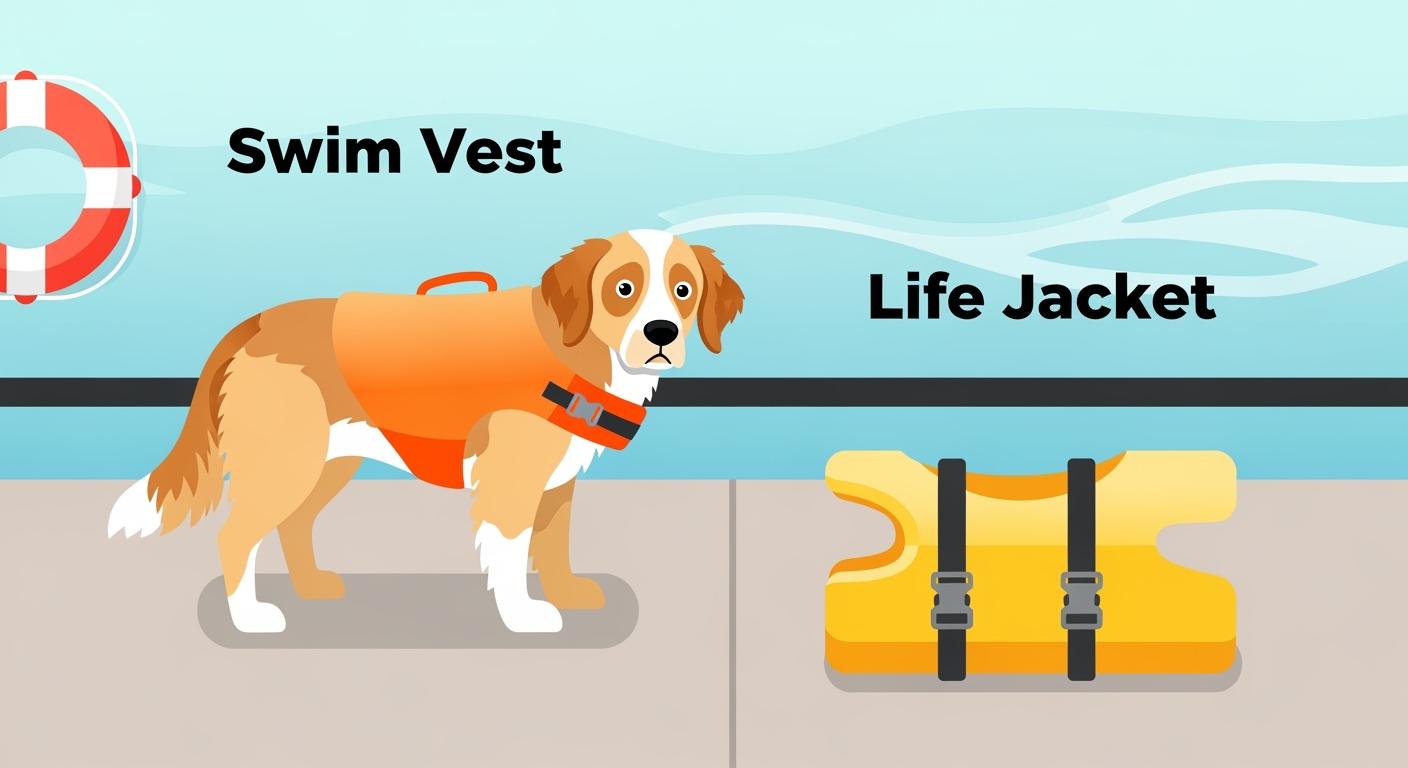
A dog swim vest feels fine in shallow water. The dog moves freely, the vest stays put, and everything looks right. Move into deeper water and the difference between a dog swim vest and a dog life jacket becomes visible fast. The vest that worked in waist-deep water no longer holds the dog’s chest and shoulders high enough. The front body sinks. The rear legs drop. Within minutes the dog shifts from a relaxed horizontal glide to a near-vertical struggle.
The root cause is not just “less flotation.” It is where the flotation sits and how it distributes buoyancy across the dog’s body as water depth removes the ground from the equation. A swim vest places thin foam panels across the back and sides. A life jacket wraps structured flotation around the chest, belly, and front shoulders. That placement difference determines whether the dog floats with its spine parallel to the surface — or fights to keep its nose clear.
Why Light Swim Vests Lose Effectiveness When Water Gets Deeper
Visible Signs a Vest Is Not Providing Enough Lift
A swim vest can mask its limits in shallow water. The dog can touch bottom when it needs to rest, so the vest never gets tested at full body weight. The failure only appears when the dog swims past standing depth.
Here is the causal chain: most swim vests concentrate their thin flotation panels along the back and upper sides. When a dog stands in shallow water, gravity presses the body down through the legs, and the vest’s back panels sit above the waterline doing almost nothing. The moment the dog pushes into deep water and the legs lose bottom contact, the entire buoyancy burden shifts to those back panels alone. There is no forward counterbalance. The rear body sinks first because nothing lifts the hindquarters. The chest follows. The dog’s natural horizontal trim angle collapses, and the body rotates toward vertical — nose up, tail down. At that angle, forward propulsion becomes wasted energy: each paddle stroke lifts the body a few inches, only for it to drop again between strokes. Fatigue accumulates within two to three minutes, not twenty.
You can verify this without any special equipment. Watch the dog from the side during the first five minutes of deep-water swimming. Two signals matter. First, check whether the dog’s spine stays within roughly 15 degrees of horizontal — a visible downward tilt of the hindquarters means the rear flotation is insufficient. Second, watch the paddling rhythm. A dog with adequate lift takes smooth, unhurried strokes with a brief glide between them. A dog fighting inadequate buoyancy paddles continuously — no glide phase, no rest between strokes. That frantic, splashy motion is not excitement. It is the dog compensating for sinking rear buoyancy with raw effort.
How a Dog’s Body Position Shifts When Flotation Is Insufficient
The body tells the story before the dog shows distress. As rear buoyancy fails, the dog’s swimming posture progresses through a predictable sequence:
- The hindquarters drop first, tilting the spine from horizontal toward a 30-to-45-degree angle. The dog is now swimming uphill against its own body weight.
- Paddling shifts from long, efficient strokes to short, choppy movements. The front legs work harder to lift the sinking rear — a mechanical disadvantage that burns energy fast.
- The neck extends upward as the dog strains to keep its nose clear. This arches the spine and further disrupts the horizontal trim that efficient swimming depends on.
- The mouth opens wide with each breath. This is not panting from exercise. It is the dog fighting for airway clearance as the body sinks lower between strokes.
A life jacket with chest and belly panels interrupts this sequence at the first step. The forward flotation panels create a counter-moment that resists rear-body drop. The dog stays closer to horizontal. The paddle strokes stay long and rhythmic. The glide phase between strokes returns — and that glide is where the dog actually rests while swimming. A dog that cannot glide between strokes is a dog that cannot rest. A dog that cannot rest is accumulating fatigue every second it stays in the water.
The Core Structural Difference — Flotation Panel Placement and Buoyancy Distribution
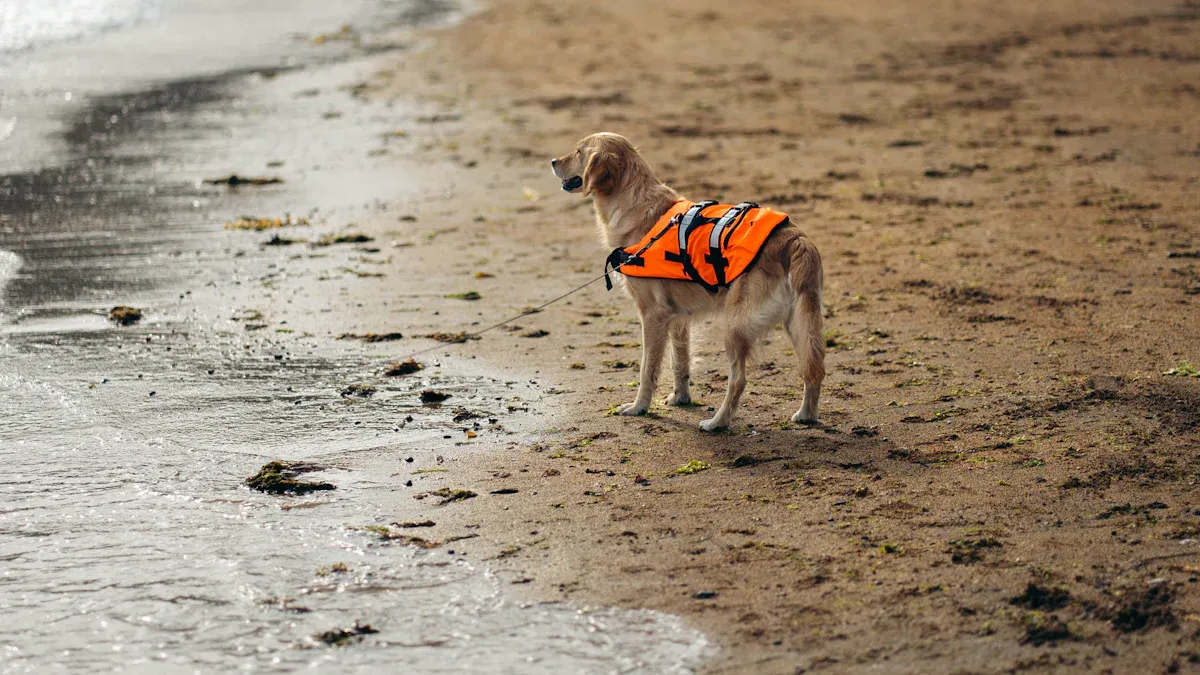
Swim Vest Construction — Light Materials, Limited Panel Coverage
A dog swim vest typically uses neoprene, nylon, or polyester shells with thin foam inserts concentrated along the back and upper sides. Neoprene offers both modest buoyancy and thermal insulation, while nylon and polyester dry fast and add minimal weight. These materials favor freedom of movement over raw lift. The trade-off is structural: back-heavy flotation with little to no forward counterbalance.
| Material | Buoyancy | Flexibility | Insulation | Comfort |
|---|---|---|---|---|
| Neoprene | Moderate | High | Yes | High |
| Nylon | Low | Moderate | No | Moderate |
| Polyester | Low | Moderate | No | Moderate |
| EVA Foam | High | Low | No | Low |
A swim vest works within a narrow envelope: short swims, calm water, experienced dogs under close supervision. Push past those limits and the rear-biased flotation layout reveals its weakness. The vest may shift during active swimming if the straps are not tensioned precisely. Once it shifts, the already-limited forward buoyancy degrades further. For dogs that swim well and conditions that stay predictable, this design is enough. For everything else, the structural gap between a swim vest and a life jacket grows with every minute the dog stays in the water.
Life Jacket Construction — Chest-and-Belly Panels That Distribute Buoyancy
A dog life jacket organizes flotation differently. Instead of concentrating foam along the back, a life jacket distributes buoyancy panels across the chest, belly, and upper body. This layout creates a three-point flotation envelope: the chest panel lifts the front body, the belly panel supports the midsection, and the back panel stabilizes the spine. Together they resist the rear-sinking rotation that a back-only vest cannot counter.
The foam itself matters. Layered PVC-free and CLPE foam — common in life jackets built for prolonged water exposure — delivers steady buoyancy that does not degrade as the foam saturates over hours of use. The difference is observable: after a 20-minute swim session, run your hand along the underside of the jacket panels. Panels that feel waterlogged and heavy have absorbed water into the foam cell structure. Panels that feel firm and springy have held their closed-cell integrity. That integrity is what keeps the dog floating at the same height at minute 20 as at minute 2.
| Design Feature | How It Works | Main Limitation |
|---|---|---|
| Multi-point strap adjustment | Lets tension be set independently at chest, belly, and neck — the jacket conforms to the dog rather than the dog conforming to the jacket | More straps mean more setup time and more points that can be misadjusted |
| Top-mounted rescue handle | Places lift force directly above the dog’s center of mass for straight vertical extraction | A single centered handle can rotate the dog sideways if the jacket fit is loose |
| Layered closed-cell foam | Maintains buoyancy across hours of water exposure without water absorption into foam cell structure | Adds bulk compared to single-layer foam; warmer in hot weather |
| Side-release buckles | Fast on/off with one hand; release under load when needed for emergency removal | Must be checked for debris in the mechanism after sandy or silty water use |
| Reflective trim | Catches light at distance; useful for open-water spotting in low-angle sunlight or dusk | Effectiveness drops in flat overcast light with no direct light source to reflect |
Dog life jackets do not operate under a universal flotation standard, so the design itself carries the safety burden. A jacket that places foam intelligently and secures it with a multi-point adjustable strap system tends to outperform one that simply adds more foam in the wrong places. The materials and sizing approach behind a life jacket determine whether the buoyancy actually reaches the parts of the dog that need it most.
When Each Design Makes Sense
Match the gear to the conditions, not the label on the product. A swim vest is the right tool when the water is shallow, calm, and warm, and the dog is a confident swimmer with no physical limitations. The vest adds visibility and a small confidence margin without restricting movement. A life jacket is the right tool when the water is deep, cold, moving, or the swim will last more than a few minutes. Dogs with short muzzles, dense bodies, or low body fat need the front-body lift a life jacket provides regardless of conditions — their natural trim angle already fights against them.
| Factor | Dog Life Jacket | Dog Swim Vest |
|---|---|---|
| Water depth | Deep water, no bottom contact | Shallow water, can stand to rest |
| Buoyancy layout | Chest, belly, and back — three-point envelope | Back and sides — rear-biased |
| Safety features | Rescue handle, D-ring, reflective trim | Minimal — focus on comfort and movement |
| Fit type | Snug, multi-point adjustable, resists shifting | Flexible, may move during active swimming |
Tip: Measure your dog’s chest girth at the widest point behind the front legs, and the neck circumference at the base. A life jacket sized by chest girth rather than weight alone tends to seat the flotation panels where they actually contact the dog’s body.
Safety-Critical Features That Determine Rescue Readiness
Handle Position and Lift Mechanics
The handle on a dog life jacket is not a convenience feature. It is the primary manual extraction point. Handle position determines whether you lift the dog straight up or accidentally rotate it sideways during a rescue.
A single top-mounted handle placed over the dog’s center of mass — roughly between the shoulder blades — delivers a straight vertical lift. The dog comes out of the water level, and you control the movement with one hand. Handles placed too far forward tilt the dog head-up during lifting, which can force water toward the airway if the dog has taken on any. Handles placed too far back tilt the dog tail-up, which is awkward but less dangerous. Dual-handle designs — one at the shoulders, one further back — give you options: the forward handle for lifting into a boat, the rear handle for steering a swimming dog toward shore without full extraction.
To verify handle placement before relying on it: with the jacket on the dog on dry land, lift the dog an inch off the ground using only the handle. The dog should rise level, not tipping forward or back more than a few degrees. If the dog tips, the handle is positioned too far from the center of mass — reposition the jacket or choose a different design.
A life jacket built for fit and confidence during swimming and kayaking places the handle where it can actually be used under load without destabilizing the dog.
Strap Security and Anti-Shift Construction
Straps do more than keep the jacket on. They determine whether the flotation panels stay where they were designed to sit. A jacket with three independent adjustment points — chest, belly, and neck — lets you tension each zone separately. The chest strap prevents the jacket from riding up over the shoulders when the dog’s front legs push downward. The belly strap stops the jacket from rotating sideways during turns. The neck adjustment keeps the front flotation panel in contact with the chest rather than gaping open.
Reinforced stitching at strap attachment points matters because these are the highest-stress zones on the entire jacket. Every paddle stroke cycles tension through the chest strap anchors. Every lift on the handle cycles tension through the back panel anchors. Seams that rely on a single stitch line or lightweight thread tend to fail at these anchors first — not during the first swim, but after repeated cycles when the thread has abraded against wet fabric.
| Feature | Design Purpose |
|---|---|
| Buoyancy distribution | Keeps the head elevated and body horizontal without constant paddling effort |
| High-visibility colors | Makes the dog spottable in choppy water, low light, or at distance |
| Rescue handle | Provides a single-point lift for extraction into boats, onto docks, or out of deep water |
| Multi-point adjustable fit | Lets each strap zone be tensioned independently to match the dog’s body shape |
| Freedom of movement | Allows a natural paddling stride without the jacket binding at the shoulders |
| D-ring attachment | Accepts a leash for controlled entry and exit at boat ramps or shorelines |
| Quick-release buckles | Enables one-handed removal under load if the jacket snags or the dog panics |
| Durability | Resists seam failure at high-cycle anchor points after repeated wet-dry cycles |
Quick-release buckles add an emergency layer. A buckle that releases smoothly under tension — not one that binds when the strap is loaded — means you can strip the jacket in seconds if it snags on underwater debris. Test this on land: pull the strap tight, then squeeze the buckle release. If it sticks, rinse the mechanism. Sand and silt are the most common causes of buckle binding after a single swim.
Visibility, Fit, and Construction Quality
Visibility is a safety feature, not a styling choice. Bright orange, yellow, or red panels catch the eye in open water where a dark-colored dog disappears into the surface reflection within 30 yards. Reflective trim extends that visibility window into dusk and dawn, but it depends on an active light source — a headlamp, boat light, or angled sunlight. In flat overcast light with no direct beam, reflective trim contributes little. The base color of the jacket carries the visibility burden in those conditions.
Fit is what makes all other features work. A jacket that is too loose shifts the flotation panels away from the body — the foam floats, but the dog sinks inside it. A jacket that is too tight restricts chest expansion during heavy breathing. The sizing and fit checks for secure swimming involve two simple tests: after strapping the jacket on, slide two fingers under each strap. They should pass through with light resistance. Then walk the dog 10 feet on land and recheck each strap position. A strap that has ridden up or loosened in 10 feet will shift far more during a swim.
Durable materials — ripstop nylon, high-denier polyester, reinforced edge binding — resist the abrasion that comes from repeated wet-dry cycles, sand exposure, and contact with boat decks or docks. The failure mode to watch for is not catastrophic tearing but seam degradation at the strap anchors. After every few swim sessions, grip each strap near its anchor point and pull firmly. Any give, stretch, or thread separation at the seam means the jacket is entering its wear-out phase.
When a Swim Vest Is the Better Choice
A structured life jacket is not the answer for every situation. For short, supervised swims in calm, warm, shallow water — a lake beach on a still afternoon, a slow river edge with easy exit points — a swim vest can be the more practical choice. It goes on faster. It dries faster. It restricts movement less. A confident dog that just needs a small buoyancy buffer and increased visibility gets those things from a vest without the bulk of full chest panels.
The swim vest also makes sense for dogs that are reluctant to enter water at all. The lighter feel and greater shoulder freedom can reduce the initial resistance that a bulkier life jacket creates. Once the dog gains water confidence, switching to a life jacket for deeper or longer sessions becomes a natural progression rather than a reluctant first step.
But the conditions where a vest works are narrow, and they are defined by what the vest cannot do. It cannot correct a sinking rear body. It cannot support a tired dog that needs to rest mid-swim. It cannot provide a reliable extraction point in an emergency. When any of those needs is possible — even if it is not certain — the vest becomes the wrong tool.
Disclaimer: The fit checks and body-position observations described here assume a smooth-coated or short-coated dog where strap placement and spinal alignment are visible from a few feet away. Double-coated breeds — huskies, malamutes, shepherds — may show subtler shifts in jacket position that require hand-checking rather than visual inspection. If the dog’s chest shape falls well outside typical breed proportions — particularly dogs with an unusually deep keel or barrel chest — the standard sizing approach described here may not catch every pressure point; test the jacket in shallow water first and watch for any gait alteration when the dog exits the water.
FAQ
How do you tell if a dog needs a life jacket instead of a swim vest?
The deciding factor is not the dog’s swimming ability. It is whether the dog can rest in the water without touching bottom. If the water depth exceeds the dog’s standing height and the swim lasts more than a few minutes, a life jacket’s forward flotation panels keep the body horizontal so the dog can glide between strokes. A swim vest cannot provide that forward lift, so the dog paddles continuously — and continuous paddling means continuous fatigue.
Can all dogs swim without flotation gear?
No. Some breeds carry dense muscle mass and low body fat, which makes staying afloat harder regardless of swimming ability. Short-muzzled breeds face an additional challenge: the forward body tilt that natural swimming produces pushes their airway closer to the waterline. Puppies, senior dogs, and dogs recovering from injury or surgery have reduced stamina and benefit from the buoyancy support a flotation device provides even in calm conditions.
How should a dog life jacket fit?
The jacket should sit snug against the body without compressing the ribcage during heavy breathing. Check strap tension by sliding two fingers under each strap — they should pass with light friction. After walking the dog 20 to 30 feet on land, recheck every strap. A strap that has shifted in that short distance will shift more in the water. The jacket should not ride up over the shoulders when the dog raises its front legs, and the belly panel should stay in contact with the underside without sagging.
What separates a safer life jacket design from a basic one?
Three structural elements set them apart. First, independent chest, belly, and neck strap adjustments — not a single continuous strap that tightens unevenly. Second, a rescue handle positioned over the dog’s center of mass so a lift brings the dog up level rather than tilting it. Third, closed-cell foam that maintains its buoyancy after hours of water exposure rather than gradually absorbing water and losing lift. Bright base colors and reflective trim add a visibility safety margin but do not substitute for these three structural requirements. A dog life jacket built with these features tends to hold its performance across a wider range of water conditions.
How do you maintain a dog life jacket between uses?
Rinse the jacket with fresh water after every saltwater or chlorinated swim. Salt crystals abrade fabric fibers as they dry, and chlorine degrades thread and elastic over time. Air-dry the jacket completely before storing — folding a damp jacket traps moisture in the foam cells and accelerates mildew growth inside the panels. Inspect buckle mechanisms for sand or silt, which causes binding under load. Every few uses, pull firmly on each strap near its anchor point. Any seam separation, thread breakage, or fabric stretch at the anchor means the jacket needs repair or replacement before the next swim.
Are there situations where a swim vest is the better choice?
Yes — short, calm-water swims where the dog can stand to rest, with an easy exit point and close supervision. A vest also works for dogs new to water that may resist the bulk of a full life jacket. But these conditions are narrow. The moment depth exceeds standing height, or the swim extends past a few minutes, or the water has any current, the features and fit of a life jacket provide the structural safety margin that a vest cannot match.






