
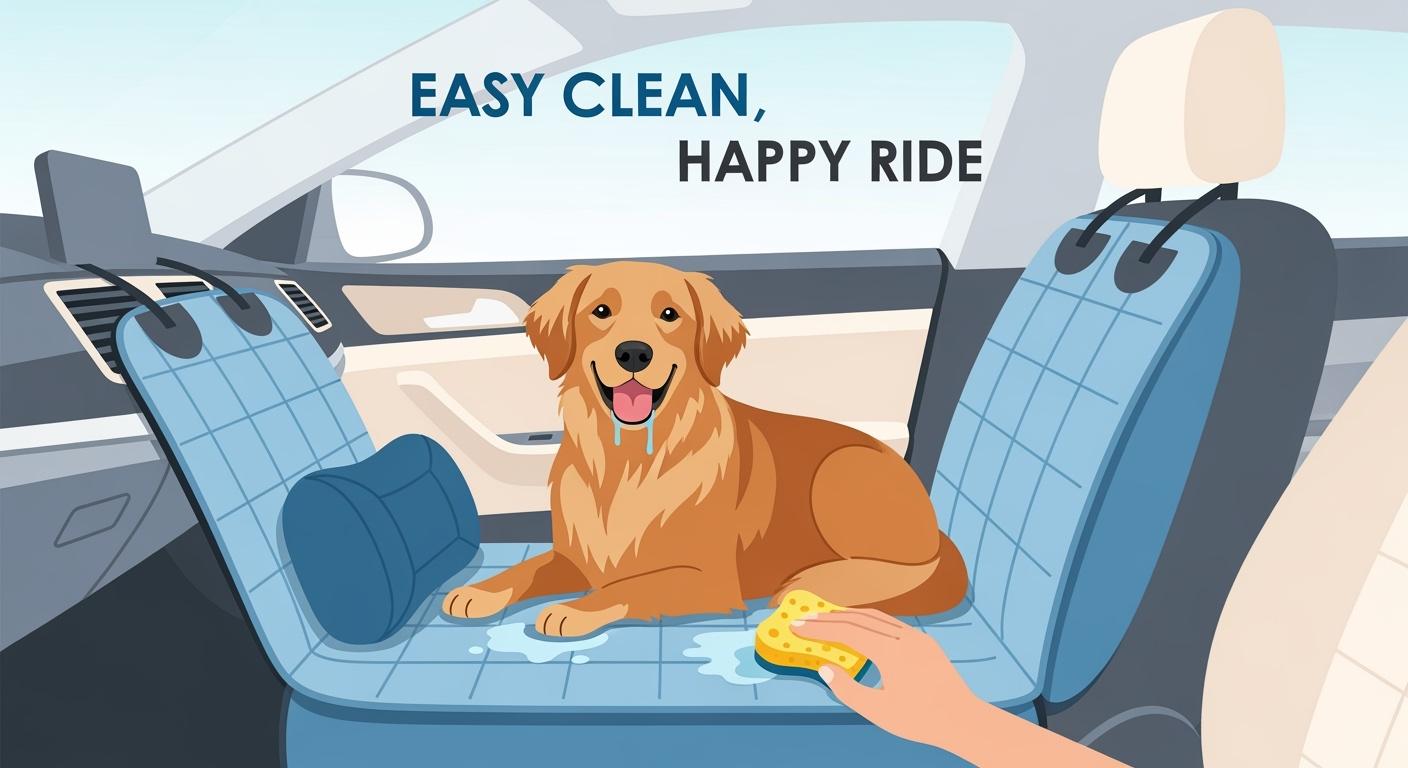
Drool is not the same as dirt, hair, or mud. It is a liquid. It spreads. It pools. And unlike a clump of fur you can brush off, drool seeps. A car seat cover that handles dried mud without issue can fail a drooling dog within the first twenty minutes of a drive — not because the fabric is weak, but because the cover was never designed to stop liquid from traveling.
The design gap is straightforward: most covers treat all messes as surface debris. Drool needs a barrier system, not a single waterproof sheet. The difference comes down to how layers, seams, and fit work together — or fail to.
Why a Single Waterproof Layer Is Not Enough
Drool Spreads, Then Penetrates
Waterproof fabric blocks liquid from passing through the weave. That part works. But blocking penetration is only half the problem. The other half is what happens to drool once it lands on the surface.
Drool pools. A dog that rides with its chin on the seat back leaves a small puddle that sits on the cover for the duration of the trip. On a single-layer waterproof cover, that puddle has nowhere to go. It spreads when the dog shifts position. It runs toward the lowest point — often a seam line, a seat belt opening, or the gap between the bench and the backrest. From there, it seeps through stitching holes and reaches the upholstery underneath.
The failure is mechanical, not chemical. Thread punctures fabric. Each stitch creates a tiny channel through the waterproof barrier. Drool under pressure — from a dog’s weight pressing down on a saturated area — gets forced through those channels. A cover can be 100% waterproof by lab test and still leave a wet spot on the seat after a drive, because the test measures fabric permeability, not seam integrity under load.
You can verify this yourself: after a trip with a drooling dog, lift the cover and run a dry hand along the seam lines on the underside. Dampness along the stitching means the barrier has already been breached at the weakest points. No dampness on the underside but moisture on the top surface means the waterproof layer is intact but the cover lacks a way to deal with surface pooling.
Odor Follows Moisture
When drool sits on a surface that cannot absorb or drain it, the moisture hangs around. In a warm car, a damp cover surface creates conditions where bacteria multiply fast. The musty smell that develops is not from the drool itself — it is from what grows in the moisture the cover failed to clear. A waterproof cover that traps moisture on top can smell worse than an absorbent one that lets some through but dries faster.
How a Multi-Layer Structure Changes the Outcome
A cover built in layers attacks the drool problem at three points, not one. The top layer repels liquid at the surface — this is the waterproof membrane most covers advertise. But underneath it, a second layer — an absorbent pad — catches what the top layer cannot stop: the thin film of saliva that remains after wiping, the moisture that spreads laterally, and the small amount forced through stitch channels under pressure.
The third layer, a second waterproof barrier beneath the padding, is the backstop. If the pad becomes saturated on a long trip, this bottom barrier keeps moisture from reaching the original seat. This is the difference between a cover that protects under normal conditions and one that protects when conditions are worst — a three-hour drive with a heavily drooling dog on a warm day. It is the same principle used in in-car protection systems where a single barrier layer cannot handle all failure modes.
From a manufacturing standpoint, the bonding method between layers matters more than the material choice alone. A pad that is fused or quilted to the waterproof layers stays flat and distributes moisture evenly, which speeds drying. A pad that is simply sandwiched between layers can bunch up after washing, creating thick spots that trap moisture and thin spots that offer no absorption. In production, quilted multi-layer covers require more stitching steps but produce a more stable product over repeated wash cycles — the quilting lines act as channels that guide moisture toward the pad instead of letting it pool on the surface.
Removable padding changes the maintenance math. Fixed padding that cannot be taken out must dry in place — and a thick pad inside a waterproof shell dries slowly. If the cover goes back into the car before the pad is fully dry, trapped moisture feeds mildew. A removable pad dries separately, in open air, and can be washed on its own cycle without exposing the waterproof shell to unnecessary mechanical wear from the machine. Seat covers with zip-out padding let you wash the absorbent layer frequently while the waterproof shell stays installed.
| Design Difference | Why It Matters for Drool | Main Limitation |
|---|---|---|
| Single waterproof layer | Blocks bulk liquid from passing through fabric weave | Stitch holes bypass the barrier; surface pooling spreads drool to edges and openings |
| Waterproof top + quilted absorbent pad | Pad captures moisture that spreads laterally; quilting channels guide liquid into the pad | Pad saturates on trips over 2 hours with heavy droolers; needs swapping or surface wiping at stops |
| Waterproof top + pad + bottom barrier | Bottom barrier is the backstop when the pad saturates; prevents upholstery contact even at worst case | More material and stitching in production; pad must be removable to dry properly between washes |
After a week of daily use, unzip and pull out the pad. Check the underside — the side facing the bottom barrier. If it is damp, the pad has been doing its job but the drying routine needs adjustment. If the bottom barrier itself is wet, the waterproof seal has been compromised.
Seams, Edge Design, and Fit — Where the Small Decisions Add Up
Seam construction reveals whether a cover was designed for solid debris or for liquids. A standard single-stitch seam leaves a row of needle holes with no secondary seal. Drool finds these holes. A double-stitched seam with taped or welded backing seals each puncture point from the underside — the tape or weld bead covers the stitch line and prevents liquid from traveling through the needle channels.
In manufacturing, seam taping adds a production step: the tape must be applied under controlled heat and pressure to bond correctly to the fabric. Skipping this step saves cost but creates a predictable failure point. On a cover with a soft, pliable bottom layer, untaped seams tend to open slightly under tension when a dog shifts weight, widening the channels drool travels through.
Edge design matters for a similar reason. Drool does not stop at the edge of the cover. It runs down the side and can wick underneath if the edge is a raw fabric cut. A folded, stitched, or piped edge creates a physical lip that interrupts the capillary path. Water follows surface tension — a clean edge break stops the wicking action.
Fit is the third variable that determines whether the other design features can do their job. A cover that shifts during a drive creates gaps. A dog that circles before lying down pushes the cover sideways. Every gap is an opening for drool to reach the seat. Elastic edges, seat anchors, and adjustable straps are not convenience features — they are what keep the barrier positioned where the seams and waterproof layers can actually work.
The test is simple: after a drive that includes turns and braking, check whether the cover has moved more than an inch from its original position. Movement of even that small amount is enough to expose seam lines and seat belt anchors. If the cover shifts, the best waterproofing in the world cannot protect a seat it no longer covers.
When the Design Reaches Its Limits
Multi-layer construction handles drool better than a single waterproof sheet. But no cover eliminates maintenance. On long trips with a heavy drooler, the absorbent pad eventually reaches saturation — the point at which it can hold no more liquid. At saturation, any additional drool sits on the surface and behaves exactly as it would on a single-layer cover: it spreads, pools, and seeks seams.
The fix is straightforward: for a dog that drools continuously on drives longer than two hours, the pad needs a swap or the surface needs a wipe-down at a rest stop. This is not a design flaw — it is the physical limit of absorbent materials. A pad can hold only so much liquid per cubic inch of fill before it reaches capacity.
Covers with a hammock-style design, where the cover spans from the front seat headrests to the rear seat headrests, create a suspended platform. Drool that pools in the center of a hammock has farther to travel before reaching an edge or seam than drool on a bench-style cover that follows the seat contours. The trade-off: hammock designs can make seat belt anchors less accessible, which matters if the dog needs to be tethered with a harness clipped to the seat belt for safety.
Disclaimer: This check assumes a short-coated dog whose drool lands directly on the cover surface. Dogs with heavy jowls — Boxers, Mastiffs, Saint Bernards — produce drool in larger volumes and often shake their heads during drives, flinging saliva onto door panels, windows, and seat backs that no bench cover can protect. For these breeds, a seat cover handles the primary landing zone, but additional coverage on door panels and the seat back may still be needed.
Disclaimer: If the drooling is caused by motion sickness rather than breed characteristics, the cover addresses the symptom, not the cause. Motion sickness drool tends to be thinner and more watery than breed-related drool, which means it spreads faster across the surface and penetrates stitching more easily. Sealed, taped seams become disproportionately important in this scenario — a single-stitch seam that holds up fine against thick drool may leak within minutes against the thinner saliva of a nauseated dog.
How do you clean a seat cover after a drool-heavy trip?
Remove loose debris first — dried drool flakes off more easily when the cover is dry. Wipe the waterproof surface with a damp cloth to lift the saliva film. For the absorbent pad, machine wash on a cold gentle cycle with mild detergent, then air dry completely before reinstalling. Avoid fabric softeners — they coat the pad fibers and reduce absorbency over time.
What is the difference between water-resistant and waterproof for drool?
Water-resistant fabric slows liquid penetration but does not stop it under sustained contact. Drool sitting on a water-resistant cover for the duration of a drive will eventually seep through. Waterproof fabric, when the seams are also sealed, blocks liquid passage entirely. The seam is the differentiator — a waterproof fabric panel with unsealed seams behaves like a water-resistant cover at the stitch lines.
Does the cover material affect how fast drool dries?
Yes. Smooth, non-porous surfaces like TPU-coated polyester allow drool to evaporate from the surface but also let it pool and spread. Textured or matte-finish waterproof layers slow lateral spread by breaking surface tension, which keeps drool more contained. Neither dries quickly on its own in a closed car — airflow matters more than surface texture for drying speed.
Will a seat cover prevent drool from reaching the door panels?
A bench or hammock seat cover only protects the seating surface. Drool that gets flung when a dog shakes its head, or that drips when the dog leans toward the window, lands outside the cover’s footprint. For dogs that shake their heads frequently during drives, a seat cover with side flaps offers partial door panel coverage, but no standard rear-seat cover extends far enough to protect the front door panels or dashboard.






