
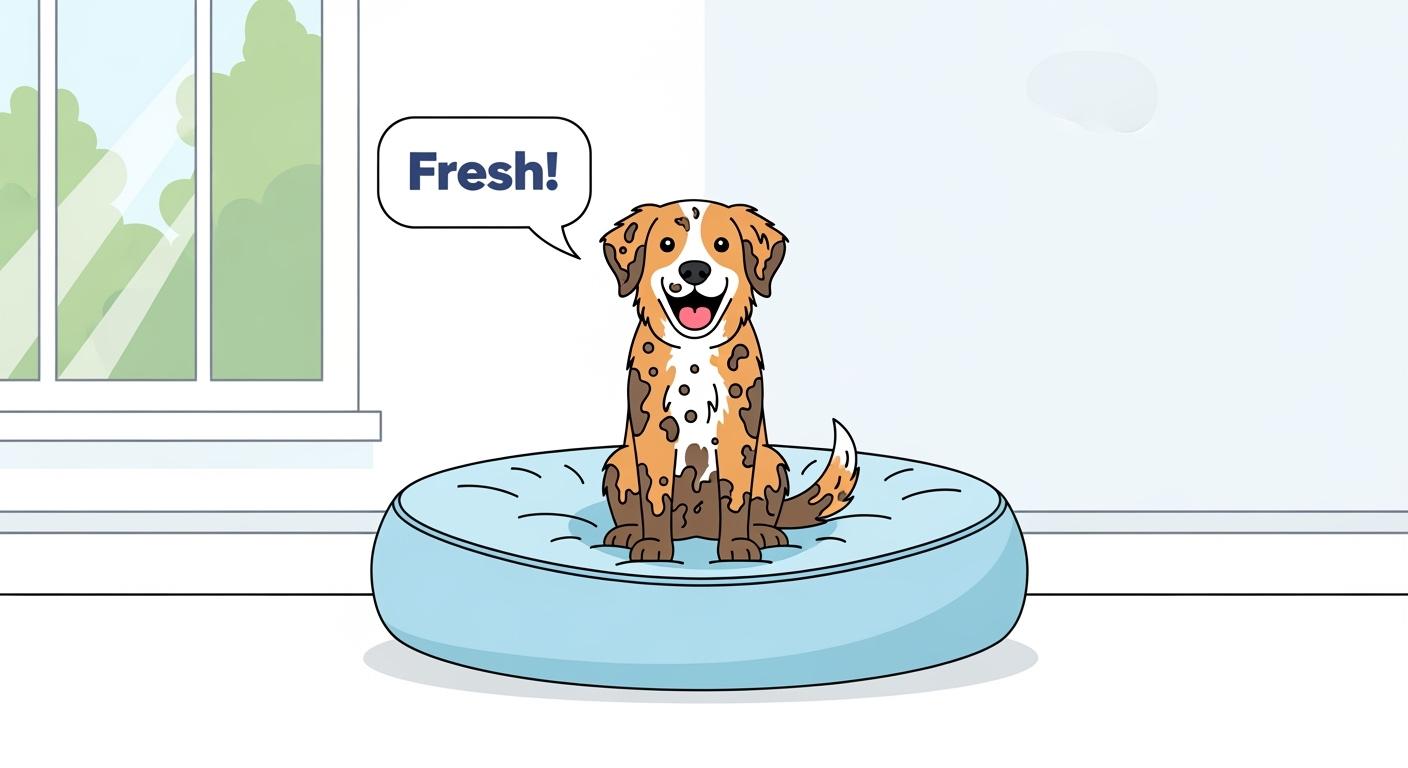
A dog comes in from the yard with mud caked between the paw pads and damp fur from shoulder to flank. It lies down on a padded bed. Within minutes, moisture wicks from the coat into the foam. By day three, the bed carries a smell that does not wash out.
That chain — wet dog to wet padding to wet smell — is what a raised bed with a removable cover is designed to break. The mechanism is simple: air gaps replace absorption. Fabrics shed instead of soak.
Selecting a dog bed for muddy dogs is not about finding the thickest cushion. It is about choosing materials and a frame geometry that keep moisture from ever reaching the places it cannot escape.
Why a Padded Bed Fails a Muddy Dog Within Days
Moisture, Foam, and the Bacteria Cycle
Open-cell foam — the fill inside most standard dog beds — is designed to trap air for cushioning. That same open-cell structure traps water just as efficiently. When a wet dog settles onto foam, body weight presses moisture into the cell cavities. The foam compresses, then rebounds, pulling liquid deeper inside as it expands.
That is the mechanical problem. The biological one follows fast. Inside damp foam at room temperature, bacteria double every 20 to 30 minutes. Mold spores that land on the fabric surface germinate once relative humidity inside the fill passes roughly 70 percent — which happens within hours when wet fur makes direct contact. The result is the familiar sour-dog odor, but the cause is microbial, not just “wet dog smell.”
You can test this directly. After your dog lies on a padded bed for ten minutes post-walk, press your palm firmly into the surface for five seconds. If your hand comes up damp, the padding has already absorbed moisture past the cover. That dampness is what bacteria feed on.
Non-Removable Covers Compound the Problem
A sewn-shut cover traps everything inside. Mud particles work past the fabric weave, hair embeds in the fibers, and dried saliva flakes accumulate in the seam folds. Without the ability to remove and wash the cover, the only cleaning option is surface wiping — which pushes contaminants deeper rather than removing them.
Seams running across the sleeping surface become collection points. Dirt settles into the stitch lines. Over repeated wet-dry cycles, the thread swells and contracts, widening the needle holes. Each cycle opens a slightly larger path for moisture to reach the foam core. Beds with fewer surface seams and zippered covers avoid this progressive deterioration.
Raised Frame — What Changes When Air Flows Under the Sleeping Surface
A raised frame changes the entire moisture equation by inserting a layer of moving air between the dog and the floor. The physics is not complicated: still air trapped under a ground-level bed reaches saturation quickly because there is no exit path for water vapor. Moving air — even barely moving air in a room — carries vapor away before it condenses on the underside of the sleeping surface.
On a raised steel-frame bed, mud that flakes off the coat falls through the fabric mesh or sits on top where it dries into loose particles. It does not grind into a fabric surface pressed against the floor. When the dog stands up, the air gap lets both sides of the sleeping surface dry — top from ambient air, bottom from convection.
An observable difference: walk the dog on wet grass, let it lie on a raised bed for fifteen minutes, then feel the underside of the fabric. It should be dry or only faintly cool. Do the same with a padded bed on the floor — the underside against the floor will be damp or actively wet. That trapped moisture is what turns into odor in a padded bed but never accumulates in a raised one.
Steel frames hold an edge over plastic for stability outdoors. Plastic frames can flex in heat, loosening the fabric tension that keeps the sleeping surface flat. A powder-coated steel frame resists that deformation and keeps the fabric taut — which matters because sagging fabric pools water instead of letting it run through the mesh. For sizing and outdoor placement decisions, the support geometry matters more than the labeled dimensions.
Fabrics That Shed Mud Instead of Storing It
Fabric choice on a dog bed for muddy dogs determines whether cleaning takes thirty seconds or thirty minutes. The difference comes down to fiber structure at the surface level.
| Material | Why It Works for Muddy Dogs | Main Limitation |
|---|---|---|
| Ballistic Nylon | Tight basket weave — mud particles sit on the surface instead of embedding between fibers. Water beads rather than wicks. Holds up to pawing and nesting behavior. | Heavier than polyester; can feel stiff before break-in. Not ideal for dogs that prefer plush surfaces. |
| High-Denier Polyester (1200D–1680D) | Smooth filament surface resists particle adhesion. Dries in under an hour indoors. UV-stable for outdoor placement. Lighter than nylon at equivalent strength. | Denier ratings alone do not guarantee performance — coating quality determines true waterproofing. Cheaper coatings crack after repeated machine washing. |
| Olefin | Solution-dyed color resists fading from sun and bleach-based cleaners. Stain-resistant at the molecular level — liquids bead rather than spread. Quickest drying of the three. | Lower abrasion resistance than nylon. Best for dogs that do not dig or paw aggressively at the bed surface. |
Removable Cover Design — Why the Zipper Matters
A zippered removable cover separates the cleaning problem into two manageable tasks: machine-wash the fabric, wipe the frame. Covers that zip on three sides peel off in seconds. Those with a single-end zipper require sliding the cover over the frame, which takes longer and makes it more likely the owner skips wash cycles.
The best-performing covers use a waterproof inner coating bonded to the fabric back. This prevents moisture that hits the surface from wicking through to the foam — if the bed uses a padded insert — or pooling on the frame. Fabric coatings vary sharply in how many wash cycles they survive before the waterproof layer begins to delaminate. Polyurethane coatings tend to crack after roughly 30 to 50 machine cycles; thermoplastic polyurethane coatings hold up longer but cost more to produce.
A quick field check: run the cover through a cold-water wash and air-dry it. After five cycles, pour a half-cup of water onto the fabric and watch for 30 seconds. Water that beads and rolls off means the coating is intact. Water that darkens the fabric and spreads means the coating has worn through — the cover is now absorbing moisture rather than repelling it.
When a Raised Washable Bed Is Not the Better Choice
Raised beds solve a specific problem well, but the design trades off other qualities.
Senior dogs with joint stiffness or arthritis benefit from orthopedic foam that distributes weight evenly across pressure points. A raised fabric surface — even with some give — does not provide the same pressure redistribution. If your dog needs joint support, a raised bed alone is insufficient. A padded topper over the raised platform can split the difference, but adds a cleaning step.
Dogs under roughly 15 pounds may hesitate to step onto an elevated surface, especially breeds with short legs and long backs. The height that enables airflow also creates a small climbing demand. If the dog already avoids jumping onto furniture, a raised bed is likely to go unused.
In unheated spaces during winter, a raised bed loses heat from below faster than a ground-level padded bed. The air gap that prevents moisture buildup also prevents the floor from radiating warmth upward. For outdoor use in freezing temperatures, a bed that stays dry on wet ground still needs additional insulation beneath it when temperatures drop.
| Design Feature | Where It Works | Where It Falls Short |
|---|---|---|
| Raised frame | Muddy dogs, wet ground, humid climates, indoor/outdoor use | Senior dogs needing joint support, dogs under 15 lbs, unheated winter spaces |
| Removable washable cover | Frequent mud exposure, multi-dog homes, allergy-sensitive households | Heavy chewers that target zippers — a zipper is a failure point if the dog mouths the bed edge |
| Quick-dry synthetic fabric | Outdoor use, rainy-season homes, dogs that swim or get hosed off | Dogs with contact allergies to synthetic fibers — some breeds react to nylon at skin-contact points |
Disclaimer: The rub-mark checks described here assume a smooth-coated dog. Double-coated breeds — huskies, malamutes, shepherds — may show subtler friction marks under the dense undercoat that require hand-checking rather than visual inspection. If your dog has a barrel chest or a particularly deep keel that falls outside the typical proportions the bed surface tension was designed for, the weight-distribution behavior described above may not hold.
For dogs that split time between a patio and a living room, a quick-dry bed that moves between indoor and outdoor spaces reduces the number of surfaces that need daily cleaning. The same raised frame that drains on the porch works next to the couch — it just needs a wipe-down between locations.
The core tradeoff is straightforward: a raised washable bed sacrifices plush softness and joint-level pressure relief in exchange for surfaces that reset to dry and clean in under an hour. For a dog that comes inside muddy three times a day, that tradeoff is the point. For a senior dog that stays mostly indoors and needs orthopedic cushioning, a washable waterproof padded bed built for support and easy cleaning fits the use case better. The right choice is not universal — it follows the dog’s actual daily routine.
FAQ
How often does a washable cover need cleaning with a truly muddy dog?
After every outing that leaves visible mud on the dog’s coat. For dogs that get lightly dusty rather than caked in mud, every one to two weeks. The signal is not the calendar — it is whether brushing your hand across the cover transfers dirt to your palm. If it does, the next dog that lies down is pressing that grit into the fabric weave.
Does a raised bed actually reduce odor, or is that marketing?
The mechanism is physical, not chemical. Odor in dog beds comes from bacteria metabolizing organic material in a damp environment. A raised bed does not kill bacteria — it removes the damp environment that lets bacteria multiply. Dry fabric is inhospitable to the microbes that produce smell. The effect is measurable: fewer wet hours means less bacterial growth means less odor. No additive or treatment is involved.
Can a raised bed stay outside year-round?
In most weather, yes — provided the frame is powder-coated steel rather than raw metal, and the fabric is UV-stabilized polyester or olefin. The exceptions are sustained freezing conditions (the air gap accelerates heat loss) and standing water that reaches the fabric surface. Bring the bed under cover during heavy storms. Snow is less of a problem than standing meltwater.
What makes one washable cover last longer than another?
Three factors: the thread used in the zipper seam (bonded nylon outlasts cotton-wrapped poly), the waterproof coating type (TPU outlasts PU under repeated machine cycles), and whether the cover is air-dried or machine-dried. Machine drying on high heat degrades the waterproof backing faster than any other single factor — the coating and the base fabric expand at different rates under heat, which causes microscopic separation.






