
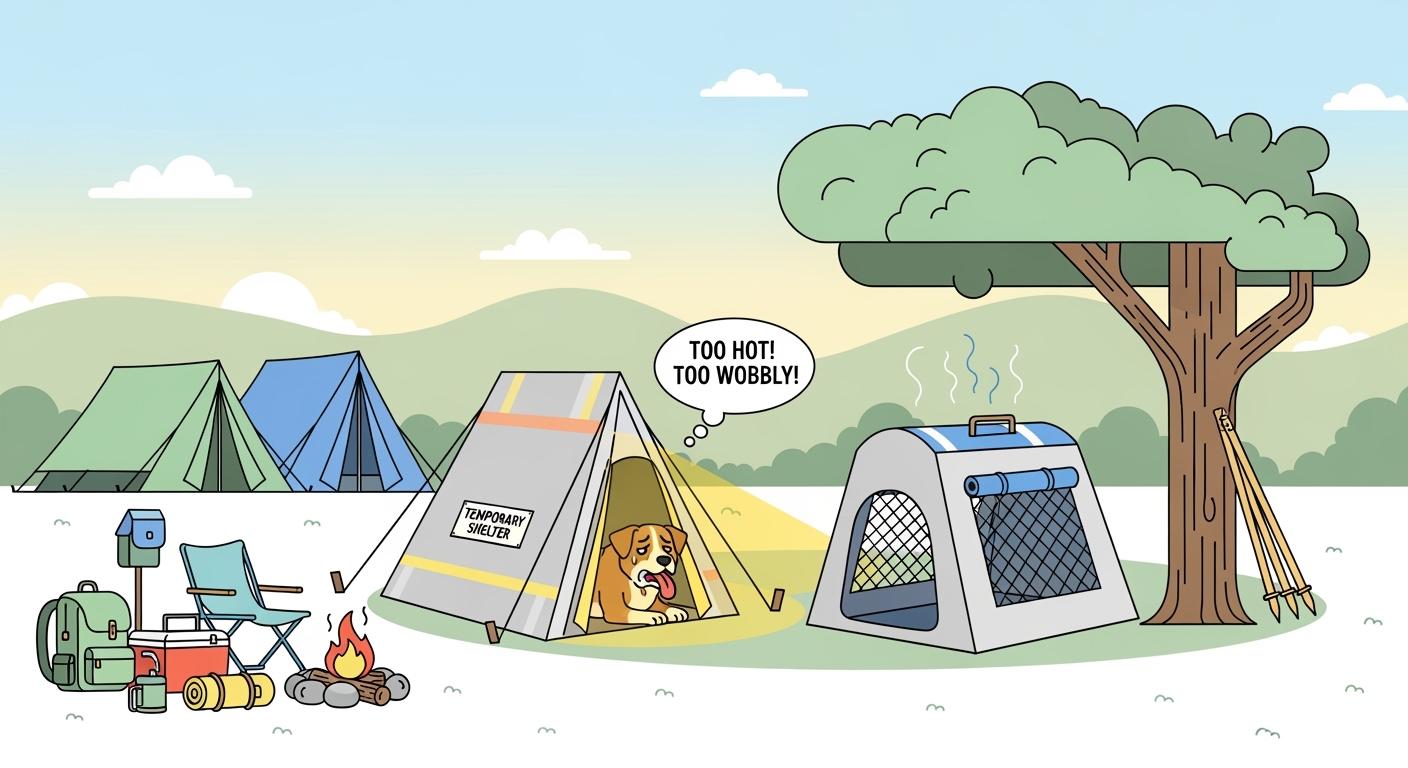
A campsite is never a flat showroom floor. The ground tilts, the wind gusts, and the sun moves. Your dog walks in and out a dozen times an hour. A portable dog shelter that handles none of this is dead weight in your trunk.
Most shelters fail for two reasons that trace back to a handful of design choices. The good news: each failure has a mechanical fix that does not require a heavier tent or a bigger budget. It requires different geometry.
Where Campsite Shelter Design Breaks Down
Anchors That Cannot Hold Soft Ground
A short stake in loose dirt is not an anchor. It is a pivot point. When a dog leans against the shelter wall, lateral force travels through the fabric to the frame, then down to the stake at a shallow angle. The stake rotates in its soil pocket instead of locking. The shelter walks itself across the campsite inch by inch. After 15 minutes, the shade you placed over your dog has drifted three feet into the sun.
Campsite ground is rarely compacted. Grass over topsoil, dry sand, pine duff — all of these need an anchor that bites deeper and resists rotation. A stake with a wider head and a longer shaft changes the force vector. More soil sits above the buried stake body, and that soil mass resists the rotational pull. The wider head distributes tension across a larger cross-section of ground. Simple physics. Easily tested.
In practice: After staking the shelter, push sideways on the top of the frame with about the force of a medium dog leaning against a door. If the far-side feet lift off the ground, the anchor system is not working — either the stakes are too shallow or the tie-down angle is wrong.
Frames That Flex Instead of Lock
A shelter frame should transfer load to the ground, not absorb it into bending poles. Soft frames with friction-fit connections wobble every time the dog brushes a wall. Over the course of an afternoon, repeated small deflections loosen the joints further. A frame that started firm at noon can be leaning by 3 p.m.
Locking-hub frames solve this differently. When the hub snaps into place, the load path runs straight from the canopy fabric through rigid pole segments into the ground stakes. There is no give in the middle to accumulate slop. The same principle applies to pop-up designs with tensioned spring steel — the frame wants to stay open, and any force that tries to collapse it must work against the spring tension. That constant outward pressure keeps joints seated.
Tip: Before packing for a trip, open and close the shelter once at home. If you have to fight a bent pole or a stuck hub, the frame has already degraded. A locking mechanism that needs coaxing is one campsite setup away from failing.
Fabric That Traps Heat While Claiming Shade
Shade alone is not cooling. A dark fabric canopy blocks direct sunlight, but if the material does not breathe, the air underneath heats up like a parked car. The dog gets shade — and a slow bake.
The difference is whether the fabric reflects or absorbs infrared, and whether there is a path for hot air to escape. A canopy with a reflective outer coating sends more solar energy back outward. Mesh side panels give rising hot air somewhere to go. Without both, a shelter is just a solar oven without a window.
What Keeps a Shelter Planted and Cool
Stake Geometry That Grips
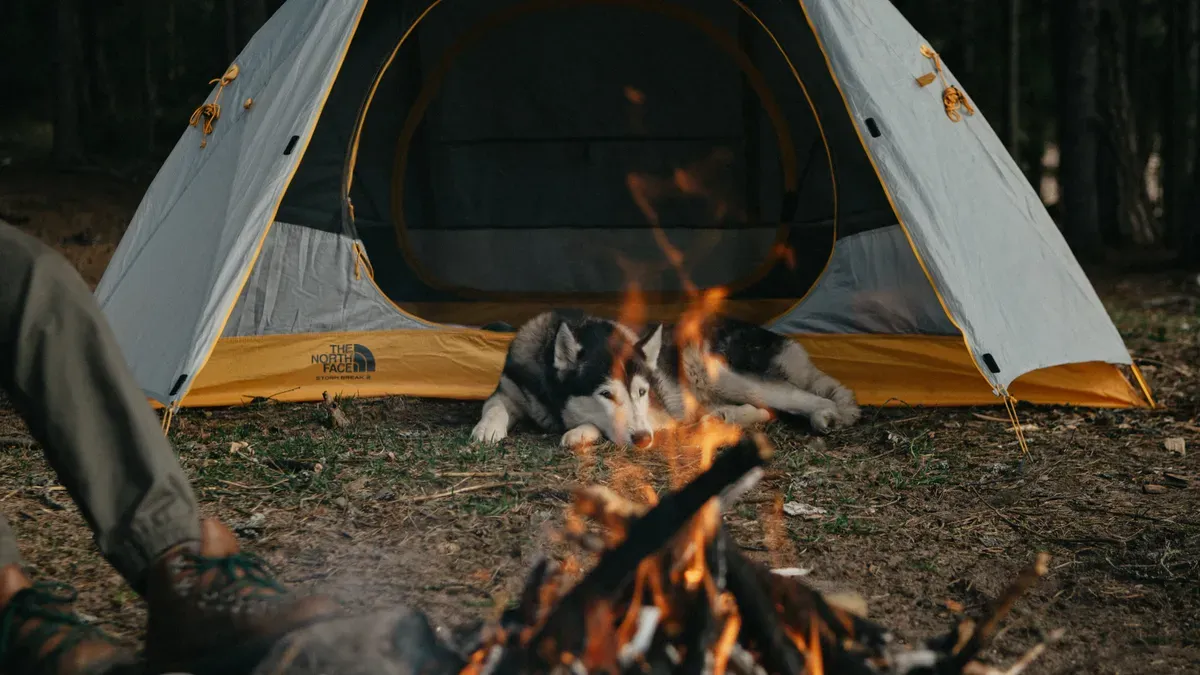
Not all stakes are interchangeable. A thin, smooth rod pulls out of loose soil as easily as it went in. A stake with spiraled fluting or a Y-beam cross-section creates resistance along its entire buried length. When the dog moves inside the shelter, the pull force hits the stake at an angle, and that angled resistance — more surface area in contact with soil — is what keeps the stake from working loose over time.
Multiple tie-down points change the math too. A shelter staked at four corners resists wind from one direction but can tilt when the dog pushes against an unstaked side. Six or eight anchor points create a tension ring. Force from any direction gets distributed across at least two stakes instead of one. The difference shows up fast.
Note: Walk around the shelter after 20 minutes of use and check whether any stake has pulled up even half an inch. A stake that moves a little will keep moving. Reset it deeper or add a second stake at a crossed angle through the same tie-down loop.
Frame Rigidity Under Real Movement
A dog does not enter a shelter gently. It noses through the door, turns around twice, then drops. If the frame flexes during the turn, the fabric panels shift and the roof sags — which reduces interior headroom and narrows the mesh openings that need to stay wide for airflow.
Sturdy frames use either shock-corded fiberglass poles under continuous tension or locking aluminum hubs. The continuous tension design matters because it eliminates loose segments. Every pole section is pulled tight against its neighbor, and the tension resists buckling when the dog leans. Aluminum hubs achieve the same result with a different mechanism: a positive-lock detent that clicks open and stays open until deliberately released. No creep. No slow collapse.
The choice of frame material and hub type changes how the shelter behaves more than the canopy fabric does. A well-ventilated tent on a wobbly frame is still a bad tent.
Airflow That Actually Moves Heat
Cross-ventilation is not a marketing word. It is a simple pressure difference. When mesh panels sit on opposite sides of the shelter, even a light breeze creates a low-pressure zone on the downwind side that pulls warm air out. A shelter with mesh on only one side or only at the top cannot create that pressure drop. Hot air rises but has nowhere to exit.
The test takes 20 minutes. Set up the shelter in direct sun with the doors closed. Reach inside and touch the fabric on the shaded interior wall. If it feels warmer than the outside air temperature, the ventilation is failing. A working cross-ventilated shelter keeps the interior fabric temperature within a few degrees of ambient.
Roomy interiors help airflow too, but not by being bigger for the sake of comfort. More interior volume means a larger thermal mass of air that takes longer to heat up. A cramped shelter — one where the dog’s body nearly fills the space — heats faster because the dog itself is a 101-degree heat source inside a small sealed volume. Give the air somewhere to go and the space to circulate it, and the temperature stays manageable.
| Design Difference | Why It Matters | Main Limitation |
|---|---|---|
| Locking-hub frame vs. friction-fit poles | Hubs transfer load to stakes; friction poles absorb wobble into joints that loosen over time | Locking mechanisms add weight and cost; a bent hub tab renders the frame unusable |
| Spiral/fluted stakes vs. smooth rods | Fluted stakes create rotational resistance along the full buried length; smooth rods act as pivot points | Fluted stakes are harder to drive into rocky or root-dense soil |
| Opposing mesh panels vs. single-side mesh | Opposing panels create a pressure differential that pulls hot air through; single-side mesh has no exit path | Opposing panels catch more wind in storms; rainfly deployment may be needed sooner |
| Reflective canopy coating vs. dark fabric | Reflective coating sends solar IR back outward; dark fabric absorbs and reradiates heat downward | Reflective coatings can degrade with repeated folding; check after a season of heavy use |
When a Portable Shelter Is Not the Right Answer
A lightweight pop-up shelter is not designed for sustained 25-mph wind, no matter how many stakes you use. The fabric acts as a sail, and the frame eventually reaches a wind load it was never built to handle. In exposed ridgeline campsites or open beach camping, a semi-rigid or rigid-sided shelter — or a vehicle-based shade setup — is the safer call.
Dogs over 80 pounds that charge into or lean against shelter walls can overwhelm even a well-staked lightweight frame. The frame may not collapse, but repeated impact loosens stake grip and stresses hub connections in ways that accumulate over a single weekend. For large, high-energy dogs in unfamiliar outdoor settings, a campsite gear strategy that includes a stronger shelter structure or a tie-out paired with the tent is worth considering.
This is also true on loose, dry sand. Stakes that hold perfectly in packed dirt pull free from sand within an hour of light wind. A ground pad or elevated cot inside the shelter does not fix the anchor problem, but sand-filled weight bags threaded onto the stake loops do — a fix that adds bulk but restores stability.
Disclaimer: The stability checks described here assume typical campsite ground — packed dirt, short grass, or firm sand. Loose sand, deep leaf litter, or snow require anchoring techniques beyond what most portable shelters are built for. If the dog’s chest shape or coat density falls outside the breed norms the shelter was patterned for — particularly barrel-chested breeds or double-coated dogs in hot weather — the airflow checks described here may underestimate heat buildup. Hand-check the interior fabric temperature more frequently for those dogs.
FAQ
Why do some portable shelters tip over even with stakes in the ground?
Shallow stakes act as pivot points, not anchors. Lateral force — from a dog leaning or a wind gust — rotates the stake in loose soil instead of being resisted by the soil mass above the buried shaft. The fix is deeper stakes with a wider cross-section and using every tie-down point the shelter provides, not just the corners.
Does a darker canopy provide better shade?
A darker canopy blocks more visible light but absorbs more infrared heat, which reradiates downward into the shelter. A reflective or light-colored canopy sends more solar energy back outward. The material’s breathability matters more than its color — a dark mesh canopy that allows airflow can run cooler than a solid light-colored one.
Can a pop-up shelter handle a dog that moves around a lot?
It depends on the frame mechanism. Pop-up designs with continuous spring-steel tension resist collapse better than friction-fit pole frames because the spring tension actively pushes back against external force. But any lightweight frame has limits — a dog over 80 pounds that charges the walls will eventually loosen even a well-designed structure.
How much interior space does a dog actually need inside a shelter?
Enough to stand, turn around, and lie down without pressing against the walls. Wall contact blocks airflow on that side and creates a heat pocket. A shelter that fits the dog’s dimensions with a few inches of clearance on all sides tends to ventilate better than one sized for extra lounging room — less dead air space means less thermal mass to heat up, but too little clearance blocks the airflow channels the mesh panels create.
How stable is a portable dog shelter in windy conditions?
Stability depends on stake count, stake depth, and frame rigidity working together. A shelter with six or eight anchor points distributes wind load across multiple stakes, reducing the pull on any single one. But fabric canopies catch wind like sails. Sustained winds above 20 mph create forces that exceed what most portable shelter stakes can resist in soft ground — at that point, the right shelter setup for camping may mean repositioning behind a natural windbreak or switching to a rigid-sided alternative. The foldable tent designs that include extra stake loops and reinforced tie-down points handle moderate wind better than basic four-corner layouts.
A portable dog shelter that works at a campsite is not the one with the most features. It is the one where the anchors stay buried, the frame does not loosen, and the air moves. Those three things — not pocket count, not color options, not accessory loops — decide whether your dog uses the shelter or lies down next to it in the dirt.






