
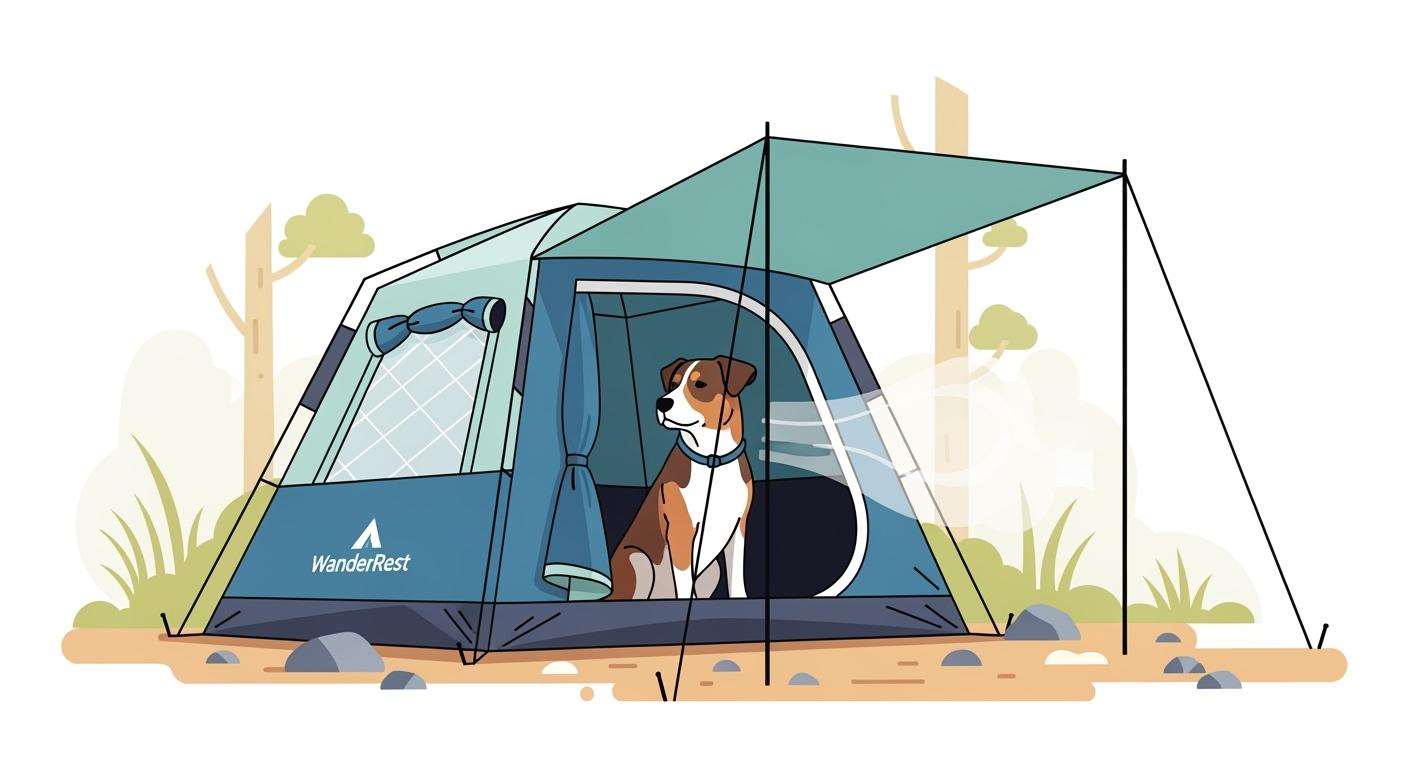
A dog tent seems like a simple piece of gear. Four poles, some fabric, a zippered door. But the difference between a tent your dog walks into willingly and one it refuses to enter comes down to a handful of design decisions that are invisible in a product photo.
Most compact dog tents share the same failure modes: materials that trap radiant heat instead of reflecting it, mesh panels positioned where they cannot create a pressure gradient, and floor dimensions that match a folded-up dog rather than a dog at rest. This article walks through those design differences — which ones matter, under what conditions, and why.
Why a Dog Tent for Camping With One Dog Can Still Feel Hot or Tight
How Tent Materials Trap Heat Instead of Shedding It
The fabric a tent uses does not just sit there. It absorbs solar radiation, conducts heat inward, and re-radiates it into the space your dog occupies. Cotton canvas is the worst offender here — its fiber structure holds moisture and thermal energy, turning the tent into a low-grade oven on sunny days. The floor material matters too. A thicker floor layer with no reflective backing acts as a thermal mass: it soaks up ground heat during the day and releases it slowly into the tent interior well after the sun drops.
| Material | Heat Behavior | When It Fails Most |
|---|---|---|
| Cotton Canvas | Absorbs and retains radiant heat | Direct sun, low wind days |
| Thick Floor (no reflective layer) | Stores ground heat, slow release | Warm soil, afternoon exposure |
| Solid Side Panels (no mesh) | Blocks air exchange entirely | Any condition — zero airflow |
This is not just about material selection. It is about the thermal pathway: sunlight hits the fabric → fabric temperature rises → inner surface re-radiates infrared into the tent cavity → air temperature around the dog climbs. Break any link in that chain — with a reflective coating, a lighter-color outer layer, or an air gap — and the interior stays measurably cooler.
Observable check: After 15 minutes in direct sun, place your palm against the inside of the roof panel. If it feels noticeably warmer than the outside air, the material is absorbing and re-radiating heat. A well-designed shade roof will feel close to ambient temperature on the inner surface.
When Mesh Placement Creates a Dead Air Pocket
Mesh is not automatically ventilation. A single mesh panel on one side of a tent creates exactly zero airflow unless there is a pressure difference across it. For air to move, the tent needs a low intake and a high exhaust — or openings on opposite sides — so that even a light breeze generates a cross-flow. Without that, the mesh is just a window into a stagnant pocket.
The physics is straightforward: warm air rises and collects near the roof. If the only mesh is at dog level on the front panel, that rising warm air has no escape path. The tent becomes a still-air cavity. A design with low front mesh and high rear mesh creates a natural chimney — cooler air enters low, warms as it passes the dog, and exits high. That is the difference between ventilation on a spec sheet and ventilation that actually moves heat away from the animal.
Where Shade, Airflow, Floor Space, and Frame Stability Usually Fail
Roof Shade That Looks Solid but Transmits Heat
A dark-colored roof stretched taut looks like it should block sun. But thin, single-layer fabric — especially in darker colors — absorbs shortwave solar radiation and converts it to longwave infrared on the inside surface. The dog underneath is not in direct sun, but it is under a radiant heater. The fix is not just a thicker roof; it is a roof with a reflective underside or a double-layer construction that creates a still-air gap. That gap is the real insulator — still air has roughly twice the thermal resistance of a single fabric layer.
Observable check: On a sunny day, stand outside the tent and look up through the roof fabric toward the sun. If you can see any pinpoint of light through the weave, UV radiation is getting through. A properly shaded roof will be optically opaque even when backlit.
Mesh Ventilation Architecture vs. Mesh as Decoration
Some foldable pet tents place mesh panels where they look good in a product photo — a small window on the front door, maybe a narrow strip near the roofline — rather than where they create a functional airflow path. Cross-ventilation is not a feature to list; it is an architectural outcome of placing openings on opposing walls at different heights.
| Design Difference | Why It Matters | Main Limitation |
|---|---|---|
| Single front mesh panel | No pressure gradient → no airflow | Becomes a heat pocket in still air |
| Front + rear mesh at same height | Works in a direct breeze only | Fails when wind direction shifts |
| Low front + high rear mesh | Creates a thermal chimney | Less effective in very high humidity |
Floor Dimensions That Match a Curled Dog, Not a Resting Dog
A dog at rest does not hold the same shape it does when anxious or cold. A relaxed dog splays its legs, stretches its spine, and occupies more floor area than its standing footprint suggests. Tent floors cut to the minimum standing dimensions force the dog into a tight curl — which increases body heat retention and reduces the likelihood the dog will choose to stay inside.
Floor material matters here as well. A thin polyester base transfers ground texture directly — every pebble, root, and temperature change registers through the fabric. A floor with a higher denier rating (in the 40D–70D range, using ripstop nylon rather than plain-weave polyester) resists punctures from claws and adds a marginal thermal break. Adding a separate footprint underneath creates a second barrier against ground moisture and conductive heat loss at night.
Frame Stability and the Wind Problem
Lightweight is a selling point. But a frame that weighs almost nothing also has almost no resistance to lateral wind loads. The failure mode is not catastrophic collapse — it is a slow lean, or a wall that flaps inward and taps the dog repeatedly. Dogs read tent instability as environmental unpredictability, and many will exit and refuse to re-enter.
| Frame Material | Stability | Weight Penalty | Best Use |
|---|---|---|---|
| Aluminum poles | High — flexes without permanent deformation | Minimal | Camping, variable terrain |
| Fiberglass poles | Moderate — can splinter under repeated flex | Minimal | Calm conditions, short trips |
| Steel wire frame | High — but sharp bends concentrate stress | Noticeable | Base camp, car camping |
Aluminum poles have an edge here for a reason that goes beyond weight: they deform elastically under gust loads and spring back, whereas fiberglass accumulates micro-fractures with each flex cycle and eventually snaps at the ferrule joint.
Packed Size and the Tradeoff You Cannot Avoid
A tent that packs small uses thinner fabric and narrower poles. A tent built to last uses heavier materials and packs larger. There is no material innovation that eliminates this tradeoff — only design choices that shift where the compromise lands. A tent with a separate pole bag and compression straps can pack into a flatter, more backpack-friendly shape than one where poles and fabric are jammed into the same sack. The packed volume matters as much as the packed weight when you are fitting gear around a sleeping bag, stove, and food.
What Makes a Better Breathable Foldable Pet Tent for Camping With One Dog
Shade Materials That Block Rather Than Absorb
The most effective shade fabrics for a foldable pet tent combine a reflective outer surface with an opaque inner layer. The outer surface bounces shortwave solar radiation away before it can penetrate the fabric matrix. The inner layer catches whatever gets through and prevents it from radiating onto the dog. A double-wall roof — two fabric layers separated by a small air gap — performs better than a single thicker layer because the air gap interrupts conductive heat transfer between the outer and inner surfaces.
This same principle applies to the side panels. A tent with solid fabric on the sun-facing side and mesh on the shaded side creates a directional cooling effect: radiant heat is blocked on the hot side while air moves freely on the cool side. The result is a tent interior that can stay within a few degrees of ambient shade temperature rather than climbing 10–15 degrees above it, which is common in single-wall designs under direct sun.
Cross-Ventilation as a System, Not a Feature
Good ventilation in a foldable pet tent is a system of openings working together, not a count of mesh panels. The minimum functional configuration is two openings on different walls at different heights. This creates a pressure differential whenever air moves outside the tent — windward opening sees higher pressure, leeward opening sees lower pressure, and air flows from one to the other through the tent interior.
Understanding how tent sizing and ventilation features interact changes how you evaluate a tent before purchase. A tent with large mesh panels but no cross-ventilation geometry is not well-ventilated — it is a mesh-sided heat trap. The same principle shows up in indoor-outdoor pet shelters, where single-entry designs struggle with the same stagnant-air problem unless a second opening is placed opposite the door.
Floor Space, Entrance Design, and Ground Protection
A dog tent floor should be sized for the dog’s natural sprawl — not its curled sleeping position. Measure from nose to base of tail when the dog is lying on its side with legs extended, then add roughly 20 percent. That is the minimum usable floor length. Width should accommodate the dog turning around without scraping the walls.
Entrance height is the other dimension that silently fails. A door that requires the dog to duck its head below shoulder level adds friction every time the dog enters or exits. Over a multi-day trip, that friction accumulates — the dog hesitates, then avoids. A door that clears the dog’s standing shoulder height by at least a couple of inches removes that barrier. For older dogs or breeds with joint sensitivity, this single design detail often determines whether the tent gets used at all.
The floor itself benefits from a layered approach. The tent’s built-in floor handles day-to-day abrasion. A separate footprint underneath blocks ground moisture and sharp objects. Together, the two layers create a more effective thermal and moisture break — the same principle used in camping shelter setups designed for extended outdoor rest — than a single thicker floor alone.
Packability Without Sacrificing What Holds Up
Every gram saved in tent weight comes from somewhere: thinner fabric, shorter poles, fewer stake points, smaller mesh panels. A foldable pet tent built for real outdoor use balances these tradeoffs by prioritizing the features that fail first — floor durability and frame integrity — while saving weight on non-structural fabric panels.
The packed shape is as important as the packed weight. A tent that folds into a flat rectangle slides into a backpack alongside other gear more easily than one that forms a bulky cylinder. Compression straps integrated into the storage bag let you reduce packed volume further, though over-compressing can crease waterproof coatings and shorten fabric life. The choice is similar to what campers face with camping ground pads versus cots: the lighter option wins on the hike in, but the more substantial option wins once you are set up.
When a Foldable Pet Tent Is Not the Right Choice

A foldable pet tent solves a specific set of problems: it provides portable shade, a defined resting space, and some weather protection for one dog at a campsite. It does not solve every outdoor resting problem, and under certain conditions it becomes the wrong tool entirely.
In sustained high humidity with no breeze, even a well-ventilated tent cannot shed heat fast enough. The thermal chimney effect that drives cross-ventilation relies on a temperature difference between the tent interior and outside air. When both are equally hot and the air is saturated, airflow stalls. In those conditions, an elevated mesh cot with no walls — something closer to choosing between warmth and raised airflow for camping dogs — may keep a dog cooler than any enclosed tent.
For dogs that are active chewers or diggers, a fabric tent floor is a consumable item, not a permanent purchase. No ripstop weave survives determined clawing or chewing. A tent used with such a dog should be treated as supervised-use-only gear.
Very large breeds — dogs over roughly 90 pounds with deep chests and long spines — often find standard tent floor dimensions too short for comfortable side-sleeping. The tent becomes a crouch-only shelter rather than a rest space. In those cases, a larger camping gear setup built around the dog’s actual sprawl dimensions works better than forcing a fit into a one-size enclosure.
Disclaimer: The fit checks and thermal observations described here assume a smooth-coated or short-coated dog. Double-coated breeds (Huskies, Malamutes, German Shepherds, and similar) may show subtler overheating signals — panting may start later, but core temperature can rise faster in an enclosed space because the coat traps heat that would otherwise dissipate. For double-coated dogs, rely on observed behavior changes (restlessness, exit attempts, refusal to re-enter) rather than surface-temperature checks. If the dog’s chest shape falls well outside the breed norms this tent style was patterned for — particularly barrel-chested breeds like Bulldogs or deep-keeled breeds like Greyhounds — the floor-space guidelines described here may not catch every pressure point or movement restriction.
FAQ
How do you know if a dog tent has enough ventilation before buying?
Look at the mesh panel placement, not the mesh panel count. Two panels on opposite walls at different heights create a functional airflow path. One panel on the front door does not. If the product photos show mesh on only one side, the tent will not ventilate in still air regardless of how large that single panel is.
What floor material holds up best against dog claws?
Ripstop nylon in the 40D–70D range offers the best balance of puncture resistance and weight. The ripstop grid pattern stops small punctures from propagating into long tears. Plain-weave polyester is lighter but tears more easily once a claw snags a single thread. A separate footprint underneath adds puncture protection without increasing the tent’s packed weight as much as a heavier built-in floor would.
Can a foldable pet tent replace a crate for camping?
No. A fabric tent provides shade and a defined space but zero containment. A dog that wants to exit will push through the door or scratch through a mesh panel. If your dog needs secure containment at a campsite — for safety near roads, wildlife, or other campers — a collapsible wire crate serves that function. A fabric tent serves a different purpose: voluntary rest in a shaded, ventilated spot.
Why do some dogs refuse to enter a tent even when it is set up correctly?
Three common design reasons. First, a low entrance that forces the dog to crouch — this reads as a trap to many dogs. Second, a dark interior with no view of the surroundings — dogs that are mildly anxious about enclosure need at least one mesh wall they can see through. Third, a floor that transmits ground texture so clearly that it feels unstable underfoot — the dog steps in, feels uneven pressure, and backs out. Each of these is a design issue, not a training issue.






