
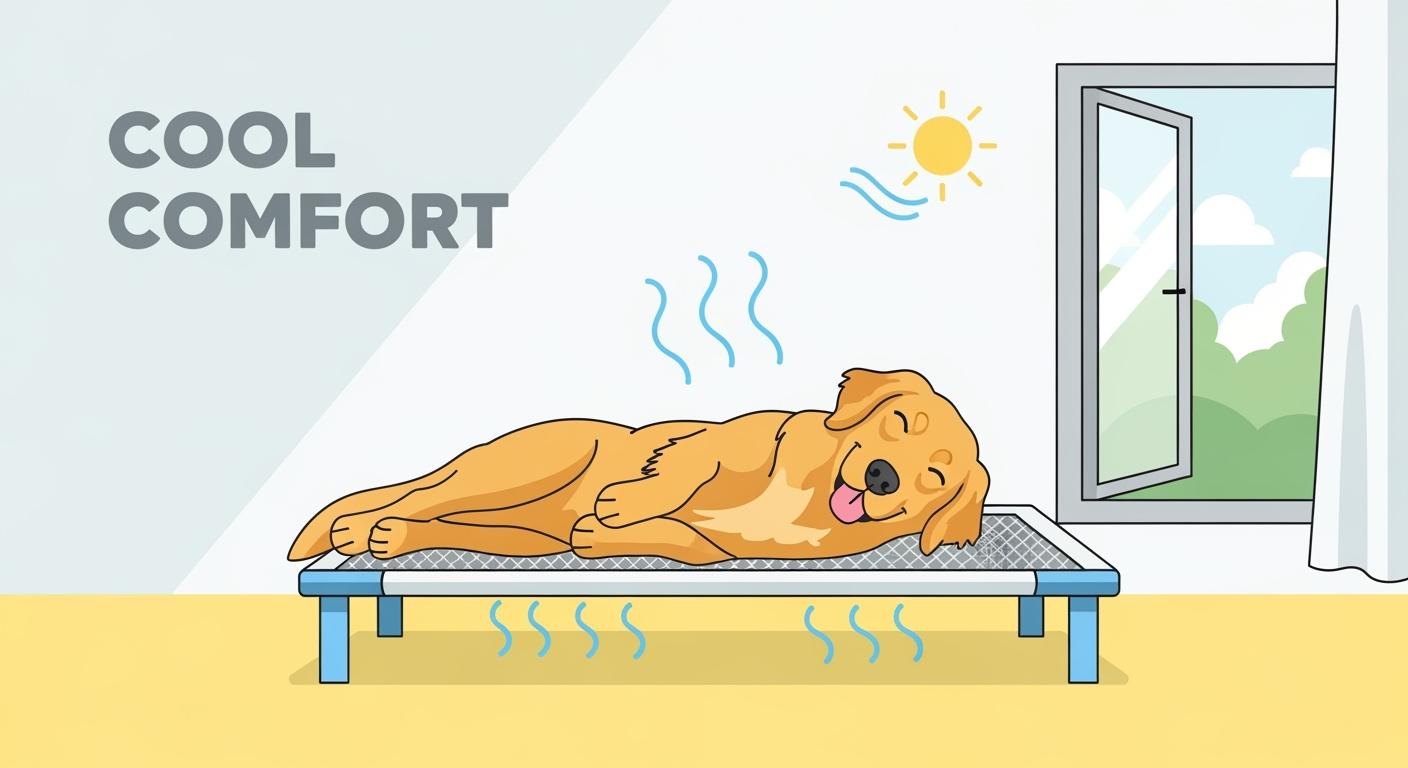
An elevated dog bed does not cool by magic. It cools by maintaining an open air gap under the body — a gap that lets moving air carry heat away instead of trapping it against the sleeping surface. Whether that gap actually stays open depends on two things most buyers never check: mesh tension and frame rigidity. A bed that sags under load loses its cooling function within minutes. The material matters too. Some fabrics breathe. Others insulate.
Why Some Elevated Beds Still Leave a Dog Overheated
The Air Gap Does the Cooling, Not the Height
Elevation alone means nothing. What counts is the uninterrupted column of air between the underside of the mesh and the ground. When a dog lies down, body heat transfers into the mesh surface. If air can circulate freely below, that heat dissipates. If the air is trapped in a shallow, stagnant pocket under a sagging panel, it heats up and radiates back. The mechanism fails.
The key physical chain: body weight presses down on the mesh, the mesh deforms, the air gap shrinks, convective airflow stalls, and body heat accumulates under the dog. Each link is a failure point. The first one — mesh deformation under load — is where most elevated beds lose. A bed can feel taut when empty and be useless under a 70-pound dog half an hour later.
Sag Is Not a Comfort Problem — It Is a Cooling Failure
A bed that sags two inches under a heavy dog has lost most of its air gap. The belly sits in a pocket of still air that gets warmer by the minute. Heavier dogs amplify the problem faster — more weight drives more sag, which leaves a smaller gap, which traps more heat. This is why two dogs on identically sized beds can have completely different cooling outcomes in the same shade, on the same afternoon. The bed does not care what brand is stamped on the frame. It cares about load versus tension.
After your dog has been on the bed for 10 minutes, slide your hand palm-up under the center of the mesh. If your knuckles brush the underside of the dog, the gap is gone and so is the cooling. This is a pass/fail check — no ambiguity.
Dogs that avoid a raised bed even when it is hot out are often telling you something the mesh already knows. The surface feels warm because the air gap collapsed the moment they lay down. Behavioral avoidance is worth paying attention to when design details like mesh tension determine whether a raised bed actually gets used.
Sunlight Turns Any Bed Into a Heat Sink
Direct sun heats the mesh surface and the frame faster than airflow can carry heat away. A bed in full sun can reach surface temperatures far above ambient — at which point the air gap underneath becomes irrelevant because the contact surface itself is the heat source. The frame material amplifies this: steel absorbs radiant heat and conducts it into the mesh at every attachment point. Shade is not a bonus. It is a prerequisite for the air gap to do its job.
How Mesh Tension and Frame Structure Control the Air Gap

What Tight Mesh Does That Loose Mesh Cannot
Mesh tension is what translates frame strength into an open air gap. When the fabric is pulled taut, body weight distributes across the entire perimeter. The mesh acts like a tensioned membrane — the load transfers outward to the frame rather than downward into a sag pocket. Same principle that keeps a drum head flat under a strike.
The physical chain that determines cooling starts with how load enters the fabric. When a dog settles, weight presses downward at the contact points — chest, hips, belly. On a tightly tensioned mesh, that downward force converts largely into tensile stress along the fibers running toward the frame. The fibers stretch microscopically but the surface stays nearly flat because the tension preload already exceeds the added load. The air gap holds.
On a loose mesh, the opposite happens. The fabric has slack. Downward force does not generate enough fiber tension to resist deformation, so the mesh deflects locally. That deflection creates a concave pocket. The body sinks into it. The air gap under the contact zone collapses to near zero. Convective airflow — which requires an open channel — stops. What remains is conduction: heat moving from dog to fabric to the warm air trapped in the pocket. That air has nowhere to go. The gap is gone. The cooling is gone. That fails fast.
Run your fingers along the underside of the mesh at the deepest point of the sleeping area after 10 minutes of use. If the mesh is warm and you can feel the contour of the body pressing through, the air gap collapsed. A functioning gap leaves the underside noticeably cooler than the top surface.
Why Frame Joints Determine Long-Term Cooling
The frame is not just a stand. It is the tension anchor. Every corner joint carries load from the mesh and must resist both vertical compression and the inward pull of the tensioned fabric. Welded steel joints hold their angle under repeated loading cycles — the kind of consistency that makes a steel-frame elevated bed maintain its cooling gap over seasons of use. Bolted or snap-fit joints can develop play over time. Fractions of a millimeter at each connection add up to visible sag at the center. The bed looks fine. The air gap is gone.
Frame material also affects heat behavior. Steel absorbs radiant heat from sunlight and conducts it into the mesh at contact points. Aluminum dissipates heat faster but costs more to manufacture with equivalent joint strength — a real production tradeoff. The material that stays cooler in the sun is harder to join rigidly at a competitive price. These are the kinds of design decisions that separate outdoor beds built for real weather exposure from indoor beds used outside.
Material Density Versus Breathability
Not all mesh is breathable in the way that matters for cooling. An open-weave polyester mesh allows both air and moisture vapor to pass through. A denser nylon weave — often chosen for tear resistance — restricts vertical airflow through the fabric itself even if the air gap underneath is intact. The dog ends up lying on a surface that does not breathe, with an air gap below that cannot compensate because heat cannot cross the fabric fast enough.
Fabric density also affects drying speed. A mesh that holds moisture from humidity, drool, or a wet coat stays warm longer because evaporative cooling at the surface pulls heat from the dog rather than from the air. Quick-drying mesh resets faster between uses. This matters most in humid climates where evaporative cooling is already sluggish. Checking edge-to-edge stability on a large elevated bed confirms whether the mesh tension is uniform or concentrated at center — uneven tension creates hot spots where the air gap thins out.
| Design Difference | Why It Matters | Main Limitation |
|---|---|---|
| Tight mesh tension | Distributes weight to frame perimeter; air gap stays open under load | Requires stronger frame joints to resist constant inward pull |
| Welded steel corner joints | Hold angle under repeated loads; no play accumulation over seasons | Heavier than bolted alternatives; harder to disassemble for transport |
| Open-weave polyester mesh | Heat and moisture pass through rather than accumulating at the surface | Less cushioning than closed-cell foam pads; trade tear resistance for airflow |
| High ground clearance | Maintains airflow even with slight mesh deflection under heavy dogs | Harder for small or arthritic dogs to step onto comfortably |
Where the Cooling Advantage Holds — and Where It Falls Apart
When the Air Gap Wins
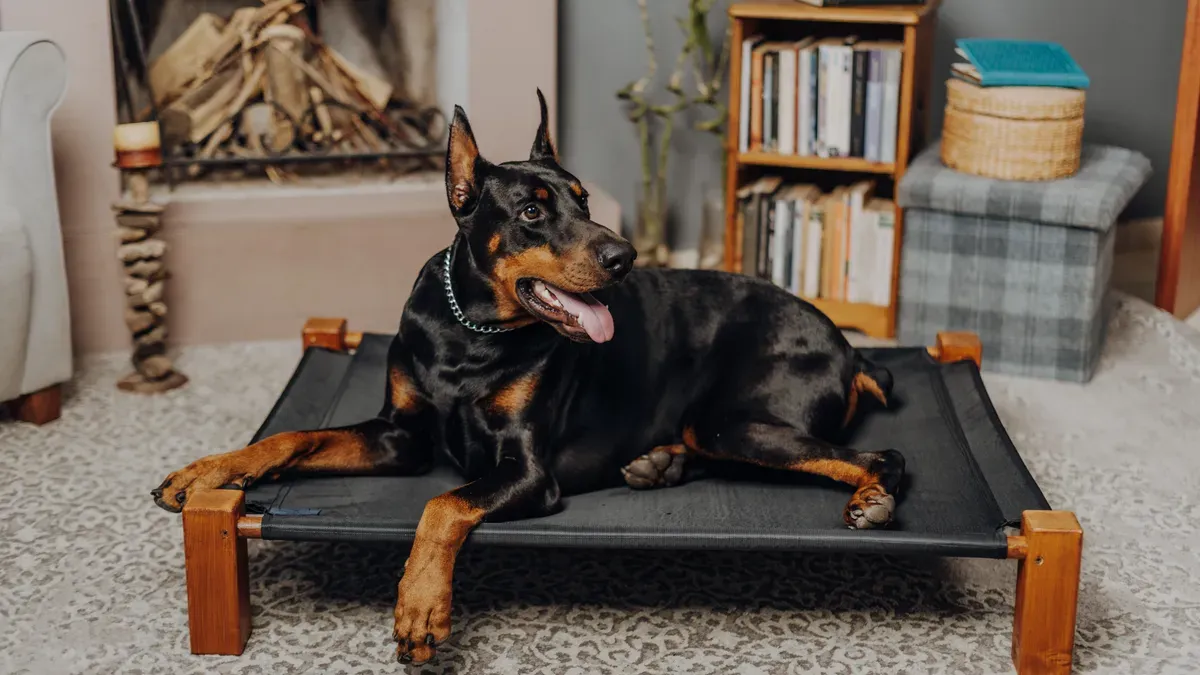
An elevated bed with taut mesh, a rigid frame, and breathable fabric delivers its best cooling in three conditions: partial shade with a light breeze, on surfaces that do not re-radiate heat — grass, shaded decking — and with a dog whose weight falls within the rated range. In these conditions, the gap stays open, convective airflow is steady, and the contact surface stays close to ambient temperature.
The effect is strongest for short-coated breeds. Their body heat transfers directly into the mesh with no insulating undercoat to trap a warm boundary layer. For these dogs, the difference between a taut mesh and a sagging one can be the difference between the dog choosing the bed or choosing the floor. A dog that moves from the bed to bare concrete on a hot day is giving you a design verdict. Listen to it.
When It Fails
The cooling advantage disappears in four conditions. Direct midday sun — the frame and mesh absorb radiant heat faster than airflow can remove it. Still air — without even a light breeze, the air under the bed stagnates and the gap becomes an insulating pocket rather than a cooling channel. An undersized bed — when the body spans nearly the full width of the mesh, there is less unsupported perimeter for air to enter and exit the under-bed space. High humidity — evaporative cooling from a damp coat or a wet mat becomes less effective, and the bed alone cannot compensate. For camping or extended outdoor rest setups, these conditions shift hour by hour — what works at 10 a.m. may fail by 2 p.m.
Place your palm flat on the mesh surface for 30 seconds on a hot afternoon. Then flip the bed and do the same on the underside. If both sides feel equally warm, the bed is absorbing ambient heat faster than airflow can remove it — shade or repositioning is necessary. A working setup shows a clear temperature drop from top to bottom.
Adding Cooling Mats Changes the Mechanism
A gel or water-filled cooling mat laid on top of an elevated bed shifts the physics from convection to conduction. The mat blocks airflow through the mesh directly under it, so the bed’s natural cooling — air moving beneath the dog — stops in that zone. What replaces it is heat flowing from the dog into the cooler mat material. In still, hot conditions this can help. In breezy shade, the mat may reduce overall cooling by sealing the mesh surface. The design tradeoff is real: you gain contact cooling but lose ventilation. Whether that is a net win depends on what outdoor elevated bed conditions you are actually dealing with — still humid heat versus dry moving air.
Disclaimer: These cooling checks assume a smooth-coated or short-coated dog. Double-coated breeds — huskies, shepherds, retrievers — carry an insulating undercoat that can trap body heat against the mesh even when the air gap is fully open. For these breeds, rely on behavior cues (panting, restlessness, seeking hard flooring) rather than hand-checks alone. If the dog’s chest shape falls outside typical breed proportions — particularly barrel-chested dogs or those with a very deep keel — weight distribution across the mesh may not match what the bed’s tension was designed for, and the air gap may close unevenly.
FAQ
Does a higher bed cool better than a lower one?
Not necessarily. Once the air gap exceeds roughly 4 inches, additional height does not meaningfully improve airflow under a resting dog. What matters is that the gap stays open under load, not how tall it is. A 4-inch clearance with tight mesh cools more effectively than an 8-inch clearance with sagging fabric.
Can a sagging elevated bed be fixed?
Sometimes. If the frame uses bolts, tightening them at every joint can restore some tension. If the mesh has stretched permanently — common with woven polyester after months of heavy use — the fabric fibers have elongated and cannot be re-tensioned. Replacing the mesh panel is the only fix at that point.
Does the frame material affect how hot the bed gets?
Indirectly, yes. Steel frames in direct sun become hot to the touch and conduct heat into the mesh at attachment points. Aluminum frames cool faster but are lighter and can shift on uneven ground. The frame material matters most when the bed sits in unshaded spots — which is also where the bed is least effective for cooling regardless of frame type.
How often should mesh tension be checked?
Check weekly during hot seasons. Press down on the center of the empty bed with moderate hand pressure. If the mesh deflects more than about an inch before the frame resists, the tension has loosened. Also check corner joints for play — wiggle each joint; any movement means the anchor points are drifting and the mesh will follow.
Does a cooling mat help or hurt on an elevated bed?
It depends on conditions. In still, humid heat a cooling mat adds a conduction path that can help. In breezy shade, the same mat blocks vertical airflow through the mesh and may reduce the bed’s natural convective cooling. The two mechanisms — conduction through the mat and convection through the mesh — work against each other in the same footprint.






