
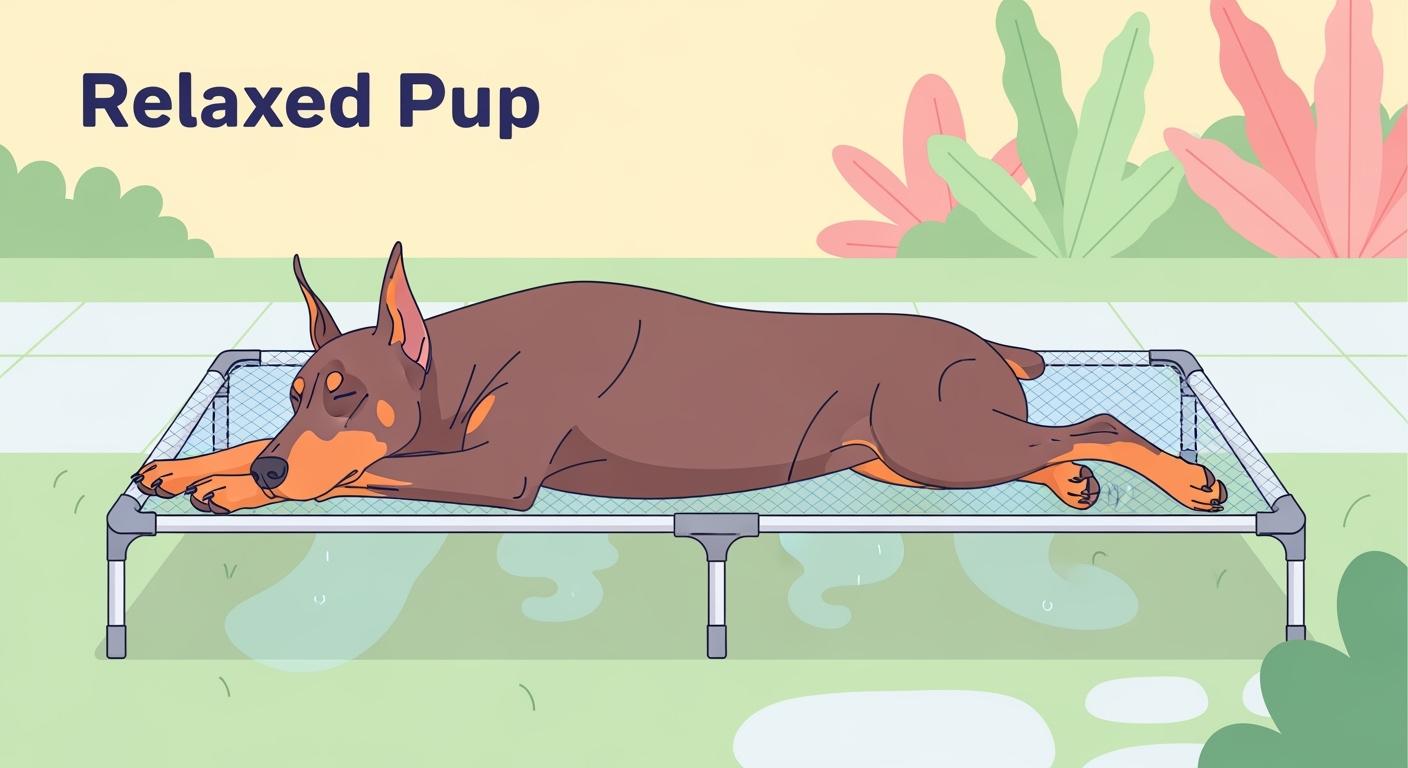
A Doberman generates a lot of heat. Short coat, lean muscle mass, high energy output — the dog runs warm and sheds that warmth into whatever surface it rests on. A ground pad receives that heat and holds onto it. No ventilation path. No exit. The bed becomes a thermal reservoir, and the dog gets up.
That is the central design problem a doberman dog bed needs to solve. Not softness. Not cushion depth. Convective heat removal. The bed has to let body heat escape, not store it and feed it back.
A raised mesh cot does this by eliminating the surface beneath the dog as a heat trap. Lift the resting platform several inches off the ground, replace solid fabric with an open mesh, and body heat follows physics: it rises, fresh air replaces it from below, and the cycle continues without electricity, water, or moving parts. That is the design advantage in one sentence. Everything else — hygiene, drying speed, joint support — follows from whether that core thermal mechanism actually works in the conditions the dog rests in.
The Physics of Why Ground-Level Beds Trap Heat Against a Doberman’s Body
Lay a solid pad on concrete or grass and place a 70-to-90-pound Doberman on top. Three things happen in sequence.
First, the dog’s body heat conducts downward into the pad’s surface layer. Polyester fill or foam absorbs that heat efficiently — that is what padding does. Second, with no air gap underneath, the only path for that heat to leave is back up through the dog, which is the opposite of useful. The underside of the pad stays sealed against the ground, so heat accumulates in the fill layer. Third, as the pad warms, the dog’s natural thermoregulation kicks in. A Doberman’s short coat offers almost no insulation against a hot surface — unlike a Husky with a dense undercoat that buffers contact heat. The dog gets up, moves to a cooler spot, or refuses the bed entirely.
That sequence is observable. After 15 minutes of outdoor rest on a sunny afternoon, lift the pad and touch the underside. If the surface beneath the dog feels warmer than the surrounding ground, the bed is functioning as a thermal battery — charging up during rest and discharging heat back into the dog. That fails fast for a breed with minimal coat insulation.
Dampness accelerates the failure. Ground pads in contact with wet grass or morning dew wick moisture into the fill layer. Wet fill conducts heat faster than dry fill — the opposite of what the dog needs — and the trapped moisture breeds odor. The bed goes from warm to wet to unpleasant within a single afternoon.
| Outdoor Failure | Design Cause | Why It Hits Dobermans Harder |
|---|---|---|
| Heat buildup under dog | No air gap beneath pad surface | Short coat provides almost zero insulation from contact heat |
| Slow drying after rain or dew | Absorbent fill traps moisture against ground | Lean body mass means more direct pressure on wet fill — deeper soak |
| Dirt and odor retention | Ground contact + hard-to-wash materials | Active breed tracks in more debris per rest session |
What Elevation Actually Changes About Airflow and Heat Transfer
Raise a mesh platform six to eight inches off the ground and the thermal equation flips. The dog still sheds heat downward through the mesh — but every square inch of mesh has an air channel directly beneath it. Warm air rises from the dog’s underside, cooler ambient air flows in from the sides to replace it, and a continuous convective current runs under the resting surface.
This is not a marginal improvement over a ground pad. It is a different mechanism entirely. A ground pad stores and re-radiates heat. A raised mesh cot transports heat away from the dog and dissipates it into the air column below. The cooling is passive — no fans, no gel packs, no phase-change materials — but it depends on two conditions being met: the mesh must stay taut enough that the dog’s weight does not close the air channels beneath, and the space under the cot must be open enough for cross-ventilation.
Here is an observable check: after the dog has rested on the cot for 20 minutes on a warm day, run a hand under the mesh surface. If the air underneath feels noticeably warmer than the air beside the cot, the convective path is working — heat is being pulled down through the mesh and vented below. If the mesh feels body-warm and the air underneath is stagnant, either the mesh is sagging enough to seal the air gap, or the cot is placed in a dead-air zone with no cross-breeze.
The mesh material itself matters here. A tightly woven textile with small pore size restricts airflow even when elevated — fewer and smaller channels mean slower convection. An open-weave mesh with visible gaps between threads maximizes the cross-sectional area available for air exchange. This is the kind of difference that does not show up on a product label but determines whether a dog bed actually gets used outside or ignored in favor of a cooler patch of grass.
Drying speed follows the same physics. With air moving freely across both sides of the mesh, moisture from rain, slobber, or a damp dog evaporates in minutes rather than hours. The mesh does not need to be “quick-dry” in a chemical sense — the geometry of the design does the work. That also means the cot resets faster between uses, which matters when a Doberman cycles through outdoor rest, play, and return multiple times in an afternoon. For outdoor shelter and rest setups where the bed stays outside through weather changes, this self-drying geometry eliminates the damp-bed problem that plagues padded ground mats.
How Frame Structure and Mesh Tension Determine Real-World Support
Here is the causal chain. When a dog lies down on a mesh cot, weight presses the fabric downward in the center while the edges — locked into the frame — pull outward. The mesh acts like a trampoline surface under tension: the load is distributed radially from the contact zone to the frame perimeter. If the frame flexes under that radial pull — which aluminum or thin-gauge tubing can do over time — the mesh loses tension. A slack mesh sags. A sagging mesh closes the air gap underneath. No air gap, no convection. The cooling mechanism shuts down.
Steel resists that flex better than lighter materials, not because steel is inherently “stronger” in the abstract, but because its higher elastic modulus means less deflection under the same load. For a 75-pound Doberman doing a controlled drop onto the cot — call it roughly double the static weight in momentary force — a steel frame maintains its shape where a less rigid frame would micro-flex on every impact. Over months of use, those micro-flex events accumulate as permanent deformation.
An observable check: after the dog has used the cot for a week, sight across the mesh surface from edge to edge at dog height. A properly tensioned mesh stays flat within a quarter-inch deflection. If the center dips visibly, the frame is yielding or the mesh is stretching. Either way, the air gap is shrinking.
The mesh itself is the other half of the system. A knit mesh with some elastane content conforms slightly under weight, which reduces pressure points on hip bones and elbows — relevant for a lean breed like a Doberman with minimal natural padding over bony prominences. But the tradeoff is real: more stretch means more sag, and more sag means less air gap. A steel-frame elevated bed that pairs rigid perimeter support with a moderately-tensioned mesh splits the difference — enough give for joint comfort, enough tension to keep the convective channel open.
Cleaning follows from the same geometry. An open mesh with no seams or folds on the top surface gives dirt, hair, and moisture exactly one place to go: through. Spray it down, wipe it, or let rain do the work. There is no fill to harbor bacteria and no seam to trap debris. This is a production-level consideration — a welded or continuously-tensioned mesh surface eliminates the stitching channels where moisture wicks into padding layers in traditional bed construction. In volume manufacturing, a seamless mesh panel is also more consistent in tension from unit to unit than a multi-panel sewn cover, which means outdoor dog bed sizing and material quality stay predictable across production batches.
Where a Raised Cot Design Reaches Its Limits
Elevation solves a cooling problem. If the problem is not cooling, the design advantage disappears.
In cold weather, the same air gap that vents excess heat in summer becomes a thermal drain. A Doberman lying on a raised mesh cot in 40-degree weather loses body heat from below faster than on an insulated ground pad. The physics does not change — convection still runs — but the desired outcome reverses. A raised cot in winter needs a thermal break: a fleece layer or insulated mat placed on top of the mesh, which partially defeats the elevation benefit but keeps the dog from losing too much heat.
Dobermans with diagnosed joint conditions — hip dysplasia, elbow arthritis — may need more than the passive support a tensioned mesh provides. The mesh distributes weight well for a healthy dog, but a joint under chronic inflammation benefits from targeted pressure relief that memory foam or an orthopedic fill can contour around. A raised cot does not contour — it stretches under load. The difference matters when a dog needs a specific joint held in a low-pressure position during rest.
Some dogs simply distrust an elevated surface. A Doberman that hesitates to step up or shows reluctance to settle on the cot may not have a cooling problem at all — the issue is confidence on an unstable-feeling platform. The cot may be perfectly stable in objective terms, but if the dog perceives flex in the mesh as instability, some dogs avoid raised beds regardless of design quality. This is a behavioral variable, not a design flaw, but it is real.
Weather resistance has an asterisk. Powder-coated steel frames resist rust in rain and humidity, but the coating is a barrier layer — once scratched through by claws or impact, exposed steel corrodes. The mesh, typically a PVC-coated polyester or similar synthetic, holds up to UV exposure for a season or two but will eventually stiffen and lose tensile strength under continuous sun. A cot left outside year-round in a high-UV climate will fail faster than one brought under cover when not in use.
Disclaimer: The convective cooling described here assumes a Doberman with a typical short, single-layer coat in outdoor temperatures above roughly 65°F with at least mild air movement. In still air above 95°F, even a raised mesh cot may not provide enough convective heat removal to prevent overheating — the air under the cot heats to near-ambient and the thermal gradient collapses. For dogs with diagnosed heat sensitivity or brachycephalic features, monitor rest behavior directly rather than relying on bed design alone. If the dog pants continuously while resting, the cooling mechanism is insufficient for the conditions, regardless of bed type.
FAQ
How high off the ground should the cot be for a Doberman?
Six to eight inches is the working range. Below six inches, the air gap is shallow enough that ground heat radiating upward can overwhelm the convective current — especially over hot concrete or asphalt. Above eight inches, the step-up height becomes a consideration for dogs with any stiffness, though most healthy adult Dobermans clear that height without issue.
Does mesh tightness affect how well the bed supports a large Doberman?
Yes. Mesh tension directly controls how far the surface deflects under the dog’s weight. A properly tensioned mesh on a rigid frame deflects less than half an inch under a 75-pound static load, keeping the air gap open. The same mesh on a frame that flexes may deflect an inch or more, closing the convective channel. The frame and mesh work as a single system — one cannot compensate for the other.
Can a raised mesh cot replace an indoor bed for a Doberman?
It can, but the tradeoff shifts. Indoors, the cooling advantage is less relevant unless the room runs warm, and the lack of cushioning becomes more noticeable on hard flooring. A Doberman that curls tightly to sleep may find the flat, unyielding mesh less comfortable than a bolstered bed with raised edges for head support. The cot works indoors — it just solves a problem the indoor environment may not have.
Will a steel frame cot hold up to a Doberman that digs at the bed before lying down?
Digging transfers force differently than resting. The claws concentrate pressure on small contact points in the mesh, and repeated digging can abrade the coating on individual mesh strands faster than body weight alone. A steel frame resists the structural load of digging — the cot will not collapse — but the mesh surface may show localized wear faster on a cot used by a digging dog. Check the mesh for broken strands monthly if the behavior persists.
| Design Feature | What It Actually Does | Where It Falls Short |
|---|---|---|
| Steel frame | Maintains perimeter tension; resists flex fatigue across seasons | Coating damage from claws exposes bare metal to rust |
| Open-weave mesh | Maximizes cross-sectional airflow for convective cooling | Offers less pressure-point cushioning than foam or memory fill |
| 6–8 inch elevation | Creates air column deep enough for passive convection | Becomes a heat drain in cold weather without added insulation |
| Seamless tensioned surface | Eliminates stitch channels where moisture and debris collect | Cannot contour around specific joints like an orthopedic bed |
A raised mesh cot solves a specific thermal problem for a breed that runs warm and rests hard. The cooling is not a feature on a checklist — it is the direct outcome of geometry: lift the dog, tension the surface, let air do the work. When the conditions match the design — warm weather, outdoor rest, an active dog that cycles between exertion and recovery — the cot outperforms every ground-level alternative without moving parts or consumables. When the conditions do not match, the same geometry that makes it work in summer makes it the wrong tool in winter. The bed does not change. The physics does not change. What changes is what the dog needs from it on that particular afternoon.






