
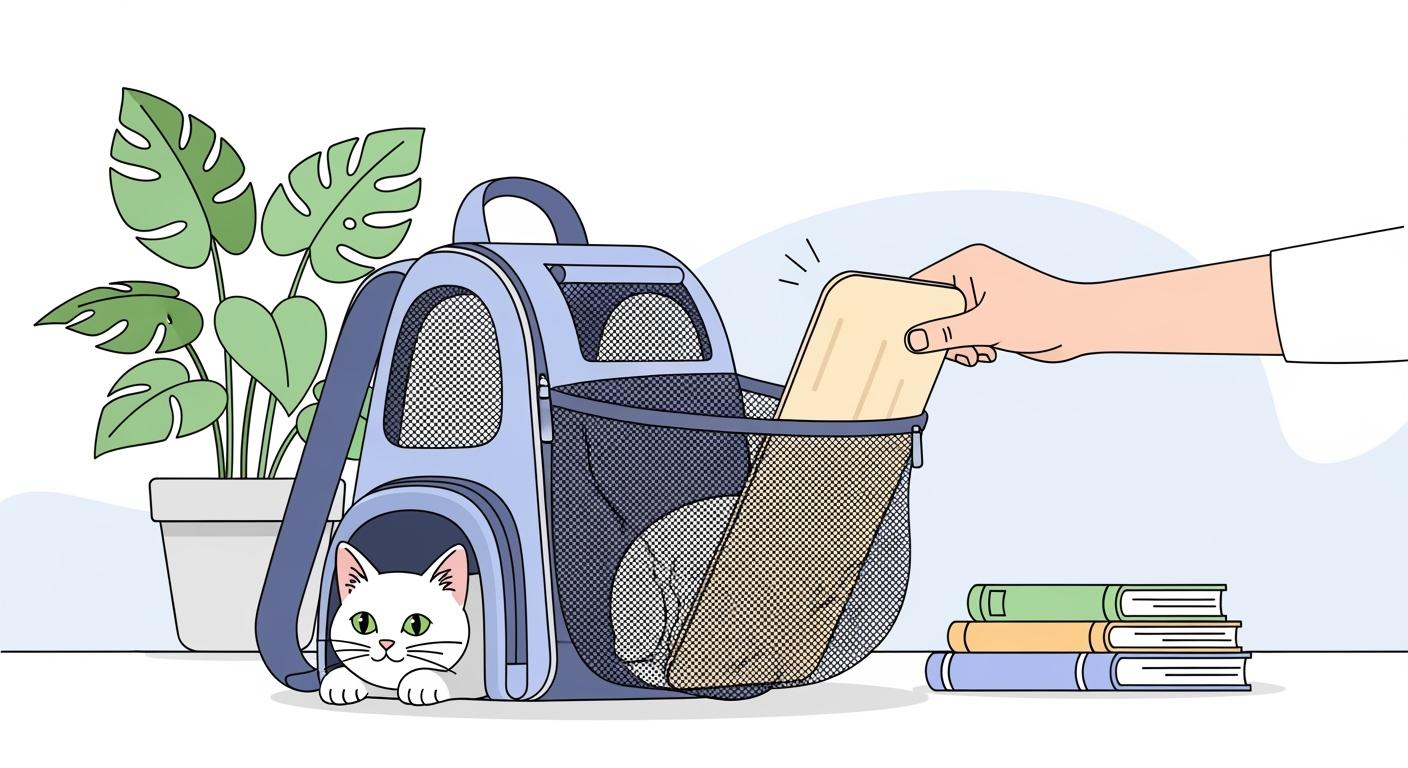
An expandable panel on a pet carrier backpack looks like free extra room. Set the backpack on a bench, unzip the expansion, and a pet gets space to stretch and turn. But the moment the backpack is lifted off that bench, the math changes. The same panel that opened easily now has no ground support under it. The base — often a single layer of fabric or thin foam — becomes the only thing between the pet’s weight and gravity. If that base flexes, the expansion stops being extra room and starts being a structural problem.
Why an Expandable Panel Loses Shape Once the Backpack Is Lifted
The structural failure follows a predictable chain. A pet’s weight presses down on the base panel. A soft base — one made from flexible fabric without a rigid insert — deflects under that load. As the base bows downward, the expansion panel loses its bottom anchor. The fabric panel, now unsupported along its lower edge, hinges at the zipper line where it meets the main compartment. The mesh buckles inward. As the mesh folds, the pet senses the floor tilting and shifts toward the lowest point, which is now the sagging rear corner. That weight shift moves the carrier’s center of gravity behind the wearer’s spine. The backpack tilts backward, the shoulder straps pull forward against the wearer’s chest, and the entire load becomes a fight.
This is not a materials problem alone. It is a support footprint problem. An expandable panel extends the carrier’s floor area without extending its rigid base. The expanded section overhangs the structural platform. Load that cantilevered section and it deflects — same as a board would if you stepped past where the support beam ends. A carrier built for larger dogs amplifies this: more weight on the same unsupported overhang produces faster, deeper sag.
| Real-use sign | Structural cause | Design fix |
|---|---|---|
| Pet slides backward | Base flexes under load, creates a rearward slope | Rigid base insert across full footprint |
| Mesh folds or collapses | Expansion panel loses lower anchor, hinges at zipper | Tensioned mesh with reinforced zipper tape |
| Zipper path bends | Panel torque twists the zipper line off-axis | Lockable zipper on a straight, reinforced path |
| Backpack pulls away from back | Center of gravity shifts rearward past spine line | Compression straps plus firm base platform |
Tip: After walking 15 steps with the expansion open, set the backpack down and sight along the zipper line. If the zipper path has bowed more than half an inch from straight, the base is flexing and the panel has lost structural support.
Design Elements That Hold an Expanded Carrier Together
Three design features decide whether an expandable carrier stays stable or folds under load: a rigid base platform, tensioned expansion panels, and compression control.
A firm base is the difference between a carrier that holds its shape and one that collapses. The most direct solution is a rigid insert — a PP board, a thin aluminum frame, or glass-reinforced rods sewn into the base panel. A rigid insert spreads the pet’s weight across the full base footprint. Instead of flexing at the center, the entire platform stays level. When the base stays level, the expansion panel’s lower edge stays anchored, and the mesh above stays upright. A rigid PP board insert is also more repeatable in production than trying to engineer fabric tension alone — fabric drapes differently across sewing runs, but a die-cut board is identical every time.
But a firm base alone is not enough. The expansion panel itself needs structure. If the fabric connecting the main compartment to the expanded section is cut generously to make zipping easy, it hangs slack when closed and buckles immediately under side load. Tensioned mesh panels solve this: cut the expansion fabric slightly undersized relative to its frame, and closing the zipper pulls it taut. That tension gives the panel enough stiffness to resist folding when a pet leans against it. A slight undercut in the pattern produces consistent tension across production runs, whereas loose-cut panels vary with every operator’s seam allowance.
Lockable zippers add a second structural layer. A standard zipper can creep open under pressure — a pet pushing against the panel can work a non-locking slider apart during a walk. A lockable zipper head stays where it is set. Paired with a reinforced zipper tape sewn along a straight rather than curved path, the closed zipper acts as a beam that resists the panel’s tendency to hinge.
Compression straps across the expanded section pull the load closer to the wearer’s spine. The closer the center of gravity stays to the back, the less leverage the expansion has to tilt the carrier. This matters even more on uneven terrain — climbing or descending amplifies every ounce of shifted weight. A carrier that stays stable on a hiking trail needs this compression as much as it needs a firm base. How the straps adjust and where the buckles sit can determine whether the carrier fights your movement or moves with it.
Note: After a 10-minute carry, remove the backpack and check whether the base insert has shifted forward. Any forward slide — even half an inch — means the insert retention system is undersized for the load. The insert should sit locked in place, not floating inside a fabric sleeve.
When Expanded Mode Helps — and When It Does Not
Expanded mode makes the most sense when the backpack is on the ground. A vet waiting room, an airport gate, a rest stop bench — the ground supports the base, and the expansion panel sits on a stable surface. The pet gets room to reposition without the carrier structure being stressed. The mesh stays open because the panel is not bearing weight unsupported. In these stationary settings, an expandable carrier with a rigid base and tensioned mesh delivers exactly what the design promises: extra room, better airflow, and a calmer pet.
The trade reverses when the backpack is on a moving body. Walking shifts weight with every step. A turn shifts it sideways. Climbing stairs pitches it forward. Each movement applies force to the expansion panel in a direction the ground no longer counters. The panel that held its shape on the bench now has to resist folding from multiple angles, with only the base insert and fabric tension to work with.
This does not mean expandable carriers are badly designed. It means expansion is a stationary-use feature built into a carrier meant for movement. Using it while walking asks the panel to do a job it was not structurally optimized for. The simpler approach: keep the carrier in compact mode during movement, unzip the expansion at stops. A hiking or backpacking setup benefits most from this discipline — the terrain is less forgiving, and the consequences of a shifted load are sharper.
Disclaimer: This analysis assumes a two-shoulder backpack carrier worn centered on the spine. Single-shoulder sling carriers and handheld totes distribute weight differently — the sag patterns described here operate under different leverage, and the stability checks above may not catch every failure mode for those designs. Smooth-coated dogs show rub marks more visibly on mesh panels; double-coated breeds may need hand-checking behind the shoulders and along the flanks rather than visual inspection alone to detect pressure points.
Warning Signs a Carrier’s Structure Is Giving Way
Design problems show up as observable signals. Catching them early means reinforcing before a failure, not after. The three earliest and most reliable signs:
| Warning sign | What is happening structurally | Immediate fix |
|---|---|---|
| Rear panel dips when backpack is lifted | Base insert is too short or too flexible for the expanded footprint | Add a full-length rigid support board |
| Mesh panels fold inward | Expansion fabric is loose-cut; panel tension is lost under side load | Apply compression straps across the expanded section |
| Zipper line curves or bows | Panel torque exceeds zipper tape stiffness; structural beam is buckling | Reinforce zipper path, switch to lockable zipper |
| Pet cannot stay centered within first 20 steps | Base platform has lost level; pet slides toward lowest point | Tighten all straps, redistribute pet weight forward |
These signs show up early in a walk — usually within the first minute of movement. Checking before leaving, rather than discovering the problem mid-trip, keeps a small fix from becoming a safety issue. A carrier matched to the pet’s size and your activity level is less likely to produce these failures in the first place — an oversized carrier with a small pet still needs a base that covers the full expanded footprint, just as a carrier loaded near its weight limit needs more base rigidity, not less.
FAQ
How do you check whether an expandable carrier can hold its shape under load?
Load the backpack with the pet inside, zip the expansion closed, walk 15 slow steps and make one gentle turn. Set the backpack down. Check three things: whether the base stayed level from front to back, whether the zipper line held its original straight path, and whether the mesh panels are still standing open. If all three pass, the structure is holding. If any one fails, reinforcement is needed before the trip.
Can the expanded section be used while walking?
The expansion panel extends the carrier’s footprint past the base’s structural support. On level ground — the carrier sitting on a bench or floor — the ground itself acts as the panel’s support. In motion, there is nothing under that overhang. The panel must self-support against shifting loads from every direction. Most expandable carriers lack enough panel tension or base rigidity to keep the expanded section stable during active movement. Compact mode during motion, expansion mode at stops produces the most reliable result.
What is the fastest way to stiffen a base that sags?
A rigid insert cut to the full base footprint — a plastic cutting board, a thin PP sheet, or a custom-fit panel — placed under the cushion. The insert must span the entire floor area, including under the expanded section, and must not shift inside the carrier. A properly sized insert turns a flexible fabric base into a stable platform in under a minute, with no permanent modification to the carrier.






