
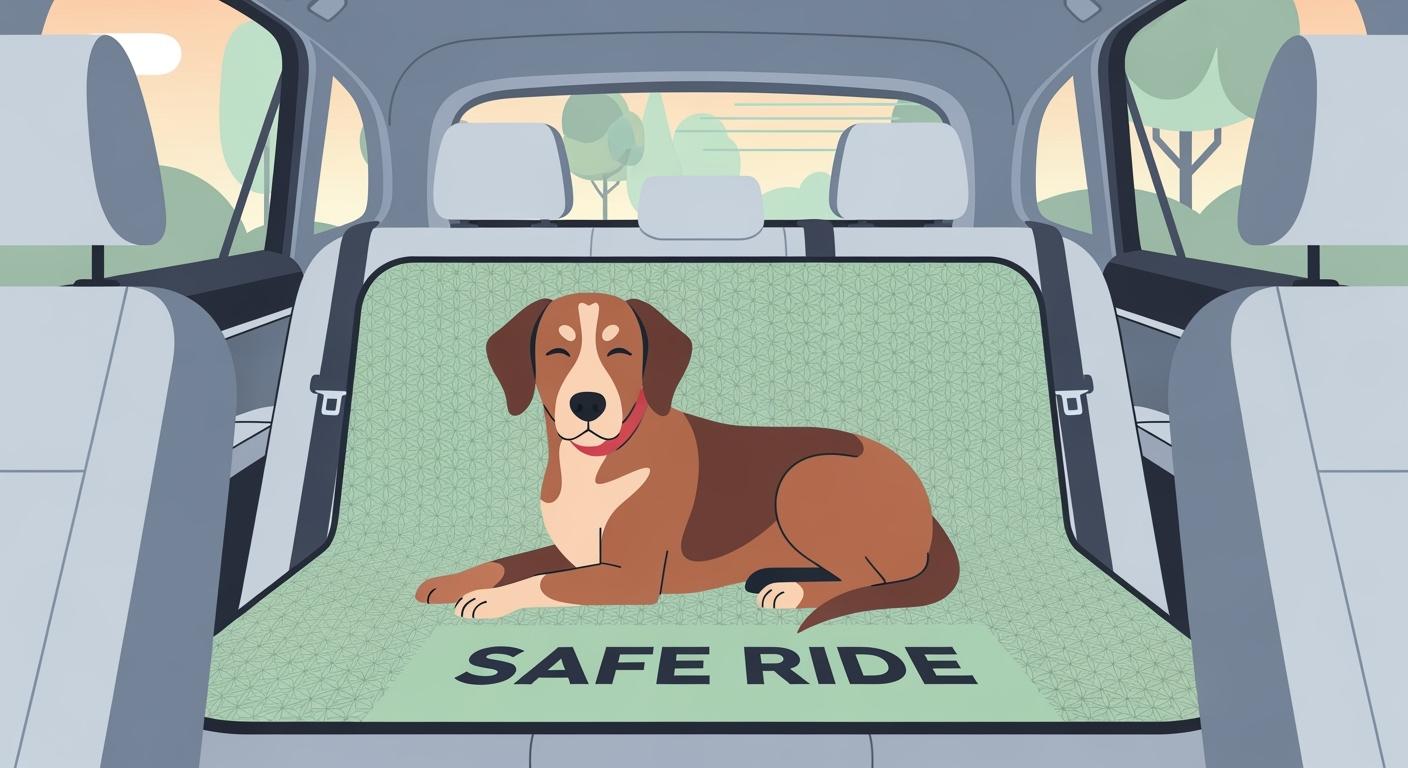
A non slip dog mat for car can grip the seat perfectly and still fail the dog. The backing holds. The mat does not shift. But the dog’s paws slide across the top surface as if nothing is there. Two separate systems are at work — and most mats only solve one of them.
The surface a dog stands on determines whether each paw finds grip or skids. A mat that stays anchored to the seat does half the job. The other half lives in the top layer: texture depth, coating friction, and how the padding responds when compressed under a dog’s weight. When back seat dog cover stability depends on only one of these systems, the dog pays for the gap.
| Design Difference | Why It Matters | Where It Fails |
|---|---|---|
| Backing grip holds the mat to the seat | Prevents the entire cover from shifting during turns and stops | Does nothing for paw-to-surface friction — a stationary mat can still be a slippery mat |
| Top-surface texture gives paws something to push against | Converts lateral paw force into forward stability instead of a slide | Slick coatings and tight-weave synthetics reduce usable friction to near zero when paws are wet |
| Padding density determines whether the surface stays flat under load | Compressed padding creates slack that turns a firm platform into an unstable bowl | Thick memory foam and low-density fill collapse under a standing dog, robbing paws of a predictable surface |
When a Non Slip Dog Mat for Car Still Lets the Dog Slide
Paw Traction vs. Mat Movement
Two independent problems hide inside the phrase “non-slip.” The first is mat-to-seat grip — whether the cover shifts when the car turns. The second is paw-to-mat grip — whether the dog’s feet stay planted on the surface itself. Solving one does not solve the other.
A silicone-backed mat anchors to leather or fabric upholstery and refuses to budge. That is a real design achievement. But the dog standing on top experiences a completely different interface. If the top layer is a tight-woven polyester treated with a water-repellent coating, the coefficient of friction between paw pad and surface drops low enough that lateral force from a turn exceeds it. The paw breaks free. The mat has not moved a millimeter — and the dog is still sliding.
After a 10-minute drive on a route with turns, look at the mat surface. Streak marks where claws dragged, patches of bunched fabric, or visible slide trails all point to the same cause: the top layer is the failure point, not the backing.
Real-World Signs of Sliding
A dog that cannot trust its footing telegraphs the problem. It braces with claws before the car moves. It hesitates to lie down, standing stiff-legged through the entire trip. During deceleration, it scrambles — rear legs splaying outward, front paws reaching for purchase that is not there. Wet paws after a walk or a rainy pickup amplify every weakness in surface texture because water acts as a lubricant between pad and fabric.
These signs show up most on smooth-coated seats and dense-weave covers. A dog that normally settles within the first mile of a drive but stays upright and rigid through the whole trip is probably fighting a surface it cannot grip.
How This Differs from Other Mat Issues
Bunching fabric and curling edges trace back to fit problems or weak anchor points. The mat physically moves out of position. Surface slip is different. The mat stays flat, the anchors hold, the seat underneath stays protected — and the dog still cannot keep its footing. Cleaning off dirt or fur will not restore grip to a surface that was slick from the start. The fix is not maintenance. It is surface design.
Why Top-Surface Grip Fails Before the Backing Does on a Dog Seat Protector
Slick Coatings and Smooth Fabrics
Waterproofing creates a tradeoff that most dog seat protectors do not manage well. A polyurethane or TPU coating seals the fabric against moisture, urine, and mud. That same coating fills in whatever surface texture the base fabric had. What was once a woven nylon with microscopic peaks and valleys becomes a near-continuous film. Paws meet film. Film offers nothing to push against.
Tightly woven polyester and ballistic nylon add their own version of the problem. These materials resist fur embedding and wipe clean in seconds — real advantages in a vehicle. But the dense, flat weave also means fewer surface irregularities for a paw pad to engage. The result is a mat that cleans easily and slides easily, often on the same day. A dog seat cover for back seat that prioritizes waterproofing without addressing surface friction will protect the upholstery and compromise the dog’s footing in a single design decision.
Soft Padding and Compression
Padding looks like comfort. Under a standing dog, it can become the opposite. When a 60-pound dog plants its weight on a thick foam layer, the material compresses. The surface that was flat and taut a moment ago now dips and slopes. That deformation does two things at once: it reduces the contact area between paw and mat, and it changes the angle at which the paw meets the surface.
The physics is straightforward. A paw pushing laterally against a flat, firm surface transfers force into forward stability. That same paw pushing against a surface that is collapsing under load transfers some of that force into further deforming the padding — the energy that should anchor the dog instead sinks into the foam. The dog feels the surface giving way and braces harder, which compresses the padding further. This feedback loop ends with the dog sliding.
A quick check: press your palm into the center of the mat with roughly the force of a dog’s weight. If the surface indents more than a quarter-inch, the padding is doing more to destabilize than to comfort. High-density foam with a thin profile — under half an inch — tends to resist this compression cycle better than thick memory-style padding, which was designed to conform and stay conformed, not to rebound under repeated lateral load. That distinction between soft vs hard bottom daily drives changes how a dog experiences every turn.
Underside Grip vs. Surface Slip
The underside of a well-designed mat uses silicone nubs, suction cups, or high-friction rubber to lock onto the seat. These features perform. They resist the forward inertia of a braking event and the lateral forces of a turn. The mat stays put.
But the dog is not attached to the underside. It is attached — through its paws — to the top. And the top layer on many protectors is the same microfiber or smooth polyester chosen for easy cleaning and a soft hand feel. Soft to the touch. Slick under a loaded paw. The gap between these two surface behaviors is where the “non-slip” claim breaks down. A material choice that works for a booster seat with raised sides and a contained space may fail on a flat bench cover where the dog has nothing else to brace against.
What Design Features Create Stable Paw Contact on a Car Seat Cover
Surface Texture That Works Under Load
A useful top surface gives a paw something to engage — not deep enough to trap dirt, but deliberate enough to create friction under lateral force. Lightly embossed patterns, micro-ribbing, or a matte-finish fabric with an open weave all increase the contact friction without turning the mat into a dirt magnet. Eco-leather with a textured grain can hit this balance: hair sits on top for easy wiping, but the surface grain provides enough irregularity for a paw pad to find grip, even after rain.
The test is not how the surface feels to a human hand at rest. It is whether a loaded paw, pushing sideways, meets enough resistance to stop. A surface that feels “grippy” to the touch can still fail under a wet paw if the texture depth is too shallow to displace water. Check after a drive in the rain: if the mat shows slide marks following the direction of turns, the texture did not clear water fast enough to let the pad reach the surface underneath.
Moderate Padding and a Stable Base
The padding layer should cushion without collapsing. A high-density foam under half an inch thick, bonded to a rigid or semi-rigid base panel, keeps the surface predictable. The dog’s weight distributes across the foam without creating a depression deep enough to change paw angle. A seat cover that lays flat and resists bunching under shifting weight depends as much on this base stability as on the anchor system.
Seat anchors and adjustable straps hold the mat in position relative to the vehicle. A non-slip backing holds it relative to the seat surface. But the base panel — whether rigid plastic, dense board, or a structured foam composite — holds the surface flat relative to the dog. Remove any one of these three, and stability degrades. A mat with strong anchors and a grippy backing but no structural base will still cup and sag under the dog, concentrating pressure at the edges and leaving the center soft.
Anchor Support and Usable Coverage
Anchors that wrap around the seat base or clip to headrest posts keep the cover from drifting. But coverage area matters just as much. If the mat does not extend far enough to cover the full zone the dog uses, the dog will step off the textured surface onto exposed upholstery — often slick leather or smooth fabric — with every weight shift. That partial coverage turns the car seat into a patchwork of grippable and un-grippable zones, and the dog learns to distrust all of it.
Tip: After installing a seat cover, run your hand across the full surface with downward pressure. Any spot that feels softer than the surrounding area — or that dips when you lean into it — will amplify under a standing dog. That is where footing will fail first.
Where a Dog Car Seat Cover Works and Where It Does Not
A textured, moderate-padding seat cover solves a specific set of problems. It gives a dog that stands, turns, or shifts during drives a stable platform. It works on smooth rear bench seats where the alternative is direct contact with slick leather. It handles daily use after walks, park visits, and wet-weather pickups — conditions where paw traction matters most.
It is not a substitute for crash protection. No seat cover alone restrains a dog during a collision; that requires a separate harness and tether system. It is not the right tool for a dog that moves heavily across the full rear seat without any restraint, or for a vehicle seat with a contour so curved the mat cannot lie flat. Dogs that need raised side containment — the kind a hammock or cargo barrier provides — will not get that from a flat bench cover.
Hard-bottom covers create a stable platform that resists sagging. Soft-bottom covers, even with good anchors, tend to form a hammock-like depression under the dog’s weight. That depression changes paw angle, reduces contact area, and makes every turn feel less certain underfoot. For dogs that already show anxiety during car rides — panting, pacing, refusal to settle — the difference between a firm surface and a soft one can determine whether the dog stands rigid for the entire trip or lies down after the first mile.
Disclaimer: The surface-stability checks described here assume a short-coated dog with dry paws on a correctly installed cover. Double-coated breeds or dogs with heavy feathering on the paws may show subtler traction loss that requires hand-checking the mat surface for slide marks rather than relying on visual paw placement alone. Dogs with barrel chests or very deep keels distribute weight differently across the seat, which can change how padding compresses — the quarter-inch deflection check may not catch every instability for these body types.
Maintaining traction means in-car protection and cleanliness working together — a surface that sheds dirt without becoming slick, padding that cushions without collapsing, and anchors that hold position through every stop and turn. When those three layers work as one system, the dog gets a surface it can trust. When any one of them is missing, the mat stays put and the dog still slides.
FAQ
Why does my dog slide on a mat that is labeled non-slip?
The “non-slip” label on most dog car mats refers to the backing — the layer that grips the vehicle seat. It does not describe the top surface your dog stands on. If that top layer is a smooth polyester or coated fabric, the backing can hold perfectly while paws still skate across the top. Two different grip problems, one label.
How can I tell if the top surface is the problem and not the fit?
Park on level ground. Press your palm flat on the mat and push sideways with about 20 pounds of force. If your hand slides before the mat moves, the top surface is the weak point. If the mat shifts under your hand before your hand slips, the backing or anchors need attention. Run this check wet — dampen your palm first — to simulate the worst-case scenario after a rainy walk.
Does padding thickness help or hurt stability?
Thick padding tends to hurt stability. It compresses unevenly under a standing dog, creating slopes and soft spots that reduce paw contact area. A thin layer of high-density foam — under half an inch — cushions without deforming enough to change how the paw meets the surface. The dog stays level, and the surface stays predictable.
What is the single most important design feature for paw grip?
Surface texture depth that can displace water. A textured top layer with enough relief to let moisture channel away from the paw pad keeps friction available even when the dog climbs in wet. Without that, a waterproof coating plus wet paws equals near-zero grip — no matter how well the backing holds.






