
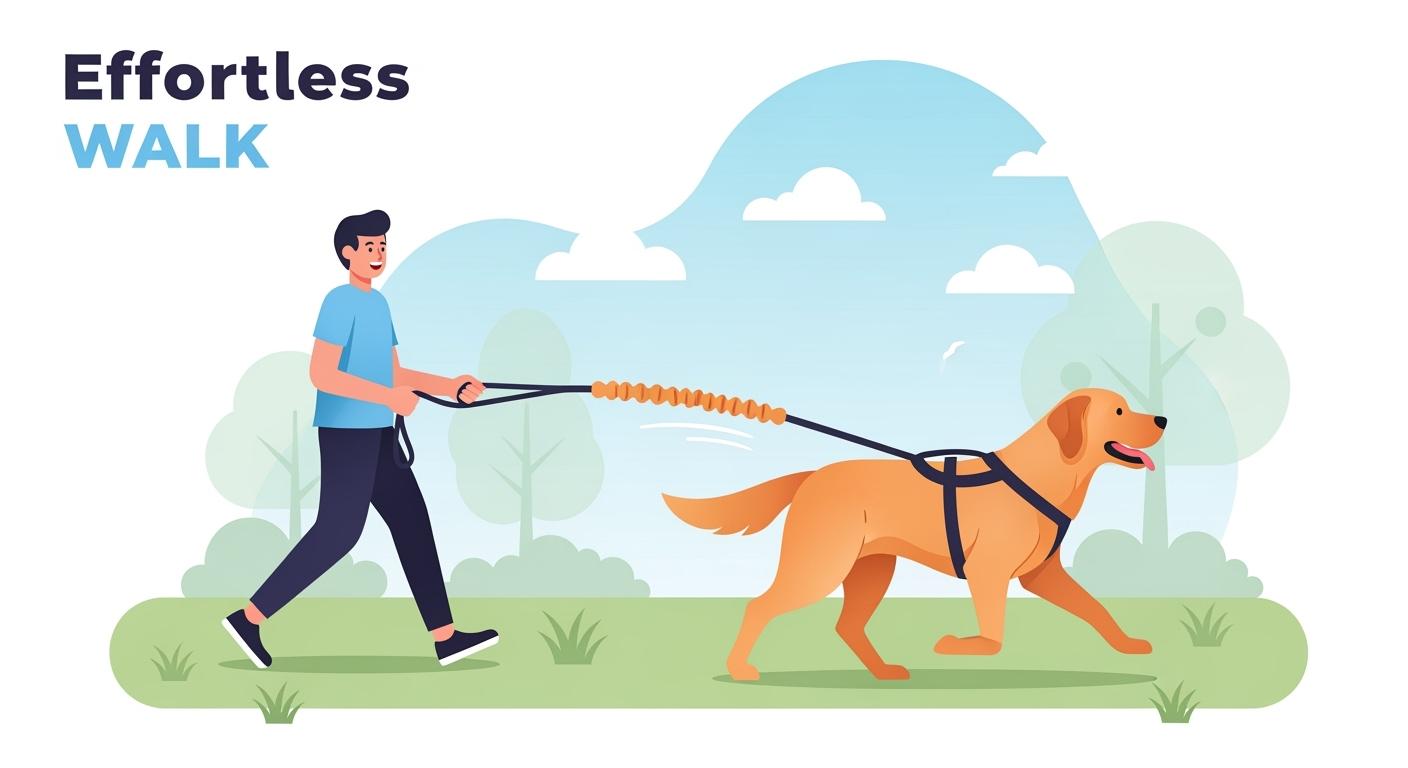
Walking a large dog means managing mass. A 70-pound body accelerating from standstill to full stride in half a second generates a force spike that travels straight up the leash into your shoulder, elbow, and wrist. A standard nylon leash transmits that spike almost unchanged. Nylon webbing has negligible elongation at the loads a large dog produces.
A bungee leash for large dogs works differently. The elastic section stretches as load rises, spreading the force peak across more milliseconds. The same total impulse reaches your hand, but the peak is lower. It is the same principle that makes airbags work: increase the deceleration distance, reduce the peak deceleration.
The design question is not whether stretch helps. It helps. The question is how much stretch, under what conditions, and whether the rest of the leash is built to handle what a large dog can generate.
Why Large Dogs Turn Normal Moments Into High-Force Events
Mass, Momentum, and the Leash as a Force Conduit
The physics is unforgiving. Force equals mass times acceleration. A large dog carries more mass. When that mass accelerates suddenly — at a squirrel or another dog or a doorbell — the force on the leash spikes before your muscles can recruit to brace. Steady pulling is a constant load you can lean against. Sudden-lunge shock is a transient peak that hits faster than human reaction time.
The leash is the only link in that chain you can change. A non-stretch leash passes the spike straight through. A bungee section lengthens the rise time. That difference in rise time is what separates a walk you recover from and a walk that leaves your shoulder aching.
Dogs absorb the mirror image of that force. On a collar, it concentrates at the trachea. On a harness, it distributes across the chest. Either way, the leash design determines how much of the dog’s own momentum snaps back into its body. This is why the same principles that apply to keeping a large dog under control on walks start with understanding what happens between the clip and your hand.
The Real Problem Is Not Pulling. It Is the Spike.
Chronic low-grade pulling irritates. A single sharp lunge injures. The distinction matters because the design solutions are different. A front-clip harness addresses steady pulling by redirecting momentum. A bungee section addresses the spike by capping peak force.
Most large dogs are not constant pullers. They walk calmly and then something triggers them. One lunge per walk. Two. The handler braces for the whole walk anticipating those moments. The bungee section removes the need to brace, because the worst-case force never materializes.
Walk your dog for 10 minutes on a standard leash, then switch to a bungee. Notice whether your shoulder stays relaxed through the transition. If you were unconsciously tensing against anticipated jerks on the standard leash, and that tension disappears on the bungee, the elastic is doing its job.
How Controlled Elastic Stretch Softens Impact Without Giving Up Control
The Elastic Section as a Mechanical Buffer
Elastic stores energy on the way out and returns it on the way back. This is both the mechanism and the risk. A bungee section that is too long or too soft lets the dog build distance before reaching the stretch limit. That distance is time. In a busy street or near an aggressive dog, a half-second of extra movement can matter.
The design target is controlled stretch: enough elongation to cap the force peak without letting the dog drift more than roughly a foot beyond the leash’s resting length. This is a production-calibration decision. The elastic insert is cut to a specific length and durometer rating. Cut it too long or spec it too soft and the leash becomes a delayed-response system instead of a shock buffer.
The tradeoff between shock absorption and response speed is the central tension in balancing comfort and control across different walking conditions. On an open trail, you bias toward absorption. On a city sidewalk, you bias toward speed. A leash that only does one fails at the other.
When the Stretch Works With You
Open routes, steady jogging, predictable paths. These are where a bungee leash earns its place. The dog moves within a consistent range and the elastic handles the small variations without the constant micro-jerking that makes a standard leash tiring to hold for miles.
Jogging amplifies the benefit. When both you and the dog are in motion, pace changes happen frequently. A slight hesitation from the dog, a slight acceleration from you — on a standard leash these become sharp tugs. On a bungee, the elastic absorbs the differential. The result is a smoother rhythm for both runners.
When the Stretch Works Against You
Crowded sidewalks, narrow paths, anywhere with close vehicle traffic. Here you need the leash to transmit your hand movement to the dog instantly. Any stretch becomes a control gap.
This is why a traffic grip matters as a design feature, not an accessory. A short fixed loop positioned close to the clip end bypasses the bungee section entirely. Grab the traffic grip and the leash behaves like a standard non-stretch lead. Release it and the elastic re-engages. The transition takes less than a second and requires no hardware adjustment.
The design question to ask is whether the leash lets you switch between shock absorption and direct control without stopping. A fixed handle plus a reachable traffic grip is the minimum viable answer.
In practice: After a walk, check how often you used the traffic grip versus the main handle. If you never reached for the traffic grip, your walking environment may not demand it. If you used it more than the main handle, a standard non-stretch leash may fit your routes better.
What Holds Up: Stitching, Hardware, and the Handle You Actually Grip
Stitching That Survives Cyclic Loading
A bungee leash sees a loading pattern that is different from a standard leash. It is not steady tension. It is cyclic peak loading — stretch, relax, stretch, relax — thousands of times over the leash’s life. Each cycle stresses the stitch lines where the elastic section meets the non-stretch webbing.
Box stitching and bar-tack stitching spread load across multiple rows in multiple directions. A single row of straight stitching at a webbing junction concentrates stress along one line. Under repeated cycling, the threads at the highest-stress point fail first, then the failure propagates across the row. Bar-tack patterns delay this progression because no single thread carries the full load.
This is a manufacturing-cost decision. Bar-tack and box-stitch machines run slower and cost more per unit than straight-stitch machines. A reflective bungee leash built with controlled stretch that uses reinforced stitching at the elastic junction has a predictable service life. One that skips this step does not.
Spread the webbing flat at the elastic junction after a month of use. Look for pulled threads, uneven stitch spacing, or any row where the thread appears thinner than its neighbors. Those are early signals that the stitch pattern is not distributing load evenly. The same inspection logic applies as when examining how fit and sizing checks affect everyday walk control: catch the small drift before it becomes a failure.
Clips, Webbing Width, and Wet-Weather Grip
A 360-degree rotating clip prevents the leash from twisting into a cord under tension. When a non-rotating clip lets the webbing wind up, the twisted section shortens the effective leash length and concentrates force into a narrow band that digs into your hand. The rotation keeps the clip gate oriented correctly under load, reducing the chance of a gate popping open under side torque.
Wide webbing is not about comfort alone. Narrow webbing under high tension concentrates force into a small contact area. If it slides through your grip during a lunge, the friction heat builds fast. Wide webbing spreads the same force across more square inches of palm, which reduces both pressure and slide speed.
Handle material matters most when it is wet. Nylon webbing handles turn slick in rain. Biothane or rubber-overmolded grips stay usable. If your hand slips on the handle during a sudden pull, the entire shock-absorption design is bypassed — because you are no longer holding the leash. For a deeper look at how material choices change the feel and lifespan of a bungee leash, the webbing width and handle coating matter as much as the elastic section itself.
Test this yourself: after a rainy walk, grip the handle with a wet hand and pull sharply. If it slides more than half an inch before your grip locks, that handle material is a liability for large-dog use.
What to Avoid
Overly long elastic sections that let the dog build too much distance before the stretch limit engages. Weak clips with no rotation lock that can twist open under side load. Narrow webbing handles that go slick in rain. These are not hypothetical failure modes. They are predictable outcomes of design decisions that prioritize low unit cost over the actual loads a large dog generates. Before buying, common mistakes owners make when switching to a bungee leash typically start with choosing stretch length based on comfort rather than control requirements.
Where the Design Delivers — and Where It Does Not
Environments and Dogs That Fit the Bungee Profile
A bungee leash for large dogs fits best on open routes: neighborhood sidewalks with good visibility, park trails, fire roads, beach paths. Places where you can see a distraction coming and the dog has room to move without immediate consequences.
The dog profile that benefits most: large breeds that walk calmly the majority of the time but have occasional excitement surges. A lab that lunges once per walk at a squirrel. A shepherd that pulls hard for the first three minutes and then settles into a loose leash. For these dogs, the bungee section absorbs the exceptions without punishing the handler during the normal stretches.
When a Standard Leash Is the Safer Tool
If your dog lunges hard and frequently — multiple times per walk, at high intensity, toward triggers you cannot always predict — a bungee leash may reduce the shock per incident but increase the total number of incidents. The softer feedback from the elastic makes it harder for the dog to learn where the boundary is. Consistent, immediate feedback is what shapes loose-leash walking. A bungee section blunts that feedback.
Crowded urban environments, narrow sidewalks, and anywhere with close vehicle traffic also favor a non-stretch leash. When the margin for error is measured in feet, even a controlled stretch introduces an unwanted variable.
Walk the dog in your normal environment with the bungee leash for a full week. Count the number of times you had to grab the traffic grip to prevent a near-miss. If that number exceeds the number of times the bungee section noticeably reduced a jolt, a standard leash is the better match for your routes.
Disclaimer: The fit and control checks described here assume a dog within typical large-breed body proportions. Dogs with unusually thick necks, very deep chests, or brachycephalic builds may respond differently to bungee-leash force dynamics. If your dog has a known neck, tracheal, or spinal condition, consult your veterinarian before switching leash types. The shock reduction described here may not be sufficient to protect a compromised structure, and in some cases the stretch-recoil cycle can introduce repetitive micro-movement that a rigid leash would avoid entirely.
A bungee leash for large dogs does not eliminate pulling. It caps peak force so that the pulling your dog already does reaches your body as a push rather than a hit. Controlled elastic stretch, reinforced stitching at the stretch junctions, a rotating clip, wide webbing, a weather-reliable handle, and a traffic grip within instant reach — these are the design features that separate a tool from a toy. Match the leash to the environment and the dog’s pull pattern, and the walk changes. Mismatch them, and the bungee becomes another variable you are managing instead of a solution you can trust.
FAQ
Can a bungee leash be used for loose-leash training?
A bungee leash can work for reinforcing an already-established loose leash during steady walks, but it is not the right tool for teaching the skill from scratch. Loose-leash training depends on the dog feeling a clear, immediate consequence the moment the leash goes taut. A bungee section softens that moment, which blurs the feedback the dog needs to connect the tension to the correction. If training is the primary goal, start with a standard non-stretch leash and introduce the bungee later for maintenance walks.
How do you clean and inspect a bungee leash?
Hand wash with mild soap and cool water. Avoid machine washing — the agitation and spin cycle can overstretch the elastic section and degrade its recovery properties. Air dry away from direct sunlight, since UV exposure accelerates elastic breakdown. Inspect the stitching at both ends of the elastic section before each walk, and check the clip gate for smooth rotation and full closure. Replace the leash if the elastic section shows permanent elongation: if it stays stretched even when not under load, the shock-absorption function is compromised.
What length bungee leash works best for large dogs?
For large dogs, a resting length of roughly 4 to 5 feet with a stretch extension to about 5.5 to 6.5 feet keeps the dog within a manageable radius on most walks. Longer leashes let the dog build more momentum before the stretch engages, which increases the peak force the elastic must absorb. Shorter leashes limit the dog’s movement too much for anything beyond heel-walking. The right length depends more on your walking environment than on the dog’s size alone — open trails can use the full extension, while mixed urban routes benefit from a length that keeps the dog within quick reach even at full stretch.






