
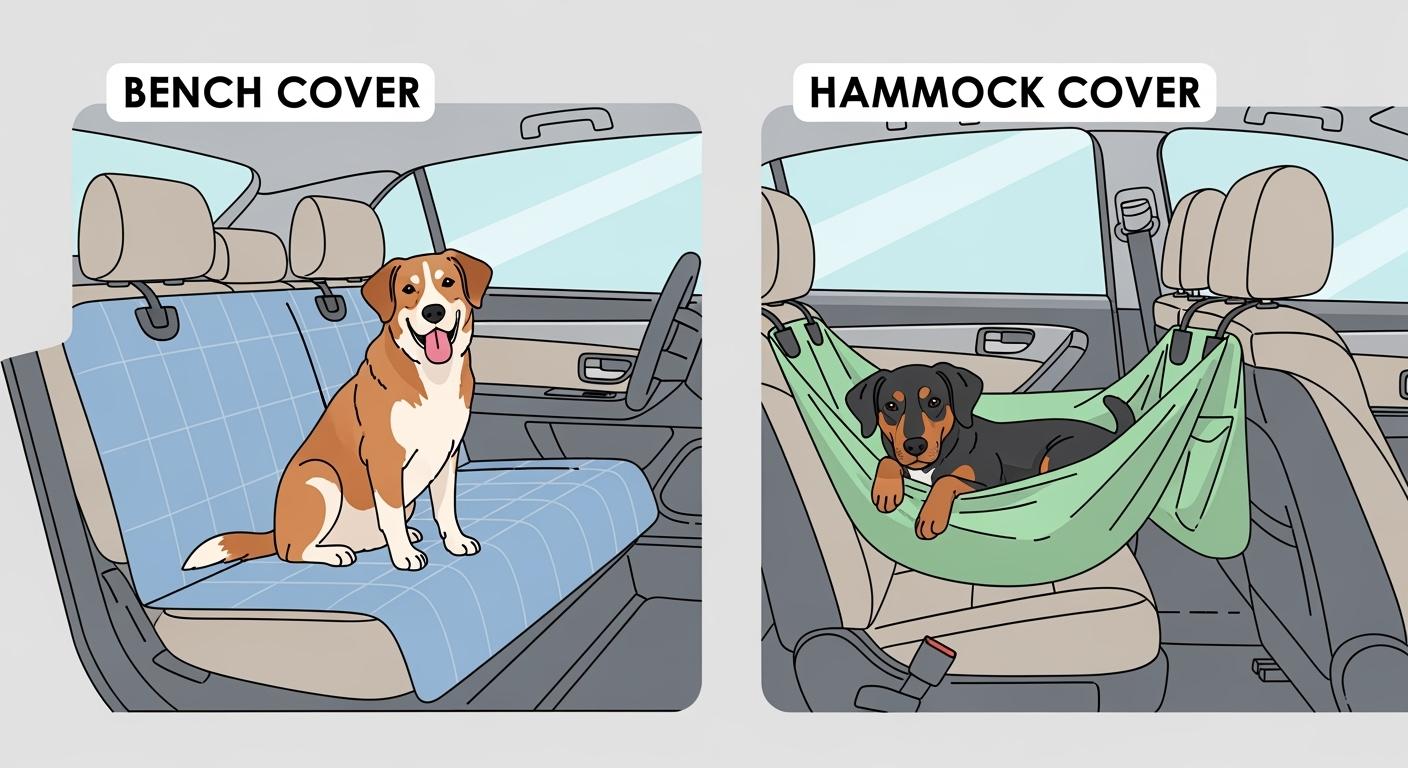
Choosing between a bench-style dog car seat cover and a hammock-style cover usually comes down to how your rear seat is used. A bench cover can make more sense when people still need to sit in the back, seat buckles must stay easy to reach, or you switch the cover in and out often. A hammock cover can offer fuller coverage when a dog moves forward, drops muddy paws into the footwell, sheds heavily, or makes cleanup harder after messy rides. Either style can protect the seat surface and help with cleaning, but it does not replace a proper restraint for keeping the dog secured in the car.
Key Takeaways
- Pick a hammock for active dogs or messy rides. Pick a bench for shared seating, easy buckle access, and flexible daily use.
- Check the fit before you buy. A flat, snug cover with easy buckle access gives your dog more comfort, better grip, and less sliding.
- Use the cover for protection and cleanup. Use a crash-tested harness or carrier for safety, because a cover does not replace restraint.
Car Seat Cover Dog Fit and Stability
A good fit does three jobs right away. It covers the seat well. It stays tight during normal driving. It gives your dog stable footing for standing, turning, and settling. If any one of those checks fails, your cover will feel less useful on every trip.
Before you buy, do a quick fit check on your rear seat:
- Measure the bench width from door side to door side.
- Check the depth from the seat edge to the seat crease.
- Look at the headrests. Count how many you can use for straps.
- Find the buckle points. Make sure you can still reach them.
- Locate lower anchors or LATCH points if you use them.
- Note any seat gaps, raised bolsters, or split-fold seams.
This quick review helps you avoid the most common fit problems. Those problems include bunching fabric, open side gaps, and covers that slide when your dog shifts weight.
Tip: Universal fit wording sounds helpful. Actual seat shape matters more. A cover that matches your seat and stays flat will usually work better than a loose cover with extra material.
Bench vs Hammock Coverage
Bench covers protect the seat bottom and usually the seatback. They work well when you want easier access to the full rear bench. They also make more sense if you share the seat with people, child gear, or other cargo.
Hammock covers add a front panel that spans between the front and rear headrests. That extra panel improves coverage in the footwell zone and helps block your dog from slipping forward. For many dogs, that means better travel containment and less chance of stepping into the rear floor area during a sudden stop.
Here is the simple fit difference:
- A bench cover gives you a more open layout.
- A hammock gives you more enclosed coverage.
- A bench often makes buckle reach easier.
- A hammock usually protects more surfaces.
Your best choice depends on how your dog rides. A calm dog that stays put may do well on a bench layout. A dog that paces, turns often, or tries to move into the front area often does better with a hammock.
A good car seat cover dog setup should sit flat across the bench. You should not see side gaps near the doors, loose folds at the seat crease, or corners that pull out of place when your dog shifts weight.
Seat-Belt and Anchor Access
Access matters more than many buyers expect. If buckle points disappear under fabric, daily use gets frustrating fast. The same problem can affect lower anchor areas or tether access points in the rear seat.
Bench designs often make buckle access easier because they use a less enclosing layout. Hammock designs can still work well, but only if the buckle openings stay aligned after you tighten the straps. The best designs leave access points visible and reachable instead of burying them under folds.
Use this installation routine after purchase:
- Attach the headrest straps first.
- Insert the seat anchors deep into the seat crease.
- Smooth the top surface by hand.
- Tighten each strap until the cover lies flat.
- Open and test each buckle slot.
- Check that anchor areas remain reachable if you need them.
- Press down on the seat and tug the cover lightly to check movement.
After installation, do a simple tug check near the seat crease and buckle openings. The cover should stay flat and return to place instead of lifting, wrinkling, or drifting. This does not make the cover a restraint. It only helps you judge whether the fit is stable enough for normal driving use.
Look for secure attachment systems that use more than one hold point. Adjustable headrest straps, seat anchors placed between cushions, and durable clips help limit sliding. A stable layout also keeps buckle openings in place instead of pulling them out of line.
Note: Easy buckle or anchor access is a design benefit. It does not prove crash performance. Your pet still needs a proper restraint in the back seat and should never ride on your lap.
Stable Comfort for Dogs
Your dog feels the surface more than you do. Soft padding alone does not guarantee comfort. Grip, noise, heat retention, and tension all shape how secure the surface feels.
When your dog stands up, turns around, or settles down, watch for these signs:
- paws slide during small movements
- fabric bunches under weight
- the rear edge lifts up
- your dog braces too hard to stay stable
- your dog avoids lying down
A stable surface usually includes a rubberized or mesh-style non-slip backing. That backing adds traction against the vehicle seat. Seat anchors help hold the center in place. Tight straps help stop drift across the bench. Together, those details reduce slipping for your dog and reduce shifting for the cover.
Material build matters too. A dense, supportive layer can help the cover keep its shape and resist compression. Very squishy padding can create slack. Slack can make footing less stable. A thinner dense build often fits better than an overly thick protector that floats above the seat contours.
Hammock layouts also help many dogs feel more supported because the front panel acts as a barrier. Some dogs relax faster when they can see you through a mesh window, though the main comfort test is still simple: can your dog stand, turn, and lie down without sliding?
If your dog seems uneasy, test the basics first:
- Retighten the straps.
- Reinsert the anchors.
- Smooth out folds near the seat crease.
- Check the underside grip.
- Make sure the size matches your bench.
A properly fitted car seat cover dog choice should feel stable on real drives, not just in your driveway. If the cover slides in routine turns or under gentle braking, your dog will feel that instability quickly. That usually means you need more grip, better tension, or a different shape.
Fit Comparison Table
| Fit factor | Bench cover | Hammock cover | Best use case |
|---|---|---|---|
| Seat coverage | Covers seat bottom and seatback well | Covers seat bottom, seatback, and front gap area more fully | Choose hammock if you want broader surface protection |
| Side-gap control | Depends heavily on seat shape and width match | Often better because the enclosed shape limits open areas | Choose the style that stays flat at the edges |
| Buckle access | Usually easier to reach | Good only when openings stay aligned after install | Choose bench if buckle reach is your top priority |
| Anchor access | Often simpler around seat crease zones | Can work well if cutouts stay clear and reachable | Check your exact seat layout before buying |
| Install tension | Can stay neat with tight straps and good anchors | Often feels more planted because of extra attachment points | Choose the one that stays tight without sagging |
| Dog stability | Good for calm dogs that settle quickly | Better for dogs that pace or move forward | Choose hammock for active riders |
| Footwell protection | Limited | Stronger because the front panel helps block drop-through | Choose hammock for better containment |
| Shared seating flexibility | Better for mixed human and dog use | Less flexible because it encloses more space | Choose bench for shared back-seat use |
Pass/Fail Fit Checklist
Use this table after installation. If you see more fail signs than pass signs, adjust the cover or try a different size or style.
| Check Item | Pass Signal | Fail Signal | Solution |
|---|---|---|---|
| Seat coverage | All main seat surfaces are covered and edges sit flat | Side gaps, exposed corners, or bunched fabric appear | Reposition the cover, tighten straps, or try a better size |
| Anchor tension | Cover stays flat and resists movement during a light tug test | Cover slides, lifts, or wrinkles at the seat crease | Retighten straps, reinsert anchors, and smooth the surface |
| Seat-belt access | Buckles stay visible and easy to use | Buckles hide under fabric or feel hard to reach | Realign the openings and check strap tension |
| Dog comfort | Your dog stands, turns, and settles without slipping | Your dog hesitates, braces, or keeps losing footing | Improve grip, remove slack, or switch styles |
| Surface grip | Paws stay planted during normal turns and stops | Top surface feels slick and unstable | Check backing grip and cover tension |
| Overall stability | Cover stays in place on short real-world drives | Cover shifts, bunches, or slides during travel | Reinstall fully or move to a more secure design |
A final buying rule can save you time: if the cover leaves bunching, side gaps, or sliding after a correct install, treat that result as a fail. Do not assume the problem will fix itself after more use. The right car seat cover dog option should fit your seat shape, support your dog’s movement, and stay neat every day.
Best Dog Car Seat Covers: Materials and Cleanup
Surface Grip and Easy Cleaning
You want a cover that handles fur, dirt, and damp paws without becoming slick or hard to clean. Durable woven fabrics with a water-resistant face are easier to wipe down after routine trips. Machine-washable construction or removable panels can also save time, especially if your dog rides often.
Mess Zones and Seam Protection
Most mess gathers on the top surface, but seams, flap edges, and anchor openings often hold the dirt longest. Check those areas after muddy or wet trips. A cover that dries cleanly and keeps its shape after washing is usually easier to live with than one that stays damp or puckers at the corners.
Non-Slip Backing and Anchor Hold
A non-slip backing helps the cover stay planted against the seat. Rubberized dots, textured backing, seat anchors, and tight headrest straps all work together to reduce bunching and drift. A planted surface also gives your dog steadier footing when standing up or turning around.
Waterproofing and Durability
Water resistance matters when your dog tracks in water, mud, or wet fur. A cover should slow leaks, protect the seat surface, and still dry out fully after cleaning. Strong stitching and a stable top layer usually matter just as much as the waterproof claim on the package.
Troubleshooting Table
| Fault Symptom | Possible Cause | Quick Check | Solution |
|---|---|---|---|
| Cover traps smell or dries slowly | Material not quick-drying | Smell or dampness after cleaning | Wash often and pick covers that dry fast |
| Cover loses shape after washing | Weak seams or bad material | Wrinkles or sagging | Choose covers with strong seams |
| Cover bunches or slides | Loose fit or weak anchors | Shifting during use | Tighten straps and check anchor spots |
Dog Car Seats, Pet Car Safety, and Choosing the Right Setup
Daily Use, Muddy Trips, and Shared Cars
You use your car for many reasons. Sometimes you drive your pet to the park. Other times you pick up groceries or give rides to family. Your choice of dog car seats and covers should match your daily routine.
- Bench-style covers work best if you often carry children, pets, and shopping bags. These covers lay flat and let you use seatbelts for people or pet harnesses. You can protect your seats from dirt and fur while still making room for passengers.
- Hammock-style covers help most when you travel alone with your pet. They block the footwell and keep your pet from falling forward. If you take your dog on muddy hikes or messy adventures, a hammock cover gives you more protection.
- Shared cars need flexible solutions. Bench covers make it easy to switch between pet trips and family rides. You can remove or fold them quickly.
Think about your main car use. If you drive with both people and pets, a bench cover gives you more options. If you want to keep mud and hair off the floor, a hammock works better.
Bench vs Hammock vs Restraint-Compatible
You have three main choices for dog car seats and covers. Each one fits a different need.
- Bench covers suit families and shared vehicles. You get easy access to seatbelts and anchors. You can buckle in children, groceries, or a properly restrained pet.
- Hammock covers work well for solo pet travel. They create a barrier that keeps your pet in the back seat. They also protect the back of the front seats and the floor.
- Restraint-compatible setups focus on pet car safety. These covers use buckle or tether openings so you can add a separate restraint without covering the access point. Always check that the cover lies flat and does not interfere with the system you use.
Seat covers protect the upholstery and help with cleanup, but they do not hold your dog in place by themselves. Use a separate restraint or carrier that matches your travel setup, and make sure the cover does not block buckle access or anchor points.
Tip: Choose a cover that matches your travel style and your pet’s behavior. Make sure it works with your restraint system.
Common Mistakes to Avoid
Many buyers make the same errors when picking dog car seats or covers. You can avoid these problems by checking a few key points.
- Picking the wrong size. A cover that does not fit your seat will bunch up or slide. This makes travel less safe and less comfortable for your pet.
- Skipping the harness. Using only a collar or letting your pet ride loose can cause injury. Always use a crash-tested harness or carrier.
- Poor installation. Loose straps or anchors let the cover move around. This reduces protection and can distract you while driving.
- Ignoring your pet’s behavior. Some pets need time to adjust to new covers or seats. Do not force your pet to use a new setup right away.
- Not cleaning the seat. Dirt and fur build up fast. Clean your cover and seat often to avoid odor and keep your pet healthy.
- Over-relying on waterproof claims. Not all covers block every spill. Check seams and edges for leaks.
- Ignoring seat shape. Universal covers do not fit every car. Measure your seat before you buy.
- Misunderstanding padding. Thick padding does not always mean more comfort. Look for stable, non-slip surfaces.
Note: Dog car seats and covers help protect your car and your pet, but only proper restraints provide real safety in a crash.
Best Choices for Different Dogs
You want the best setup for your pet. Think about your dog’s size, energy, and travel habits.
| Dog Type or Trip | Best Cover or Seat Choice | Why It Works |
|---|---|---|
| Small, calm dog | Bench cover with harness | Easy access, simple cleaning, and comfort for short trips |
| Large, active dog | Hammock cover with crash-tested harness | Extra containment, more coverage, and better pet car safety |
| Muddy or outdoor trips | Hammock cover | Protects seats and floor from dirt and water |
| Shared family car | Bench cover | Lets you switch between pet and passenger use |
| Long travel | Restraint-compatible cover with separate restraint access | Keeps the seat protected while leaving room for a more controlled long-trip setup |
You can match your cover to your dog’s needs. If your pet moves around a lot, pick a hammock or a cover with side flaps. For short, calm rides, a bench cover may be enough.
Must-Check Features Before Buying
You should always check certain features before you buy a dog car seat cover. These features affect how well the cover protects your car and your pet.
| Must-check feature | How it affects seat cover performance |
|---|---|
| Side flaps | Protect seat edges from claws and help keep your pet from slipping off |
| Washable construction | Makes cleanup after spills or pet accidents much easier |
| Waterproof build | Helps block leaks and keeps moisture from reaching your seat |
| Anchor security | Keeps the cover tight and stable during travel |
| Buckle system | Allows quick setup and removal for cleaning or switching seats |
| Buckle openings | Keeps restraint or seat-belt access usable after installation |
Look for anti-slip backing, adjustable straps, stable anchor points, and clear buckle openings. Washable construction and water-resistant materials also make daily cleanup easier and help the cover stay usable over time.
Safety reminder: a seat cover helps with comfort, containment, and cleanup, but it does not replace a separate restraint or carrier.
- Choose a hammock when containment and fuller coverage matter most.
- Pick a bench cover when flexible access and shared seating matter more.
- You base your decision on your pet’s behavior, car seat layout, and travel needs.
- Use the cover to protect seats and improve day-to-day comfort.
- Use a separate restraint or carrier when safety control matters.
FAQ
Should you choose a hammock or bench cover for a pet that moves a lot?
Choose a hammock if your pet paces, turns, or steps forward during travel. It gives your pet more containment. A bench works better if your pet stays calm.
Do seat covers replace crash-tested restraints for pet safety?
No. Seat covers protect your car, support your pet, and improve cleanup. You still need crash-tested restraints, carriers, or dog car seats for real pet safety.
What should you check before using covers with dog car seats?
Check buckle access, flat fit, dry fabric, and restraint openings. These features help your pet stay comfortable. They also help dog car seats fit without blocked access.






