
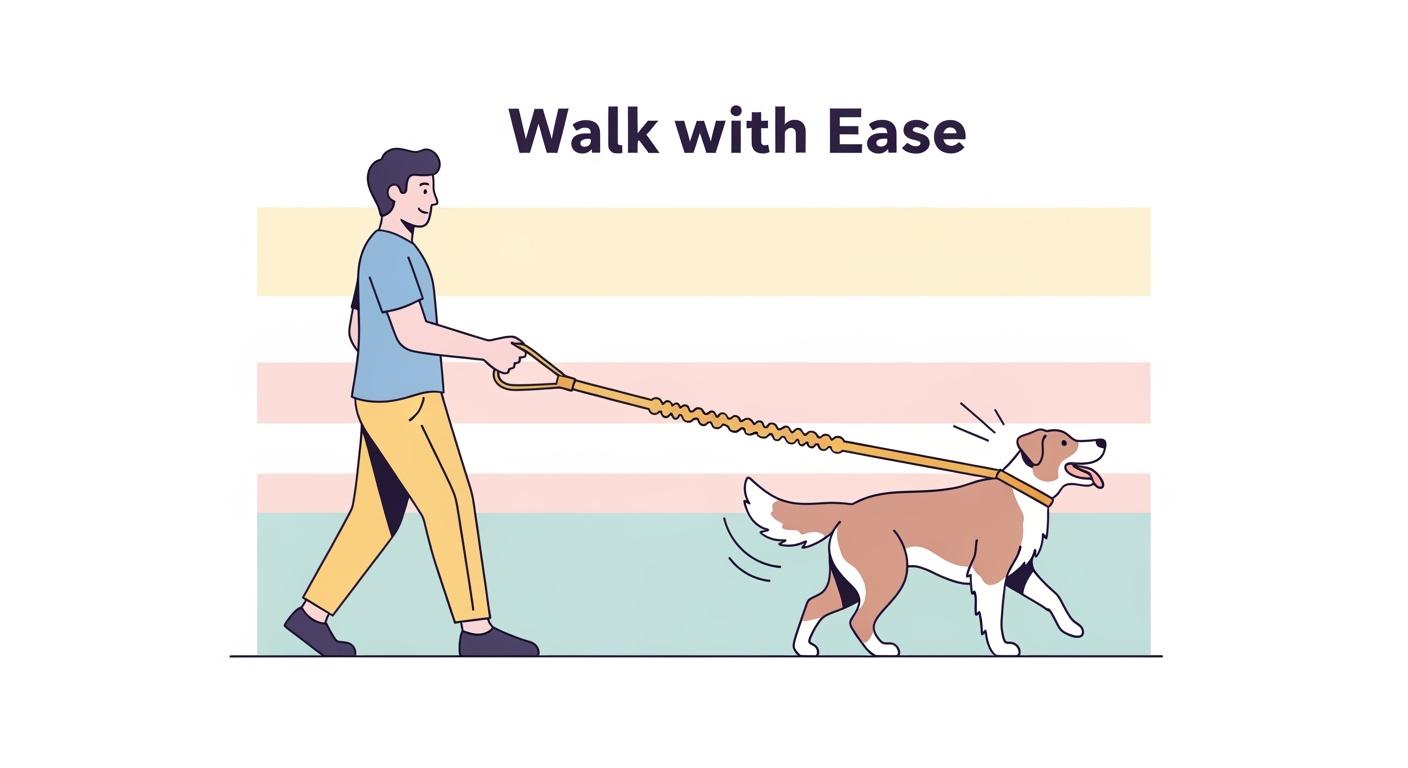
A bungee dog leash can make walks feel smoother, but that same stretch can also delay your response when you need your dog close right now. That is the real tradeoff. The question is not whether bungee feels softer. It is whether the extra give helps your everyday route or works against your control.
This article stays focused on that one decision. It is not a broad leash guide. It helps you judge when stretch improves handling, when it becomes a problem, and which build details matter once the leash starts absorbing real pull instead of just looking comfortable in your hand.
Key Takeaways
- A bungee leash helps most when your dog surges occasionally and you want less jolt through your arm, not when you need the fastest close-distance control.
- Too much stretch can slow your correction at curbs, doorways, crowds, and passing dogs.
- Think about what the leash is made of and what features it has for comfort and strength. Elastic recovery, stitch quality, hardware condition, and easy cleaning matter more than a soft handle alone.
When a Bungee Leash Really Helps
It softens occasional surges
You need to match your leash to your real walking needs. Do not just look at your dog’s size or breed. A bungee section is most useful when your dog is mostly manageable but still makes sudden forward moves. The stretch can reduce sharp jolts through your hand, elbow, and shoulder and make the end of the leash feel less abrupt for the dog too.
It works better on steady routes than chaotic ones
Bungee makes more sense on longer sidewalks, open paths, or mixed-terrain walks where you have some reaction space. It makes less sense when your route keeps forcing instant shortening and precise leash handling. If your walk includes repeated curb checks, busy crosswalks, tight store entrances, or reactive moments, the stretch may start feeling less like comfort and more like delay.
It suits handlers who can manage rebound calmly
A bungee leash does not just stretch. It rebounds. Some handlers like that softer feel. Others find the return motion distracting, especially if the dog changes direction quickly. The right match depends on whether the leash helps you stay smoother or makes your timing less precise.
Tip: A bungee leash should reduce shock without making you feel late to every small correction.
When Stretch Starts to Cost You Control
Busy spaces expose the downside fast
If you need to bring your dog close immediately, stretch works against you. The give in the line means there is a small delay before you get direct control again. That matters most around traffic, crowds, bikes, doorways, and other dogs.
Strong pullers can turn comfort into drift
A strong or reactive dog can keep loading the elastic instead of learning to stay within a predictable leash distance. In that situation, the walk can start feeling springy, inconsistent, and harder to read. You are not just handling forward movement anymore. You are handling stored tension.
Some dogs need clearer feedback than a bungee gives
If your dog responds best to short, direct leash guidance, too much elasticity can blur that feedback. A bungee leash does not replace leash manners, and it is not the best tool for every dog that pulls. It is a conditional comfort feature, not a universal control upgrade.
| Walking Situation | Pass Signal | Fail Signal | Better Direction |
|---|---|---|---|
| Open or moderate space | Stretch softens surges without making handling vague | Dog keeps loading the elastic and drifting out | Reduce stretch or move to a more fixed setup |
| Crowded sidewalks | You can shorten quickly and keep a clear position | You feel late bringing the dog back in | Use a standard leash or fixed short section |
| Passing triggers or distractions | Dog stays readable and you stay ahead of the moment | Rebound and surge make the interaction harder to manage | Choose more direct leash feedback |
| Handler comfort | Less arm jolt without losing confidence | Walk feels springy, loose, or hard to predict | Use less stretch or a different leash type |
Note: If the leash feels calmer only in open space but messy everywhere else, that is already a useful answer.
Build Details Matter More Than a Soft Handle

Check the transition zones first
When you pick a bungee dog leash, you want it to feel nice in your hand and work well for your dog. The weak points are often where the elastic section meets the webbing, where the handle folds back into stitching, and where the clip hardware is attached. Those zones see repeated loading and unloading, so they tell you more about long-term confidence than padding alone.
Elastic recovery is part of control, not just comfort
Good elastic recovery means the leash returns to a controlled resting length after stretch instead of staying loose and over-extended. Once a bungee section starts staying long, your walk usually becomes harder to read and harder to shorten cleanly.
Hardware should feel scaled, not just heavy
The clip should close cleanly, rotate without sticking, and feel proportionate to the collar or harness connection point. Oversized hardware can create its own handling problems, especially on lighter dogs. If the maker does not state basic hardware material, clip style, or any load-testing information, treat strength claims more cautiously.
| Check Item | Pass Signal | Fail Signal | What to Do |
|---|---|---|---|
| Elastic recovery | The leash returns close to its resting length after pull | The stretch stays long or feels tired | Replace before control gets softer than intended |
| Stitch zones | Dense, even stitching with no opening at fold points | Loose threads, spreading holes, or twisted attachment points | Stop using once wear reaches the load zones |
| Clip and ring area | Opens smoothly and closes positively | Rust, grit, sticking gate, or visible deformation | Clean and reassess, then replace if needed |
| Handle comfort | Comfortable without forcing a bulky grip | Soft padding hides a leash that is otherwise hard to manage | Judge comfort after you judge response and control |
Travel and Everyday Use Have Different Limits
Packable does not mean universally useful
A bungee leash can be easy to fold, easy to clip on quickly, and convenient for mixed outings. That helps with daily errands and travel transitions. It does not mean the same leash is ideal for every stop on the route. A leash that feels fine on an open path may still be the wrong choice for a busy station platform or a tight urban sidewalk.
Easy cleaning matters after wet or dirty walks
Outdoor use puts stress on both the elastic and the hardware. Mud, grit, and damp storage can make clips rougher to use and can shorten the useful life of the stretch section. Wipe-clean materials and full drying matter because a leash that stays dirty or damp is harder to inspect honestly.
Use the route, not the product label, to decide
Some handlers do best with a bungee leash only for certain walks, while keeping a fixed leash for crowded or higher-control situations. That is often the more realistic answer than trying to force one leash type into every environment.
| Travel or Daily Issue | What to Check Fast | Practical Response |
|---|---|---|
| Leash feels sluggish after getting wet | Stretch and release the elastic after drying | Do not store it damp or packed tight |
| Clip becomes hard to open | Inspect for grit, corrosion, or gate resistance | Clean, dry fully, and replace if action stays rough |
| Leash feels too vague in busy areas | Notice whether you keep reaching to shorten earlier | Switch to a fixed leash for those routes |
| Leash looks fine but walks feel worse | Check recovery, stitching, and clip action instead of the surface only | Trust the handling change, not just the appearance |
Always put safety first. Use the leash that fits your real route, not the one that sounds best in a product title.
FAQ
Is a bungee leash better for every strong dog?
No. It can soften shock for some strong dogs, but it can also make control less direct. If your dog needs fast shortening and precise handling, the stretch may become a disadvantage.
What is the first sign that a bungee leash is wearing out?
Often it is not a dramatic break. It is slower elastic recovery, widening stitch holes at transition zones, or hardware that no longer feels clean and confident in use.
Should you use a bungee leash in crowded places?
Usually only with caution, and often not as your main crowd-control option. If the route demands quick shortening and predictable distance, a more fixed leash setup is usually easier to manage.
Note: This FAQ does not replace medical, veterinary, or behavior advice. For safety or reactivity concerns, ask a qualified professional for hands-on guidance.






