
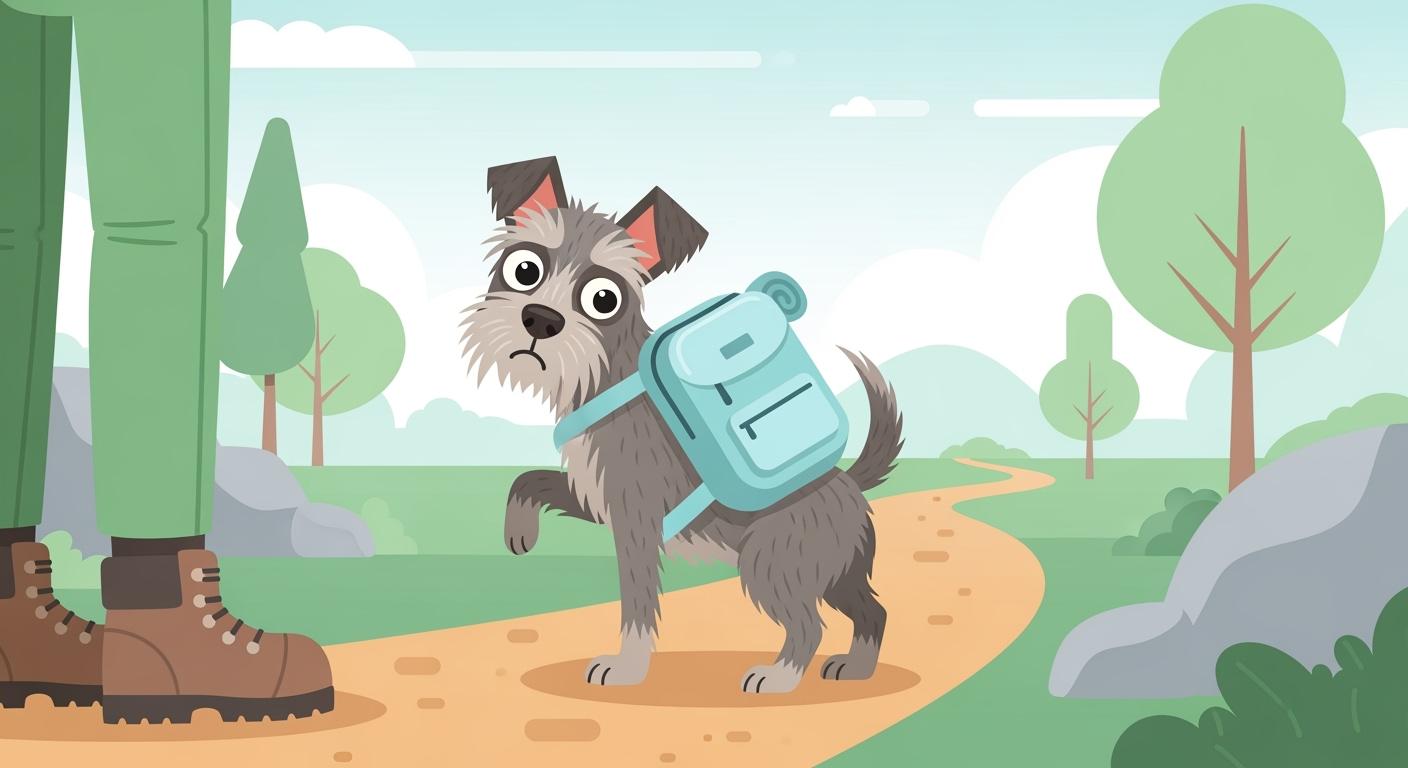
When a dog backpack changes a dog’s stride on the trail, the weight inside the pack is rarely the only cause. A dog taking shorter steps, drifting sideways, or refusing obstacles is reacting to how the backpack fits—where straps cross the shoulders, how saddlebags sit against the ribs, and whether the load stays balanced during movement. These problems show up even with light packs. They can turn a hike into a source of discomfort, muscle fatigue, or long-term joint strain, and they almost always trace back to specific design choices in the backpack itself.
Quick decision rule: If a dog’s stride changes within the first ten minutes of wearing a backpack, the fit or strap path is the problem—not the weight. Remove the pack, check pressure areas, and reassess before continuing.
Where a Dog Hiking Backpack First Changes Stride and Comfort
Visible Signs of Stride Disruption
A dog wearing a poorly fitted hiking backpack often shows movement changes within the first few minutes on the trail. These signs appear before any obvious injury and should be treated as early warnings that the product is interfering with natural gait:
- Shorter steps or a choppy stride, especially on flat ground where stride should be fluid
- Stiff or wide turns on narrow trail sections that the dog would normally navigate easily
- Reluctance to move forward, sudden stops, or repeated attempts to shake off the pack
- Drifting to one side instead of walking a straight line
- Licking, scratching, or rubbing at straps and panel edges
These behaviors are not quirks or training issues. They are product-fit problems. A dog that hesitates at obstacles, slows on uneven ground, or paws at the straps is responding to pressure, restricted range of motion, or load instability caused by how the backpack sits on the body.
Why Light Loads Still Cause Problems
A pack that weighs only a few pounds can still change how a dog moves if the strap path, saddlebag position, or panel stiffness creates resistance against normal muscle function. The shoulder and back muscles work harder to stabilize a pack during movement even when the total load is light. This extra effort accumulates over distance and can leave a dog sore or reluctant to move the next day.
The issue is not whether the load exceeds some percentage of body weight. The issue is where and how the load sits. A strap that crosses too close to the shoulder joint restricts front-leg extension regardless of what the pack weighs. A saddlebag that hangs away from the ribcage creates leverage that pulls the dog off balance with every step. These design problems produce the same stride disruption at two pounds as they would at six.
Product review point: Light does not equal harmless. The wrong strap path, saddlebag height, or pocket bulk can make hiking harder for a dog even when the pack is nearly empty.
Trail Behaviors That Signal a Fit Problem
Certain behaviors on the trail point directly to backpack fit issues rather than fatigue or environmental factors:
- Slowing down or stopping more often than the dog does without a pack on the same trail
- Avoiding jumps, logs, or rocky sections the dog normally clears without hesitation
- Shifting weight from side to side while standing still
- Dragging paws or stumbling on roots—a sign that the dog cannot lift its legs normally
- Heavy panting that starts earlier than expected for the conditions
Comparing a dog’s movement before and after putting on the backpack reveals what the pack itself is changing. Several observation methods can help identify gait disruption:
| Observation Method | What It Reveals | When It Is Most Useful |
|---|---|---|
| Visual observation (no tools) | Immediate stride changes, side drift, stiffness on turns | First few minutes on trail; before and after pack removal |
| Video recording with slow-motion playback | Subtle shoulder and hip movement changes not visible in real time | Comparing gait with and without the pack on the same surface |
| Stance analysis at rest | Weight shifting, odd limb positions, reluctance to stand square | Before the hike, after putting on the pack, and after removal |
| Post-hike skin and coat check | Redness, hair disturbance, sweat patterns that reveal pressure points | Immediately after removing the pack |
Most problems are visible to the naked eye. The key is watching for changes that appear only when the pack is on and disappear when it comes off.
How Strap Path, Saddlebag Shape, and Load Position Cause the Problem
Strap Placement and Shoulder Restriction
Where the front straps sit relative to the shoulder joint is one of the most consequential fit variables in a dog hiking backpack. A strap that crosses too close to the shoulder blades or sits high against the neck limits how far a dog can extend its front legs. The result is a shortened stride, stiff turning, and extra muscle work with every step.
Even harness-style backpacks marketed as non-restrictive can decrease shoulder extension if the strap path crowds the joint. The shoulder blade needs to slide freely during movement; any strap crossing that area creates friction and resistance. This is a design geometry problem, not a padding or tightness problem.
- Shoulder extension is greater without a backpack than with one, across all strap designs.
- Strap paths that cross the point of the shoulder or sit within two finger-widths of the armpit produce the most visible stride changes.
- A strap path that runs closer to the sternum and stays clear of the shoulder joint preserves more natural front-leg movement.
A backpack that leaves visible shoulder clearance and uses a front strap path that does not crowd the joint gives the dog more freedom to extend, turn, and navigate uneven ground.
Saddlebag Position, Shape, and Body Contact
Saddlebag position and shape affect balance, pressure distribution, and whether a dog can move without rubbing against the pack. Saddlebags that sit too high create a top-heavy load that pulls sideways on descents. Saddlebags that sit too low or too far back press on the lower ribcage and can interfere with hip movement. Pockets that bulge away from the body catch on branches and rocks, pulling the dog off balance.
A well-designed saddlebag stays close to the ribcage, follows the contour of the body, and keeps the load centered over the shoulders. The shape should match the dog’s side profile so the pack does not shift during turns or on side slopes. Saddlebags that extend beyond the last rib or sag below the chest line create leverage that makes every step harder. If a dog drifts to one side or stops frequently to shake, the saddlebag position or shape is usually the cause.
Load Distribution and Balance
How weight is placed inside the backpack matters as much as the total load. Uneven loading on the left and right sides creates a constant correction demand that fatigues the dog’s stabilizing muscles. Weight placed too far forward strains the shoulders and neck. Weight placed too far back stresses the spine and can interfere with hind-leg drive.
| Load Position | Effect on Movement | Design Direction |
|---|---|---|
| Centered over shoulders | Most stable, least gait disruption | Saddlebag compartments positioned above the front ribcage |
| Mid-back placement | Moderate stability, acceptable for lighter items | Secondary compartments behind the shoulder zone |
| Behind last rib / over loin | Spine strain, hind-leg interference, side sway | No load-bearing compartments in this zone |
| Uneven left-right loading | Side drift, compensatory muscle fatigue, stumbling | Equal compartment sizes on both sides; pack symmetrically |
Compartment design affects whether balanced loading is even possible. Pockets that are different sizes on the left and right sides make even weight distribution harder to achieve. Trail reloading becomes more difficult when saddlebag openings are too small or positioned where a dog cannot tolerate repeated contact during a hike.
Decision rule: If a dog drifts or leans consistently in one direction, the load is almost certainly unbalanced. Repack so both sides carry equal weight, with heavier items positioned near the shoulders on both sides.
Pressure Points from Panels, Binding, and Buckles
Backpack components that press against the dog’s body during movement create pressure points that can cause pain, skin damage, and movement avoidance. Three component types are responsible for most pressure-related failures:
Panels. The main body panels cover the dog’s back and sides. Stiff panels that do not flex with the dog’s movement dig into the ribs and spine. Over time, this causes soreness that makes the dog unwilling to wear the pack. Flexible, body-shaped panels distribute pressure more evenly and allow the dog to bend, turn, and lie down without resistance.
Edge binding. The material that finishes the edges of panels and straps sits directly against the dog’s skin or coat. Rough, thick, or stiff binding rubs with every step. Dogs with short coats or thin skin show redness and hair loss at binding contact points within a single long hike. Smooth, soft edge binding reduces friction and prevents the kind of cumulative irritation that leads to refusal.
Buckles. Buckles placed near the armpits, under the belly, or over bony prominences press into soft tissue and bone with every movement cycle. A dog that licks or bites at a buckle location is responding to direct pressure pain. Buckles should sit flat against the pack body and stay clear of joints, with quick-release mechanisms that allow fast removal if a problem develops.
| Pressure Point | Early Symptom | Better Design Direction |
|---|---|---|
| Stiff panel over ribs | Soreness after hiking, side drift during movement | Flexible panels that follow body contour |
| Rough binding at armpit or flank | Redness, licking, hair loss at contact line | Smooth rolled binding or laser-cut edge finish |
| Buckle over joint or bony point | Refusal to move, biting at hardware location | Flat-profile buckles positioned away from joints |
When a Hiking Backpack Helps and When It Creates More Problems
Use Cases Where a Dog Backpack Works
A dog hiking backpack serves a clear function when the dog is physically conditioned for the load, the trail demands are moderate, and the pack design matches the dog’s body. Day hikes on smooth to moderately rough terrain with a properly fitted pack are the most reliable use case. The dog carries a small amount of its own water or gear, and the pack’s structure does not interfere with natural movement.
Cool to mild weather is the safer temperature range. Backpack panels and straps trap heat against the dog’s body, and even breathable fabrics add insulation. In warm conditions, the same pack that worked well at 60°F can cause overheating at 80°F because the covered skin surface cannot release heat effectively.
Dogs with a balanced build—moderate chest depth, straight back, proportional leg length—tend to fit standard backpack designs with fewer adjustments. Breeds with extreme body shapes, such as very deep chests, short legs, or long backs, need more careful fit assessment because standard strap geometry may not clear the shoulders or may shift during movement.
When a Dog Backpack Is the Wrong Choice
Several conditions make a dog hiking backpack a liability rather than a tool:
Hot weather. The covered body surface area that a backpack creates restricts heat dissipation. Dogs cool themselves primarily through panting and through the skin on their undersides and paw pads—not through their backs. A backpack covering the back and sides does not directly block these cooling paths, but the extra insulation and muscle work raise core temperature faster than uncovered hiking does.
Very young or old dogs. Growing dogs have developing joints and growth plates that should not carry structured loads. Older dogs may have undiagnosed joint changes that a backpack load can aggravate. For both groups, the risk of causing or worsening a musculoskeletal problem outweighs the benefit of having the dog carry gear.
Dogs under roughly 10 to 12 pounds. The weight of the backpack itself represents a meaningful percentage of body weight for very small dogs before any gear is added. A pack that weighs 8 to 12 ounces empty may already exceed a safe carrying percentage for a 10-pound dog.
Technical or scramble-heavy terrain. Trails that require jumping, squeezing through rocks, or navigating steep side slopes demand full range of motion. A backpack, no matter how well designed, restricts some degree of spinal flexion and shoulder extension. On technical terrain, that restriction can cause a misstep or fall.
Dogs with existing joint or spine conditions. Any pre-existing orthopedic issue makes load carrying riskier. The extra muscle work of stabilizing a pack can accelerate joint stress even when the dog shows no immediate signs of discomfort.
Disclaimer: A dog with a known health condition, recent injury, or unusual body shape should be evaluated by a veterinarian before carrying any backpack load. The product design factors discussed here address fit and function—they do not replace individual health assessment.
Load Limits and Conditioning
A dog that has never worn a backpack needs a conditioning period before carrying meaningful weight. Starting with an empty pack for short walks lets the dog adapt to the feel of the straps and panels without the added demand of stabilizing a load. Over several weeks, weight can be added in small increments while watching for any change in stride or behavior.
A commonly cited guideline is that total pack weight, including the backpack itself, should not exceed 10 to 12 percent of the dog’s body weight for a conditioned dog. This is a starting reference, not a fixed rule. A dog with a narrow build, a long back, or less muscle mass may show stride changes well below that threshold. The dog’s movement under load is the real limit—not a percentage.
Design Details That Change How a Dog Moves Under Load
Panel Flexibility and Body Conformity
The main panels of a dog backpack determine whether the pack moves with the dog or fights against every step. Rigid panels hold their shape but create pressure peaks where they bridge across the natural curves of the dog’s body. Flexible panels conform to the ribcage and spine during movement, distributing pressure more evenly and reducing the hotspots that cause soreness.
The tradeoff is structure versus adaptability. A more structured panel protects contents better and holds its shape when loaded unevenly. A more flexible panel is more comfortable but may sag if the load is poorly distributed. For day hiking with moderate loads, flexible body-shaped panels produce fewer fit complaints and less post-hike soreness.
Strap Adjustability and Shoulder Clearance
Multiple adjustment points allow the same backpack to fit different body shapes. The most important adjustment zones are chest girth, shoulder strap length, and saddlebag position along the back. A pack with only one or two adjustment points forces a compromise on fit that usually means the straps sit too close to the shoulders or too loose to stay stable.
Shoulder clearance is the dimension most often missed in fit checks. The front strap should sit far enough from the shoulder joint that the dog can extend the leg forward fully without the strap creating resistance. A practical check is to watch the dog walk and confirm that the strap does not bunch or shift as the shoulder blade moves.
Buckle Layout and Hardware Profile
Buckle placement and hardware profile affect whether a dog tolerates the backpack over hours of continuous movement. Flat-profile buckles that sit flush against the pack body create less pressure than raised buckles that dig in when the dog lies down or squeezes through narrow spaces.
The most problematic buckle positions are under the belly, directly behind the front legs, and over the spine. Designs that position hardware away from joint areas and use low-profile fasteners reduce the pressure points that cause licking, biting, and refusal behavior. Quick-release buckles also allow fast pack removal if a dog shows sudden discomfort on the trail.
Saddlebag Profile and Load Stability
Saddlebag shape determines how close the load stays to the dog’s body and how much leverage it creates during movement. Low-profile saddlebags that hug the ribcage produce less side-to-side sway than tall, narrow pockets that project outward. A rucksack-style design with reinforced panel structure can hold shape better on multi-day trips, but the added structure should not come at the cost of body conformity on uneven trail surfaces.
Saddlebags that extend too far down the sides can interfere with the dog’s elbows during movement. The lower edge of the pack should sit above the elbow line so the front legs can move without brushing against the bag with each step.
Breathability and Heat Management
Backpack panels, straps, and saddlebags all trap heat against the dog’s body. Mesh panels and perforated fabrics allow some airflow but do not eliminate the insulation effect of having material against the coat. In warm weather, even the most breathable design raises a dog’s operating temperature faster than hiking without a pack.
The practical limit is ambient temperature and humidity, not fabric specification. A pack that causes no heat issues at 55°F on a dry day may cause heavy panting and early fatigue at 75°F with humidity, even if the fabric is described as breathable. Dark-colored packs absorb more solar radiation and heat up faster in direct sun than light-colored packs made of the same material.
| Design Attribute | Why It Changes Movement Outcomes | What to Check Before Use |
|---|---|---|
| Panel flexibility | Stiff panels create pressure peaks on ribs and spine; flexible panels follow body contour during turns and descents | Bend the panel by hand before fitting; it should flex without cracking or holding a crease |
| Shoulder strap clearance | Straps that crowd the shoulder joint shorten stride and increase front-leg fatigue | Watch the dog walk; confirm the strap does not shift or bunch over the shoulder blade |
| Saddlebag profile and position | Bulky or low-hanging saddlebags create leverage, side sway, and elbow interference | Check that saddlebags sit above the elbow line and stay close to the ribcage when loaded |
| Edge binding finish | Rough or thick binding rubs against skin with every step, causing redness and hair loss | Run a finger along all binding edges; they should feel smooth with no hard corners |
| Buckle placement and profile | Raised buckles over joints or under the belly create focused pressure pain during movement | Confirm all buckles sit flat against the pack body and clear the armpits and spine |
Workflow tip: Check fit at the start of every hike, not just the first time the pack is used. Saddlebag contents shift, straps loosen, and a dog’s body condition changes over weeks of use. A pack that adds storage capacity but introduces bulk that interferes with stride will produce more refusal behavior than a simpler design that preserves natural movement.
FAQ
How much weight can a dog safely carry in a hiking backpack?
Total pack weight, including the backpack itself, is commonly kept under 10 to 12 percent of the dog’s body weight for a conditioned dog. This is a reference point, not a fixed limit. A dog with a narrow frame, long back, or less-developed shoulder muscles may show stride changes at lower percentages. Start with an empty pack, add weight gradually over weeks, and let the dog’s movement under load determine the upper limit.
What signs show that a dog backpack does not fit?
Shortened stride, stiff turns, side drift, reluctance to move forward, and rubbing or licking at the straps are the most common visible signs. Post-hike redness, hair disturbance, or soreness at strap contact points also indicate pressure problems. A dog that repeatedly tries to shake off the pack or stops more often than usual is signaling that the fit is wrong.
Can small dogs use hiking backpacks?
Small dogs can wear a backpack if the design is proportioned for a smaller body and the empty pack weight is low enough relative to body weight. For dogs under roughly 10 to 12 pounds, the empty pack alone may represent a meaningful load percentage before any gear is added. The strap path must clear the shoulder joint on a smaller frame, which requires closer attention to fit than on a larger dog where strap placement has more margin for error.
How is load balance checked before a hike?
Pack equal weight on both sides, with heavier items placed near the shoulders inside each saddlebag. After securing the pack, watch the dog walk on flat ground. Side drift, leaning, or a visible saddlebag sag on one side indicates uneven loading. Adjust until the dog walks a straight line without correction. Recheck balance after any trail stop where the pack is opened, since removing and replacing items can shift the load.






