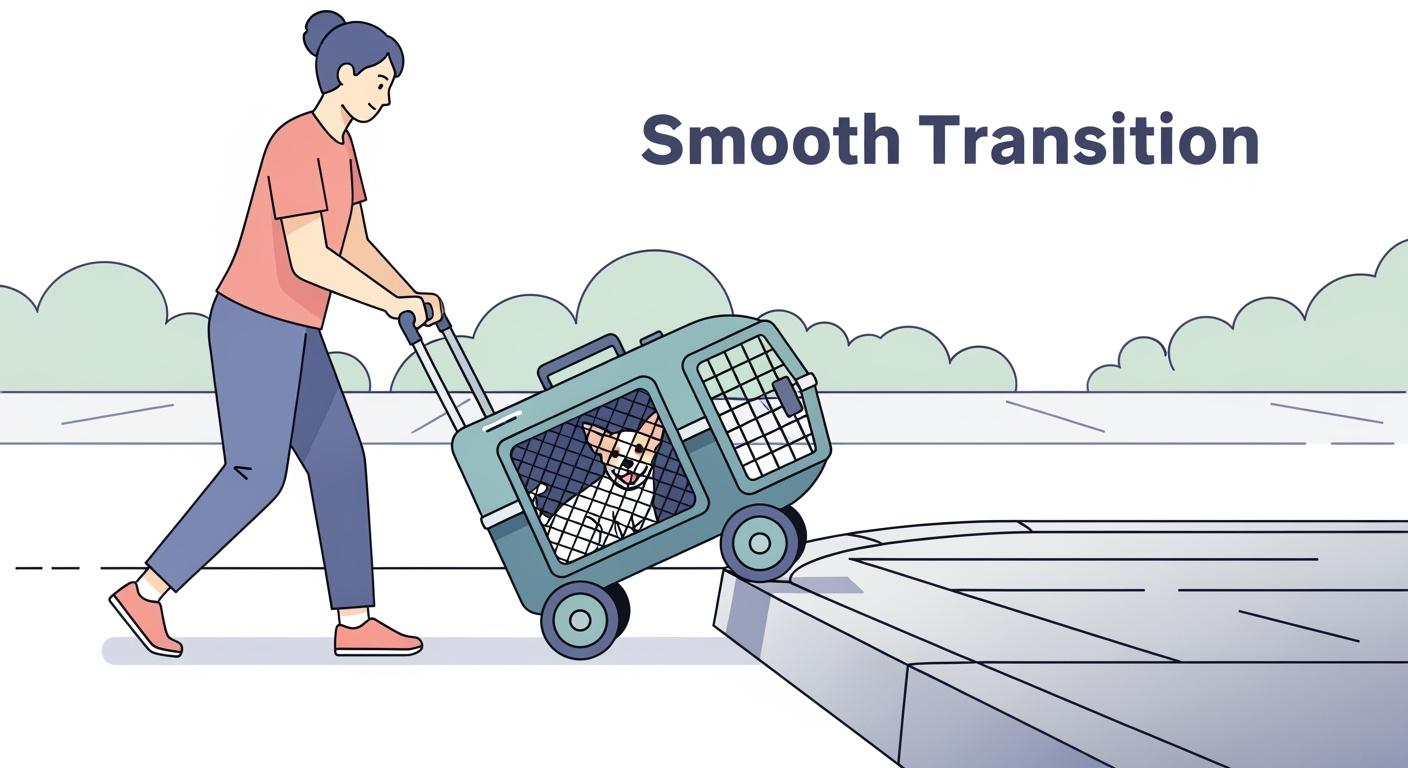
A pet carrier with wheels and handle rolls smoothly on flat ground. The wheels track straight. The load stays level. Then a curb changes the physics entirely. The front wheels hit a vertical edge instead of rolling forward, and the carrier tries to pivot nose-down around the rear axle. Whether it tips or stays upright depends on two variables: how wide the wheelbase is relative to the carrier height, and what angle the handle pulls from.
This is not about wheel quality in isolation. Smooth bearings and large-diameter wheels help on rough pavement, but they do not change the tipping math. The geometry of the base, the wheel track width, and where the combined center of mass sits determine whether a carrier rolls over an obstacle or rotates around it. A wheeled carrier designed for airport terminals may clear smooth curbs easily but struggle with the taller, sharper edges common on city streets and transit platforms.
Why Wheeled Carriers Tip at Curbs
When a carrier’s front wheels strike a curb, the force vector shifts. On flat ground, the pulling force is mostly horizontal and the carrier rolls. At the curb face, the wheels meet a vertical barrier. The horizontal pull continues, but now the curb resists forward motion at wheel height. This creates a rotational couple: the pull force above and the curb reaction below try to spin the carrier forward.
The wider the wheelbase, the longer the moment arm that resists this rotation. A narrow base — wheels tucked close together under the carrier body — offers a short lever against tipping. The same curb impact that barely nudges a wide-stance carrier can flip a narrow one. The handle angle compounds this: a steep upward pull shifts the line of force higher above the rear axle, adding to the forward rotation rather than pulling through the center of mass.
Think of the carrier as a lever system. The rear wheels are the fulcrum. The combined weight of pet and cargo pushes down through the center of mass, resisting rotation. The curb impact and handle pull push forward above the fulcrum. When (pull force × pull height) exceeds (carrier weight × half the wheelbase), the carrier tips. That is the tipping threshold — and it explains why a 2-inch increase in wheelbase width can matter more than doubling the wheel diameter.
| Failure signal | Likely design cause | Better design direction |
|---|---|---|
| Carrier tips forward at curbs | Narrow wheelbase, bottom panel flex | Wider wheel track, reinforced base |
| Carrier drags or scrapes at curb | Low front-edge clearance | Higher front clearance, side lift handles |
| Carrier wobbles on flat ground | Loose wheel mounts, uneven load | Fixed axles, wide-set wheel placement |
Pet Movement as a Dynamic Load
A stationary carrier loaded with supplies is one stability problem. A carrier with a live animal inside is another. When the carrier tilts at a curb, the pet braces — shifting weight toward the front or one side. This is not a passive load; it is a moving mass that amplifies whatever instability the base geometry already creates.
A dog standing up raises the center of gravity several inches, loosening the restoring moment that resists tipping. A dog leaning against one side wall creates an off-center load that the wheel track must counter as a lateral moment. The carrier’s stability is proportional to (track width × total mass) divided by (center-of-gravity height × lateral force). When the pet stands, the numerator stays the same but the denominator grows — the stability margin shrinks.
In practice: after rolling across mixed surfaces for 10 minutes, stop and note your pet’s position inside. A pet that has drifted from center toward one wall signals inadequate lateral stability — the track width is not countering normal weight shifts during travel. The carrier that keeps the pet centered through a full trip is the one with a stability margin that absorbs movement without leaning.
| Pet action | Effect on carrier | Design factor that counters it |
|---|---|---|
| Standing up | Raises center of gravity, increases tip risk | Low cargo floor height relative to wheelbase |
| Leaning sideways | Creates off-center lateral load | Wide wheel track width |
| Bracing at sudden jolt | Shifts mass forward abruptly | Side lift handles for obstacle clearance |
How Handle Angle and Base Geometry Control Tipping
Pull Angle and the Telescoping Handle
A telescoping handle that locks at multiple heights does more than suit different user statures — it controls the pull angle. When the handle extends so the pulling force runs nearly horizontal, the force vector passes through or near the carrier’s center of mass. The rotational component stays small. Pull at a steep angle, and the force tilts: the horizontal component pulls the carrier forward while the vertical component pushes the nose down. At a curb, where the wheels already meet resistance, that downward component adds directly to the tipping moment.
Handle rigidity matters here. A telescoping shaft that flexes under load changes the effective pull angle unpredictably — the carrier responds to the force direction at the wheel contact, not to where the grip sits in your hand. A handle mechanism that locks without play keeps the pull angle consistent regardless of terrain. The same shaft that feels solid on a showroom floor may flex enough on a bumpy sidewalk to shift the pull line by several degrees, and at the tipping threshold, a few degrees can make the difference.
Wheel Track Width and the Stability Triangle
The wheel track width sets the stability baseline. Two wheels mounted close together create a narrow support footprint — the carrier can rotate sideways with minimal lateral force. Two wheels spaced to the outer edges of the base create a broad footprint that resists both forward and lateral tipping.
Picture a triangle drawn between the two rear wheel contact points and the front ground-contact point. That triangle is the stability zone — the carrier stays upright as long as the combined center of mass projects inside it. The wider the rear track, the larger that triangle. When the pet shifts weight or the carrier tilts at a curb, the center of mass must travel farther to cross outside the triangle boundary. A base that is 4 inches wider side-to-side roughly doubles the lateral force needed to produce the same tilt angle — it is a direct multiplier on stability, not a marginal improvement.
Check this yourself: load the carrier with typical cargo weight. Place one hand on each side of the carrier at handle height. Push sideways gently. A carrier that resists tilting until you apply noticeable force has adequate track width for that load. One that leans with light finger pressure will lean harder under a shifting pet.
Front-Edge Clearance and Bottom Panel Stiffness
Front-edge clearance determines whether the carrier clears a curb or catches on it. A low-slung front edge strikes the curb face before the wheels can climb. The impact transmits through the frame — the pet feels the jolt and braces, shifting weight forward at the worst possible moment.
A reinforced bottom panel prevents two failure modes: sag under static load (which reduces effective front clearance over time) and flex during lifting (which changes the carrier’s shape when side handles are used to clear a curb). If the bottom panel bends under the combined weight of pet and cargo, the front edge droops lower than the design intended. What cleared a 4-inch curb when new may scrape it six months later as the panel fatigues.
Load the carrier and roll it toward a standard curb at walking speed. If the front edge contacts the curb face before either wheel begins climbing, the clearance is insufficient for that curb height. Measure the gap between the front edge and the curb — under 2 inches means lifting will be the only safe method for most urban curbs.
Design Features That Keep the Carrier Level Through Obstacles
Wheels mounted at the outer edges of the carrier frame maximize the support footprint without increasing the carrier’s overall dimensions. This is a packaging decision made at the design stage — it costs nothing in folded size but changes the stability math significantly. A carrier with wheels flush against the body sides has fundamentally different curb-crossing behavior than one where the wheels are tucked under a central spine.
The same principle applies to how cargo sits inside. Dense items (water bottles, food containers) packed at the bottom drop the center of gravity. The lower it sits, the larger the tipping force needed. A rolling carrier with a structured lower compartment enforces this mechanically — the design itself keeps heavy items low rather than relying on the user to remember.
For urban carrying across mixed surfaces, this combination of wide track and low load placement turns what would be a tip-over into a controlled roll. The stability triangle stays large, and the center of gravity stays low inside it. The same logic that keeps a low-slung suitcase upright on train platforms applies to a pet carrier crossing curbs and ramps.
Separate Lift Handles for Dual-Mode Handling
A well-designed wheeled carrier operates in two distinct modes: rolling across smooth surfaces and lifting over obstacles. The telescoping handle serves the first mode. Side-mounted lift handles serve the second. Trying to use the rolling handle to drag the carrier up a curb defeats the design — it applies force at the wrong angle through the wrong attachment point.
Side handles positioned near the carrier’s center of mass let the user lift straight up with the carrier staying level. Top-mounted handles create a pendulum effect: the carrier swings, the pet inside shifts to compensate, and the landing is less controlled. Side handles also let the user keep the carrier close to the body, reducing wrist strain and the instability that comes from holding the load at arm’s length. This is the same ergonomic principle that luggage designers apply to heavy suitcases — the lift point belongs near the center of mass, not above it.
When shopping for a carrier with well-placed handles, check whether the side grips align roughly with the midpoint of the loaded carrier, not just its empty centerline. The distinction matters once the carrier is packed.
Packing for Stability
Weight distribution inside the carrier is part of the stability system. Packing that ignores it works against whatever mechanical advantages the base geometry provides.
Heavy items at the bottom. Supplies distributed evenly between left and right sides. Nothing loose that can roll when the carrier tilts — a water bottle shifting from one side to the other at the moment of tipping can be the difference between recovery and a full tip-over. A soft mat on the floor adds comfort but should lie flat; a bunched-up mat changes the pet’s footing and can shift unpredictably.
- Place dense items (water, food, batteries) at the bottom of the carrier.
- Distribute supplies evenly between left and right compartments.
- Position loose items so they cannot roll laterally when the carrier tilts.
- Lay the floor mat flat — bunching creates an unstable surface under the pet.
- Check balance by lifting the loaded carrier with side handles before leaving.
Step-by-Step: Crossing Curbs With a Wheeled Carrier
The carrier works best when rolling and lifting are treated as two separate moves, not one continuous motion.
- Stop before the curb. The rolling handle stays in your grip.
- Check that the pet sits near the center of the carrier.
- Grip the side lift handles with both hands.
- Lift straight up — do not tilt the carrier forward or backward during the lift.
- Step onto the curb. Set the carrier down gently, wheels first.
- Switch back to the telescoping handle. Resume rolling at a low pull angle.
- Watch the pet for signs of stress after the lift. Pause if the pet seems unsettled.
Note: A high curb or rough surface calls for lifting, not dragging. Dragging grinds the front edge against the curb and transmits impact directly to the pet. The side handles exist for this exact scenario — using the rolling handle to drag the carrier up a curb is like using a suitcase handle to hoist it over a turnstile.
When a Wheeled Carrier Is the Wrong Tool
A wheeled carrier earns its keep when most of the travel route is paved and level — airports, city sidewalks, transit terminals, shopping areas. The wheels carry the weight, the telescoping handle directs it, and the occasional curb is manageable with the lift handles. The design fits the use pattern.
That value drops when stairs, steep ramps, broken pavement, or packed dirt dominate the route. At that point the wheels become dead weight. The carrier frame, wheel mounts, and telescoping shaft add structural mass versus a comparable soft-sided carrier. On a route with 20 curbs and three flights of stairs, the user lifts that extra weight at every vertical transition — the wheels that saved effort on flat stretches become a penalty on climbs.
A soft-sided travel bag without wheels serves better on stair-heavy urban routes or mixed terrain where rolling is the exception rather than the rule. The design decision comes down to the ratio of rollable distance to lift-only distance on a typical trip. When less than half the route is smooth enough to roll, the wheel-and-handle system is adding weight without adding utility.
Disclaimer: This analysis assumes a standard urban curb height of 4 to 6 inches and a carrier loaded within its rated weight range. If the route includes higher curbs, steep driveway transitions, cobblestone, or broken pavement, wheel diameter and ground clearance become the limiting factors — base width alone may not prevent tipping. For dogs with a barrel chest or very deep keel, the fit checks described here assume the carrier’s internal dimensions accommodate those body shapes; carriers sized for small, short-backed breeds distribute weight differently and may reach their stability limit at lower loads.
Häufig gestellte Fragen
Why does the carrier tip more when my dog stands up?
Standing raises the dog’s center of mass by several inches, which increases the height of the combined center of gravity. The higher that point sits above the wheel axle line, the shorter the moment arm resisting forward rotation. A dog that sits during curb crossings keeps the center of gravity low and the stability margin wider. This is the same reason low-floor cargo areas improve stability — they keep the heaviest part of the load close to axle height.
Do larger wheels fix the tipping problem?
Larger-diameter wheels roll over bumps more easily, which reduces the initial impact that triggers tipping. But wheel diameter does not change the tipping moment arm — that is set by the distance between the rear axle and the front ground-contact point, which is the wheelbase. A carrier with large wheels and a narrow wheelbase still tips more readily than one with smaller wheels and a wide track. Wheel size and base width address different parts of the stability equation.
Are four-wheel carriers more stable than two-wheel carriers?
Four wheels add longitudinal stability — the carrier is less likely to tip forward or backward when stationary on level ground. But lateral stability still depends on the track width between the left and right wheels. A four-wheel carrier with a narrow track tips sideways just as readily as a two-wheel carrier with the same track width. The front wheels prevent nose-down tipping on flat ground but do not help at a curb, where the front axle itself is the pivot point.
How can I tell if the bottom panel is stiff enough for my dog’s weight?
Load the carrier with weight equivalent to your dog (use bagged rice or similar). Support the carrier only under the wheel mounts — not across the full base. Check the bottom panel’s deflection at the center. If the panel sags more than roughly half an inch, it is flexing enough to reduce effective front clearance and change the carrier’s shape during a side-handle lift. A carrier whose bottom panel stays nearly flat under full load passes; one that bows noticeably downward will scrape curbs that the front-edge height alone suggests it should clear.
A pet carrier with wheels and handle stays level through curbs and uneven surfaces when the base geometry works in its favor. Wide-set wheels create a larger stability triangle. A low center of gravity keeps the tipping threshold high. Side lift handles provide a second mode for obstacles where rolling is not possible. Separating the two modes — roll on flats, lift at curbs — prevents the dragging and tipping that happen when one handle tries to serve both purposes. The design works best on paved routes with occasional obstacles, not on route profiles dominated by stairs or rough terrain where the wheel-and-frame weight becomes a liability rather than an advantage.