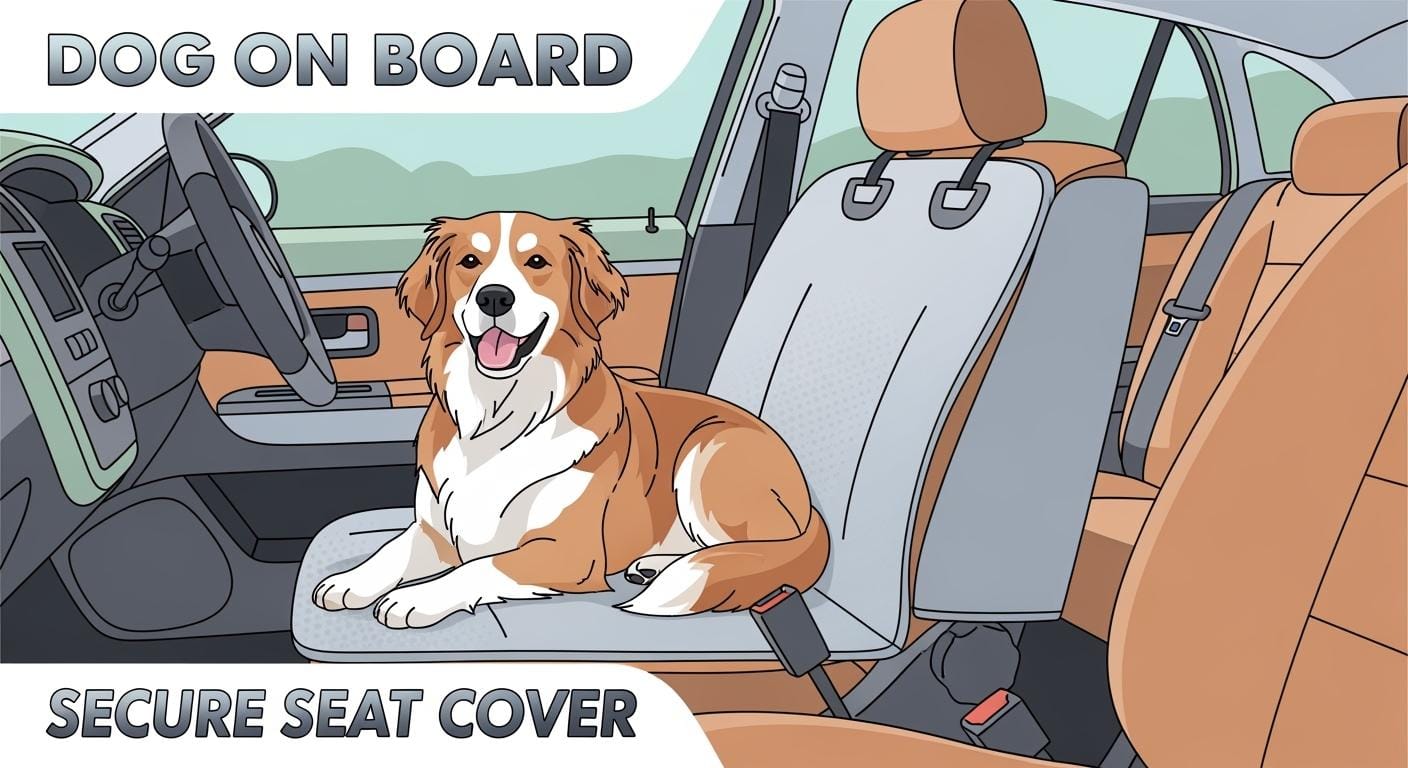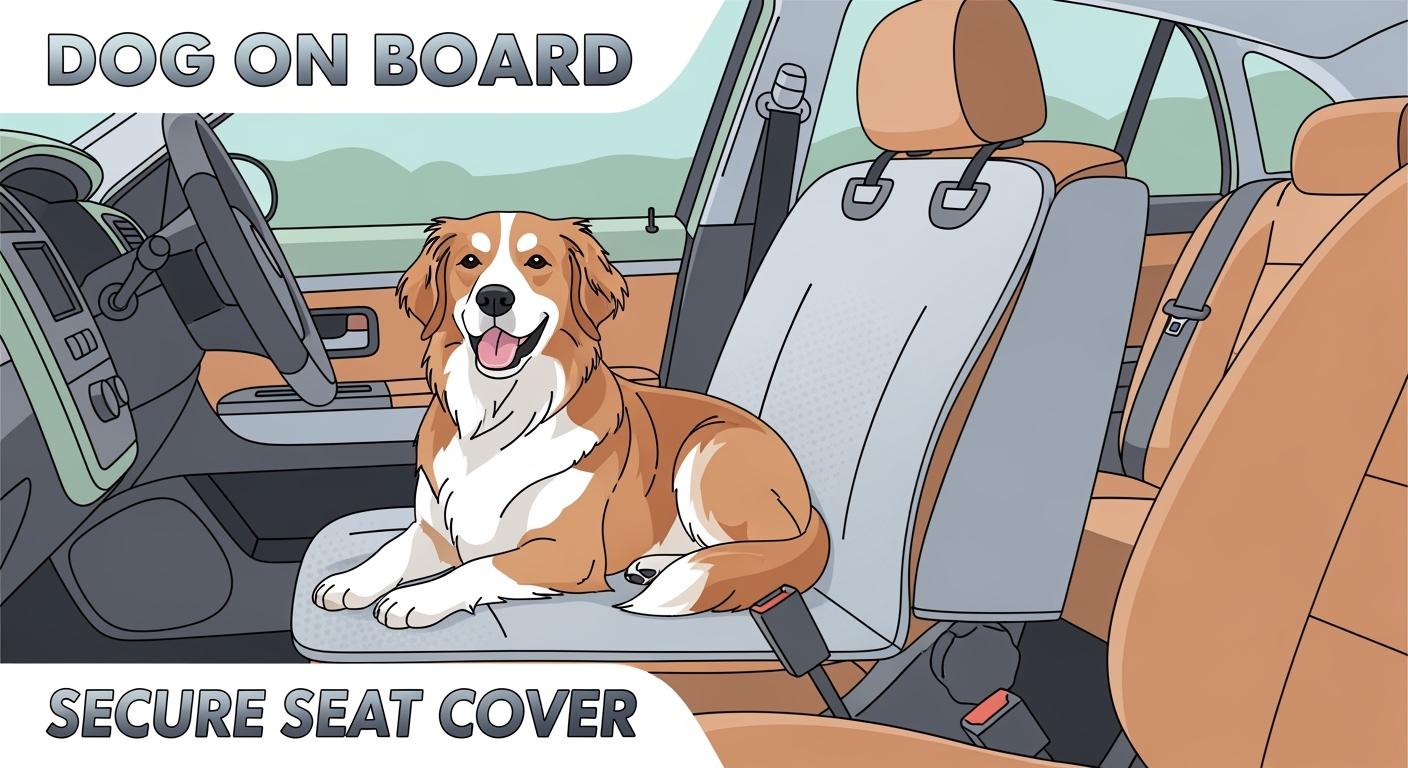
Leather looks good in a car. It also gives a dog car seat cover almost nothing to hold onto. Fabric seats provide texture that a cover can bite into. Leather does not. The cover sits on a near-frictionless surface, and every time the dog shifts weight, turns around, or braces against a turn, the cover wants to move with the dog rather than stay anchored to the seat. That is not a material flaw. It is a traction problem — and the right design solves it at the interface between the cover’s underside and the leather’s surface. A dog car seat cover for leather seats works when it treats the leather not as a seat to cover but as a surface to grip.
Why Dog Car Seat Covers Slide More on Leather
The mechanics are straightforward. A cover on fabric stays in place through mechanical interlock — the textile fibers on both sides create thousands of micro-obstructions that resist lateral movement. Leather has none of that. Its surface is sealed, uniform, and slick. When a dog jumps onto the back seat and the cover lacks a high-friction underside, the cover’s only resistance to sliding comes from whatever downward force the dog’s weight provides — and that force shifts constantly.
Here is where the physics turns against the cover. A dog turning around does not just sit. It plants a paw, pushes off, and creates a lateral force vector that peaks at roughly the angle of the turn. On fabric, the cover’s textile backing distributes that force across hundreds of contact points. On leather, the same force meets a single plane of low friction. The result is predictable: the cover slides in the direction of the push, bunches at the far edge, and leaves the near side of the seat exposed. Once the cover has shifted even a few inches, the buckle openings drift out of alignment, the seat anchors lose tension, and the edges that were tucked into the seat gap pull free. From there, every subsequent movement compounds the problem.
In practice: If the cover slides more than an inch during a 10-minute drive with a calm dog, it will not hold position during a sharp turn or sudden stop. That gap between static grip and dynamic grip is where most covers fail on leather.
The failure chain is worth tracing because it explains why single-feature fixes rarely work. A waterproof top layer does not increase underside friction. Tightening the headrest straps harder does not fix the absence of seat-anchor depth. Adding weight to the cover — through thicker fabric — can actually make things worse: more mass means more inertia during turns, which means more lateral force for the same level of grip. The only design path that works is increasing the coefficient of friction at the cover-to-leather interface while simultaneously pinning the cover at enough fixed points that lateral force cannot accumulate into movement. That combination — high-friction backing plus deep mechanical anchoring — is what separates covers that stay put from covers that need constant readjustment.
Where a Leather-Seat Cover Fails First
Failure follows a pattern, and it almost always starts at the underside. On leather, a cover with a smooth polyester or nylon backing has about the same grip as a plastic sheet on glass. The first hard stop or sharp turn sends it forward. You can verify this yourself: after a drive, run your hand along the back edge of the seat bottom where it meets the backrest. If the cover’s seat anchor has pulled up more than half an inch, the backing has already lost its hold. A dog seat cover with a rubberized non-slip backing tends to hold that anchor line across drives because the rubber deforms into the leather’s micro-texture under pressure, creating a suction-like grip that smooth fabric cannot replicate.
Seat anchors are the second failure point. Shallow anchors — the kind that wedge just an inch or two into the seat gap — rely entirely on compression to stay put. Under the repeated tugging of a dog shifting position, compression alone is not enough. The anchor works its way upward, the panel tension goes slack, and the cover begins to bunch at the center. Deep anchors, pushed well into the gap between the seat back and bottom, add a mechanical lock: the foam of the seat cushions closes around the anchor tube, resisting upward pull. A cover with deep anchors and adjustable strap tension stays flat because the anchor is not just wedged — it is trapped.
Edge shifting is the third failure zone, and it is the one most visible from outside the car. When a dog enters or exits, paws hit the door-side edge of the cover first. Without side flaps that wrap down over the seat bolster, that edge lifts and slides inward. After a few entries, you will see a strip of exposed leather along the door side — and leather at that edge is particularly vulnerable to claw marks. Walk around the car after a trip and check both door-side seat bolsters. If the cover has retreated more than an inch from the door sill on either side, the side flaps are either absent or too short to do their job. A cover with full side flaps that extend below the bolster line protects those edges and reduces the leverage that paws can apply to shift the entire cover.
Buckle openings that drift out of position are a downstream consequence of all three failures. When the cover slides forward, the openings — designed to align with the seat belt buckles — move with it. Reaching under a bunched cover to find a buckle is not just inconvenient; it discourages using a restraint, which pushes the safety equation in the wrong direction. A cover designed for in-car protection keeps these openings reinforced and positioned so they stay usable even after the dog has repositioned.
What Design Keeps the Cover in Place on Leather
Three features do the heavy lifting, and they have to work together. A non-slip backing without deep anchors will grip the leather but still drift under lateral load. Deep anchors without a non-slip backing will hold the center but allow the edges to creep. Side flaps without either will protect the bolsters on entry but slowly work themselves loose. The system works when all three are present and correctly tensioned.
The backing material matters more than most buyers realize. Rubberized or silicone-dotted backings work because they increase the coefficient of static friction — the force required to initiate movement — well above what smooth fabric can achieve. The difference is testable: press the cover down onto the leather with your hand and try to slide it laterally. A cover with effective non-slip backing will resist the initial movement noticeably more than one without. That resistance at initiation is what keeps the cover from creeping during gradual weight shifts, and it is what a cover built for stability and grip on slick seats must deliver at a minimum.
Side flaps change the failure pattern at the edges. Rather than the edge of the cover sitting on top of the seat bolster — where a paw can catch it and peel it inward — the side flap drapes over the bolster and down the door-side face. This does two things mechanically. First, it moves the cover’s termination point away from the high-traffic entry zone. Second, it creates a wrap angle that converts some of the lateral force from a dog’s entry into downward tension on the flap, which actually helps seat the flap more firmly. The result is that the cover edge stays put through dozens of entries rather than retreating after the first few.
Flat panel construction matters for a subtler reason. A cover with excessive quilting, deep channels, or thick padding creates surface irregularity — and irregularity means the dog’s weight is concentrated on the high points rather than distributed across the full contact area. Concentrated pressure points push through to the leather and create localized friction differences that encourage the cover to pivot around those points. A flatter panel with even weight distribution keeps the non-slip backing in full contact with the leather, eliminating the pivot points that lead to rotation and bunching. An understanding of how car-seat products achieve fit through material choice applies here: flat, even contact beats thick, uneven cushioning when grip is the priority.
Multi-layer construction adds durability without sacrificing grip. A waterproof top layer — typically 600D Oxford fabric or a heavy-duty polyester with a polyurethane coating — blocks spills and resists claw perforation. The middle layer can carry light padding for comfort without creating the pressure-concentration problem, as long as it is uniform and quilted sparingly. The bottom layer is the non-slip backing. These three layers are bonded rather than loosely sandwiched, which prevents internal shifting that would decouple the top surface from the gripping underside. When the layers stay aligned, the load transfer from dog movement goes straight through to the backing, where the friction fight is won or lost.
Disclaimer: This analysis assumes smooth, untextured, factory-finished automotive leather. Aftermarket leather treatments, conditioners, or protectants can alter the surface friction coefficient — some make leather slicker, others add a slight tack. If you treat your seats regularly, test the cover’s grip after applying the treatment, not just on a clean untreated surface.
Sizing, Installation, and What a Cover Cannot Fix
Even the best-designed cover fails if the size is wrong. A cover that is too narrow leaves the outer bolsters exposed. One that is too wide creates slack panels that fold and bunch regardless of how well the backing grips. Measure across the widest point of the bench seat and compare against the cover’s stated width range. For hammock-style covers, the front-to-back measurement — from the rear seat backrest to the back of the front seats — determines whether the hammock will sit flat or pull forward under tension.
Installation takes under five minutes once you understand the sequence. Push the seat anchors deep into the gap between the seat back and bottom, then pull upward on the cover to seat them against the underside of the cushion. Attach the headrest straps and tighten until the cover lays flat without sagging. Fold the side flaps down over the bolsters and tuck any excess into the door-side gap. Line up the buckle openings with the seat belt receivers. After the first drive, check whether the anchors have pulled up and whether the side flaps have held — this tells you whether your initial tension was sufficient.
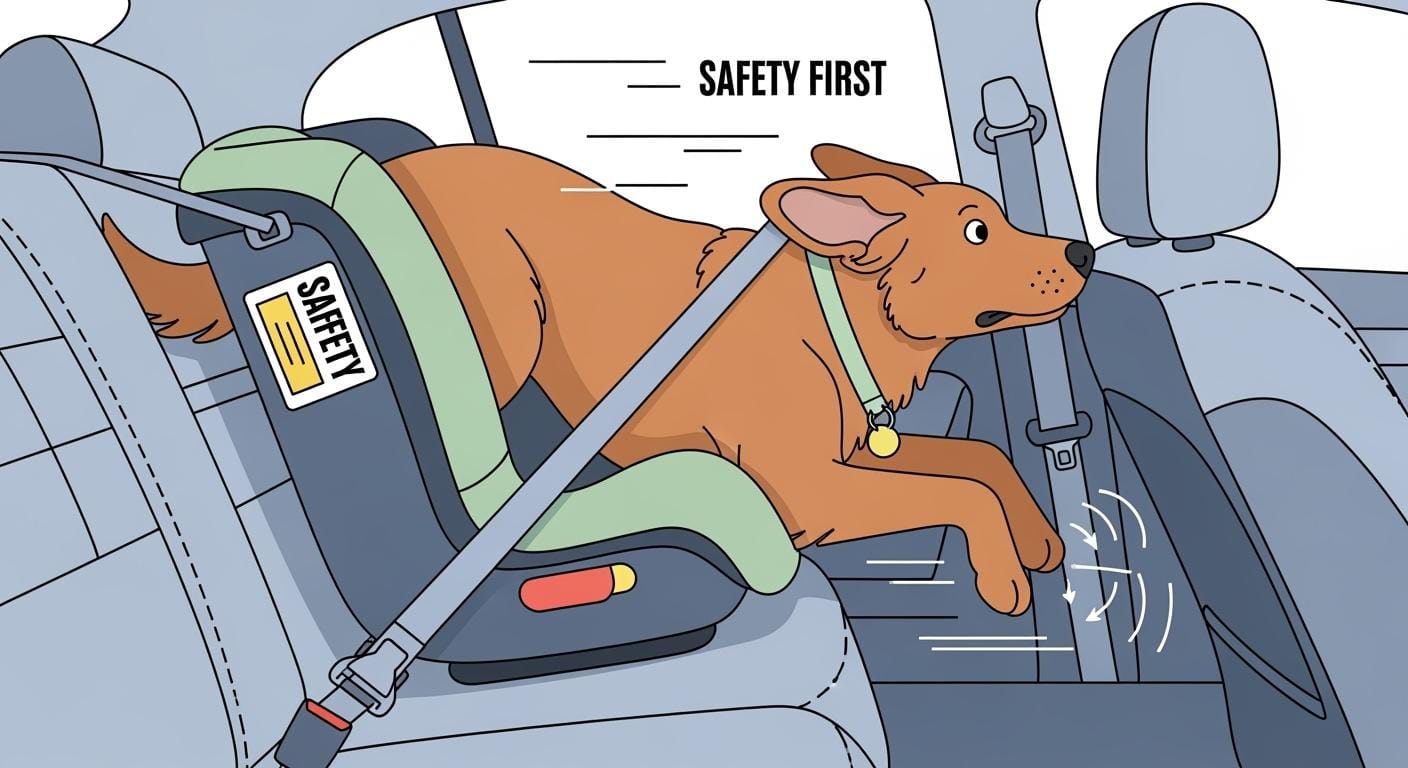
Some problems are not design problems. A cover cannot prevent a dog from chewing through it. It cannot stop a dog that is not restrained from climbing into the front seat. It cannot protect the door panels below the side flap line from a dog that scratches at the window. And no cover, regardless of grip, will stay perfectly flat if the dog is unrestrained and actively pacing the back seat during a drive — the forces in that scenario exceed what passive friction alone can resist. A cover designed for full protection works best when paired with a restraint that limits the dog’s range of motion to a single seating position.
Cleaning is simple on a waterproof cover. Shake out loose hair and debris after each trip. Wipe spills with a damp cloth before they dry. For deeper cleaning, most multi-layer covers can go through a machine wash on a gentle cycle with mild detergent — but air-dry only, since dryer heat can degrade the non-slip backing over time. A cover that gets washed regularly and air-dried tends to maintain its backing grip longer than one that sits unwashed with accumulated oils and dirt filling the backing’s micro-texture.
Disclaimer: The grip and fit checks described here assume a standard bench seat configuration in sedans, SUVs, and crew-cab trucks. Split-folding seats, seats with pronounced contouring, or seats with integrated side airbags in the bolster area may require covers designed specifically for those configurations — side flaps that drape over a bolstered airbag housing, for example, should not interfere with deployment. Check your vehicle’s manual for seat-mounted airbag locations before installing any cover.
Häufig gestellte Fragen
Can a dog car seat cover damage leather seats over time?
A cover with a non-slip rubberized backing that stays in place is less likely to damage leather than one that slides, because sliding concentrates friction in small patches that can burnish or scuff the leather surface. A stationary cover distributes pressure evenly. That said, any cover left installed continuously for months may trap humidity against the leather, which can affect the finish on untreated or aniline leather. Removing the cover periodically to let the leather breathe is a sensible precaution.
Are hammock-style covers better than bench-style covers for leather seats?
The hammock design adds two front anchor points — the straps that loop around the front headrests — which create tension across a larger area and reduce forward sliding. But the hammock also introduces a suspended panel between the back seat and the front seats, and that panel bears the dog’s full weight without a solid surface underneath. On leather, the front anchors help, but only if the non-slip backing on the bench portion is already doing its job. A hammock with a weak backing will still slide; it will just take the front panel with it.
How often should I re-tighten the cover on leather seats?
Check after the first drive, then after the first week. If the anchors have not pulled up and the side flaps have not crept inward after a week of regular use, the initial tension was right. After that, a monthly check is usually sufficient — more often if the dog is large or particularly active during drives. The headrest straps tend to loosen slightly as the fabric settles, so a quick re-tension after the first few uses prevents cumulative slack.