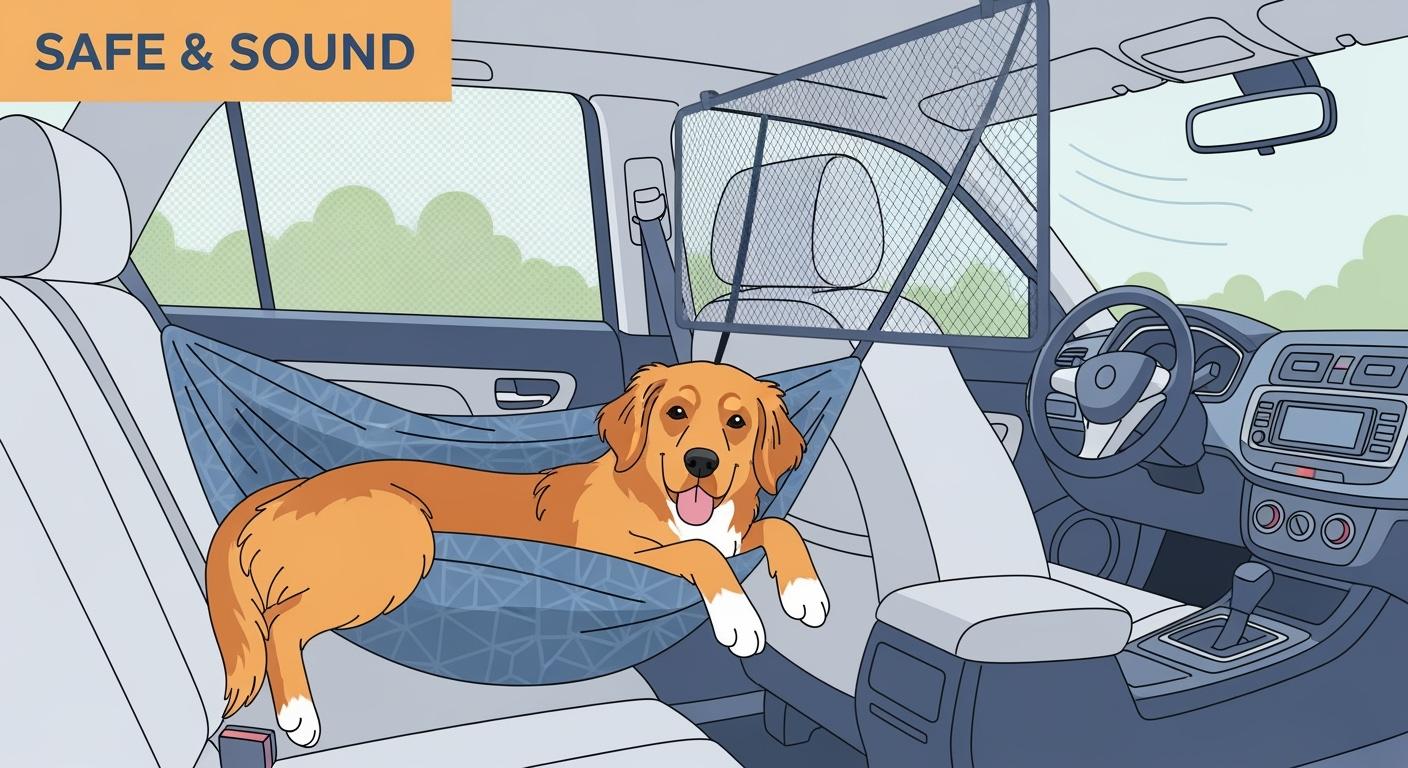
A mesh window in a dog car hammock does two things at once: it lets air move through the back seat and gives the dog a clear sightline to the front. When it works. When it sags, it blocks both. The dog pants harder. The cabin feels stuffy. The barrier that was supposed to reduce anxiety becomes another source of it.
Most mesh windows sag for the same mechanical reason. The front panel loses tension. The edge that should hold the mesh flat goes soft. And once a dog leans or shifts against it, the panel folds inward and stays there. Fixing that is not about finding a stiffer mesh. It is about how the whole front assembly distributes load.
Why Mesh Windows Sag: The Load Path That Fails
The front mesh panel in a hammock-style back seat dog cover hangs between two headrests. The top edge attaches to the headrest straps. The sides meet the hammock body. Gravity alone pulls the mesh downward. Add a dog moving in the back — leaning, shifting weight, pressing a nose against the panel — and the mesh takes horizontal load it was never built to resist.
Here is the chain. Lateral force from the dog’s body pushes the mesh inward. That force travels to the edge binding. If the binding is a single row of stitching through lightweight fabric, the edge rolls. Rolling concentrates the entire load onto a narrow crease instead of spreading it across the panel width. The crease deepens. The mesh folds. Airflow stops.
It is a torsional failure, not a tensile one. The mesh itself does not tear. It rotates. A soft edge acts as a hinge, converting horizontal push force into inward rotation. A reinforced edge — double-stitched binding with a firmer border material — resists that rotation. It keeps the mesh in its original plane even when the dog presses against it.
Strap placement makes this better or worse. Headrest straps that attach only at two top points leave the lower half of the mesh unanchored. The panel becomes a pendulum. A dog shifting weight in the footwell area pushes the unsecured lower edge forward, and the whole panel tilts. Center tie-down straps — the kind that anchor to the front seat base or console — add a third tension vector that pulls the bottom edge rearward. That counter-tension is what keeps the mesh upright under dynamic load, not the stiffness of the mesh weave alone.
In practice: Check the front mesh panel after a 10-minute drive with the dog in back. Run your hand along the bottom edge. If it has drifted forward more than an inch from where it sat when you buckled in, the anchor path is losing tension somewhere — usually at the headrest buckle or the seat anchor point.
Design Features That Hold the Mesh Open Under Load
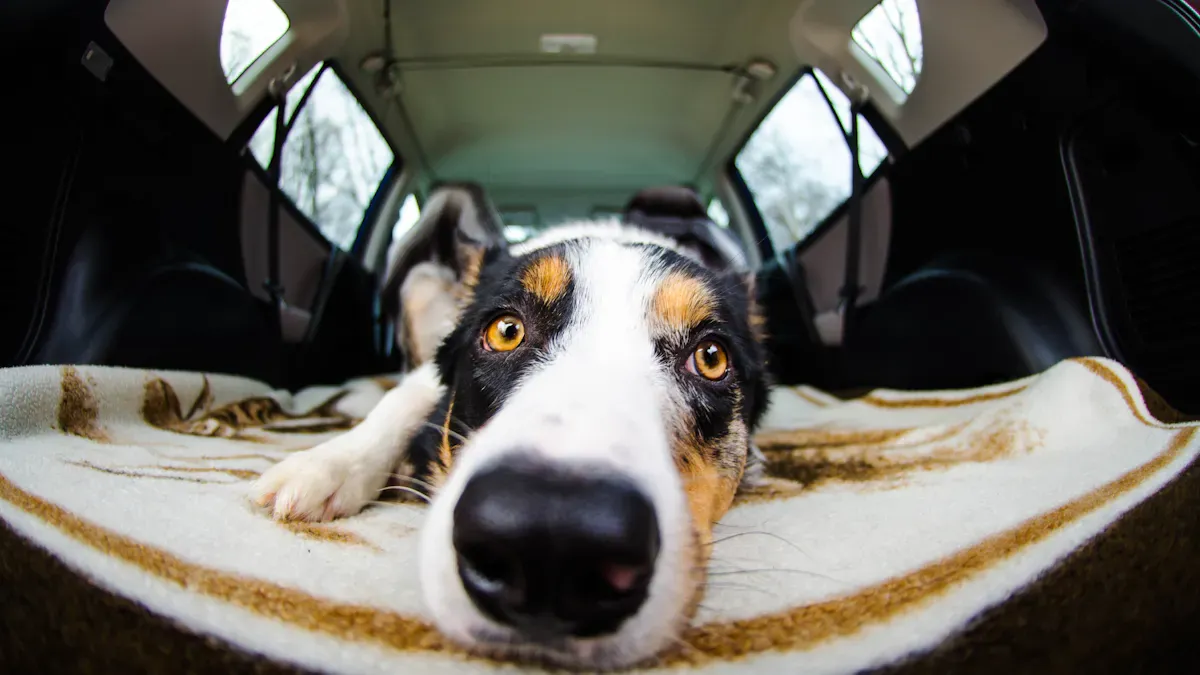
Four design decisions determine whether the mesh barrier stays open or folds inward during a drive. They work as a system — one weak link and the whole front panel loses tension.
Reinforced Edge Binding and Tensioned Panel Geometry
The edge binding is the load path. A single-line stitch through lightweight polyester edging allows the mesh to roll under side pressure. A double-stitched binding with a denser border material — typically a nylon webbing folded over the mesh edge — creates a rigid rectangular frame. When the dog leans, force travels along the frame rather than folding it.
Panel geometry matters just as much. A mesh panel cut wider than the distance between the two headrests creates inherent slack. Even under tension, the extra width has nowhere to go but inward. A panel sized to match the headrest span — plus a small tolerance for seat adjustment — stays flatter under the same strap tension. The difference is visible before the dog even gets in: a well-dimensioned panel sits flat across the opening with no puckering or billowing.
You can verify this before a drive. Buckle the hammock in, pull the headrest straps snug, and press the center of the mesh with two fingers. A panel that deflects more than an inch under light finger pressure lacks sufficient edge rigidity. A panel that resists and rebounds has enough structural stiffness in the binding to hold its shape against a dog’s nose or shoulder.
Multi-Point Anchoring and Strap Placement
Two headrest clips create a hinge at the top. The bottom of the mesh swings free. Add a center anchor strap — one that runs from the lower mesh edge down to the seat base or center console — and the panel becomes a three-point tension system. The bottom edge pulls rearward, the top edge pulls upward, and the mesh spans between them like a drumhead.
This is why some back seat dog covers stay open through an entire trip while others collapse within the first few turns. The difference is not the mesh. It is the number and direction of the tension vectors holding the panel in place.
Seat anchors contribute the same way at the base. If the anchor tubes pushed into the seat crease slip forward, the entire hammock body shifts. The front panel tilts. The mesh folds. Non-slip backing on the anchor tubes — typically rubberized dots or a silicone strip — stops that drift. Without it, every brake and acceleration cycle inches the hammock forward until the front panel collapses.
| Design Difference | Warum das wichtig ist | Main Limitation |
|---|---|---|
| Reinforced edge binding (double-stitched, nylon border) | Resists mesh rolling under lateral dog pressure; keeps the panel in-plane | Adds a small amount of bulk at the fold line; may make the hammock slightly harder to fold flat for storage |
| Three-point anchor system (headrests + center tie-down) | Creates opposing tension vectors that hold the mesh panel upright under braking and dog movement | Requires an anchor point at the seat base or console; not all vehicle layouts offer a clean attachment path |
| Low-stretch panel fabric with non-slip seat anchors | Prevents cumulative forward drift that slackens the front panel over the course of a drive | Non-slip backing can trap debris; requires periodic cleaning to maintain grip on leather or smooth seat surfaces |
Fabric Selection and Side Support Alignment
Fabric stretch is a slow failure mode. A material with high elastane content feels flexible during installation, but under sustained tension — like a dog leaning against the panel for 20 minutes — it creeps. Creep is the permanent elongation that remains after the load is removed. Each drive adds a millimeter. Over weeks, the panel grows slack and the mesh window sags even with the straps fully tightened.
Low-stretch fabrics — typically an Oxford weave with minimal elastic content — resist creep better. They hold their original dimensions across repeated loading cycles. The tradeoff is a stiffer hand feel during initial setup, but the panel geometry stays stable through months of regular use.
Aligned side supports complete the frame. When the hammock side panels rise at the same plane as the front mesh, they brace the vertical edges and prevent inward folding at the corners — the most common failure point. Side panels that angle outward or sit lower than the mesh edge leave the corners unsupported. Force concentrates there. The corner folds first, then the fold propagates inward across the mesh.
In a hammock-style dog seat cover, the entire front assembly works as a unified tension structure. The mesh is only as stable as its weakest anchor point.
Where the Design Works — and Where It Does Not
A reinforced mesh panel with multi-point anchoring performs best when the hammock fits the vehicle’s rear seat geometry closely. The headrest spacing should match the panel width within an inch or two. The seat base should provide a clean anchor path for a center tie-down strap. Under these conditions, the tension system stays stable and the mesh holds its plane through braking, acceleration, and dog movement.
Performance drops off in several specific scenarios. Deep bucket seats create a gap between the seat anchors and the seat surface — the anchor tubes cannot grip what they cannot reach. A vehicle with widely spaced headrests stretches the mesh panel beyond its designed width, pulling the edge binding into tension before the dog even adds load. And a dog that habitually stands with front paws on the center console applies concentrated force directly to the weakest part of the mesh — the center span between anchor points. That loading pattern will fold even a reinforced panel over time.
The design also assumes a single dog in the back seat. Two dogs create competing load paths that the panel geometry cannot resolve. One leans left, one leans right, and the mesh stretches in opposing directions simultaneously. The result is usually a diagonal crease that blocks airflow and visibility on one side.
Choosing between a bench-style cover and a full hammock changes how much the mesh matters. A bench cover that leaves the footwell open removes the hammock’s containment function — there is no front barrier to sag — but also removes the mesh window benefit entirely. The right call depends on whether the dog needs the visual barrier and airflow the mesh provides, or just seat protection.
Disclaimer: The fit checks described here assume a smooth-coated dog of typical proportions for its breed. Double-coated breeds or dogs with very deep chests may show subtler pressure patterns against the mesh that require hand-checking rather than visual inspection. If the dog’s chest shape falls outside the breed norms the hammock’s panel geometry was patterned for — particularly barrel-chested or very deep-keeled dogs — the tension distribution described here may shift, and visible mesh sagging may not be the only signal of a poor fit.
The in-car protection and cleanliness a hammock provides is only as reliable as the barrier staying in place. A mesh panel that folds inward during a drive is not protecting anything — it is adding cleanup work later, when the dog has been anxious and panting for an hour in a stuffy, closed-in space.
Häufig gestellte Fragen
Does a stiffer mesh material prevent sagging?
Not by itself. Mesh stiffness resists local deformation, but the panel still sags if the edge binding is soft or the anchor tension is low. The failure mode is usually torsional — the edge rolls, the mesh follows. A reinforced edge binding matters more than mesh stiffness alone.
Can a center tie-down strap be added to any hammock?
Only if the lower edge of the front panel has an attachment point for it. Hammocks designed for three-point tension include a D-ring or webbing loop at the bottom center of the mesh panel. Without that hardware, a DIY strap attached to the mesh itself concentrates force on a single weave intersection and can tear the panel under repeated loading. The fit principles for car travel gear apply here too — aftermarket modifications rarely distribute load the way the original anchor design intended.
How often should the strap tension be rechecked?
Before every drive, especially if the hammock stays installed between trips. Headrest straps loosen as passengers adjust the front seats. Seat anchors creep forward under daily use. A 30-second tension check — pull each strap firm, verify the mesh sits flat — prevents cumulative slack from turning into a collapsed panel mid-drive.