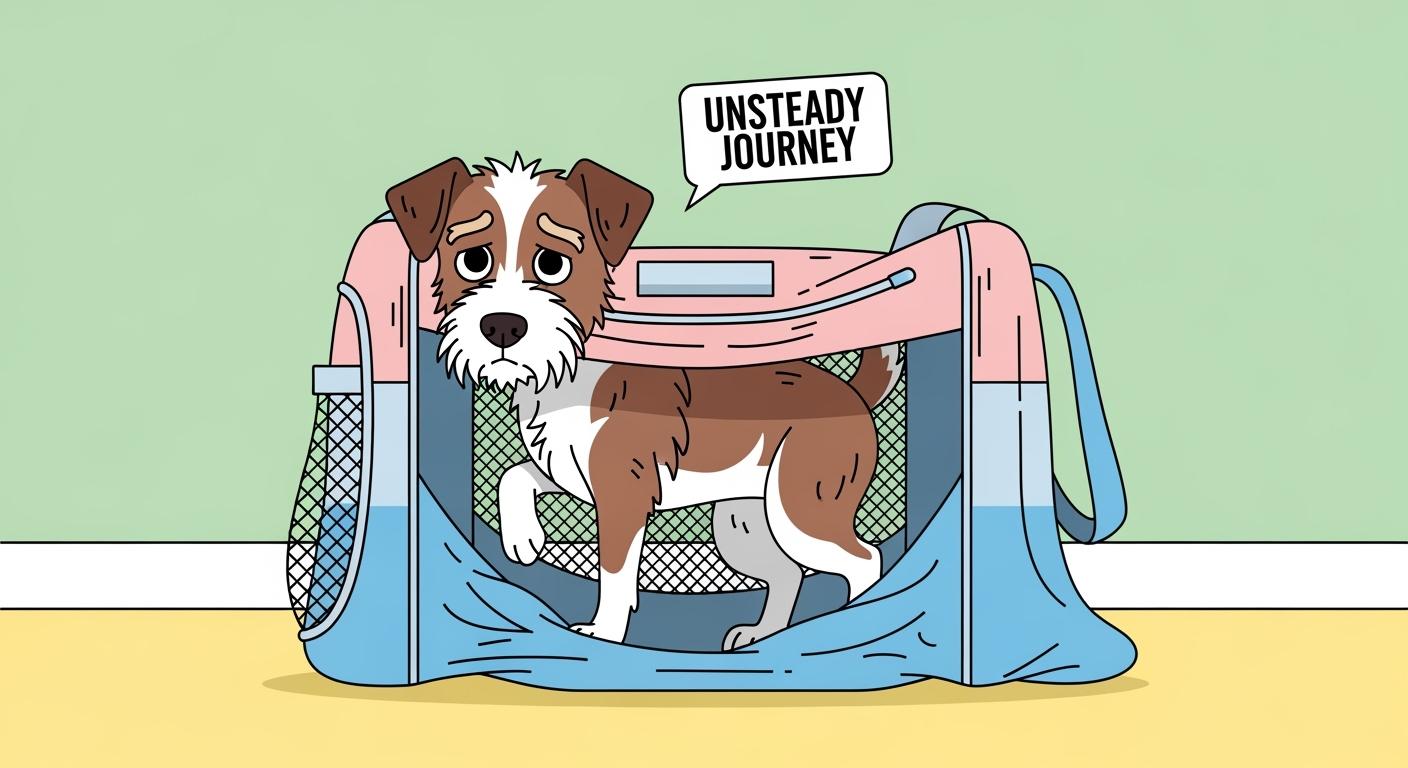
The question behind the question is not whether carriers are good for dogs. It is whether the specific carrier in front of you has a structure that holds up when a dog moves. A stable carrier does not just contain a dog — it removes the physical triggers that set off the shift-pace-escape sequence. An unstable one creates them.
When the Carrier Structure Fails the Dog
A soft base is the first failure point. When the bottom panel bends or collapses under body weight, the dog loses its footing. There is no stable surface to plant on. The dog does what any animal does on unsteady ground — it shifts. Weight rocks side to side. Front paws go up on the edge. The hind end drops, and the spine curves into a position it was not built to hold.
This is where the mechanical cascade begins. A sagging base creates a tilted surface. The tilt pushes the dog’s center of mass forward. To compensate, the dog plants its front paws on the carrier’s front edge and locks its shoulders. That locked position transfers road vibration and sudden-stop forces straight up through the shoulder joints and cervical spine — no damping, no distribution. Over a 20-minute car ride or a bumpy walking path, that repeated loading adds up. The dog does not need to be in a crash to take real joint stress.
What you see on the outside — the pacing, the pawing at zippers, the whining — is the tail end of that chain. It started with a base that bent.
In practice: Set the empty carrier on a flat floor and press down on the center of the base panel with your hand. If the panel deflects more than a fraction of an inch, it will deflect further under a dog’s weight. The dog feels that movement before you see it.
Weak side panels multiply the problem. When the carrier walls lack internal reinforcement — no rigid frame edge, no tensioned fabric panel, just soft textile that buckles under lateral load — the dog cannot lean against them for stability. A dog that wants to settle into a down position tests the sides by shifting weight laterally first. If the side gives way, the dog aborts the settle and stays standing. Standing leads to more shifting. More shifting leads to escape attempts. The most common carrier failures trace back to this exact sequence — a base that gives, sides that fold, and a zipper that becomes the only way out.
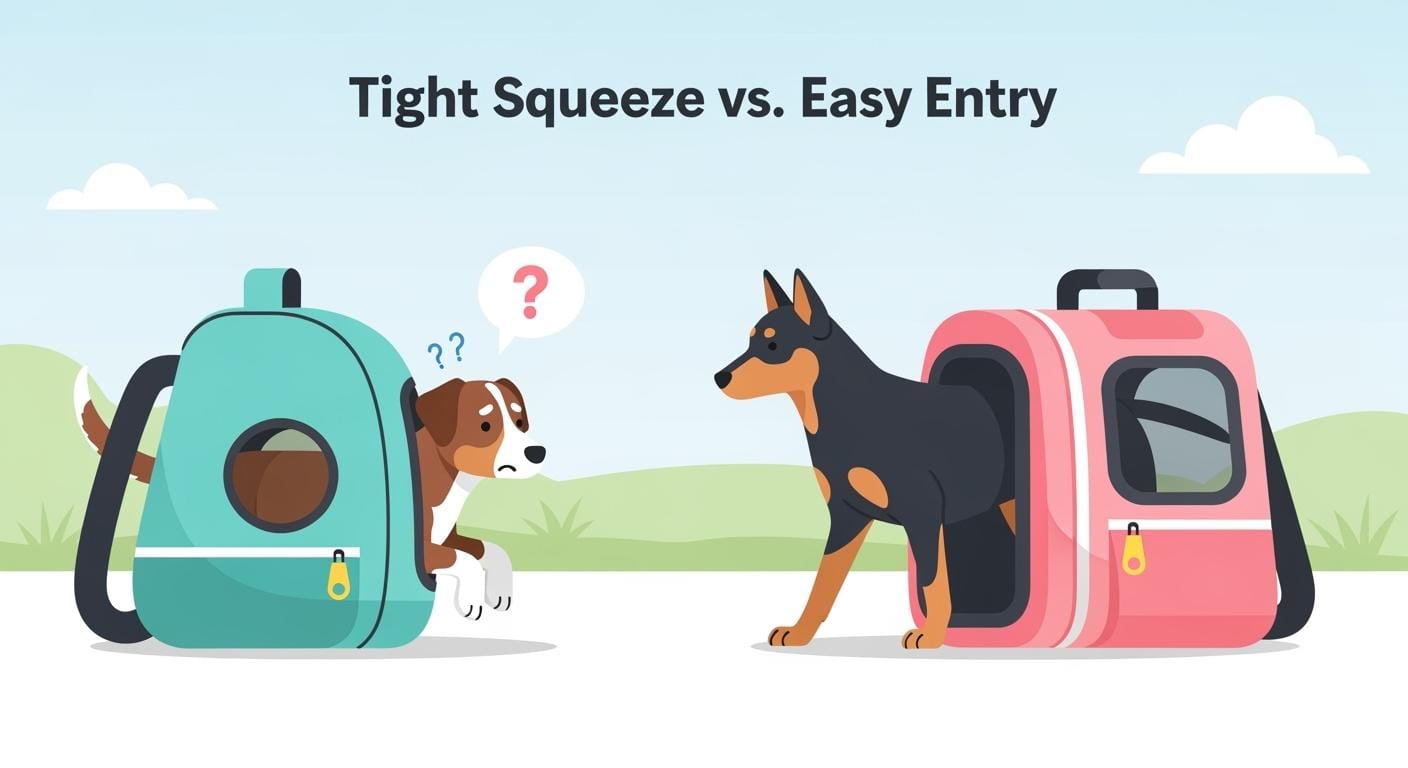
The opening design is the final gate. An oversized opening with a weak zipper is not a feature — it is an exit. When a dog already feels unstable from the base and unsupported by the sides, a gap at the front becomes the obvious route out. Zippers that separate under lateral pressure — common with coil zippers that lack a locking slider — fail exactly when the dog pushes against them. A dog that escapes once learns that the carrier is not a barrier. That learning transfers to every future outing.
How Instability Registers in the Dog’s Body
A dog that cannot find a stable surface inside a carrier does not just get annoyed. The constant micro-adjustments — the small weight shifts to rebalance every time the carrier sways — produce low-grade muscle fatigue. The hind legs brace. The shoulders lock. The neck stays rigid to hold the head steady. None of these are resting positions.
Dogs are built for horizontal locomotion, not sustained vertical bracing. Holding a semi-upright posture with a curved spine inside a sagging carrier loads joints in ways canine anatomy is not designed to absorb long-term. A young, athletic dog may shake it off. A senior dog or a breed with a long spine — Dachshund, Corgi, Basset — cannot. For those dogs, base instability is not a comfort complaint. It is a physical stress that compounds with every outing.
What a Stable Carrier Design Changes

Three design decisions separate a carrier that holds a dog steady from one that does not. Each addresses a different point in the cascade.
The base material and how it is fixed in place. A firm base is not about being hard — it is about resisting bending moment under a point load. When a dog’s weight concentrates on two paw-sized contact patches, the base panel experiences bending stress that peaks at the center. A panel with a rigid insert — a dense structural sheet, not just foam — distributes that point load across a larger area before it can create a local depression. The dog feels a flat surface under every paw placement. No tilt, no compensation, no cascade.
How the insert is secured matters as much as what it is made of. A drop-in panel that floats inside a fabric sleeve shifts after repeated loading cycles, eventually riding up one side and leaving the opposite corner unsupported. A base that is fixed — integrated into the sidewall seam or held by full-length internal retention — stays flat across hundreds of loading cycles. This distinction is invisible on a showroom floor and obvious after three weeks of daily use.
Reinforced sidewalls are the second decision. A side panel that holds its shape under lateral load gives the dog a surface to lean into. This matters more for dogs that prefer sitting to lying down — the sitting position has a higher center of mass, which creates a larger moment arm when the vehicle turns or the carrier sways. Without side support, the dog’s torso muscles work constantly to maintain posture. Over 30 minutes, that is low-grade exhaustion. Over repeated outings, it is conditioning that makes the dog dread the carrier.
The semi-enclosed shape is the third piece. A carrier that is too open — low sides, no top cover, wide mesh on all faces — reads as exposed. The dog sees exit routes in every direction and stays on alert. A carrier with raised sides and a partial top cover limits the visual field to one or two directions. That reduction in sensory input is what lets a dog switch from monitoring mode to rest mode. The design is not about confinement. It is about removing the need for constant vigilance. Getting the enclosure dimensions right — enough room to turn and lie flat without excess space that undermines the sheltering effect — is where sizing and structure intersect.
Tip: After a 15-minute outing, open the carrier and observe whether the dog bolts or stays settled. A dog that launches out the moment the zipper opens was holding tension the entire time. A dog that stays put — even briefly — had enough stability to relax.
When Carrier Design Matters Most — and When It Matters Less
The performance gap between a well-structured carrier and a poorly built one widens or narrows depending on the dog and the conditions.
Where the design differences show up hardest
Active dogs that do not naturally settle. Breeds with high baseline alertness — terriers, herding breeds, spitz types — are already scanning their environment. Give them an unstable surface and they will spend the entire outing trying to fix their footing. A firm base and rigid sides remove the physical variable so the dog can process the environmental one without stacking stressors.
Dogs with existing joint issues or non-standard proportions. A dog with hip dysplasia or a long-backed breed cannot compensate for a tilted base the way a young, proportionally built dog can. The sag forces the spine into extension or lateral flexion that these dogs cannot sustain without pain. For them, base stability crosses from comfort to physical necessity.
Long outings where micro-adjustments accumulate. A 10-minute coffee shop stop with a soft carrier might go fine. A two-hour car ride with the same carrier is a different equation. The accumulation of small balance corrections produces muscle fatigue that shows up as restlessness first, then vocalization, then escape behavior. A travel bag that fits the dog’s dimensions and stays structurally sound over time prevents the cramped-posture-to-escape pipeline.
Where the gap narrows
Dogs that reliably lie down regardless of surface. Some dogs — particularly low-energy companion breeds — curl up and stay down on almost anything. The base does not sag because the dog never stands on one spot long enough to create the bending load. For these dogs, even a minimally structured carrier may work because the dog never tests it.
Very short, stationary use. A carrier that sits on a stable surface for five minutes while the owner pays at a counter does not face the same dynamic loads as one carried on a shoulder through a train station. The design requirements scale with the motion the carrier experiences.
Front-pack carry where the owner’s body braces the structure. In this position, the carrier back panel presses against the owner’s chest, effectively bracing the structure from outside. The carrier’s own base and side reinforcement matters less because the external bracing does part of the work. Urban carrying setups span a wide range — the carrier structure that works for a front-pack coffee run may fall short for a shoulder-slung commute.
Disclaimer: The stability checks described here assume a smooth-coated dog where rub marks and pressure points are visible on the skin. Double-coated breeds may show subtler signs — run your fingers along the chest and underarm area after carrier use rather than relying on visual inspection alone. If the dog’s chest shape falls outside typical breed proportions for which most carriers are patterned — particularly barrel-chested breeds or dogs with a very deep keel — the fit assessments here may not catch every pressure point. A carrier that passes a static fit check can still create hot spots once motion and body heat are added; always check after the first real outing, not just the living-room test-fit.
Design Details That Shift Real-World Use
Two details that get less attention than base and side structure but change the in-carrier experience significantly.
Ventilation is about air path, not panel material
A carrier with mesh on only one side creates a dead air zone on the opposite face. The dog’s body heat builds up there because there is no cross-flow to carry it away. Mesh on at least two opposing sides creates a pressure differential — air enters the windward side and exits the leeward side, pulling heat and humidity with it. This is why carriers with mesh on three sides tend to run cooler: the third panel provides a secondary exit path when carrier orientation shifts relative to airflow.
Dogs cool primarily through panting, not skin sweating. In a poorly ventilated carrier, the dog pants harder to compensate, which raises arousal, which raises body temperature further. The cycle escalates. Mesh panel placement is not a styling choice — it is thermal management that directly affects whether the dog stays calm or tips into stress.
Observable signal: after an outing, reach inside and touch the carrier’s back wall. If that surface feels warmer than the ambient air by more than a few degrees, the ventilation path is not moving enough air through the full interior volume.
Internal tether placement: anchor point changes everything
A tether anchored near the carrier opening does the opposite of its intended job. It lets the dog lean out while still clipped in, loading the neck or harness attachment at an angle that concentrates force rather than distributing it. The correct anchor point is set back far enough that the tether goes taut before the dog’s nose reaches the zipper line. The ideal length allows standing, turning, and lying down fully — but not reaching the opening.
A tether clipped to a harness back attachment — never a collar, and not a front chest ring — distributes any sudden load across the dog’s torso rather than concentrating it on the trachea or a single shoulder strap. Fit problems and material failures are the two most common reasons carriers get returned — and a poorly placed or sized tether contributes to both, because the dog never settles and the owner assumes the carrier simply does not fit.
Häufig gestellte Fragen
How do you know whether a carrier’s base is firm enough before buying?
Unzip the carrier in-store or immediately after unboxing and press the center of the base panel with your full hand, not just fingertips. A base that deflects under hand pressure will deflect more under a dog standing on two paws. Also check whether the base insert is sewn into the perimeter or just dropped into a sleeve — lift the interior pad and look for stitching that anchors it to the sidewalls. A floating insert migrates over time and creates an uneven surface.
What size carrier should a dog that stands or shifts have?
Measure the dog’s standing height from floor to top of head and length from nose to base of tail. The carrier interior should exceed both measurements by enough that the dog can stand without the head pressing into the top panel and turn around without folding the spine laterally. If the only way the dog fits is by ducking or curling, the carrier is too small — and a cramped dog is far more likely to paw at openings and attempt escape.
Can a soft-sided carrier work for an active dog?
It can, but only if the base has a rigid structural insert — not just a foam pad — and the side panels hold their shape when pressed from inside. The test is simple: push outward against the side wall with moderate hand pressure. If the wall buckles or folds, the dog’s body weight will do the same thing during a turn or a sway. Soft-sided does not have to mean unstructured, but many soft-sided carriers skip the internal reinforcement that makes the difference.