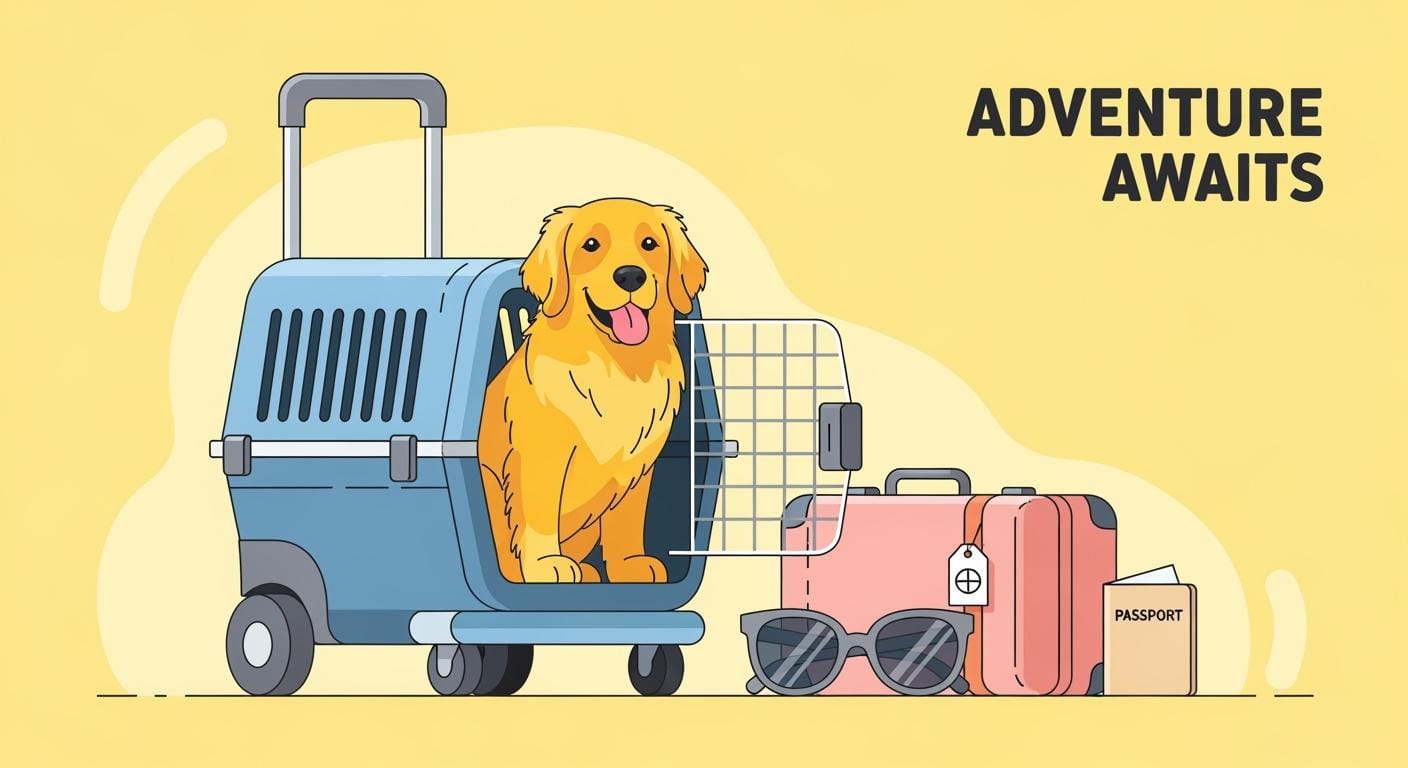
A wheeled pet carrier seems like the simplest airport solution: load the dog, extend the handle, roll. The problem starts at the first turn. If the base flexes or the wheel track is too narrow, the carrier leans. The dog slides. What looked like a convenience becomes a struggle to keep the carrier upright through every gate change and terminal corridor.
Stability is not about how many wheels a large dog carrier with wheels has. It is about where the base puts the dog’s weight relative to the wheel contact points — and whether the frame holds its shape when pulled at an angle.
Why the Base Decides Whether a Wheeled Carrier Tips
Most tip-over failures trace to the same root cause: a support triangle too small for the load it carries. A wheeled dog carrier has two or more wheels touching the ground and a handle through which pulling force enters the system. When the handle is pulled at an angle — turning in an airport queue, weaving through a station crowd — the force vector points sideways and downward. If the wheelbase is narrow, that sideways component creates a moment arm long enough to rotate the carrier around its outside wheel. The carrier tips. The dog hits the side panel.
Widen the wheelbase and the math changes. The same sideways force now acts across a longer lever arm at the base, so the moment needed to lift the inside wheels off the ground increases. A carrier with wheels set 14 inches apart resists tipping roughly twice as well as one with wheels at 10 inches, assuming the same center of gravity height. That is not a marginal difference. It is the gap between a carrier that stays planted through a sharp turn and one that goes over.
But the wheelbase alone is not enough. A soft base panel introduces a second failure mode. When the bottom flexes under the dog’s weight, the dog’s hips drop and the front paws press against the front edge. The dog’s center of mass shifts forward and to one side — usually the side of the sag. Now even a wide wheelbase fights a losing battle, because the load is no longer centered over it. A structured bottom — a rigid insert or a double-layer panel with reinforced stitching — keeps the dog’s weight distributed evenly inside the support footprint.
Here is what that looks like across different design choices:
| Design Difference | Warum das wichtig ist | Main Limitation |
|---|---|---|
| Wide vs. narrow wheelbase | Increases the side-force needed to tip the carrier; directly reduces tipping on turns | Wider base adds bulk in narrow airplane aisles |
| Structured bottom vs. soft base panel | Keeps dog’s hips level and weight centered over the wheels; prevents forward weight shift during movement | Adds weight; rigid panels make the carrier less compressible for under-seat storage |
| Adjustable vs. fixed handle length | Lets the user match pull angle to their height, reducing tilt when the carrier is pulled behind | Adjustment mechanisms add a failure point at the joint |
In practice: After a 10-minute walk through a terminal, stop and check whether the carrier’s back panel still sits vertical. A forward lean of more than a few degrees means the base is sagging under load — the dog’s weight has shifted forward and the carrier is fighting to stay upright on every subsequent turn.
Materials and Seams — Where the Frame Gives Way Under Load
Single-needle stitching along load-bearing seams is the most common weak point in a large dog carrier with wheels. When the carrier is pulled, tension runs from the handle attachment through the frame and into the base. Every seam along that path experiences cyclic loading — tight during a pull, slack when stopped. A single stitch line concentrates stress along one row of needle holes. Over dozens of trips, the fabric perforations elongate, the thread abrades, and the seam opens. Bar-tacked reinforcement at the handle attachment and base corners spreads that load across multiple stitch lines in a box or zigzag pattern. The difference in fatigue life is not subtle — a bar-tacked seam at a high-stress junction outlasts a single-needle seam by a wide margin under repeated tension cycling.
Zipper material choices follow the same pattern. Recycled plastics like rPET are common in carrier zippers because they meet sustainability targets at lower material cost. But rPET zipper teeth tend to be more brittle than virgin nylon or acetal — under side pressure from a dog leaning against the mesh panel, the teeth can crack rather than flex. A failed zipper on a mesh opening means the carrier cannot be secured, and that fails the airline cabin check immediately.
Mesh panels introduce another variable. Four-side mesh gives airflow and visibility, but mesh is structurally the weakest panel on the carrier. Without internal frame support — a sewn-in stay or a rigid edge binding — the mesh collapses inward when the carrier is pulled around a corner and the side panel takes pressure from the dog’s body weight. Once the mesh folds, airflow drops and the dog’s sight line closes. The carrier goes from ventilated to claustrophobic in a single turn.
Disclaimer: The seam inspection described here assumes a carrier used at or below its stated weight limit on paved indoor surfaces. If the carrier is pulled over cobblestone, gravel, or unpaved terminal approaches, vibration accelerates seam fatigue and zipper wear. Check seams and zipper function before the return trip — not just before the outbound leg — because damage often accumulates on the first pull through rough ground and only becomes visible on the second.
When Stability Matters Most — and When It Does Not
The design advantage of a structured base and wide wheelbase is not uniform across all travel conditions. It amplifies in specific environments and nearly disappears in others.
Where it matters most: Long indoor corridors with frequent turns — airport terminals, train stations, convention centers. These spaces combine hard, polished floors (low rolling resistance but zero vibration damping) with sharp directional changes at gates, escalator bypasses, and queue lines. Every turn is a mini stress test of the carrier’s tip resistance. Add a suitcase stacked on top via a luggage strap and the center of gravity rises — now the same turn applies more tipping moment to the same wheelbase. A carrier that felt stable during a straight-line test in the living room can tip on the first airport turn once a carry-on is strapped to it.
Where it matters less: Short, straight pulls across smooth surfaces — hotel lobbies, elevator corridors, parking garage walkways. Here even a narrow-wheelbase carrier with a soft bottom can stay upright, because there is no lateral force input. The dog might still shift inside if the base sags, but the carrier will not tip. This is also the condition where the weight penalty of a fully rigid base insert is hardest to justify — for a two-minute roll from the car to the check-in desk, a semi-structured base works fine.
Spinner wheels change the equation in crowded spaces. They let the carrier move sideways without tilting, which means the user can slide past obstacles without pulling at an angle. But spinners need a rigid base to work as intended — if the base flexes, the wheel mounts go out of plane and the spinners bind. A spinner-wheeled carrier with a soft bottom performs worse than a fixed-wheel carrier with a structured bottom, because the spinners cannot rotate freely when their mounting surface deforms.
Here is how to verify stability before a trip, without relying on product descriptions:
- Load the carrier with a weight equal to the dog (use bagged rice or water bottles), zip it closed, and pull it through three consecutive sharp turns on a hard floor. If the carrier tilts more than a few degrees on any turn, the wheelbase is too narrow or the center of gravity is too high for real airport use.
- After the turn test, unzip and check the base panel. Press down firmly in the center. If the panel deflects more than half an inch, the base will sag further under repeated loading during a full travel day.
Disclaimer: These checks assume a standard short-coated dog breed with weight evenly distributed in a resting position. For barrel-chested breeds or dogs that tend to stand and shift weight during travel, the center of gravity moves higher and more forward than these static-load tests account for. If the dog stands frequently during movement, add a margin — the carrier that passes the loaded-turn test may still tip when a standing dog shifts its weight to one side during a turn.
Häufig gestellte Fragen
Why does my dog slide to one side even when the carrier is not tipping?
Sliding without tipping points to a soft base panel, not the wheelbase. When the bottom flexes, the dog’s hips sink and the body follows the lowest point of the sag — usually toward the rear corner opposite the handle. A structured bottom insert prevents this by keeping the floor flat, but adds weight and reduces compressibility for under-seat storage. The trade-off is real: carriers that fold flat for storage use flexible base panels by necessity, and those panels are the first thing to check when a dog starts leaning during travel.
Do more wheels make the carrier more stable?
Not directly. Wheel count affects maneuverability, not tip resistance. A six-wheel carrier with a narrow track width tips just as easily as a two-wheel carrier with the same wheel spacing — the extra wheels add ground contact points but do not widen the support base. What matters is the distance between the outermost left and right wheel contact points. A two-wheel carrier with wheels set wide can be more stable than a multi-wheel design with a narrow stance.
Can a luggage strap make an unstable carrier stable?
A luggage strap prevents the carrier from sliding off the suitcase, but it raises the combined center of gravity and increases the tipping moment during turns. If the carrier’s base is already marginal, stacking it on a suitcase and strapping it down makes tipping more likely, not less. The strap solves the wrong problem — slippage, not stability.
How do I know if the seams will hold up over multiple trips?
Before the first trip, load the carrier and pull the handle to full extension. Run your fingers along the seams where the handle attaches to the body and where the base meets the side panels. If you feel any thread gaps wider than the surrounding stitching, or if the fabric puckers unevenly along the seam line, the stitching is already under uneven tension. That unevenness concentrates stress and will open further with each trip. A well-constructed seam feels uniform to the touch along its full length under load.