A treat pouch that stays put during training is not about brand or price. It is about two physical decisions: how the pouch attaches to your body and whether the opening holds its shape under load. Most clip-on bags fail on both counts once you start walking, bending, and reaching for rewards. A dog treat pouch built around a wide waist anchor and a firm rim solves both problems at once — and the difference shows up in reward timing, not in a product photo.
Why Clip-On Treat Bags Flip Once Training Starts Moving
Standing Still Is Not the Test
A pouch clipped to a belt loop or pocket feels secure when you stand upright and motionless. The clip grips. The bag hangs. Everything stays where you put it. But training does not happen standing still.
The moment you take a step, two forces go to work on that clip. Your hip rises and drops with each stride, transmitting a vertical impulse through the attachment point. At the same time, your torso rotation during walking creates a lateral swing. A narrow clip converts both of these into torque around a single pivot — the clip itself. With no second anchor to resist rotation, the pouch twists. After ten or fifteen steps, the opening that faced your hand now faces your hip or your back.
Bending amplifies the problem. When you lean forward to reward a dog at ground level, a clip-attached pouch swings outward like a pendulum. The treat weight at the bottom of the pouch pulls the center of mass away from your body. On the return swing, the pouch overshoots and lands rotated. You straighten up, reach for a treat, and find the opening collapsed against your leg.
What This Does to Reward Timing
Delayed rewards confuse dogs. The behavior you meant to mark happened three seconds ago. By the time you fish a treat out of a flipped pouch, the dog has already offered a different behavior — or lost focus entirely. A stable dog treat training bag keeps the opening where your hand expects it, so the reward lands within the critical one-to-two-second window. That window is not a training preference. It is how associative learning works.
You can verify this yourself. Time five reward deliveries from a clip-on pouch during a moving training session. If any delivery takes longer than two seconds from cue to treat-in-mouth, the pouch is working against you.
What Keeps a Treat Pouch Stable During Active Training
Anchor Width and Load Distribution
A wide waistband does not just hold tighter. It changes the physics of the attachment. When force enters a wide anchor — from a stride, a bend, a turn — it spreads across a broader contact patch. The distributed pressure creates friction across the entire band rather than concentrating it at a single clip point. That friction resists rotation because any twist would have to overcome grip along the full length of the band, not just at one pivot.
Put another way: a narrow clip gives the pouch a single axis to spin around. A wide waist anchor removes that axis. The pouch moves with your body instead of pivoting independently of it.
Test this before a session. Walk ten paces at a normal training pace, then stop and look down. If the pouch opening has rotated more than an inch off-center from your hip, the anchor is too narrow for the load.
Rim Stiffness and One-Handed Access
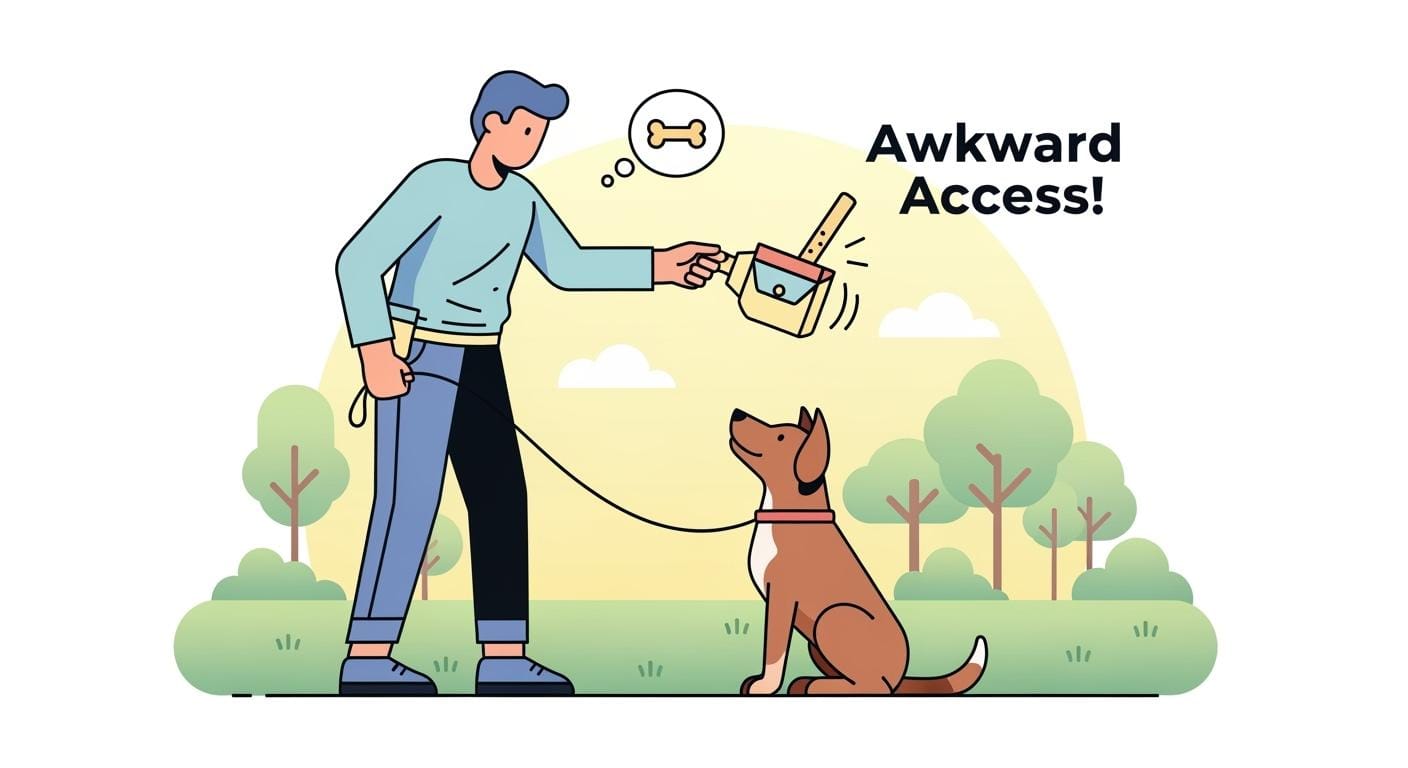
Even a well-anchored pouch fails if the opening collapses. A soft or unstructured rim folds inward when the pouch is partially full, sealing the treats inside a fabric pocket you cannot see into. You end up using two hands — one to hold the pouch open, one to grab a treat — while also managing a leash.
A firm rim solves this by maintaining the opening’s shape regardless of fill level. The rim acts as a structural ring: treats press against the sides, but the sides do not buckle. You can reach in without looking because the opening stays where you left it and in the shape you expect.
Materials matter here. A rim reinforced with a stiffener that resists deformation after repeated compression tends to hold shape across months of daily use. Rims that rely on fabric tension alone soften over time, especially when exposed to treat oils and moisture.
Check rim health after a session. If the opening has narrowed or the rim has taken on a crease that stays when you release it, the structure is degrading. A firm rim should spring back to its original shape immediately when you let go. More on how pouch structure compares across designs in this comparison of dog treat pouches.
Separated Storage Without Pulling the Pouch Off-Body
Extra pockets for keys, waste bags, or a phone sound useful. But every pocket adds weight and bulk that can shift the pouch’s center of gravity away from your body. The safest design keeps secondary storage close against the main compartment rather than hanging off the side or front. When pockets pull outward, they create leverage that works against the anchor — the same physics that makes a narrow clip fail, just at a larger scale.
A well-designed dog treat training pouch keeps the main treat compartment as the core structure, with any additional storage layered flat against it. The result is a pouch that carries a full training load without tilting or bouncing.
When a Stable Waist Pouch Works Best — and When It Does Not
Training Conditions That Reward a Wide-Anchor Design
Active outdoor sessions expose anchor weaknesses fast. Walking on uneven ground, turning frequently, bending to reward, and managing a leash with the other hand — all of these generate the off-axis forces that make narrow attachments fail. A waist pouch with a wide band keeps the opening reachable through every movement because the band absorbs and distributes those forces instead of translating them into pouch rotation.
Summer training in light clothing pushes the same advantage. Without belt loops or sturdy pockets to clip onto, a waist-worn pouch becomes the only stable attachment method available. The band carries the load independently of what you are wearing.
High-reward sessions — where you deliver treats every few seconds — make one-handed access non-negotiable. A wide anchor plus a firm rim means you reach, grab, and reward without ever looking down. Your visual attention stays on the dog, where it belongs.
When a Clip-On or Minimal Pouch Might Be Enough
A light clip-on pouch works for short, low-movement outings. A quick potty break. A five-minute reinforcement session in the backyard where you stand in one spot. The forces are low. The clip does not face the repeated impulses that break its grip during longer sessions.
Winter jackets with deep, structured pockets can sometimes replace a dedicated pouch — but only if the pocket opening stays accessible when you are wearing gloves and the pocket interior does not collect treat crumbs that attract wildlife or pests on later walks. A regular bag simply cannot match the speed difference between a treat pouch and a regular bag when reward timing matters.
Disclaimer: an unstructured clip-on pouch that works for a ten-pound dog’s training session may flip repeatedly under the treat load needed for an eighty-pound dog. Pouch stability depends on the ratio of treat weight to anchor surface area — not just the attachment style. If your dog’s daily training requires more than a handful of treats, a narrow-clip design will likely underperform regardless of build quality.
Häufig gestellte Fragen
Why does a waist-belt pouch stay more stable than a clip-on pouch?
A waist belt spreads the pouch’s weight across a wide contact area, creating friction along the full band. A clip-on attachment concentrates force at a single pivot point, which allows the pouch to spin independently of your body movement.
What makes the pouch opening stay accessible during movement?
A firm rim resists buckling when the pouch is partially full. The rim maintains the opening’s diameter and orientation, so you can reach in without looking or using a second hand to hold it open. Fabric-only rims soften over time, especially with treat-oil exposure.
Can a pouch with extra pockets still stay stable?
It depends on placement. Pockets that lie flat against the main compartment add minimal rotational leverage. Pockets that hang off the side pull the center of gravity outward, which works against the anchor and increases tilt during movement. For a complete walk setup, the spill-free training setup approach covers how pouch stability interacts with leash handling.
How do I know if my current pouch is stable enough for active training?
Walk ten paces at your normal training pace, then stop and check. If the pouch opening has rotated more than an inch from its starting position, or if you need to use your other hand to hold it open for every reward, the anchor or rim is underbuilt for your session demands.