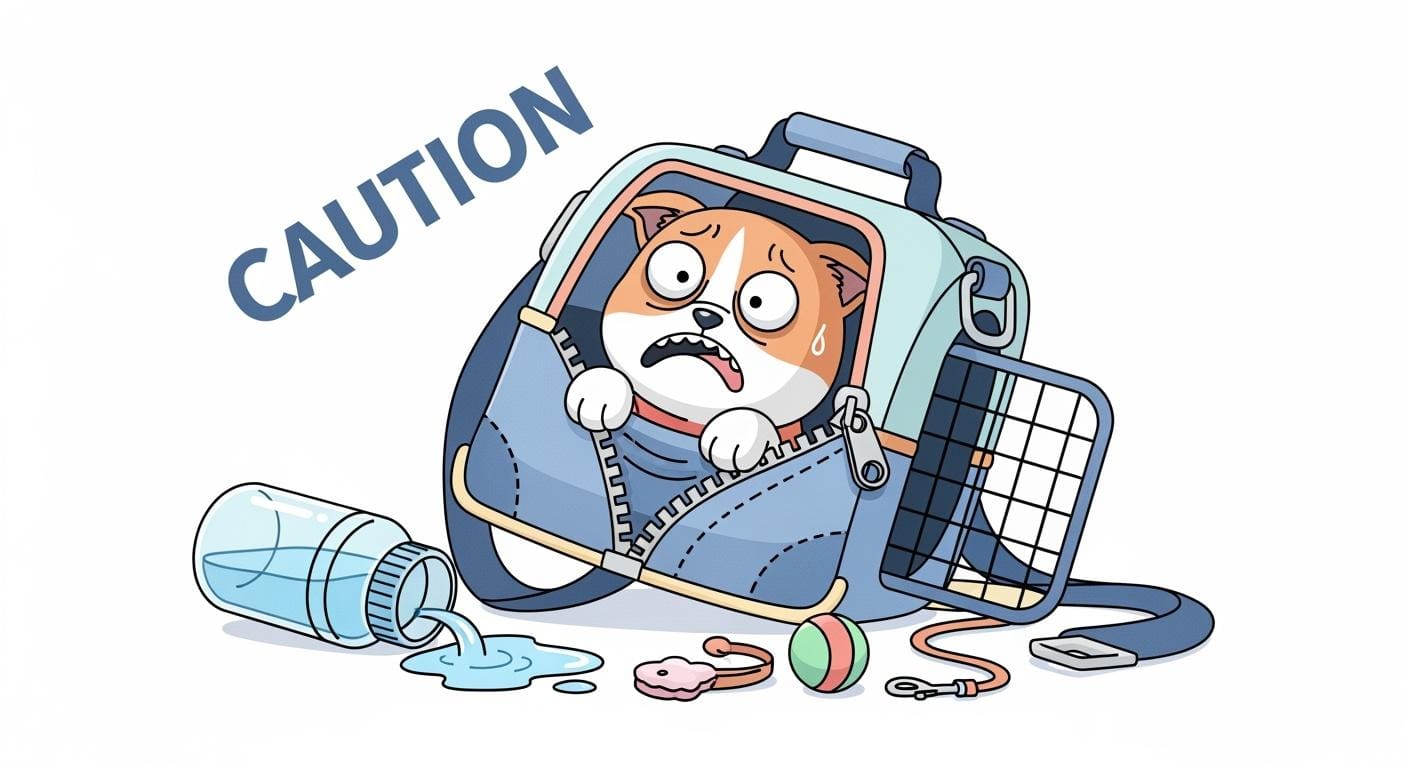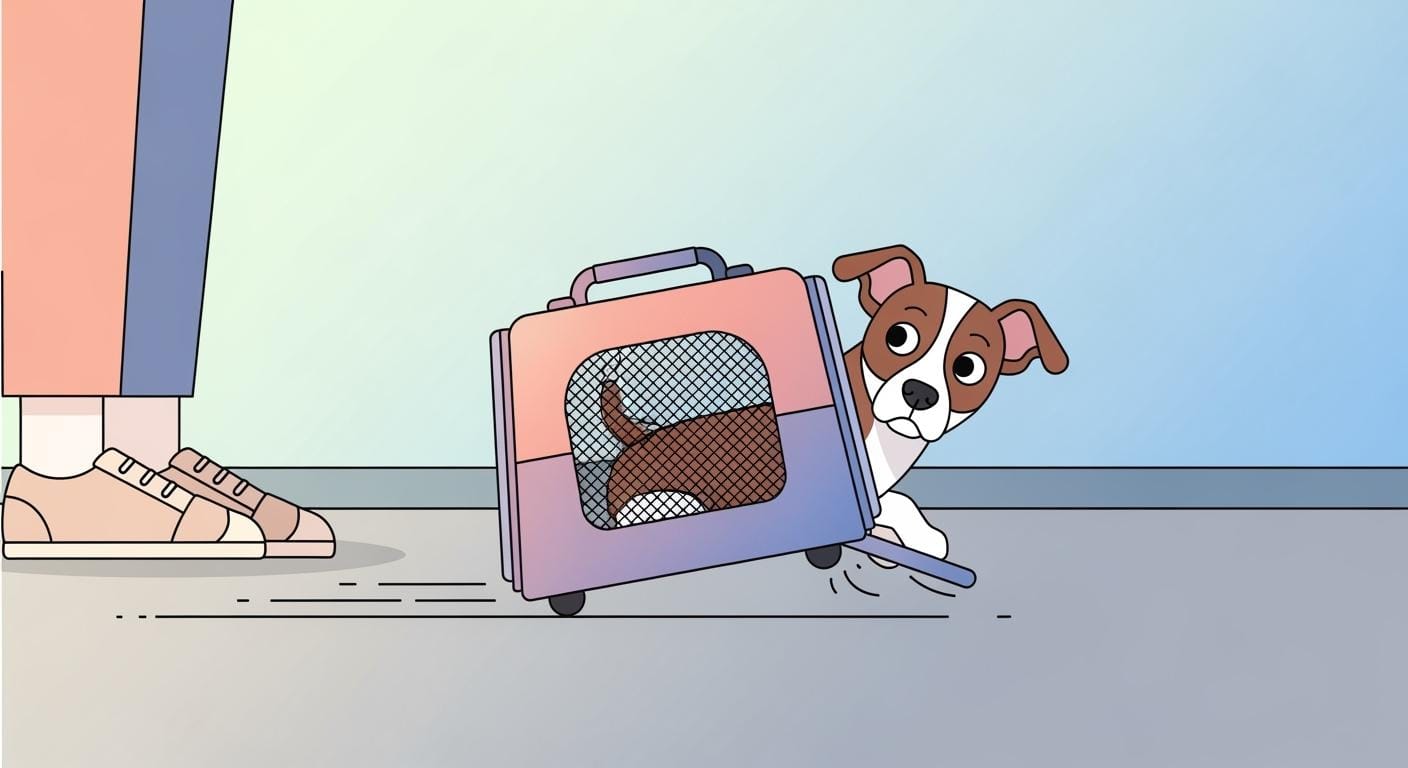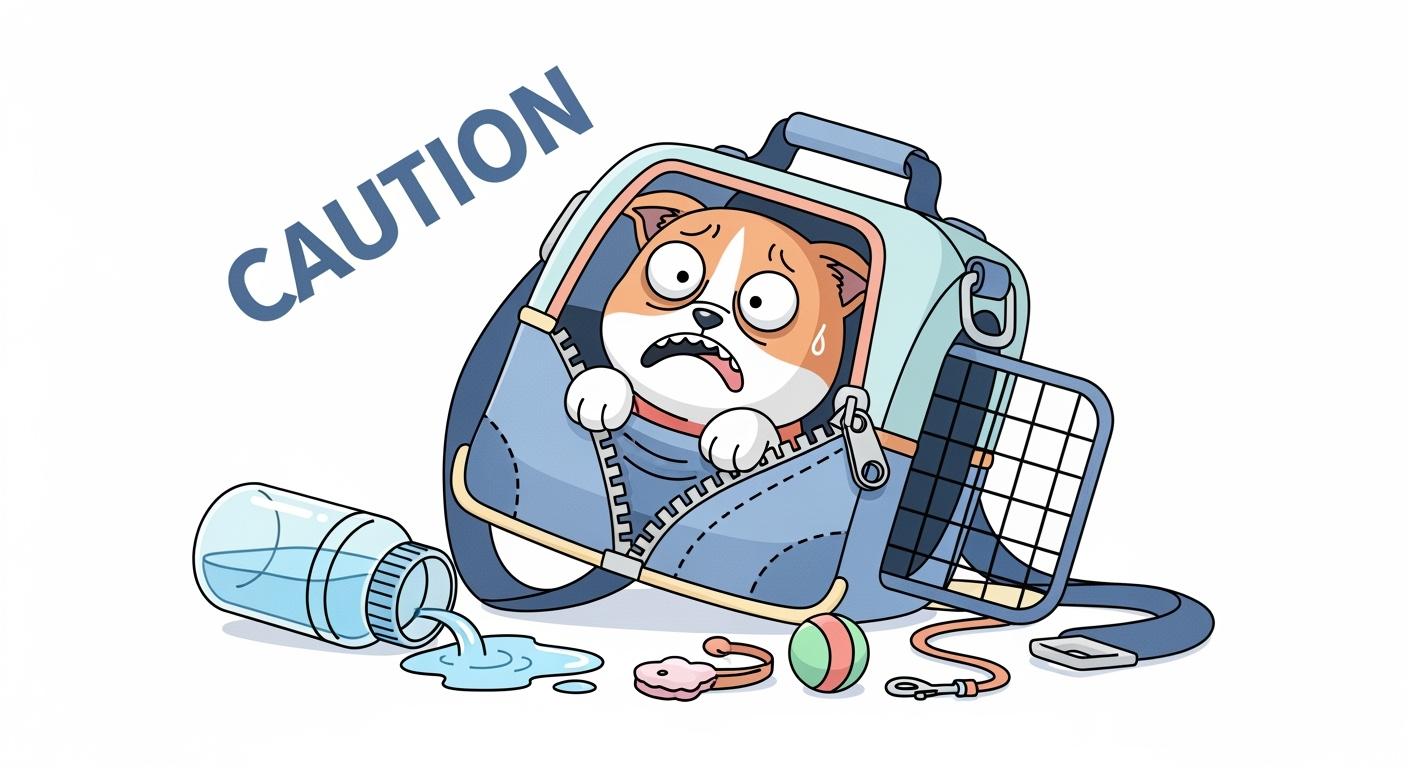
A pet carrier bag can sit dead level on the living room floor. You load your cat inside, the base feels firm, and nothing moves. Then you put it on a car seat. Within the first turn or stop, the carrier tips forward or slides sideways. The cat braces against a wall or slips into one corner. The carrier that seemed stable indoors has failed in the one place it needs to work.
The difference is the base panel and the sidewall structure. When a car brakes, the pet’s body keeps moving forward inside the carrier. That forward inertia lands on the floor panel first. If the panel flexes, the load shifts to the lowest point — usually near the front wall or one side — and the whole carrier rotates around its leading edge. A rigid panel spreads that force across its entire footprint instead of concentrating it at a single flex point. That is the mechanical reason a flat reinforced base resists tipping while a thin or padded floor invites it.
A carrier that folds or slides during a short drive is not a random failure. It follows predictable design limits. Most carrier bag mistakes trace back to the same few structural weak points — and most are visible before the carrier ever leaves the house.
Why a Soft-Sided Pet Carrier Loses Stability in a Moving Car
Five Design Weak Points That Surface Only in Motion
Place a carrier on a flat floor at home and it looks fine. The real test happens when the car moves. Five structural shortcomings tend to appear only under dynamic load.
| Design Weak Point | What Happens in the Car | How the Pet Reacts |
|---|---|---|
| Flexible floor panel | Base bends or sags under the pet’s weight during braking | Pet slides toward the dip, braces against the front wall |
| Unsupported sidewalls | Walls fold inward when the pet leans or shifts laterally | Pet feels squeezed, tries to push back or find a corner |
| Rounded or narrow bottom | Carrier rocks on its curved edge or tips sideways on turns | Pet loses footing, shifts weight to compensate |
| Slick underside fabric | Carrier slides across the seat or footwell mat during turns | Pet rides the movement, unable to settle |
| Top-heavy weight distribution | High handle points or thick upper padding raise the center of mass | Carrier tips even when the pet stays still |
Each of these weak points is testable before a drive. Load the carrier with weight equivalent to your pet, place it on a car seat, and push gently forward and sideways. If the base dips, the walls cave, or the whole unit slides, the structure will not hold up under real braking or cornering forces. This is an observable check, not a manufacturer claim.
When the Floor Panel Flexes: The Force Path That Causes Tipping
A flexible base panel is the most common cause of forward tipping. Here is the force chain: the car decelerates → the pet’s inertia pushes forward against the front wall of the carrier → that forward force transfers down into the floor panel → if the panel bends, the pet’s weight drops into the resulting dip → the center of mass shifts forward and downward → the carrier rotates around its front edge. The carrier tips.
A flat reinforced panel interrupts this chain at the transfer point. The panel does not bend, so the weight stays distributed, the center of mass stays low, and the carrier stays level. The difference is not a thicker piece of fabric — it is a rigid insert, often a plastic or composite board sewn into or slid beneath the floor liner. Carriers built with a structured floor panel tend to hold level across repeated stops and starts, while those with only foam or fabric underfoot tend to dip within the first few braking events.
What the Base Panel, Sidewalls, and Handle Placement Decide

Flat Reinforced Base vs. Flexible Floors
The floor panel is the single highest-leverage design decision in a pet carrier bag. A flat reinforced base stays level because it resists bending under point load. A flexible floor — common in carriers that use only foam padding or unsupported fabric — sags where the pet’s weight concentrates. Once the base takes a bowl shape, the pet slides to the lowest point and cannot reposition without fighting gravity.
The observable difference after a 10-minute drive is easy to spot: open the carrier and check whether the floor liner sits flat or shows a visible dip where the pet was resting. A dip means the panel flexed. No dip means it held.
| Base Type | Behavior Under Load | Pet’s Position After Drive |
|---|---|---|
| Flat reinforced (rigid insert) | Stays level, no sag | Pet remains near center, posture natural |
| Flexible (foam or fabric only) | Bends, dips, or bowls | Pet has slid to one wall or corner |
Anti-Slip Bottom and Center of Gravity
A slick underside lets the carrier glide across a fabric car seat or a carpeted footwell mat. An anti-slip bottom — typically a rubberized or textured panel — increases surface friction enough to hold position under cornering loads. Combined with a low center of gravity, it keeps the carrier planted. Carriers that stack the handle hardware high or use thick upper padding raise the center of mass and become easier to tip, even if the base itself is flat.
Controlled Soft Sidewalls and Interior Floor Width
Soft sidewalls are not inherently a problem. The problem is sidewalls with no structure at all. When a pet leans into a turn or shifts position, an unsupported wall folds inward. The carrier loses its shape. The pet loses usable floor space and ends up pressed against fabric that offers no resistance.
A controlled soft sidewall — one with sewn-in reinforcement panels or strategically placed structural seams — gives enough to cushion but resists full collapse. Cat carriers with reinforced side panels hold their internal volume during turns, which keeps airflow paths open and gives the pet a stable reference surface.
Interior floor width matters for the same reason. A narrow floor forces the pet into a single position. Any shift in weight sends the pet into a wall. A wider floor gives the pet room to adjust without pressing against the sidewalls, which reduces the lateral force that triggers wall collapse in the first place.
How Thick Padding Can Backfire
Thick soft padding under the floor liner may look comfortable, but it creates an unstable surface. Under load, padding compresses unevenly — more under the heaviest part of the pet, less elsewhere. The base takes a bowl shape. The pet slides to the center of the bowl and cannot find a flat spot to settle. A firm, minimally padded base avoids this entirely. Carrier bags with a rigid floor insert and controlled padding stay flat under body weight instead of cupping around it.
Handle Placement and Carrying Mechanics
Handle placement determines how the carrier behaves when you lift it — and how it sits when you set it down. Short, stable handles mounted close to the carrier body keep the weight balanced and close to your torso. Long, loose handles let the carrier swing. That swing translates into tipping when you place the carrier on a seat: one side touches down first, the pet slides, and the carrier settles crooked.
| Handle Design | Carrying Experience | Effect on Pet |
|---|---|---|
| Short, close-mounted | Carrier stays near body, balanced lift | Pet does not shift during pickup or set-down |
| Long, top-mounted only | Carrier swings, tips on placement | Pet slides to low side, braces |
The second observable check: after carrying the loaded carrier from the house to the car, set it on the seat and check whether it lands flat or tilted. A tilted landing means the handle geometry is working against stability. Car-ride carrier mistakes often start before the engine turns on — with a crooked placement that the pet has to fight for the rest of the trip.
Fail Signals and Better Design Responses
| Fehlermeldung | What You See | Better Design Response |
|---|---|---|
| Sidewall collapse | Walls fold inward, pet pressed into a corner | Controlled soft structure with reinforcement seams |
| Bowl-shaped base | Pet slides to center, cannot stay on one side | Flat reinforced floor panel, minimal padding |
| Narrow floor | Pet has one position, shifts directly into walls | Wider interior footprint |
| Base sagging | Carrier tips forward during braking | Rigid base insert |
| Seat sliding | Carrier moves across seat during turns | Anti-slip bottom panel |
When a Soft-Sided Carrier Is Not the Right Tool
A soft-sided pet carrier works best under a specific set of conditions: calm small pets, short car rides, and flat seat surfaces. Push beyond those boundaries and the same design features that make the carrier lightweight and collapsible become liabilities.
Restless pets that pace or dig inside the carrier apply repeated lateral force to the sidewalls. Even a well-structured wall can fatigue under constant prying. Large dogs exceed the weight range that soft-sided floor panels are built to support — a 50-pound dog in a carrier designed for 15 pounds will bottom out the base panel regardless of how rigid it is. Long drives compound every stability problem: a slight base sag that is tolerable for 10 minutes becomes a stress position for the pet after an hour.
Warning signs that the carrier is failing its job:
- The carrier tips forward when you brake gently.
- The pet has slid to one wall by the end of the drive.
- Sidewalls show permanent creases or inward folding marks.
- The base panel dips visibly when you lift the empty carrier by one end.
- The carrier slides across the seat during normal turns.
Disclaimer: The stability checks described here assume a smooth-coated cat or small dog in the 8–18 lb range and a flat rear seat surface. Double-coated or long-haired breeds may mask subtle sliding because fur compresses against the carrier wall, so visual inspection may miss small position shifts. Cats with a very deep chest or barrel-shaped torso may sit differently inside the carrier, changing the weight distribution and altering how the base panel performs. If your pet’s body shape falls outside typical breed proportions, hand-check the floor panel for dips after each drive rather than relying on visual position checks alone.
For a restless or large pet, a hard crate with a rigid shell and tie-down points does what a soft-sided bag cannot. The carrier that passes a living-room test can still fail on the road — because static fit and dynamic stability are different design problems.
Häufig gestellte Fragen
What should you check before putting a pet carrier in the car?
Load the carrier with a weight roughly equal to your pet, place it on the car seat, and push firmly forward and sideways. Watch for three things: does the base bend, do the sidewalls fold inward, and does the carrier slide across the seat surface. If any of these happen, the carrier will not hold up under real driving forces.
Why does a carrier that sits flat at home tip forward in the car?
The test conditions are different. At home, the carrier sits on a hard, level floor with no lateral or deceleration forces. In the car, braking shifts the pet’s weight forward into the front wall and floor panel. If the floor lacks a rigid insert, it flexes under that load and the carrier pivots around its front edge.
Can you use the same carrier for a cat and a small dog?
Yes, if both pets fall within the carrier’s weight range and the interior floor gives each enough room to sit and turn without pressing against the walls. A carrier that fits a 10-pound cat snugly may leave a 15-pound dog cramped, which increases lateral wall pressure and the chance of collapse during turns.
When should you replace a soft-sided pet carrier?
Replace it when the floor panel shows a permanent dip even when empty, when sidewall reinforcement seams have torn or stretched, or when zippers and closures no longer hold under light pressure. A carrier that cannot keep its shape without a pet inside will not keep it with one.