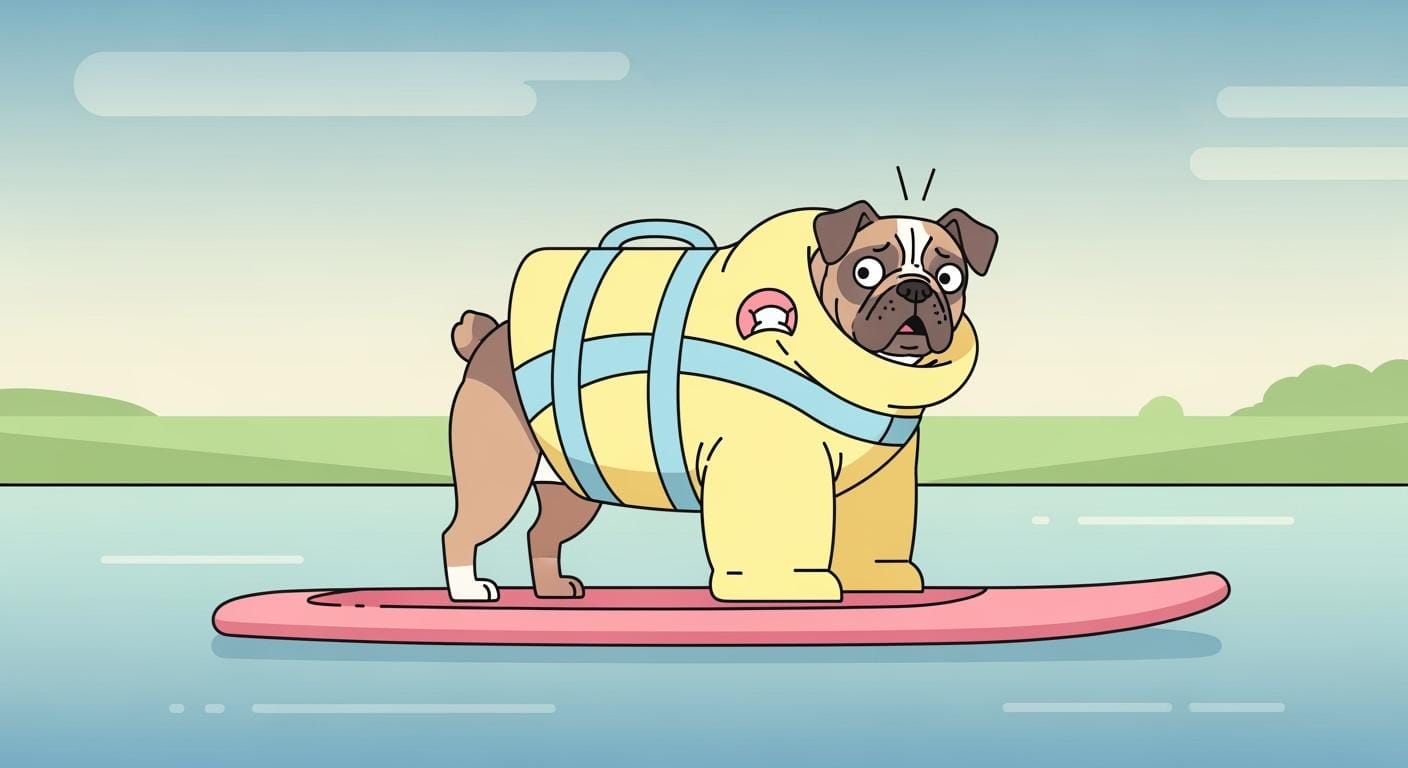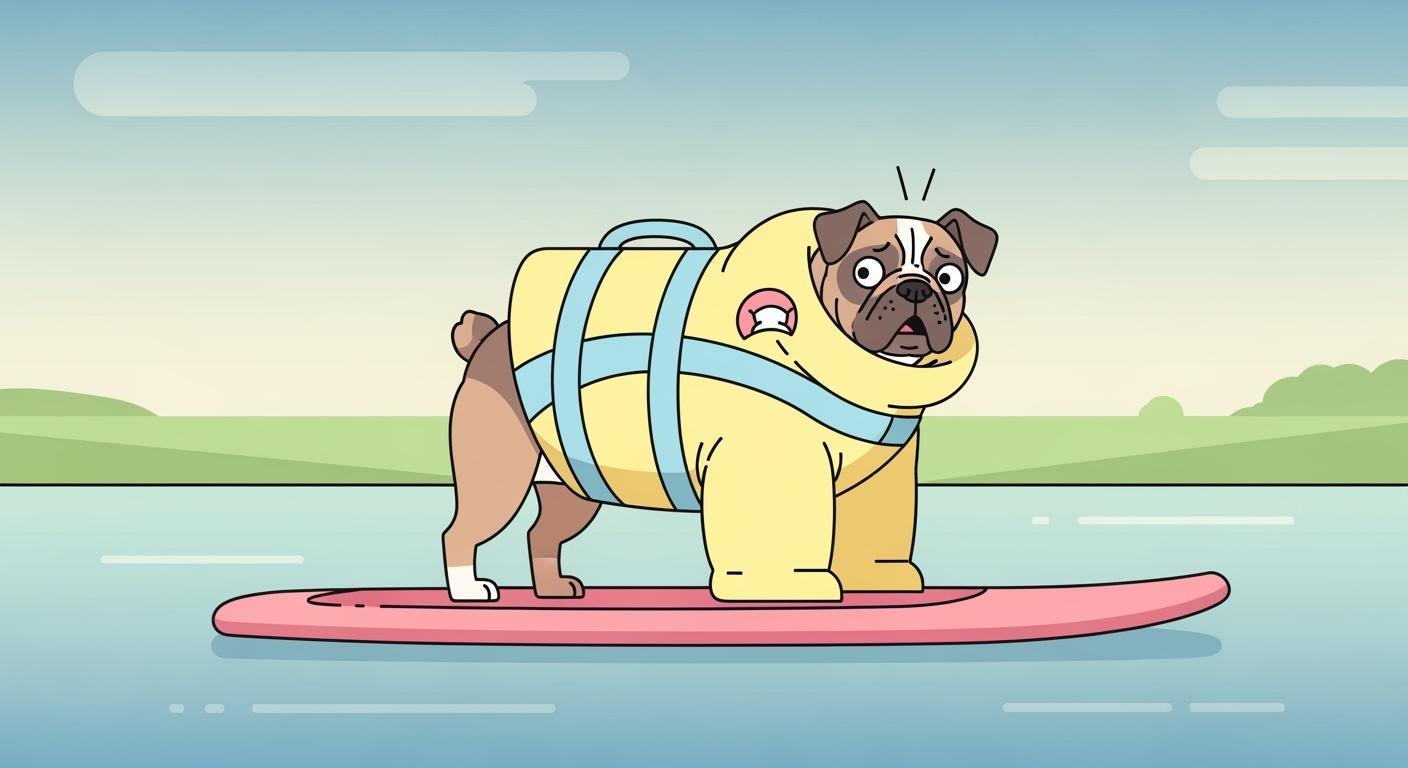
A dog life jacket for paddle board use often surprises you at the one moment that matters most: re-entry. In open water the jacket floats. Your dog swims. Everything works. But at the board edge, thick side panels catch, the jacket twists, and forward momentum stalls. The problem is not your dog’s effort. It is the shape of the foam between your dog and the board.
Most life jackets are built for swimming, not for sliding over a rigid board edge. The same wide side panels that provide flotation in open water become snag points when a dog tries to climb. This tension between buoyancy and clearance is what makes paddle board re-entry a genuine design test.
Why Re-Entry Is Where the Dog Life Jacket for Paddle Board Starts to Fail
How Side Panels Convert Forward Motion Into Twist
When a dog approaches the board edge from the water, the side panel of the jacket contacts the board first. If that panel is thick foam extending below the chest line, it creates a protruding leading edge. This edge does not slide. It catches.
The physics is straightforward. Forward momentum meets a rigid board edge through a soft, compressible panel. The force that should carry the dog onto the board instead rotates the jacket around the dog’s torso axis. The belly panel shifts. One side rises, the other dips. The dog loses the smooth glide path needed to clear the edge.
Loose strap ends and exposed buckle housings compound the problem. Each protrusion becomes a secondary catch point. The jacket rolls, the dog loses grip, and a movement that should take two seconds becomes a repeated struggle. This ride-up and twist pattern often traces back to side panel geometry and strap routing, not to the dog’s swimming ability.
An observable check: after a re-entry attempt, look at whether the jacket’s back seam still tracks the spine. If the centerline has rotated more than an inch off midline, the side panels caught and twisted during the lift.
| Fehlermeldung | Likely Product Cause | Better Design Direction |
|---|---|---|
| Jacket stalls at board edge | Thick side foam extending below chest | Streamlined side panels with clean lower edge |
| Handle lifts unevenly | Handle stitched to surface shell only | Handle anchored to structural webbing through core |
| Jacket twists or rolls mid-lift | Belly panel deforms under asymmetric load | Stable belly panel with edge reinforcement |
| Straps snag or catch | Loose strap ends and exposed buckles | Tucked strap routing flush to jacket body |
What Low-Snag Re-Entry Design Actually Means
Side Panels, Lower Edges, and the Clearance Window
Streamlined side panels keep the foam close to the ribcage rather than flaring outward. The material profile matters more than total buoyancy in this context. A panel that extends half an inch beyond the dog’s body contour creates a catch ledge. A panel that follows the ribcage curvature presents a smooth surface to the board edge.
Clean lower edges are equally important. When the jacket’s bottom hem sits above the dog’s deepest chest point, there is no excess material to drag. When foam hangs below the belly line, it acts as a brake the moment it contacts the board. The difference between a smooth re-entry and a stall often comes down to whether the jacket’s lower edge clears the board or collides with it.
Strap Routing and Belly Panel Stability
Tucked strap paths route webbing through internal channels rather than leaving loops and loose ends exposed. Exposed strap loops catch on board edges precisely when the dog’s body is at its most compressed during the climb. A design that keeps all hardware flush against the jacket body eliminates these secondary catch points.
The belly panel faces a specific structural demand during re-entry. When the handle lifts from above, tension concentrates at the panel’s leading edge. A panel without edge reinforcement rolls under, shifting the entire flotation array off-center. A properly constructed life jacket integrates the belly panel edges into the same structural webbing that anchors the handle — so lift force distributes across the dog’s underside rather than peeling one edge away.
The handle itself needs to sit over the thoracic spine, anchored to webbing that runs through the foam core. Surface-stitched handles can separate the outer shell from the foam under wet load, creating a loose grab point that amplifies twist with every lift.
Wet test before heading out: grab the handle and pull upward while someone holds the jacket at dog height. Watch the belly panel. If it rolls under while dry, it will roll worse when saturated. If the jacket’s back seam stays centered and the panel stays flat, the load path is doing its job.
When Low-Snag Design Wins — and When Maximum Flotation Still Matters
A streamlined side panel design earns its keep in conditions that demand repeated re-entry: paddle boarding, dock diving, kayak launches where the dog jumps off and climbs back multiple times per session. The difference between a jacket built for kayaking and one built for open-water boating often shows in the side panel profile. Flotation volume that helps a dog stay buoyant during a long swim becomes a liability when clearing a rigid edge every few minutes.
But there are conditions where thicker side panels are the right tradeoff. Dogs with very low body fat — sighthounds, some working breeds — lose body heat faster in cold water. The additional foam volume that makes re-entry harder also provides thermal insulation and reserve buoyancy. Non-swimmers and dogs that tire quickly in water benefit from maximum flotation, and if the dog rarely needs to self-recover onto a board, the snag risk diminishes.
The decision turns on usage pattern more than product category. A dog that paddle boards weekly in warm water needs side panel clearance more than reserve buoyancy. A dog that rides on a boat and occasionally swims in cold open water needs the opposite. Material type and foam density also shift how the jacket behaves when wet — closed-cell foam absorbs less water than open-cell, so the jacket stays lighter and shifts less during repeated lifts.
Disclaimer: This assessment assumes a smooth-coated dog with a standard chest conformation. Double-coated breeds may show subtler jacket shift patterns because the undercoat compresses differently under wet load — a visual midline check may miss pressure points that require hand-checking under the jacket edges. Dogs with a pronounced barrel chest or very deep keel may experience panel catch even on streamlined designs if the chest-to-waist contour drop exceeds the panel’s curvature.
Visibility during re-entry also deserves attention. A jacket that fits well but disappears against dark water makes it harder to track the dog’s position during the lift. Bright colors and reflective trim help in low light, in choppy water, and in any situation where the board operator needs to locate the handle quickly with one hand while stabilizing the board with the other.
Fit Checks That Change Re-Entry Outcomes
Even a well-designed jacket fails at re-entry if the fit is loose. A jacket that shifts more than an inch along the spine during a dry lift test will shift more when wet fabric stretches and water adds drag. The shoulder openings need enough clearance for the front legs to extend forward during the climbing motion — restricted shoulder movement forces the dog to pull with the chest alone, which increases the panel-to-board contact angle.
Measure along the spine from the base of the neck to a couple of inches above the tail. Measure the chest at its widest point behind the front legs. The jacket should sit snug without compression — the sizing and fit checks for swimming vests apply just as directly to paddle board use, with the added requirement that the jacket must not shift when lifted by the handle at a 30-degree angle, which simulates the board-edge geometry.
| Design Difference | Warum das wichtig ist | Where It Works | Main Limitation |
|---|---|---|---|
| Streamlined side panels vs. thick foam | Reduces catch points at board edge | Frequent re-entry, paddle boarding | Less flotation reserve for non-swimmers |
| Structural handle anchoring vs. surface stitching | Prevents shell separation under wet load | Heavy or wet dogs, repeated lifts | Adds manufacturing complexity |
| Tucked strap routing vs. exposed loops | Eliminates secondary snag points | Any board-based activity | Harder to adjust on the fly |
| Stable belly panel vs. unstructured panel | Keeps flotation array centered during lift | Dogs that twist or roll during re-entry | Slightly stiffer fit on land |
Frequently Asked Questions
Why does my dog’s life jacket twist when I use the handle to lift?
Handle force that is not centered over the dog’s spine, combined with side panels that catch the board edge, converts upward lift into rotational torque. If the belly panel lacks edge reinforcement, it rolls under and the entire jacket shifts off-axis. The fix is a handle anchored to structural webbing paired with a belly panel that resists deformation under asymmetric load.
Can a thicker life jacket work for paddle boarding if I lift the dog differently?
Lift technique helps but does not override panel geometry. Positioning the board perpendicular to the dog and pulling at a shallow angle reduces the contact force between the side panel and the board edge. If the foam still protrudes beyond the ribcage, however, the catch point remains. Technique can reduce the frequency of snags but cannot eliminate the underlying clearance problem.
What should I check before taking a life jacket on a paddle board for the first time?
Three checks. First: dry lift test. Grab the handle and pull upward — the jacket’s back seam should not rotate off the spine midline, and the belly panel should stay flat. Second: wet the jacket, repeat the test. Third: check shoulder clearance by having the dog extend its front legs forward as if climbing — the jacket should not bind at the shoulder opening.
Do small dogs need different jacket features for paddle board re-entry?
The same design principles apply, but the leverage ratios change. A smaller dog’s lighter body mass means less forward momentum at the board edge, so side panel drag has a proportionally larger effect. A compact jacket with even less side bulk and a proportionally wider belly panel tends to perform better for dogs under 20 pounds.