A cat bed cave entrance that folds inward stops being a cave. It becomes a collapsed shell — harder to enter, harder to clean, and less likely to get used. The problem is rarely the cat. It is almost always the materials inside the rim and walls.
Thin foam loses structural memory within weeks. Plush fabric without an internal frame drapes instead of standing. A bottom panel that flexes too easily lets the entire cave roll or flatten under a cat’s weight. These are not wear-and-tear inevitabilities. They are design decisions made at the material level, and they show up fast under daily compression.
A cat bed cave that holds its shape does not need more material. It needs material in the right places — a rim with enough internal resistance to spring back after every entry, walls thick enough to resist folding, and a base stable enough to anchor the structure. When those three points are right, the entrance stays open through washing, packing, and months of use.
Why a Soft Cat Bed Cave Entrance Collapses
What Causes the Rim to Fold Inward
Most cat bed cave entrances rely on foam or plush fill to hold their shape. The failure is mechanical. Foam is a viscoelastic material — under repeated compression from a cat pushing through the entrance, its cellular structure breaks down. Air pockets collapse. The material thins. Once it thins past a critical point, it no longer generates enough restorative force to push the fabric back into an open arch. The entrance does not gradually sag. It works until internal cell damage accumulates past a threshold, then it folds.
Plush fiberfill is worse. Polyester fiberfill has almost no structural memory. It compresses under load and stays compressed. If the rim contains only fiberfill, the entrance begins to sag within weeks regardless of how gently the cat enters. The fabric shell is not the problem — it is draping over a core that has given up.
Weak seams accelerate the failure. When stitching around the rim stretches or loosens, the fabric can twist relative to the fill. What was a round opening becomes an asymmetrical slit. A cat judges entry clearance visually before committing, and a twisted entrance reads as narrower than it is.
| Failure Signal | Mögliche Ursache | Better Design Direction |
|---|---|---|
| Entrance folds inward | Thin foam or fiberfill-only rim | Reinforced arch, hoop, or ring insert |
| Doorway twists asymmetrically | Weak or stretched seam stitching | Double-stitched rim channel with reinforced thread |
| Roof sags into entrance | Loose or underfilled roof panel | Structured roof with dense foam or felt layer |
Why Washing and Packing Make It Worse
Water and heat are the two fastest ways to destroy foam memory. A cold-water gentle cycle may preserve structure, but any exposure to warm water or machine drying weakens foam cell walls. Once the rim fill loses its rebound capacity, the entrance will not return to its original height without manual reshaping — and manual reshaping cannot restore the internal cell structure that made the foam spring back in the first place.
Packing creates a separate problem. When a cat bed cave is compressed for storage or travel, the rim and walls stay under constant load — sometimes for weeks. Foam develops compression set: permanent deformation that remains even after the load is removed. Pull a bed cave out of storage and the entrance stays flat on its own? The rim fill has taken a set. It will not recover. A cozy cat bed setup that gets packed and unpacked regularly demands rim materials that resist compression set — fiberfill cannot do this, and thin open-cell foam rarely does.
What a Collapsed Entrance Changes About Daily Use
Entry Hesitation and Blocked Sightline
A cat approaches a cave entrance by stopping, scanning, and deciding whether the opening allows a clean entry. When the entrance has folded inward, two things change. The opening is physically smaller. And from the cat’s eye level — roughly 10 to 12 inches off the ground — the interior looks darker and more obstructed.
The behavioral signal is consistent. A cat that pauses more than a few seconds at the entrance, or paws at the roof before entering, is telling you the opening has narrowed past its comfort threshold. More telling: a cat that switches to sleeping on top of the cave instead of inside it. The roof becomes the only usable surface — the cat still wants the location but no longer trusts the interior access.
In practice: Watch your cat approach the cave three times over the course of a day. If the cat enters without pausing on at least two of those approaches, the entrance shape is functional. A pause longer than 3 seconds, pawing at the roof, or bypassing the cave entirely on two or more approaches signals the rim has lost enough structure to change behavior.
Reduced Airflow and Harder Cleaning
A collapsed entrance does not just block the cat — it blocks air. When the opening narrows, passive airflow through the interior drops. Moisture from breath and body heat accumulates faster. The interior can feel stuffy within an hour, which discourages longer stays. A cat may enter, circle once, and leave — not because the cave is uncomfortable, but because the air inside has gone stale.
Cleaning access degrades in lockstep. A fully open entrance lets you reach inside to remove fur and debris without deforming the structure. A half-collapsed opening forces you to push against the rim to get a hand or vacuum attachment inside — and each push strains the already-weakened structure further. Dampness trapped inside a cave with poor airflow also extends drying time after washing, which accelerates fill degradation.
Design Features That Keep the Entrance Open
Reinforced Arch and Firm Entrance Rim
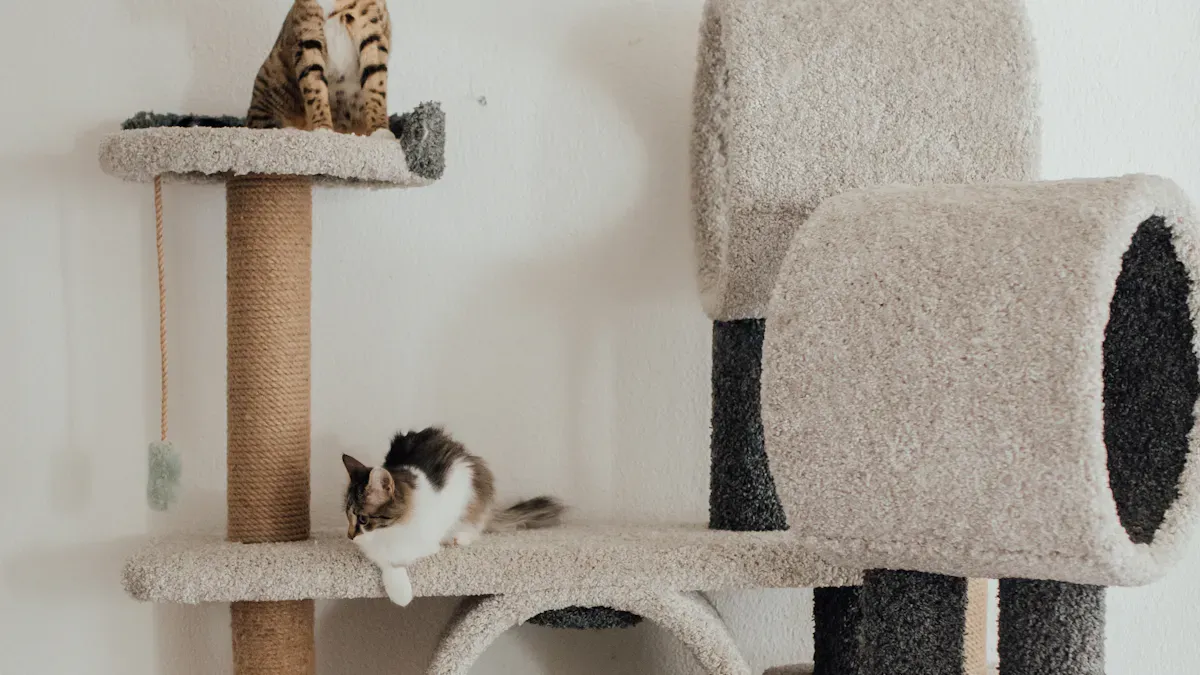
The entrance rim is the single highest-leverage design point on a cat bed cave. Get it right, and most other problems shrink. Get it wrong, and the cave is unusable within months.
Three material approaches produce a rim that holds its shape. Flexible plastic hoops — the same structural class used in pop-up laundry hampers — provide spring-loaded resistance that actively pushes back against compression. The hoop stores elastic energy when deformed and releases it immediately when the load is removed. A steel ring sewn into the rim channel creates a fixed-diameter opening that cannot collapse inward — it folds flat for storage but returns to a circle when released. Dense closed-cell foam, at least 8 mm thick, occupies the middle ground: less rigid than a hoop or ring, but with enough cellular density to recover after repeated compression.
The design tradeoff is real. A rigid rim holds its shape better but makes the cave harder to fold for storage. A softer rim packs down smaller but collapses sooner. The tunnel-style cat bed applies the same rim-reinforcement principle — the structural ring defines the usable space, and everything else follows from it.
| Material | Shape Retention Mechanism | Main Limitation |
|---|---|---|
| Flexible plastic hoop | Elastic deformation — stores and releases energy | Bulkier when folded for storage |
| Steel ring insert | Fixed geometry — does not deform under load | Adds weight; can feel rigid against the cat |
| Dense closed-cell foam (≥8 mm) | Cellular rebound — recovers after compression | Slower recovery; degrades with heat exposure |
| Thick wool felt (≥400 g/m²) | Fiber interlock — resists folding across plane | Less spring-back than hoop or ring |
Resilient Wall Material and Stable Bottom Panel
Wall material determines whether the cave keeps its interior volume or slowly deflates. Thick felt — particularly wool felt above 400 g/m² — holds vertical structure through repeated use because the fibers are mechanically interlocked, not just layered. Dense polyurethane foam sheets resist folding because they distribute compressive force across their full surface area rather than concentrating it at a crease. Both materials share a key property: they return to their manufactured shape after the load is removed, rather than taking a new set.
The bottom panel is load-bearing. When a cat steps inside, the base takes the full weight and must resist two failure modes: tipping and flattening. A wooden base or double-layered rigid panel prevents both. Without a stable bottom, even a well-structured entrance becomes unreliable — the cave shifts under the cat’s weight, the entrance angle changes relative to the floor, and the whole structure can roll. Cat bed house designs face the same challenge: a structure is only as stable as its foundation, regardless of how well the walls and roof are built.
Tip: After washing and air-drying, place the cave on a flat surface and press down on the center of the roof with moderate hand pressure. Release. The roof should rebound to its original height within 2 to 3 seconds. A dimple that stays longer or a roof that does not fully recover signals the wall fill is losing structural integrity.
Removable Cushion and Entrance Height
A non-removable cushion traps moisture because it cannot dry independently of the shell. After washing, shell and cushion dry at different rates — the shell dries faster, the cushion stays damp, and moisture migrates back into the fabric. Over multiple wash cycles, this degrades both the fill and the fabric. A removable cushion avoids the problem entirely: separate washing, separate drying, full reassembly only when both components are completely dry.
Entrance height matters independently of rim structure. A lower entry edge — roughly 4 to 5 inches — works for most adult cats. Senior cats and kittens need a lower threshold, closer to 3 inches, or a wider opening that does not require stepping over a high lip. The height determines whether the cat steps in or climbs in, and stepping is always the easier motion. If the design forces a climb, deciding between a covered cave and an open donut bed shifts — cats that find entry awkward may prefer an open bed simply because there is no entrance to navigate.
How Design Fits Different Cat Preferences
Not every cat wants the same cave. A cat that burrows and hides wants enclosure — high walls, a moderate opening, and enough interior darkness to feel concealed. A cat that prefers to monitor its surroundings wants a wider entrance and shallower interior so it can see out while resting. A reinforced rim serves both types, but differently. For the burrower, the firm entrance guarantees the cave will not collapse inward during entry, which would otherwise startle the cat mid-motion. For the observer, a wide reinforced opening stays predictably open — the cat learns that the entrance does not change shape between visits and enters without re-evaluating each time.
For multi-cat households, stability matters more than rim structure. Two cats inside a cave shift weight unpredictably. A base that resists tipping and walls that do not fold when cats lean against them outweigh whether the entrance is a perfect arch. If the cave rolls or flattens under shifting loads, one cat will eventually stop using it — usually the more cautious one. Before choosing a cat bed across different types, checking base stability with a two-handed press test catches the most common structural failures before the cat does.
| Cat Preference | Design Feature That Matters | Where It Falls Short |
|---|---|---|
| Burrower / hider | High walls, moderate opening, firm rim | Too rigid an entrance may be avoided by cats that want a soft push-through feel |
| Observer / monitor | Wide reinforced opening, shallower interior | Too much visibility reduces the sense of enclosure some cats need to settle |
| Multi-cat shared use | Stable base, walls that resist folding under lateral load | Larger footprint required; may not fit typical shelf or corner placement |
| Senior / limited mobility | Low entry threshold (≤3 inches) or wide opening | Low entry can reduce interior darkness, which some cats need for security |
When a Shape-Holding Design Is Not the Right Fit
A rigid rim is not universally better. Some cats avoid anything that feels structured at the entrance — they prefer a soft, collapsible opening they can push through with minimal resistance. A steel ring or plastic hoop creates a fixed portal. For a cat that wants to burrow in and feel completely enveloped, that rigidity can read as an obstacle rather than an invitation.
Cats that sleep on top of the cave rather than inside it do not benefit from rim reinforcement at all. They need a stable roof — a firm top panel that does not dip under body weight. The entrance structure is irrelevant if the cat never uses it.
Storage requirements also change the equation. A cave with a reinforced rim packs down less compactly than one with a fully soft structure. If the cave is stored under a bed or in a closet when not in use, the tradeoff between shape retention and storability may favor a softer design — provided you accept that the entrance may need periodic manual reshaping. The structural demands on elevated cat beds follow a parallel logic: the right amount of structure depends on whether the bed stays in place or gets moved, and whether the cat uses it as intended or finds an alternative way to occupy it.
Disclaimer: The entrance-height and fit observations described here assume a healthy adult cat of average build. Cats with arthritis, limited hip mobility, or recovering from surgery may need a significantly lower entry — under 2 inches — or a cave with a fully removable top that eliminates the entrance barrier entirely. If the cat’s chest depth or shoulder width falls well outside typical breed proportions — particularly cats with a deep keel or unusually broad shoulders — the structural checks described here may not catch every pressure point or entry obstruction. Double-coated breeds may show subtler signs of discomfort at the entrance that require hand-checking rather than visual observation.
Häufig gestellte Fragen
Why does a cat bed cave entrance collapse after washing?
Water exposure weakens foam cell walls, and the mechanical agitation of a wash cycle accelerates the breakdown. If the rim fill is low-density foam or fiberfill, it absorbs water, the cells rupture during the spin cycle, and the material loses the internal pressure needed to push the fabric back into an arch. Air-drying cannot reverse this — once cell structure is damaged, the rim will not recover. A removable cushion also helps because it dries independently and does not hold moisture against the rim fill during the drying period.
What materials keep a cat bed cave entrance firm over time?
Three material classes work. Flexible plastic hoops provide spring-loaded resistance and bounce back immediately after compression. Steel rings create a fixed-diameter opening that folds flat for storage but always returns to a circle — they resist collapse entirely rather than recovering from it. Dense closed-cell foam, at least 8 mm thick, recovers more slowly than a hoop but packs smaller. Fiberfill alone, regardless of stated density, does not hold an entrance arch for more than a few months of daily use.
Does a reinforced entrance make the cave harder to clean?
The opposite. A firm entrance stays open during cleaning, which gives unobstructed access to the interior. Without reinforcement, the entrance collapses as soon as you reach inside, forcing you to hold the rim open with one hand while cleaning with the other. A removable cushion further simplifies the process — pull it out, wash it separately, and let both the cushion and the cave shell dry fully before reassembly.
Is a rigid-rim cat bed cave safe for kittens?
A reinforced rim is generally safe for kittens provided the entry threshold is low enough — under 3 inches — for easy in-and-out movement. Kittens move unpredictably and may launch themselves at the entrance rather than stepping through calmly. A fixed-diameter hoop or ring handles this without deforming. The larger concern with kittens is wall material: loosely woven felt or fabric with exposed seams can catch claws during kneading or climbing, which is a material selection issue separate from rim structure.