
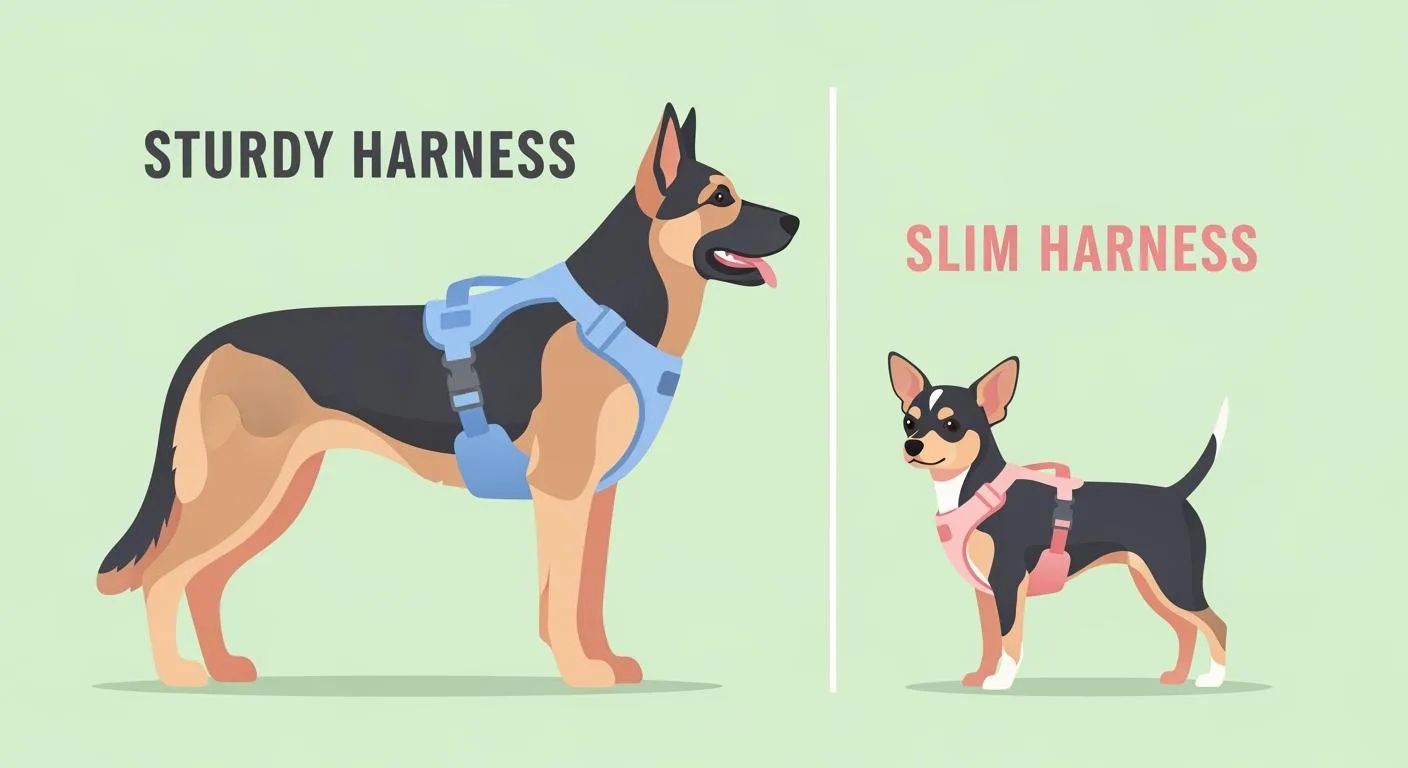
When a harness wall or product page mixes small and large options too closely, it becomes easy to compare the wrong things. Shoppers may focus on color or style first, then miss the details that matter most: adjustment range, chest support, strap width, pressure points, and how stable the harness feels when the dog pulls or turns.
This article keeps the title question practical. Separating large dog harness and small dog harness ranges is about comparing the right features for the right body size. That helps you avoid common fit mistakes, narrow options faster, and choose a harness that feels safer and more comfortable in real use.
Key Takeaways
- Large and small dog harness ranges should be separated first by body scale, not by color or style.
- A large dog harness usually needs wider load-bearing areas, stronger hardware, and more stable chest coverage than a small dog harness.
- A small dog harness often needs lighter materials, softer edges, and a lower-bulk shape so it does not overwhelm the dog’s frame.
- The easiest way to separate ranges is to compare adjustment range, support structure, and daily use before you compare appearance.
- If a harness looks right but shifts, rubs, or restricts movement, it belongs in the wrong range for that dog.
Why Large and Small Dog Harness Ranges Should Be Separated
Body Scale Changes What “Good Fit” Means
Large dogs and small dogs do not just wear different sizes of the same product. Their bodies place different demands on the harness. A larger dog usually creates more force when pulling, stopping, leaning, or twisting. That means the harness often needs broader contact points, more stable construction, and hardware that does not feel flimsy under load. Small dogs usually need the opposite: less bulk, softer edges, and a shape that does not sit too close to the shoulder or throat.
That is why it helps to treat the two ranges separately from the start. Once you do, you stop asking, “Which harness looks nicest?” and start asking, “Which harness is built for a dog this size?”
| What to Compare | Large Dog Range | Small Dog Range |
|---|---|---|
| Strap width | Usually wider to spread pressure and improve control. | Usually narrower so the harness does not feel bulky. |
| Chest coverage | Often broader and more structured for stability. | Usually lighter and shorter to avoid crowding the front legs. |
| Hardware feel | Should feel secure and proportionate to a stronger pull force. | Should feel secure without making the harness heavy. |
| Common fit risk | Pinching, shifting, or weak support under tension. | Bulk, rubbing, or a neckline that sits too high. |
Confusion Usually Starts Before the Dog Even Tries It On
Most shoppers do not start with a tape measure. They start with a quick visual filter. If large and small harness ranges look too similar, you can end up comparing products that were never built for the same body scale. That leads to the most common frustration points: a harness that seems adjustable but still feels short on the chest, a padded design that looks comfortable but overwhelms a smaller frame, or a light harness that looks sleek but feels too flimsy for a stronger dog.
Separating the ranges mentally before you compare product details helps you avoid those dead ends. It also makes the next step clearer: checking the structure instead of guessing from appearance.
3 Smart Ways to Separate Large Dog Harness and Small Dog Harness Ranges

1. Separate by Support Level Before You Separate by Style
The fastest way to compare correctly is to ask how much support the dog actually needs. For large dogs, a harness often works better when the chest panel, strap path, and hardware feel balanced under real pulling force. For smaller dogs, the better option is often the one that stays light, flexible, and less intrusive while still staying secure.
Look at support first, then style. A harness designed mainly for appearance can still be the wrong choice if the chest coverage is too narrow for a large build or too heavy for a smaller dog. If you are browsing a range where the differences are not obvious, it helps to start with the most safe and simple construction and only move toward extra features once the basic fit logic makes sense.
Tip: A large dog harness should feel stable without concentrating force in one narrow area. A small dog harness should feel secure without adding unnecessary weight or stiffness.
2. Separate by Adjustment Range and Contact Points
Many fit mistakes happen because shoppers assume “adjustable” means “for many body types.” It does not. A harness can have several adjustment points and still suit only a narrow shape range. To separate large and small ranges more accurately, look at where the harness touches the dog and how much useful adjustment it really offers.
- Check whether the chest strap can expand enough without pushing the front panel too high.
- Check whether the neck opening stays clear of the throat when the harness is tightened.
- Check whether padding sits on support areas instead of folding into the armpit zone.
- Check whether the harness still feels balanced when the leash is clipped on.
For many shoppers, this is the moment where large and small ranges become easier to tell apart. Large-dog options usually need more stable spacing between contact points. Small-dog options usually need less material and more freedom around the shoulder and neck. If you are comparing task-oriented or heavier builds, looking at special harnesses can also make the construction differences easier to spot.
3. Separate by Real Daily Use, Not by Marketing Labels
The right range becomes clearer when you think about what the harness needs to do every day. A large dog that pulls on walks, rides in the car often, or spends time outdoors may need a different structure from a calm dog that mainly needs a simple walking harness. A small dog that is sensitive to rubbing or hates bulky gear may do better in a lighter shape even if another style looks more protective.
Ask these questions before choosing:
- Will this harness be used for calm walks, strong pulling, car rides, or longer outings?
- Does the dog need more control and stability, or more softness and freedom of movement?
- Is the dog between sizes, broad-chested, deep-chested, or especially fine-boned?
- Does the harness still make sense after ten minutes of movement, not just during the first try-on?
Thinking this way keeps the article centered on the title. You are separating large dog harness and small dog harness ranges by function, fit logic, and body scale. That makes it easier to make your harness choices better without getting distracted by labels that sound impressive but do not solve the dog’s actual problem.
What to Check Before You Choose
Signs the Harness Belongs in the Wrong Range
Even when a harness is technically the right size, it can still belong in the wrong range for the dog. Watch for these warning signs:
- The front sits too high and seems close to the throat.
- The harness shifts to one side when the dog turns.
- The chest area looks too narrow for a larger build.
- The padding or edge bulk looks too heavy for a small frame.
- The dog shortens stride, scratches at the harness, or seems reluctant to move.
A Simple Comparison Method That Keeps You on Track
If you are deciding between several options, compare them in this order:
- Start with the dog’s build and likely pressure points.
- Remove any harnesses that look clearly too bulky or too lightly built.
- Compare adjustment range and chest-panel position.
- Check how the harness behaves when the dog walks, turns, and pauses.
- Only then compare extra features, colors, or add-ons.
This order helps keep the decision practical. It also keeps the article focused on what readers actually need: a clearer way to separate large and small harness ranges by fit logic, support level, and daily use.
About This Guide
This guide is written to help readers compare large dog harness and small dog harness ranges more clearly. The focus is on fit logic, support level, comfort, and common mistakes that happen when shoppers compare products built for different body scales as if they were interchangeable.
The goal is simple: make the title useful in practice. If you can separate the two ranges by support, adjustment range, and daily use, you can narrow choices faster and reduce the chance of choosing a harness that looks fine on the shelf but feels wrong on the dog.
FAQ
Why is it helpful to separate large dog harness and small dog harness ranges first?
Because it keeps you from comparing the wrong products. Once you separate the ranges by body scale, it becomes easier to judge support, strap width, and comfort in a more realistic way.
Is a large dog harness just a scaled-up version of a small dog harness?
No. Larger dogs often need different pressure distribution, broader support areas, and more stable hardware. Small dogs often need lighter builds and softer edges instead of more structure.
What is the quickest way to tell that a harness belongs in the wrong range?
Watch how it sits on the dog. If it looks bulky, shifts easily, crowds the throat, or seems too narrow in the chest area, it may be the wrong range even if the label says the size is correct.
Should I compare color and style first?
No. Compare support level, adjustment range, and contact points first. Style only matters after the harness already makes sense for the dog’s body and daily use.
What matters more for a dog between sizes?
Look at structure, usable adjustment range, and how the harness behaves in motion. A between-size dog often exposes the difference between a harness that only looks adjustable and one that actually adapts well.






