
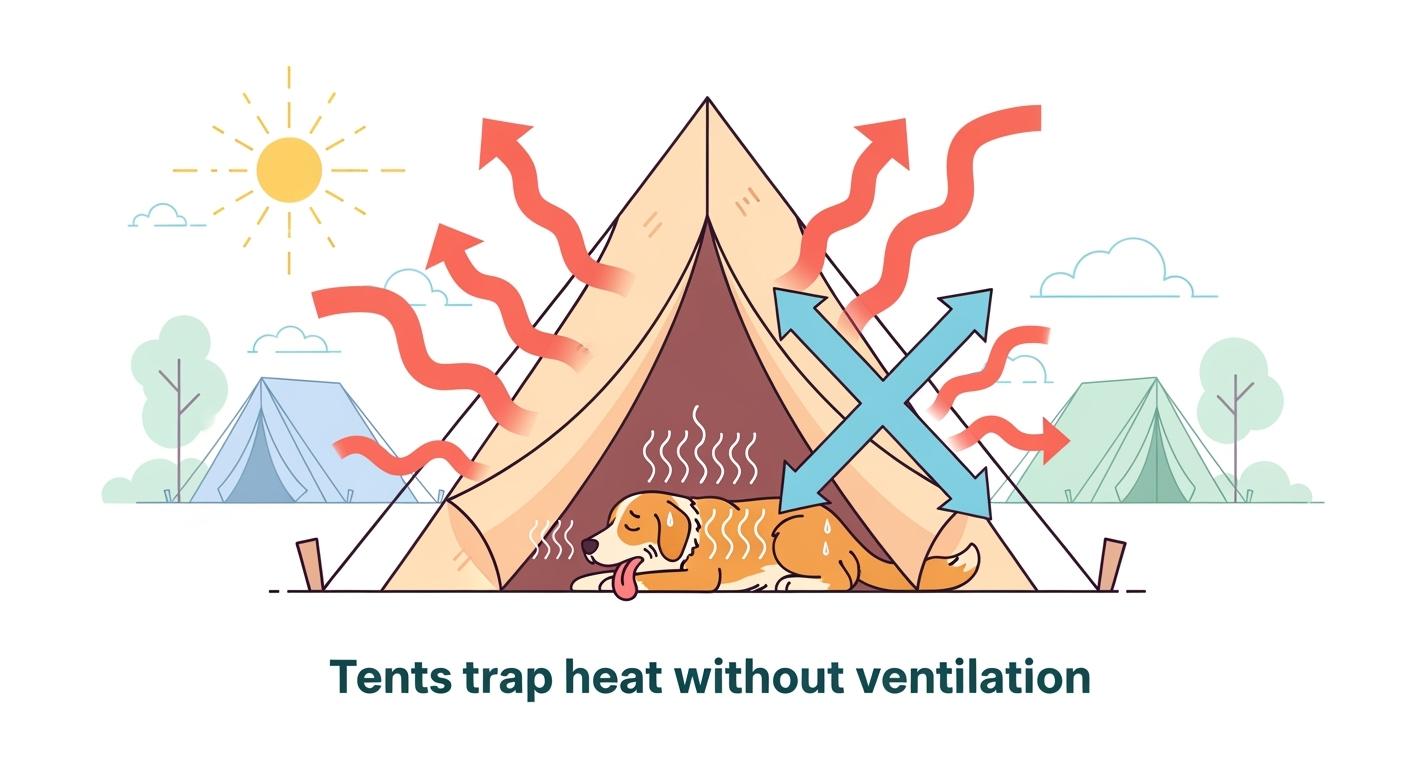
A tent with mesh on one side looks ventilated. It is not. Airflow is not about how much mesh a tent has. It is about whether air has a path to enter, travel across the dog, and exit. That path requires openings on opposite sides. Most pet tents do not provide it.
Mesh stitched into a single wall lets heat radiate out but does not create the pressure differential that pulls fresh air through. The dog sits in still, warming air regardless of how large that single mesh panel is. This is the gap between “has mesh” and “is ventilated.” Closing it means looking past material labels and into how a tent structure routes air.
Shade blocks radiant heat from the sun. It does not move air. A tent under a tree with no cross-ventilation can be hotter inside than outside within twenty minutes, because the dog’s own body heat and exhaled moisture have nowhere to go. The fabric walls that provide shade become the same walls that trap that heat.
When a Dog Tent Turns Into a Heat Trap
Mesh placement matters more than mesh quantity
A tent with a large mesh panel on one side and solid fabric on the other three creates a pocket. Warm air enters through the mesh. Body heat from the dog adds to it. The solid walls prevent it from leaving. The interior becomes a still-air oven. Opening a single door helps, but only at the door — a foot away from the opening, the air barely moves.
This is why the placement and layout of mesh panels matters more than the total square inches of mesh. Two smaller panels on opposite walls outperform one large panel on a single wall every time. The physics is straightforward: air moves when there is a pressure difference between two points. Without an exit, there is no pressure drop to pull air across the interior. Mesh on one side is a window. Mesh on two opposite sides is a channel.
Shade is not ventilation
Shade stops solar radiation. It does not move air. A tent pitched under a tree canopy with blocked sidewalls will still climb in temperature because the dog’s body heat — roughly 100 to 102 degrees Fahrenheit at rest — continuously warms the trapped air pocket. In camping setups where the tent doubles as shelter and rest space, the distinction between shade and airflow determines whether the spot is usable or dangerous.
A practical test: after the dog has been inside for fifteen minutes, reach in and feel the air at the dog’s level near the center of the tent. If it feels noticeably warmer than the outside air at the same height, shade alone is not enough. The tent needs openings that let that warm air escape.
How fast overheating starts
Dogs cool themselves primarily through panting and vasodilation in the ears and paw pads. They do not sweat across their skin. In still air, panting becomes less effective because each exhale adds warm, moisture-laden air to an already saturated interior. With no cross-flow to replace it, the dog essentially re-breathes heated air. This accelerates the heat buildup loop. A tent that starts at ambient temperature can cross into dangerous territory within fifteen to twenty minutes on an 85-degree day if the interior has no through-path for air.
Early signals are subtle. The dog shifts position repeatedly without settling. Panting increases even though the dog is at rest. The tongue extends further and appears wider at the base. These changes happen before heavy drooling or bright red gums appear. That is the window for intervention: move the dog to moving air, offer small amounts of cool water, and wet the belly and paw pads with a damp cloth. Ice-cold water immersion can trigger vasoconstriction that paradoxically traps heat in the core. Lukewarm or cool water is safer.
Cross-Ventilation: The Design Difference That Actually Moves Air
The physics of two openings versus one
Cross-ventilation is not a feature. It is a structural condition: two openings on opposing walls, positioned so that prevailing wind or natural convection creates a pressure differential. Air enters the windward opening at slightly higher pressure, travels across the interior, and exits the leeward opening at lower pressure. The dog sits in the path of that moving air column.
This is the causal chain that separates genuinely ventilated tents from mesh-decorated ones. Without opposite-side openings, there is no pressure gradient. No gradient means no bulk air movement — only weak, localized convection near each individual mesh panel that barely reaches the interior. The dog gains nothing from mesh it is not sitting directly against.
Here is an observable check: set up the tent, get down to dog height, and hold a lightweight strip of tissue or a single ply of toilet paper at the center of the interior. If it does not move within three seconds on a day with at least a light breeze, cross-ventilation is not functioning — regardless of how many mesh panels the tent has. Walk the tissue test around the interior. Dead spots near the floor or corners are where the dog’s body would be.
Entrance design as part of the airflow system
A wide, stable entrance on one side combined with a large mesh panel on the opposite wall functions as a cross-ventilation pair. The entrance becomes the intake or exhaust depending on wind direction. But this only works if the entrance stays open. Roll-up doors with tie-backs keep the opening clear without flapping shut when the wind shifts. A zippered door that must stay closed for containment eliminates that airflow path entirely — turning a two-opening system back into a one-opening pocket.
Placement of the entrance relative to sun angle also matters. An entrance facing the morning or late-afternoon sun pulls in preheated air and directs it across the dog. Angling the entrance away from direct sun, or using a tent design where the structural openings align with expected wind patterns, keeps the incoming air cooler.
Roof vents and the chimney effect
Hot air rises. A tent with mesh panels low on the walls and a vent or gap high on the roof can create a convection loop: cooler air enters low, warms as it passes the dog, rises, and exits through the roof vent. This works even on still days when there is no wind to drive cross-ventilation. A rainfly that can be raised or adjusted without fully removing it lets the owner tune airflow for conditions — more gap on hot still days, tighter coverage when wind and rain pick up.
The chimney effect is most useful when combined with cross-ventilation rather than used alone. Alone, the convection current is weak — enough to prevent extreme stagnation but not enough to create meaningful cooling on a hot day. Paired with opposite-side wall openings, the roof vent accelerates the exit of warm air and strengthens the pressure gradient across the tent.
Materials, Space, and Conditions: What Makes Ventilation Work or Fail
The material a tent wall is made from determines how much heat it radiates back into the interior after absorbing it. Synthetic fabrics like polyester and nylon reflect less infrared and tend to hold heat close to the surface. Cotton canvas and cotton-linen blends are more porous at the weave level — air and moisture vapor can pass through the fabric itself, even before considering mesh panels.
This matters at the production level: a tent made from medium-weight cotton canvas, roughly 10oz, achieves structural stiffness and a degree of passive breathability that synthetics match only by adding more mesh — which then compromises shade coverage. The trade-off is inherent in the material choice before a single seam is sewn. Synthetics win on packed weight and water resistance. Cotton blends win on interior climate control in dry heat. Neither is universally better. The conditions dictate which material’s strengths align with what the dog needs.
A breathable fabric wall paired with solid walls on the other three sides still fails. Porosity amplifies ventilation. It does not replace it. The combination that works is opposite-side mesh openings driving bulk air movement, with breathable wall fabric letting additional heat and moisture escape through the remaining surface area.
Interior space and roof height
A tent with a low roof leaves a thin layer of air above the dog. That thin layer warms faster and saturates with moisture sooner. When the roof sits high enough that the dog can sit fully upright with a gap above the head — roughly four to six inches for a medium-sized dog — warm air has room to collect away from the dog’s body before the chimney effect pulls it out.
Interior floor space matters for a different reason. A dog pressed against tent walls blocks airflow at those contact points and creates dead zones. The dog needs room to shift position, stretch laterally, and turn without resting against the fabric. This is less about comfort in the conventional sense and more about whether the air column can move unimpeded around the dog. Packing a tent for a camping trip means choosing dimensions that leave clearance on all sides, not just a floor area that technically fits the dog’s length.
Where even good ventilation falls short
Cross-ventilation has limits. On a 95-degree day with high humidity and no wind, even the best-ventilated tent cannot cool below ambient temperature — and ambient is already dangerous. Mesh panels and chimney vents can only bring the interior temperature down toward the outside air temperature. They cannot refrigerate. This is not a design failure. It is a thermodynamic boundary.
Conditions that outrun passive ventilation include: air temperatures above 90 degrees Fahrenheit with humidity above 70 percent, direct sun on any tent surface regardless of ventilation design, and extended use beyond thirty to forty minutes without a cooldown period outside the tent. Airflow-focused dog houses and tents improve safety margins but do not eliminate them. The dog’s own panting efficiency, coat type, and acclimation to heat determine how much margin actually exists on a given day.
Disclaimer: The tissue-paper airflow test described above assumes a short-coated dog and a tent with mesh panel coverage on at least two opposing sides. Double-coated breeds such as Huskies, Malamutes, and Shepherds retain more body heat and may show heat stress even in tents that pass the tissue test. For these breeds, add a second check: after ten minutes inside, slide a hand under the dog’s belly and feel for moisture accumulation. Dampness without active airflow means the tent’s ventilation rate is insufficient for that dog’s coat density, regardless of how the tissue test reads.
Dogs with brachycephalic airway structure — Bulldogs, Pugs, Boston Terriers — have reduced panting efficiency as a starting condition. A tent that keeps a Labrador comfortable may still be too warm for a French Bulldog at the same ambient temperature. Recognizing overheating signals early is the owner’s responsibility regardless of gear quality. No tent design replaces supervision and time limits in extreme heat.
FAQ
Can mesh panels alone keep a dog tent cool in summer?
Mesh panels on a single wall cannot. They reduce radiant heat buildup but do not create airflow through the tent. Without an exit opening on the opposite side, the interior air stays still and warms from the dog’s body heat. Mesh on two opposing walls is the minimum configuration that produces measurable air movement at the dog’s position.
How much interior space does a dog need for proper airflow?
Enough to lie down, sit upright without the roof touching the head, and shift position without leaning against any wall. Clearance on all sides — roughly three to four inches for a medium-sized dog — keeps the air column from being blocked at contact points. A tent that barely fits the dog’s body length in floor dimensions leaves no room for air to travel around the dog.
Is a raised rainfly enough for ventilation on a still day?
It helps but is rarely enough alone. A raised rainfly creates a high exit for warm air via convection, but without a corresponding low intake opening, the convection loop is weak. Pairing a raised rainfly with open low-level mesh on opposite walls gives the rising warm air a fresh-air supply to pull from, which strengthens the entire loop.






