
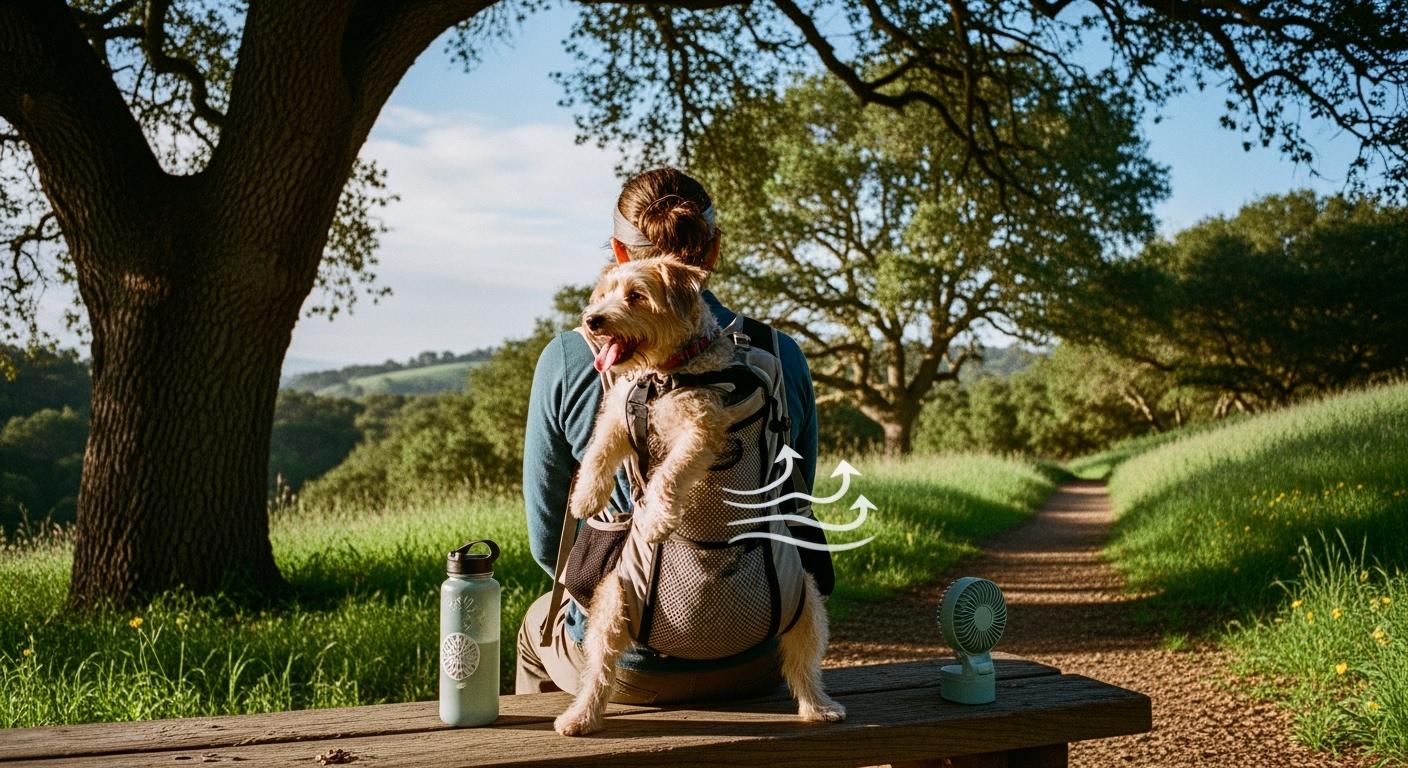
A backpack carrier that heats up in twenty minutes is not just uncomfortable. It is unsafe. The difference between a carrier that stays breathable on a summer trail and one that turns into a heat box after two blocks almost always comes down to three design decisions: where mesh panels sit, whether air has a path to move through, and how the base supports the dog’s weight.
Most carriers have mesh somewhere. That does not mean they ventilate. Mesh on one side moves almost no air. Heat rises off the dog’s body, hits the closed panel opposite, and pools. A second mesh panel on the opposing side changes the physics: warm air exits through one opening while cooler air enters through the other. That is cross-ventilation, and it is the most important thermal-management feature in an enclosed carrier. A carrier with opposing ventilation panels runs measurably cooler than one with mesh concentrated on a single face, regardless of total mesh area.
Why a Dog Backpack Carrier Turns Into a Heat Trap
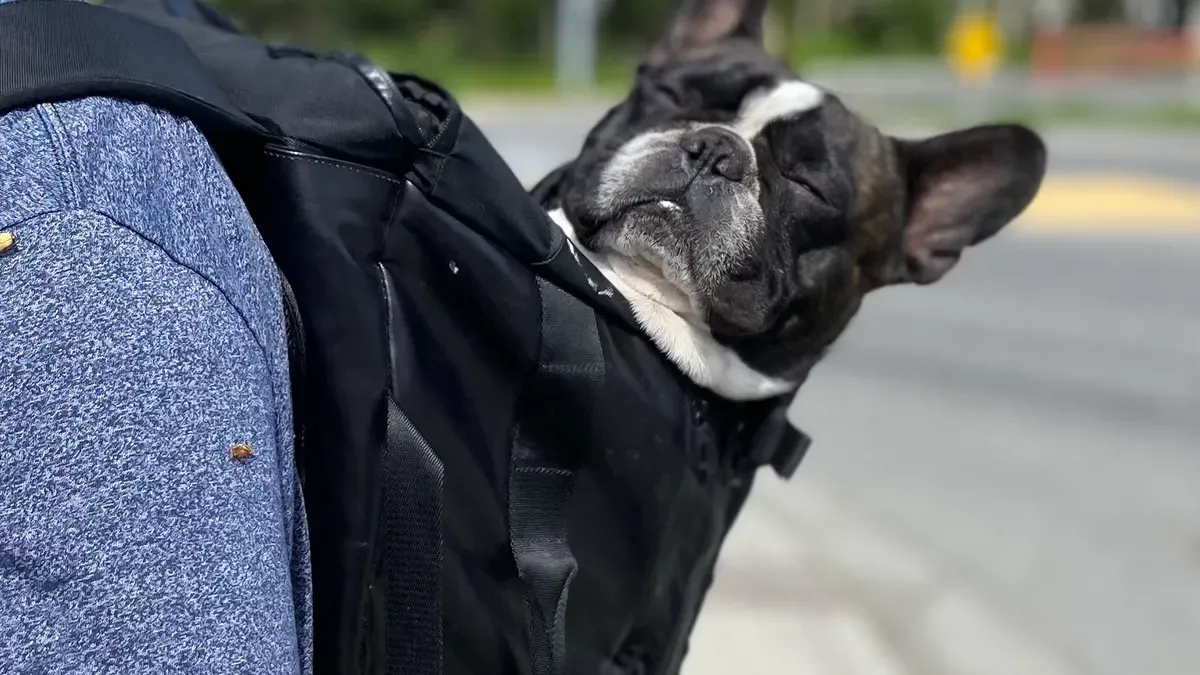
Closed Panels and Single-Side Ventilation
A carrier with mesh on the front only is a greenhouse with one small window. Heat does not leave. It circulates inside until the interior temperature climbs well past the outside air temperature. A dog’s normal body temperature sits around 101–102°F. Inside a poorly ventilated carrier, that heat has nowhere to go.
The physics is straightforward. Warm air expands and rises. If the only opening is at the front, rising warm air collects against the rear and top panels, where it stays. Mesh on opposing sides — front and rear, or left and right — creates a pressure differential. As warm air exits the higher opening, cooler outside air is drawn in through the lower one. This passive airflow cycle does not require a fan or wind. It is driven entirely by thermal buoyancy: hot air rises and pulls replacement air behind it. Without this cross-flow path, a carrier does not ventilate. It insulates.
Tip: Hold a mesh panel up to a light source. Individual light points mean high-porosity weave. A diffuse glow means tightly woven fabric that restricts airflow regardless of panel size.
Thick Padding and Soft-Bottom Bases
Padding is not the enemy. How it is positioned is. Thick foam across the base panel traps body heat at the belly and chest — the two largest heat-exchange surfaces on a dog. When the base is soft and the dog sinks into it, more body surface contacts insulating material and less skin is exposed to moving air.
A stable, firm base solves this differently. It keeps the dog slightly elevated, with air channels underneath. Combined with mesh side panels, this base allows heat to escape downward and outward rather than being absorbed into padding and radiated back up. The dog’s weight is supported without eliminating the air gap that makes convective cooling possible.
Carry time and ambient temperature compound the issue. On a 75°F day, heat buildup inside a carrier with single-side ventilation becomes noticeable within 20 to 30 minutes. Above 85°F, that window shrinks sharply — sometimes to 10 minutes or less for brachycephalic breeds whose respiratory cooling is already compromised. The safe carry window in warm conditions depends far more on ventilation design than on the outside temperature alone.
Design Features That Actually Reduce Heat Buildup
Mesh Coverage and Placement Over Heat-Release Zones
Not all mesh does the same job. The panel count matters less than where those panels sit relative to the dog’s heat-release zones.
Dogs release most excess heat through the chest, belly, and paw pads. The sides contribute less but still matter when air is moving. A carrier with a large front mesh panel but solid fabric on the sides and rear channels airflow past the dog’s face while leaving body heat trapped inside. That fails fast.
High-coverage mesh — above roughly 50% of the total surface area — changes the carrier’s thermal profile. But coverage alone is not enough. The opening pattern is what counts. Mesh panels on opposing faces (front-to-rear or left-to-right) create the cross-flow path. Mesh concentrated on one side, even at high coverage, cannot produce the same result. There is no pressure differential to drive air exchange through a single face.
The airflow demands of flat-faced breeds expose this difference immediately. A French Bulldog in a single-side-ventilated carrier may show heat stress in half the time of a longer-snouted dog of the same weight. The carrier design is the same. The physiological ceiling is different, and the ventilation design either accommodates it or it does not.
In practice: After a 15-minute carry on a warm day, unzip the carrier and place a hand on the inside of the rear panel. If it feels warmer than the outside air, the ventilation path is incomplete — warm air is pooling rather than exiting. A properly cross-ventilated carrier shows little temperature difference between the interior rear panel and ambient air.
Stable Base, Waist Strap Air Gap, and Structural Rigidity
A soft-bottom carrier that collapses under the dog’s weight eliminates the air channel beneath the body. The dog sinks in, the fabric wraps up around the sides, and contact surface area increases. More contact means more conductive heat transfer into the carrier material. Less convective cooling from moving air. Both work against the dog.
A firm, structured base prevents this collapse. It maintains the dog’s position above the bottom panel, preserving the air gap. When the base holds its shape, mesh side panels stay taut rather than folding inward. Taut mesh has higher effective porosity — the weave openings remain open rather than being pinched closed by fabric tension pulling sideways. A carrier with a rigid breathable frame maintains this airflow geometry across the full carry duration.
A waist strap adds a second thermal benefit beyond weight distribution. It holds the carrier slightly away from the wearer’s back, creating an air gap that prevents body-to-body heat transfer. Without this gap, the wearer’s back heat adds to the dog’s body heat inside an already enclosed space.
Openings positioned for quick access — side zippers or top flaps — serve a thermal function beyond convenience. They enable spot checks. After a climb or a stretch of direct sun, reaching in to feel the dog’s ears and belly gives a direct temperature reading. Warm ears typically precede heavy panting by several minutes. Catching heat stress at the warm-ear stage means you can intervene before the dog is in distress.
Disclaimer: These carry-time estimates assume a smooth-coated, healthy adult dog. Double-coated breeds may show different heat-tolerance profiles — their undercoat insulates in both directions, slowing heat absorption from outside but also slowing heat release from inside. If the dog has a thick undercoat, rely on direct checks (ear and belly temperature, panting rate) rather than time-based rules.
When Ventilation Design Works — and When It Falls Short
Cross-ventilation and a stable base extend safe carry time. They do not make a carrier heatproof. Every design has a thermal ceiling, and knowing where it sits is more useful than pretending it does not exist.
Where the design advantages hold. Shaded trails on days under 80°F, with breaks every 20 to 30 minutes: in these conditions, a well-ventilated carrier with an elevated base stays within a safe temperature range. The dog’s body heat exits through the mesh, replacement air enters, and the stable base prevents hot-spot buildup at contact surfaces. Short urban commutes — 15 minutes or less — also fall within the design’s effective range, even at warmer temperatures, provided the carrier stays out of direct sun. The thermal mass of the carrier and dog has not had time to saturate.
Where the advantages disappear. Direct sun exposure overrides passive ventilation. Solar radiation heats the carrier’s exterior fabric faster than cross-ventilation can exchange the interior air. A carrier in full sun on an 85°F day can reach interior temperatures well above ambient within minutes, regardless of mesh design. Light-colored exterior fabric reflects more solar radiation and slows this process. It does not stop it.
High humidity compounds the problem. Dogs cool primarily through panting — evaporative cooling from the tongue and respiratory tract. When ambient air is already saturated with moisture, evaporation slows. The dog pants harder but cools less. Inside a carrier, expired humid air is harder to purge, and interior humidity rises. In these conditions, even cross-ventilated carriers have sharply reduced effective carry times. The thermal limits of hiking with a dog in a carrier are set as much by humidity and sun angle as by the thermometer reading.
Brachycephalic breeds and physiological limits. French Bulldogs, Pugs, and Boston Terriers face a constraint no carrier design can override. Their shortened airways are less efficient at evaporative cooling even under ideal conditions. The same carrier that keeps a Border Terrier comfortable for 40 minutes may only be safe for 15 minutes with a French Bulldog. This is not a design failure. It is a physiological limit, and a carrier that fits well and ventilates properly still cannot change the dog’s baseline cooling capacity. Recognizing that boundary is part of responsible use.
Disclaimer: Dogs with barrel chests or unusually deep keels may not benefit equally from the base-elevation design described here. Their chest geometry places more body mass in contact with the carrier floor regardless of base stiffness. If the dog’s chest shape falls outside the breed norms this carrier was patterned for, the fit and ventilation checks described may not catch every pressure point or hot spot.
FAQ
How long can a dog safely stay in a backpack carrier on a warm day?
It depends on ventilation design, ambient temperature, sun exposure, humidity, and the individual dog. In a carrier with cross-ventilation and a stable elevated base, a healthy adult dog on a shaded 75°F day can usually ride 30 to 45 minutes with breaks. Above 85°F, cut that time by at least half regardless of carrier design. Brachycephalic breeds need shorter windows across all temperatures.
Does carrier color affect interior temperature?
Yes, but less than ventilation design does. A light-colored exterior reflects more solar radiation and heats more slowly in direct sun. A dark carrier and a light carrier perform nearly identically in shade. Color matters most when sun exposure cannot be avoided — but sun exposure should be avoided regardless of color.
Can I add a cooling mat inside the carrier?
A cooling mat addresses only conductive cooling at the contact surface. It does nothing for the ambient air temperature surrounding the dog’s head and torso. If the ventilation design is poor, the air inside still heats up regardless of what the dog lies on. A cooling mat is a supplement. It is not a substitute for cross-ventilation.
What single design feature matters most for preventing overheating?
Opposing mesh panels that create a cross-ventilation path. A carrier can have a stable base, a light color, and a waist strap — without cross-ventilation, none of those features prevent air from stagnating inside. Once warm air can exit and cooler air can enter, every other thermal-management feature becomes more effective.
Is a front-carry or back-carry position cooler for the dog?
A rear-carry position typically runs cooler because the dog is not pressed against the wearer’s chest, and the backpack format usually provides better structural rigidity for the base. A front carrier with good cross-ventilation and a rigid base can perform comparably. The position matters less than whether a waist strap creates an air gap between the wearer and the carrier body.






