
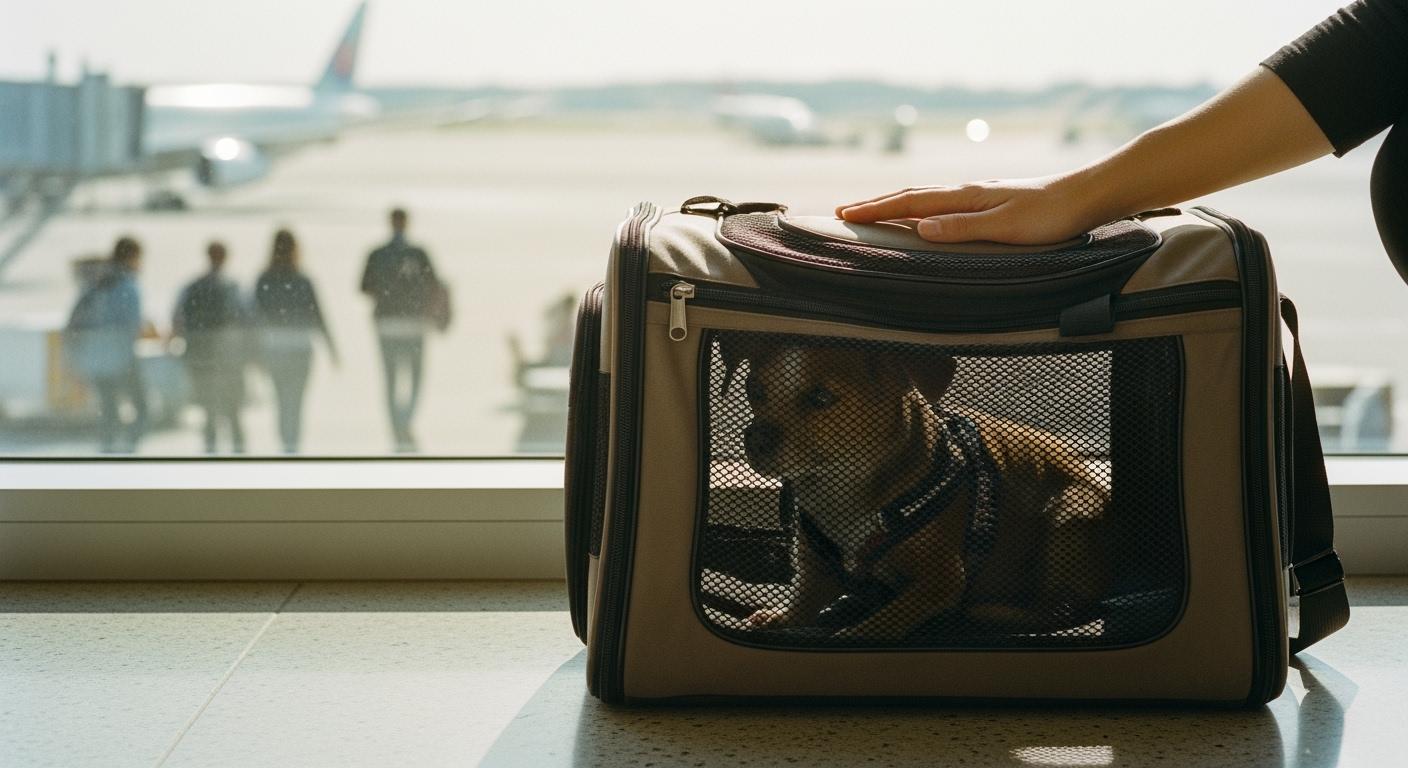
A nervous dog does not settle in a carrier the way a calm dog does. Faced with airport noise, crowds, and the rumble of jet engines, a stressed dog presses outward. It noses zipper paths. It paws at mesh panels. It tests every seam. The carrier opening is not a passive boundary. It is the primary failure interface. Whether that opening stays shut depends on three design details: how the zipper path is reinforced, how the mesh is supported at its edges, and whether the base holds its shape when the carrier is squeezed under a seat.
Which openings hold and which ones gap open is not about brand or price. It is about how the carrier handles lateral compression and off-axis force. The same carrier that looks secure sitting on a living room floor can fail in a gate area — because the forces a nervous dog applies in a confined space are different from what a relaxed dog produces, and the mechanical loads of under-seat stowage amplify every weak point.
Why Nervous Dogs Target Carrier Openings at Airports
Stress Amplifies Escape Drive — and Openings Are the Release Point
Airport terminals combine several stressors that operate simultaneously: unfamiliar surfaces underfoot, unpredictable loud sounds, rapid human movement, and separation from the handler during security screening. A dog that might rest quietly in a carrier at home enters a different behavioral state here. The confined space of an under-seat carrier triggers thigmotactic pressure — the instinct to push against enclosing surfaces when escape is blocked.
Here is the causal chain worth tracing. Sensory overload raises cortisol. Elevated cortisol sharpens the fight-or-flight response. In a confined carrier, flight is impossible. The dog defaults to pushing against boundary surfaces — zippers, mesh panels, seam edges — with sustained, repetitive force. A zipper path that is loose or un-reinforced will gap under this kind of loading. A mesh panel whose edge stitching lacks backing support will pull away from the frame. These are not random failures. They follow directly from the direction and duration of force a stressed dog applies, which is fundamentally different from the brief, passive contact a calm dog makes.
You can observe this at home before traveling. Place the empty carrier in a quiet room, then in a louder setting with movement nearby. Watch whether the zipper pulls stay aligned when the carrier body is pushed from the inside at an angle — not straight down, but at roughly 30 to 45 degrees off vertical, which approximates how a dog presses with its shoulder or nose. If the zipper tracks separate or the mesh bows outward more than half an inch, that is the same failure mode an airport environment will amplify.
The Three Airport Moments That Test Every Opening
Security screening demands you remove the dog. The carrier goes through the scanner empty, then you re-insert the dog on the other side — often hurriedly, with partial zipper closure. Boarding involves tilting the carrier to navigate narrow aisles, applying off-axis torque to the frame. Under-seat placement compresses the carrier from the top and sometimes the sides, depending on seat configuration and the passenger ahead reclining. Each of these moments applies force differently. A carrier design that handles only vertical load or only symmetrical compression will fail at one of these three points. The right design handles all three without the zipper path separating or mesh edges pulling free.
Where Standard Carrier Designs Start to Fail Under Seat
Zipper Path Gapping Under Lateral Compression
A zipper is only as secure as the fabric it is sewn into. When a soft-sided carrier is compressed under an airline seat, the fabric panels buckle. If the zipper runs along a seam without a structured edge — a rigid plastic or metal rod sewn into a sleeve along the opening — the fabric on either side of the zipper folds inward. This creates a V-shaped gap at the zipper track. A dog pressing outward from inside widens that gap with each push. The zipper teeth themselves may hold, but the fabric around them deforms enough to create an opening.
The home test that catches this is straightforward. Before your trip, zip the carrier closed and press outward from the inside with both hands along the full zipper path, applying steady pressure — not a sharp jab. If you can see daylight through the zipper track, the opening edge lacks sufficient reinforcement, and the same gap will form under seat compression. A carrier has to survive not just the geometry of the seat space but the inward buckling that geometry forces onto soft panels.
Mesh Edge Separation and Panel Collapse
Mesh on a dog carrier serves two functions: airflow and visibility. But from a structural standpoint, mesh is a weak point. Woven mesh has negligible resistance to in-plane tension — it stretches — and its attachment to the carrier frame is a seam. Under sustained outward pressure from a nervous dog, unsupported mesh stretches and pulls at the stitching. If the edge lacks a backing strip or double-stitched reinforcement, the mesh separates from the frame. Once a gap opens, even a small one, the dog’s paw or nose can work it wider.
Check this before flying. In good light, run a finger along each mesh-to-frame seam from the inside. If you feel stitching that is single-pass or the seam allowance is under a quarter-inch, that seam is a candidate for failure under sustained load. What matters is not the mesh material itself — nylon, polyester, vinyl-coated — but whether the edge attachment resists peel force, the same way a zipper resists separation force. Peel force is what a dog generates by pushing outward at an angle.
The same compression that gaps zippers collapses unsupported side panels. When the space inside the carrier shrinks by even 20%, a dog that could previously stand and turn may be forced into a crouch. That loss of space triggers panic, which triggers more forceful pushing — a feedback loop that ends at the weakest seam. A carrier that passes a home fit check can still fail under real seat compression because the forces are different — at home the carrier sits open on a floor; under a seat, it is squeezed from above and the dog is inside pushing outward.
Base Instability and the Escape Cascade
A soft or flexible base does more than make the dog uncomfortable. When the floor panel bends under the dog’s weight, the dog loses stable footing. Every muscle micro-adjustment to regain balance adds to the dog’s stress load. A dog that feels unsteady searches for a way out more aggressively. If the base flexes enough to tilt the carrier, the zipper orientation shifts relative to the dog’s pushing angle — and a zipper that was secure in one orientation may gap in another.
The observable check: place the loaded carrier (use a 10-to-15-pound weight if the dog is not present) on a flat surface, then tilt it forward and to each side by about 15 degrees. If the base panel visibly buckles or the carrier tips past 20 degrees without self-righting, the base lacks the rigidity to stay stable during boarding and under-seat maneuvering. A stable base is not about padding thickness. It is about a rigid insert — typically a removable board of plastic, plywood, or compressed fiber — that distributes the dog’s weight evenly and resists deformation when the carrier is handled at an angle.
| Airport failure signal | Likely carrier design cause | Better carrier design direction |
|---|---|---|
| Zipper gap forms under seat compression | Unstructured opening edge; fabric buckles inward at zipper track | Rigid edge rod in zipper sleeve; zipper pulls lock together |
| Mesh bulges or pulls away from frame | Single-pass stitching without backing strip; narrow seam allowance | Double-stitched mesh with internal backing strip; seam allowance at least 3/8 inch |
| Carrier collapses or tips during handling | Flexible base panel without rigid insert | Removable rigid base board; base dimensions match carrier footprint |
What Design Details Keep Openings Secure
The simplest failure to prevent is also the most common: a zipper that the dog noses open from the inside. A locking zipper closure — two zipper pulls that clip or snap together — prevents the dog from working the pulls apart with its nose or paw. But the lock alone is not enough. The zipper path itself must resist gapping when the surrounding fabric buckles.
Structured opening edges solve this. A rigid rod — typically plastic or lightweight metal — sewn into a fabric sleeve along the top of the opening prevents the fabric on either side of the zipper from folding inward under compression. When the seat bottom presses down on the carrier, the load transfers through the structured edge rod into the carrier frame, not into the zipper track. The zipper stays aligned because the fabric cannot deform toward it. An airline-approved pet carrier with structured zipper edges keeps the opening plane stable even when the carrier body is compressed from above or tilted during boarding.
The test: close the carrier and press down on the top with about 10 pounds of force — roughly the pressure of a seat back or the carrier being slid into position. Run a finger along the zipper track from the outside. If you feel the zipper teeth separate or the fabric gap, the edge lacks reinforcement. A structured edge keeps the opening plane intact; without it, the zipper becomes the load-bearing element, and zippers are not designed to bear compressive load.
Supported Mesh and Stable Base — Two Systems That Work Together
Mesh support and base stability are usually discussed separately. They should not be. When the base is unstable, the dog shifts and pushes against the nearest surface — often a mesh panel. When the mesh is unsupported, that same push becomes a tear risk. The two failure modes feed each other.
Supported mesh means the mesh panel has a backing strip — a strip of non-stretch fabric, typically nylon webbing, sewn along the inside edge where the mesh meets the frame. This strip absorbs peel force before it reaches the stitching. The mesh itself handles airflow; the backing strip handles structural load. Without it, every outward push applies tension directly to the seam.
A stable base with a rigid insert does two things: it gives the dog a level surface, and it prevents the carrier frame from twisting. Frame twist is what reorients zippers and mesh panels relative to the dog’s pushing direction. A carrier frame that stays square under load keeps every opening in its designed orientation. The combination of supported mesh and a rigid base means the dog’s outward force meets resistance at both the point of contact and the structural frame behind it.
Check both together. Load the carrier with weight, place it on a surface that is slightly uneven — a folded towel simulates the uneven pressure of under-seat stowage — and push outward against each mesh panel from the inside. If the mesh seam shows any puckering or the base shifts enough to change the carrier’s angle, one of the two systems is undersized for the load a nervous dog generates.
| Design feature | Why it matters for opening security | Main limitation |
|---|---|---|
| Locking zipper closures | Prevents the dog from working zipper pulls apart with nose or paw | A lock does not fix a weak zipper path; both must be present |
| Structured opening edges | Transfers compressive load to frame instead of zipper track, preventing V-gapping | Adds weight and slight rigidity; may reduce how flat the carrier folds for storage |
| Supported mesh with backing strip | Backing strip absorbs peel force before stitching; mesh handles airflow only | Reduces the transparent mesh area slightly; backing strip must be checked for fraying over time |
| Rigid removable base board | Keeps carrier frame square under load; prevents tilt that reorients openings toward dog’s pushing angle | Adds a separate component to manage during packing and cleaning |
Controlled Access Points and Proper Under-Seat Fit
Every opening on a carrier is a potential escape route. More openings mean more edges to reinforce and more zipper paths to secure. Two well-designed entries — typically one top and one side — with locking zippers and structured edges outperform four or five wide openings with lighter hardware. The design principle is simple: every opening adds a seam, and every seam is a load path that must resist peel force.
Under-seat fit is equally structural. A carrier that is too tall for the seat space will be compressed more aggressively, amplifying the forces on every zipper and seam. A carrier that is too small forces the dog into a cramped posture, raising stress and the intensity of escape behavior. The right fit lets the dog stand, turn, and lie down naturally — which reduces the panic that drives escape attempts. An under-seat carrier sizing check before flying is not about airline compliance alone. It is about whether the carrier volume can absorb compression without transmitting that load into the openings.
Internal safety tethers add a final layer. When you must open the carrier — at security, to offer water, to check on the dog — a tether clipped to a harness prevents a sudden bolt. This is not a substitute for secure openings. It is a backup for the moment the opening is intentionally unzipped. The combination of limited access points, locking closures, and an internal tether follows the same redundancy logic that any well-designed containment system uses: no single point of failure between the dog and the open terminal.
When These Design Advantages Matter Most — and When They Do Not
Conditions That Amplify the Advantage
Reinforced openings, supported mesh, and a rigid base deliver their strongest benefit under three conditions: the dog is actively anxious and pushing outward, the carrier is compressed in an under-seat space, and the carrier is being handled — tilted, lifted, slid — as happens during boarding and security. In a busy international terminal with long security lines, gate changes, and a stressed dog, every design difference is amplified. A structured zipper edge that prevents a 2-millimeter gap at home prevents a 15-millimeter gap under seat compression.
These same design details matter most for dogs that push persistently rather than intermittently. A dog that noses the zipper for 30 seconds and then rests needs less edge reinforcement than a dog that presses outward continuously for 20 minutes. Sustained load is what causes fabric creep around unstructured openings and what peels unsupported mesh away from its stitching over time.
When the Advantage Diminishes
For a calm dog on a short flight where the carrier sits upright on a seat rather than compressed underneath, the design differences shrink. A dog that sleeps through the flight and does not test openings will not expose the weaknesses that a nervous dog would. For car travel — where the carrier is typically not compressed from above and the dog can see the owner — the under-seat design advantages are less relevant. A different set of priorities applies, covered in under-seat carrier selection for different travel scenarios.
Carriers with wheels introduce a trade-off: the wheel assembly raises the carrier height, which can make under-seat fit worse and create new compression points at the base-to-body seam. For a nervous dog in an airport, the mobility advantage of wheels rarely outweighs the compression risk they introduce. A checklist-based approach to flying with a pet carrier helps surface these trade-offs before the travel day, when they become expensive to fix.
Disclaimer: The fit and opening checks described here assume a smooth-coated dog whose body shape falls within typical breed proportions. Double-coated breeds may show subtler signs of pressure at seams because fur masks the contact — hand-check seams after each use rather than relying on visual inspection alone. If the dog has a barrel chest or very deep keel that falls outside the body proportions this carrier style was patterned for, the fit checks described may not catch every pressure point. A carrier that passes all structural tests can still fail if the dog’s body shape forces the frame into an orientation the design did not anticipate.
Frequently Asked Questions
How do locking zipper closures actually prevent a dog from opening the carrier?
Two zipper pulls that clip or snap together cannot be separated by the dog’s nose or paw. The dog can push against the zipper track with sustained force, but without the ability to separate the pulls and then push one along the track, the zipper stays closed. The limitation: a locking closure only prevents the dog from operating the zipper mechanism. It does not prevent gapping if the surrounding fabric deforms under compression — that requires structured opening edges, which is a separate design feature.
Can you reinforce a carrier that already has weak openings?
Stitching a backing strip along the inside of existing mesh seams can improve peel-force resistance, but it requires a sewing machine capable of piercing the carrier’s fabric layers and the skill to maintain consistent seam allowance. Adding a rigid base insert is simpler — a piece of corrugated plastic or thin plywood cut to the carrier’s interior footprint and wrapped in fabric. Zipper-edge reinforcement is harder to add after manufacturing; if the opening edge lacks a rod sleeve, the fabric will continue to buckle under compression even with a locking zipper pull added.
What is the single most important design feature for a nervous dog’s carrier?
Structured opening edges with a rigid rod sewn into the zipper path. This one design detail prevents the most common failure mode — fabric buckling and V-gapping at the zipper track under seat compression. Locking zipper pulls, supported mesh, and a rigid base all matter, but they build on the foundation of an opening edge that does not deform under load. Without it, every other security feature inherits a gap risk.
How does under-seat compression differ from normal carrier pressure?
Normal pressure — the dog leaning against a side panel — applies force in one direction against a surface that can move outward. Under-seat compression is different: the carrier is constrained from above and often from one or both sides. Force from the dog pushing outward meets counter-force from the seat structure pressing inward. This constraint amplifies the load on every seam and zipper because the fabric cannot deflect to absorb energy. The same outward push that produces a 2-millimeter bulge in open air can produce a 10-millimeter gap when the carrier body is compressed and the only release point is an unsupported opening. Checking carrier fit before travel under simulated compression — pressing down on the top while checking seams from the inside — catches failures that open-air checks miss.






