
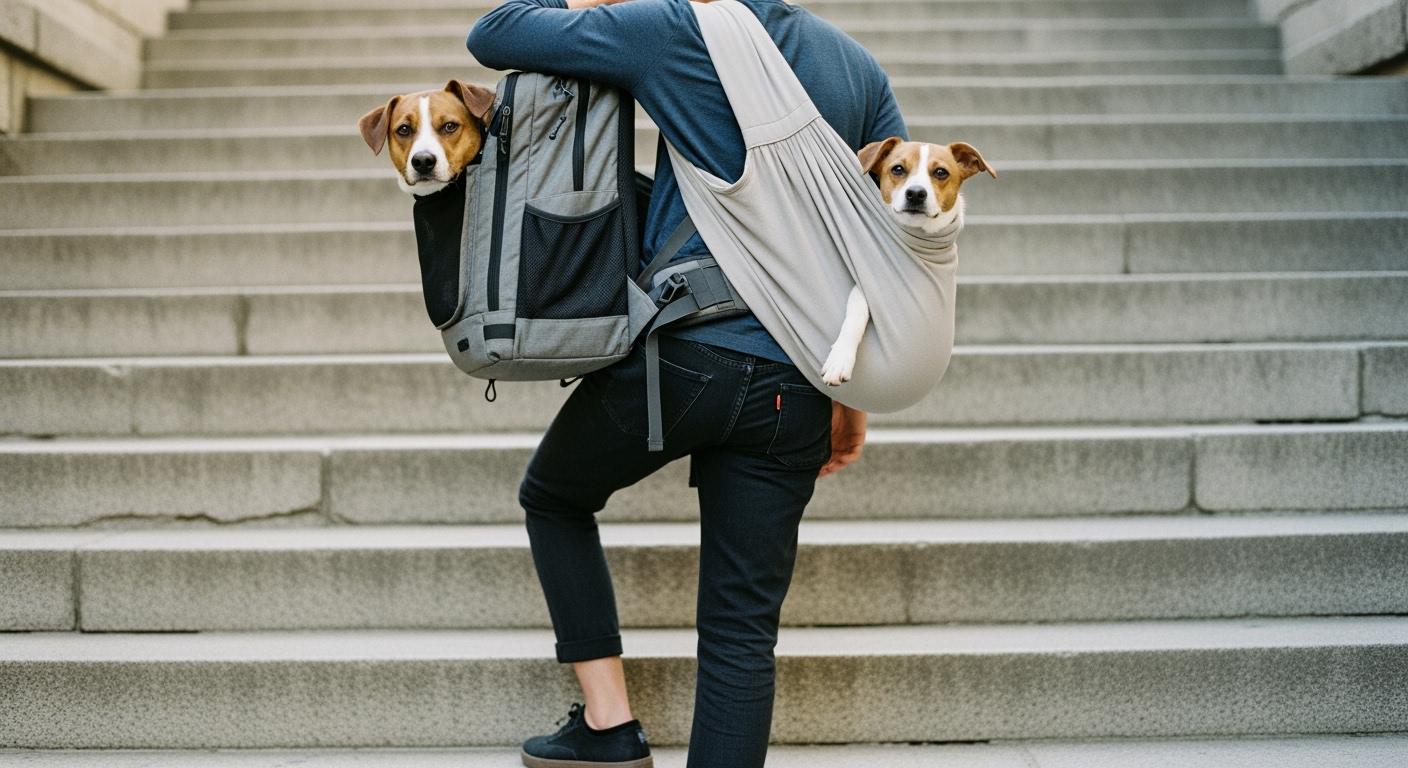
A sling carrier feels fine at first. The fabric cups your dog close to your body, your hands stay free, and on a short errand the setup seems almost effortless. Then you climb a flight of stairs. Or a crowd tightens around you. Or your dog shifts weight to look at something. The sling swings.
That swing is not a minor annoyance. It is the physical consequence of a single anchor point bearing an off-center load.
When a Sling Carrier Swings Instead of Supports
The Single-Anchor Problem
A dog sling routes the entire weight of your dog through one strap crossing one shoulder. On flat ground at a steady pace, that load stays manageable. The moment you introduce lateral movement — turning a corner, sidestepping someone on a sidewalk, shifting balance on stairs — the physics change. The dog inside the sling becomes a pendulum.
Here is the causal chain: a single shoulder strap creates a single force input point high on the torso. When the dog shifts or external movement tilts the carrier, that force vector moves off-vertical. Your body compensates by contracting the opposite-side obliques and trapezius to counter the rotation. Over minutes, not hours, those muscles fatigue. The shoulder on the loaded side drops. The spine curves laterally to re-center mass. What started as a convenient hands-free carry becomes sustained asymmetric loading.
A sling carrier with a wider shoulder pad and reinforced base stitching can delay this fatigue but cannot eliminate it — the single-anchor architecture guarantees an eventual load imbalance once movement exceeds a low threshold.
How to Spot the Sling Failing
The sling does not announce its limits. You notice them through small, repeatable signals. After a 10-minute walk with turns and one flight of stairs, stand in front of a mirror. Check whether the shoulder that held the sling sits visibly lower than the other. That drop, even half an inch, is your trapezius surrendering to the asymmetric load. Next, look at the base of the sling — has it sagged more than an inch from where it started? That sag means the fabric under your dog has stretched or shifted, reducing support.
Other failure signals: your dog pressing against the opening or leaning one direction, the need to keep one hand on the sling to steady it, soreness that migrates from the shoulder up into the neck within 20 minutes.
Tip: If you find yourself bracing the sling with your forearm against your ribs to stop the swing, the carrier is no longer carrying — you are.
| Real-use signal | Why the sling struggles | Better carrier direction |
|---|---|---|
| Pet shifts or leans | Single anchor allows pendulum swing, base fabric stretches under dynamic load | Backpack with firm base |
| Shoulder feels sore after 10–15 min | One-shoulder load forces lateral spine compensation | Backpack with two shoulder straps |
| Climbing stairs or navigating crowds | Sling swings outward, pet slides toward opening | Structured backpack carrier with chest strap |
How Backpack Carriers Handle Movement Differently

Two Straps Change the Load Path
A backpack carrier replaces the single anchor point with two. That change is not cosmetic. Two shoulder straps split the dog’s weight into two roughly equal vertical force vectors, one descending through each side of the spine. The body handles this symmetrically — the erector spinae muscles engage evenly, the shoulders stay level, and the pelvis does not need to tilt to counter a one-sided load.
On stairs, the advantage compounds. Each step upward involves a momentary single-leg stance where the pelvis naturally tilts. With a sling, that tilt adds to the already asymmetric load. With a backpack, the bilateral load stays independent of the pelvic rhythm of walking or climbing. You can verify a backpack carrier’s load distribution by checking whether the shoulder straps feel equally tight after 15 minutes of walking — if one strap has taken more tension, adjust the ladder-lock position, not the carrier choice.
The Firm Base Does the Work the Fabric Cannot
A sling relies on fabric tension to support your dog. Fabric under load deforms — it stretches, it drapes, it conforms to the shape of whatever presses against it. A structured base panel inside a backpack carrier resists that deformation. Your dog sits or stands on a platform, not a hammock.
This matters most during direction changes. When you turn, the base panel transfers that rotational force to the backpack frame and then to your torso as a unit. In a sling, the same turn creates shear between the fabric and the dog — the fabric twists, the dog slides, and the center of mass shifts further from your body. That increasing lever arm amplifies the force your shoulder must counter. A firm base keeps the lever arm short and constant.
Backpack carriers also benefit from manufacturing choices that are hard to replicate in a soft sling. The base panel in a structured carrier uses a rigid insert — typically PE board or dense EVA foam — that holds its shape across hundreds of loading cycles. In production, that insert is cut to a fixed template and sewn into a dedicated base pocket, which means the support surface is consistent unit to unit. A sling’s support surface is the fabric itself, and fabric tension varies with stitch tension, panel alignment, and even ambient humidity during sewing. The difference between a carrier that holds shape and one that sags often traces back to whether there is a rigid element in the load path at all.
Chest and Waist Straps as Secondary Stabilization
Chest and waist straps serve a distinct function from shoulder straps. Shoulder straps carry vertical load. Chest and waist straps manage horizontal displacement — they prevent the pack from swinging away from your body during lateral movement. With both engaged, the carrier becomes a closed system around your torso. Your dog’s weight moves as your torso moves, with no independent momentum.
Walk 10 minutes with the chest strap unbuckled, then 10 with it buckled. The difference is most apparent when you stop suddenly or change direction — without the chest strap, the backpack continues its trajectory for a split second after your body stops. That lag is the carrier’s inertia acting independently. The chest strap couples the carrier’s inertia to yours.
In practice: A backpack with a firm base and engaged chest strap turns the dog-and-carrier unit into a single mass that follows your center of gravity — no pendulum, no independent momentum, no corrective bracing from your arms.
Where a Sling Still Fits — and Where It Does Not
Short, Calm, Close: The Sling’s Operating Envelope
A sling carrier is not a bad design. It is a narrow-use design. Its operating envelope covers short-duration carrying where movement stays predictable: a walk from the car to the vet’s office, a subway ride where you stand still, a quick errand through a quiet store. Under 15 minutes, with a dog under 12 pounds who sits still, the single-shoulder load never accumulates enough fatigue to matter. The closeness a sling provides — your dog pressed against your chest or side — can also reduce anxiety in dogs who startle easily in new environments.
But that envelope has hard edges. Exceed the time, the weight, or the movement predictability, and the design works against you. The transition is not gradual — it is usually abrupt, triggered by a specific event like a stair climb or a sudden turn.
When to Switch: Observable Thresholds
You do not need a spec sheet to know when the sling has left its operating range. Three observable checks, each testable on your next walk:
First, the mirror check described earlier — shoulder drop after 10 minutes. Second, the base-sag test: mark the sling’s bottom edge position against your hip at the start of a walk, then check it after 10 minutes of normal movement. A drop of more than an inch means fabric stretch has consumed the carrier’s structural reserve. Third, the brace test: count how many times in a 15-minute walk you use your hand or forearm to steady the sling. More than twice, and the carrier is no longer self-supporting.
Any single failure across these three checks means the movement intensity has exceeded what a single-anchor soft carrier can handle. The fix is not a different sling — it is a different load-path architecture entirely. The decision between a sling, tote, or backpack carrier turns less on dog size than on movement intensity during the trips you actually take.
| Design Difference | Why it matters | Main limitation | Where it works |
|---|---|---|---|
| Single-shoulder sling | Direct body contact reduces dog anxiety in new settings | Asymmetric load fatigues shoulder within 15–20 min; pendulum effect under lateral movement | Short errands, stationary waiting, dogs under 12 lb who stay still |
| Dual-strap backpack with firm base | Symmetric load preserves posture; rigid base prevents sag and pet shifting | Bulkier; more steps to put on and adjust; less direct body contact | Walks over 15 min, stairs, crowds, hikes, dogs up to rated weight limit |
| Backpack with chest and waist straps | Eliminates independent carrier momentum during stops and turns | Additional adjustment points increase setup time; waist strap may not fit all body types | Active movement, direction changes, uneven terrain |
Disclaimer: The shoulder-drop mirror check assumes a smooth-coated dog whose weight stays centered in the carrier. Double-coated breeds or dogs who consistently lean to one side may produce a shoulder imbalance that reflects the dog’s position, not the carrier’s load distribution. If the dog’s chest shape falls outside breed norms — particularly barrel-chested or very deep-keeled dogs — the fit and balance checks described here may not catch every pressure point. Hand-check the carrier base for hot spots after the first few uses.
Matching Carrier Design to How You Actually Move
Weight, Not Just Size
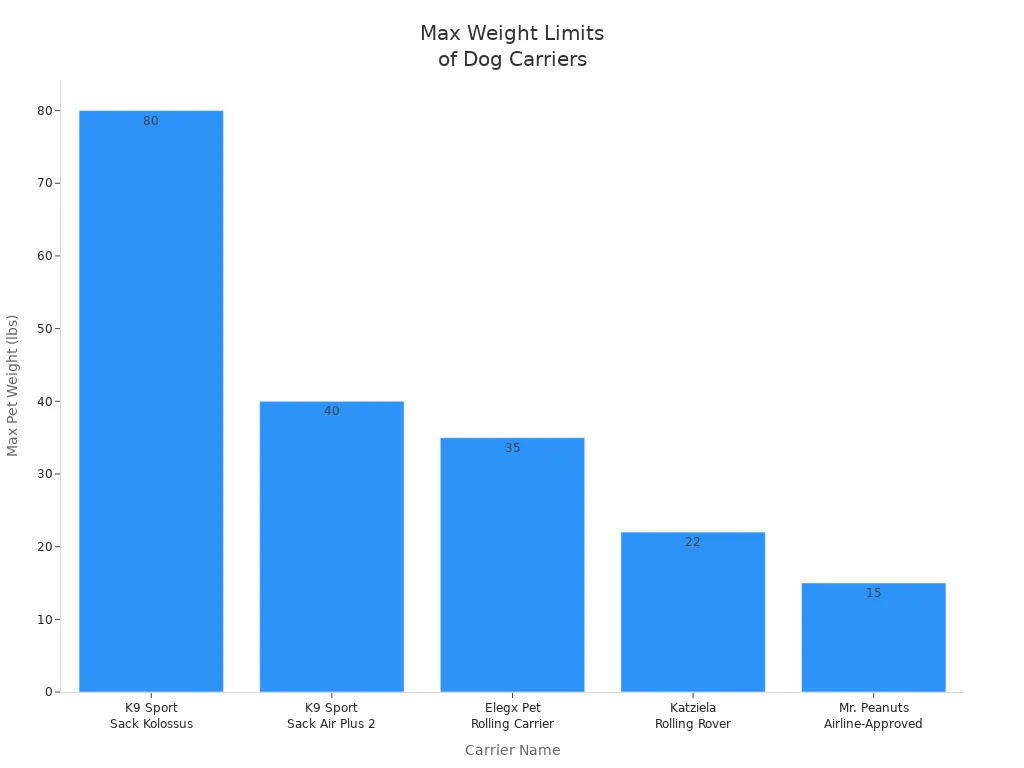
A carrier’s weight rating is its primary structural constraint. Most sling carriers use fabric and stitching as the sole load-bearing system, which limits practical capacity. Backpack carriers with rigid base inserts can handle substantially more weight because the load transfers through the frame to the shoulder straps rather than hanging entirely on seam strength.
For a dog near the upper end of a sling’s rated range, every step adds a small bounce that cycles the load through the shoulder strap. Over a mile of walking, that is roughly 2,000 load cycles on a single seam line. The same dog in a backpack splits each cycle across two straps and a rigid base — 1,000 cycles per strap, with the base absorbing the impact component.
Health Conditions That Favor a Backpack
Dogs with joint issues, spinal conditions, or breeds predisposed to IVDD need a carrier that maintains a horizontal, supported position. A sling allows the dog’s spine to curve with the fabric — a C-shape that concentrates pressure on the intervertebral discs. A backpack with a firm base keeps the dog’s spine neutral and supported from below.
The ventilation difference matters too. Backpack carriers typically use mesh panels on at least two sides. A sling wraps fabric around the dog on three sides. On a warm day, that difference in airflow can push a dog from comfortable to panting within 10 minutes. Check for dampness on the inner lining after a walk — if the fabric against the dog’s back is wet, ventilation is insufficient for that duration and temperature.
Matching a backpack carrier to your activity level means looking past the weight rating to how much movement the carrier will actually see. A carrier rated for 25 pounds that you use on flat sidewalks once a week is under different stress than the same carrier on a hiking trail three times a week. The urban carrying solutions that work for subway commutes may not translate to trail use — and vice versa.
FAQ
Can a sling carrier work for a dog over 15 pounds?
It can for very short durations with a dog who stays still. The limiting factor is not the fabric strength but the single-shoulder load path — the heavier the dog, the faster asymmetric fatigue accumulates. Above 15 pounds, the usable carry time shrinks enough that a backpack carrier becomes the more practical choice for anything beyond a few minutes.
How do you know if the base is firm enough?
Load the carrier with a weight equivalent to your dog and hold it by the straps. If the base panel visibly bends or bows, it will not hold shape under live weight during movement. A base that stays flat under static load but flexes when you walk is also insufficient — dynamic loading adds roughly 1.2 to 1.5 times the static force with each step.
Does a chest strap actually make a measurable difference?
Yes. Without a chest strap, the shoulder straps can migrate outward toward the edges of your shoulders — a movement called strap splay. As the straps splay, the carrier’s center of mass moves away from your spine, increasing the lever arm your back muscles must counter. A chest strap sets a fixed maximum distance between the shoulder straps, capping that lever arm regardless of movement.
Are backpack carriers safe for dogs with back problems?
A backpack carrier with a rigid, horizontal base supports the dog’s spine in a neutral position. This is generally safer than a sling, which allows the spine to curve. But the carrier must be sized correctly — if the dog cannot lie flat with legs extended, the curled position can still stress the spine. Avoid vertical-orientation carriers entirely for dogs with diagnosed spinal conditions.






