
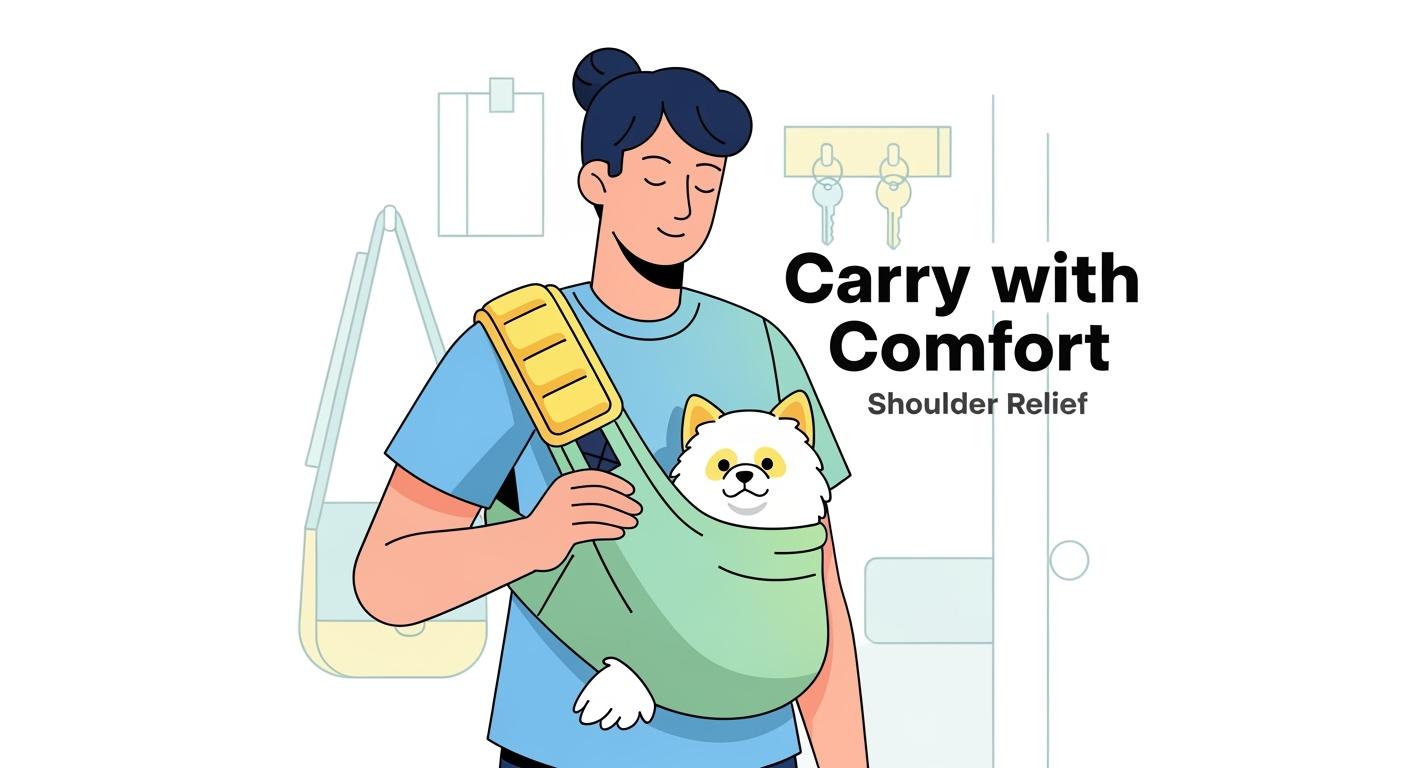
A thin strap concentrates your dog’s weight into a narrow band across one shoulder. After ten minutes of walking, that band becomes a hot spot. After twenty, you are adjusting your posture to compensate. The problem is not the dog’s weight. It is the contact patch.
Pressure equals force divided by area. A strap that is 1.5 inches wide puts the same eight-pound dog through roughly half the square inches of a strap that is 3 inches wide. Same dog, same force, roughly double the pressure on your shoulder tissue. That is the physics a dog carrier sling with padded shoulder strap is designed to change — but only if the width and padding density are both right.
Why Strap Width and Padding Density Decide How Your Shoulder Feels After a Walk
A strap’s job sounds simple: hold the load. But the way it holds the load changes everything about how your shoulder feels at the end of a trip.
Width determines the contact area. A narrow strap — say under 2 inches — concentrates the sling’s entire loaded weight onto a strip of shoulder that may be no wider than a seatbelt. Soft tissue compresses under that focused pressure. Blood flow to the skin directly under the strap slows. Red marks appear. Given enough repeated daily carry, the discomfort becomes cumulative.
Widen that same strap to 3 inches or more, and the contact patch roughly doubles. The same eight-pound dog now presses on twice the square inches of shoulder. Peak pressure under the strap drops. The difference is not subtle after the first few blocks.
But width alone is not enough. Padding density is the second variable that usually gets overlooked.
Soft, low-density foam feels plush when you squeeze it in your hand. Under load, it compresses. A half-inch of soft padding may compress to an eighth of an inch once the dog’s weight settles in. At that point, the effective contact area shrinks because the padding has bottomed out — the strap’s edge webbing becomes the primary load-bearing surface. You are back to a narrow strip.
Denser padding resists this collapse. It deforms less under the same load, maintaining more of its cross-sectional thickness. The strap continues to spread force across its full width even after the dog has been in the sling for twenty minutes. The feel is different: not pillowy-soft at first touch, but supportive through the entire walk. This is a material selection tradeoff worth checking before choosing a sling — foam that rebounds quickly after compression tends to hold up better over months of daily use than foam that stays dimpled.
Tip: After a 10-minute carry, take the sling off and look at your shoulder in a mirror. A red mark wider than the strap itself means the padding compressed and the webbing edges took over. A mark that matches the full strap width with no concentrated center line means the padding held its shape under load.
| Design Difference | Why It Matters | Where It Falls Short |
|---|---|---|
| Wide strap (3 in+) vs. narrow (under 2 in) | Larger contact patch lowers peak pressure on shoulder tissue | Wider strap adds bulk; may feel oversized on very petite frames |
| Dense, slow-recovery foam vs. soft, fast-compressing foam | Maintains load-spreading cross-section throughout the walk | Denser foam feels firmer at first touch; some users mistake this for less comfort |
| Non-slip strap backing vs. smooth fabric | Prevents contact patch from shrinking as the strap twists or migrates | High-friction backing can pill or grab certain clothing fabrics |
What Happens When the Sling Body Holds the Dog Away From You
The strap is only half the system. The sling body — the pouch that holds the dog — determines where the load sits relative to your center of mass. And that distance matters more than most people realize.
When the sling lets the dog hang away from your side, the weight moves laterally off your body’s midline. That horizontal offset creates a moment arm. Your shoulder and upper back now work against a rotational force, not just a downward one. Muscles that should be stabilizing become load-bearing. Fatigue sets in faster — not because the dog is heavy, but because the lever is long.
A sling that holds the dog snug against your hip or torso shortens that lever. The dog’s center of mass stays inside your base of support. Your shoulder carries mostly vertical load, which is what it is built for. The difference shows up after about 15 minutes: with a close-fitting sling, you forget you are adjusting. With a loose-hanging one, you have shifted your weight to the opposite hip three times already.
This body-hugging geometry also affects strap stability. When the dog swings, the strap’s contact patch on your shoulder shifts. The area bearing the load shrinks and moves. A stable sling body — one with a shaped pouch that wraps rather than hangs — reduces these oscillations. Carrying position and sling body shape interact in ways that are easy to miss in a 30-second try-on but obvious after a real walk.
In practice: Walk for five minutes at a normal pace, then glance down at the sling body without adjusting it. If the pouch has migrated more than an inch away from your body, the design is not holding the load close enough. That inch becomes a lever your shoulder pays for over the next mile.
This is also where the crossbody angle matters. A strap that runs at too shallow an angle lets the sling body drift forward. Too steep, and it rides up toward the neck. The right angle — typically around 30 to 45 degrees from horizontal — keeps the pouch anchored near the hip, where the load is easiest to manage. Urban carrying setups that prioritize hands-free stability tend to get this angle right because the design brief assumes walking, not just standing still.
When a Padded Strap Is Still Not Enough
A well-designed strap solves a real problem. It does not solve every problem.
If the dog exceeds the sling’s weight range, no amount of padding compensates. The strap’s attachment points, the stitching that joins the pouch to the webbing, and the buckle hardware all have load limits. Exceed them and the failure mode may not be sudden — it may be progressive seam elongation that slowly changes the sling’s geometry over weeks of use. Weight limits on sling carriers are structural constraints, not suggestions.
Dogs that shift position constantly inside the pouch present a different challenge. Even a wide, dense strap cannot fully stabilize a load that keeps redistributing itself. If your dog tends to stand up, turn around, or lean out of the sling mid-walk, the strap’s contact patch on your shoulder changes with each shift. The resulting discomfort is not a strap design failure — it is a mismatch between the dog’s behavior and the sling format. A more structured sling with firmer sides may reduce this internal movement better than extra padding alone.
Weather adds another variable. On hot, humid days, even the best foam padding traps heat against your shoulder. Breathable mesh strap covers help, but they trade some padding density for airflow. In practice, a mesh-covered strap that is slightly thinner but ventilated may feel better over 30 minutes in summer than a fully padded strap that turns into a sweat band.
Disclaimer: This check assumes a smooth-coated dog under 15 pounds carried in moderate weather on paved surfaces. Double-coated breeds carried in warm conditions may create a hotter, more humid microclimate inside the sling that changes how fabrics and foams behave — a strap that tests well in an air-conditioned room may feel different after 20 minutes outside at 85 degrees. If your dog’s chest shape is unusually deep or barrel-shaped for its weight class, the sling body may not seat correctly against your hip, changing the load path regardless of strap quality.
FAQ
Does a padded strap help if my dog weighs under 5 pounds?
Yes, but the benefit is less about acute pain prevention and more about cumulative comfort. Even a 5-pound dog carried daily for 20-minute walks applies repeated pressure to the same shoulder tissue. Over weeks, a wider strap reduces the localized compression that leads to tenderness. The strap width matters more than the dog’s absolute weight.
Can I use the same sling for two dogs of different sizes?
A sling sized for a 12-pound dog will not fit a 5-pound dog the same way. The pouch volume changes how the dog settles, which changes where the load sits on your body. If the pouch is too large, the smaller dog can shift inside it, creating the same leverage problem as a loose-hanging sling. One sling per dog size range is the more reliable approach.
How do I tell if the padding is dense enough before buying?
Press the strap padding firmly between your thumb and forefinger for five seconds, then release. If the foam rebounds to its original shape within a second or two, it has reasonable density. If it stays dimpled for several seconds or feels like you can easily pinch through to feel your fingers on the other side, it will likely compress too much under load. This is a rough field test, not a lab measurement, but it correlates reasonably well with long-term performance.
Does strap width matter if I only carry my dog from the car to the vet?
For very short carries — under two minutes — the difference is marginal. But most people who start with “just car to vet” end up carrying their dog through the waiting room, into the exam room, and back out. Those minutes add up. A wider strap adds negligible weight to the sling and substantial comfort headroom for the day the vet is running late.






