
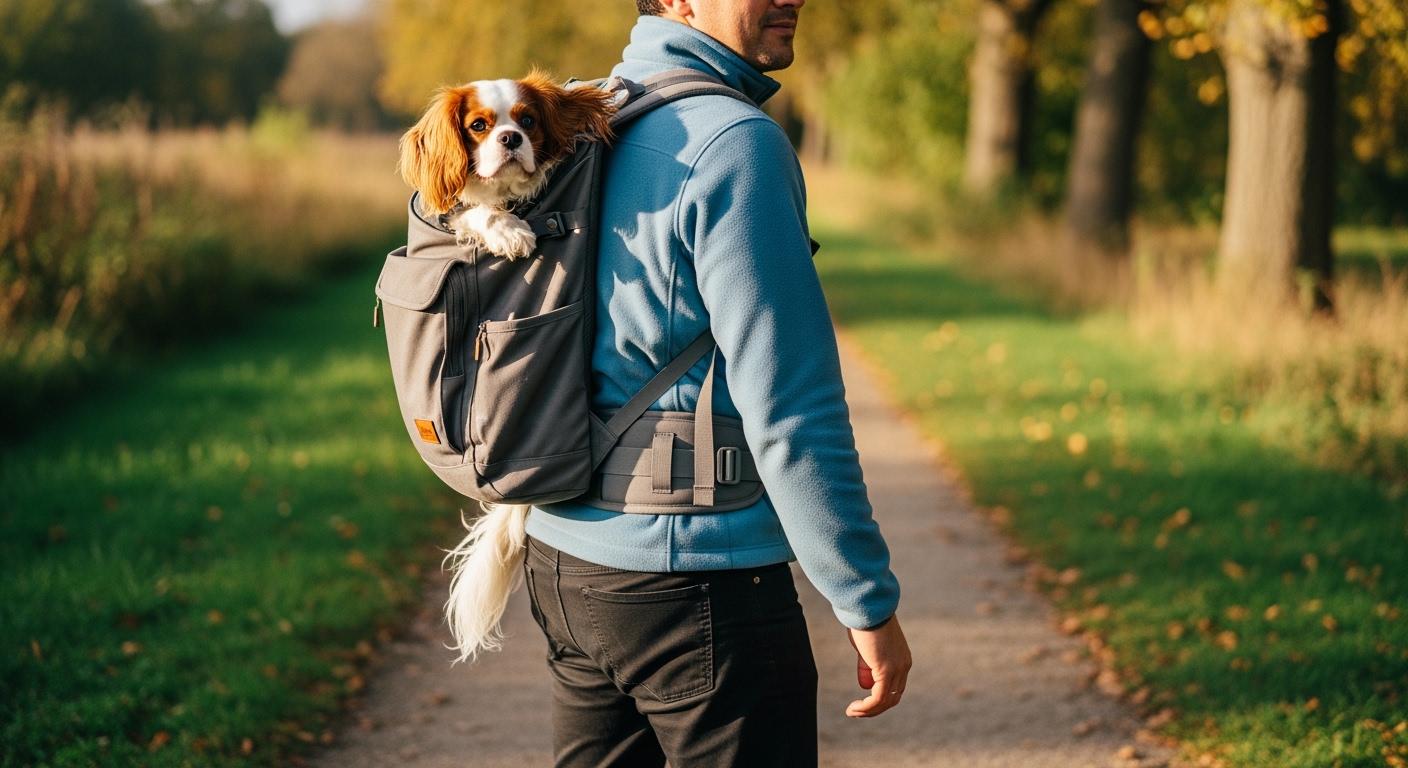
A dog backpack carrier with a waist strap handles load differently than one that hangs from the shoulders alone. The difference is not obvious during the first quarter mile. It becomes hard to ignore by mile two. A carrier without lower anchorage drifts with each step. The dog shifts inside. The base sags. You tighten the shoulder straps. It drifts again.
The waist strap anchors the bottom of the carrier to your pelvis. Combined with a sternum strap across the chest and a structured base under the dog, this creates a three-point system that resists swing, bounce, and rearward pull. What follows unpacks why shoulder-only carriers destabilize, how each anchor point changes the physics, and what to check before trusting a carrier on a longer hike.
Why a Dog Backpack Carrier Starts to Swing After the First Mile
Shoulder-Only Load Path
Shoulder straps alone create a single suspension point high on the torso. The carrier hangs from that point. Every step rotates your shoulders, and the pack moves with them. On pavement at a steady pace the motion is small. On uneven ground or stairs, the carrier swings wider. The shoulders become both load bearer and motion damper. That works for the first ten minutes. It stops working once muscle fatigue sets in and the carrier begins to drift with less resistance.
The stability gap between a shoulder-only carrier and one with waist anchorage becomes pronounced on stairs, rocky trails, and when the dog shifts position. A waist-strapped carrier tracks the pelvis rather than the shoulders, cutting lateral swing at its source.
Dog Movement as a Shifting Mass
A dog inside the carrier is not a static weight. It adjusts, turns, leans into a turn. Each shift changes the center of mass relative to your spine. In a shoulder-only carrier, that moving mass acts on a long lever arm — the distance from your shoulder blades to the pack’s center of gravity. The farther the pack sits from your back, the longer that lever becomes, and the more side-to-side torque each small dog movement generates.
If the interior compartment lacks structure, the dog can settle off-center. The carrier tilts. You compensate by leaning. Then the dog shifts again. The cycle repeats, and each correction costs energy.
Base Sag and the Pendulum Effect
A flexible base panel sags under the dog’s weight over time. The pack bottom drops, shifting the center of mass rearward and downward. On stairs, this angled pull increases — your shoulders alone fight a force vector that points back and down.
A sagging base turns the carrier into a pendulum. The load swings away from your spine with each stride. Your shoulders become the sole counterforce. Over a mile, those small corrections add up to measurable fatigue.
Three conditions converge to make shoulder-only carriers unstable on longer walks: a single high suspension point, a shifting internal mass, and a base that deforms under sustained load. Each amplifies the others. But a backpack carrier built for hiking redistributes the load by adding lower anchorage.
How a Waist Strap, Sternum Strap, and Rigid Base Change Load Transfer
Waist Strap: Redirecting Force to the Pelvis
When you fasten a waist strap and cinch it snug against the iliac crest, the load path splits. Instead of the full weight routing through the shoulder straps into the upper spine, a portion of the downward force transfers laterally through the hip belt into the pelvis. The pelvis is a far more stable platform than the shoulder girdle — it does not rotate with each step the way shoulders do. The lower portion of the carrier stops swinging because it is mechanically coupled to a structure that moves in a straight line during walking.
This is the causal chain: waist strap tension → lower pack panel pressed against lumbar/hip region → friction + compression lock the pack base to the pelvis → side-to-side torque from dog movement meets resistance at the bottom anchor → less rotational displacement reaches the shoulder straps. You feel the difference as reduced shoulder tension and a pack that tracks your hips instead of wandering.
Sternum Strap: Blocking Lateral Strap Drift
Shoulder straps tend to migrate outward during walking. The natural motion of the arms pulls them laterally. A sternum strap connects the two shoulder straps across the chest, creating a horizontal tie that resists this spread. Without it, each shoulder strap drifts independently — one slips toward the edge of the shoulder, the other follows, and the pack loses centered alignment.
The sternum strap also pre-tensions the shoulder straps against the upper chest, which adds a third contact patch to the stability system. The pack cannot rotate freely around the vertical axis because it is pinned at three levels: sternum, mid-back via shoulder straps, and hips via the waist belt. That three-point constraint is what turns a swaying load into a steady one.
| Design Difference | Why It Matters | Main Limitation |
|---|---|---|
| Waist strap anchored to pelvis | Splits load path; pelvis is more stable than shoulders during gait | Requires correct hip placement; a strap riding too high transfers no weight |
| Sternum strap connecting shoulder straps | Prevents lateral strap drift; adds third contact point for rotational resistance | Positioned too low restricts ribcage expansion during heavy breathing |
| Rigid base panel under dog compartment | Resists sag; keeps center of mass close to spine and reduces pendulum arm length | Adds structural weight; overly stiff bases can dig into the lower back |
Rigid Base: Cutting the Pendulum Arm
A structured base panel does two things mechanically. First, it prevents the pack floor from deforming under sustained load, so the dog’s weight does not migrate rearward as the fabric stretches. Second, it creates a flat bearing surface that presses evenly against your lower back rather than cupping into a curve that concentrates pressure. Less deformation means the lever arm from your spine to the center of mass stays short, which reduces the torque that each stride must overcome. A hiking carrier with a reinforced floor panel shows measurably less vertical bounce on descents because the base does not flex and rebound with each foot strike.
Fit Checks That Tell You If the Waist-Strap System Is Working
Waist Strap Position Test
Put the carrier on, fasten the waist strap, and load the dog. Walk ten minutes on flat ground. Stop and check where the waist strap sits. It should still rest above your hip bones, not riding up toward your ribs. A strap that migrates upward is not bearing weight — it is just along for the ride. Tighten it until you feel pressure evenly across the front of your hips, not pinched at two points.
After the walk, unbuckle and check your shirt. A horizontal crease or light impression across the hip area means the strap stayed in place under load. No mark at all suggests it loosened and stopped transferring force. This is a pass/fail check: no hip contact mark after ten minutes under load → the waist strap is not doing mechanical work.
Sternum Strap Drift Check
Mid-walk, glance at the shoulder straps where they cross your collarbone. They should sit roughly symmetrical, about two fingers width from the edge of each shoulder. If one strap has crept outward or both have spread wider than they started, the sternum strap is either too loose or positioned too low. Slide it up to roughly an inch below the clavicle and tighten until you feel a gentle pull across the chest without restricted breathing. Walk another five minutes. Re-check. If the straps stay put, the fit of the sternum strap is doing its job.
Base Bounce Observation
Have someone walk behind you on a slight downhill. They should watch the bottom of the carrier. On each foot strike, does the base panel bounce independently of your back, creating a visible gap? Or does it ride flat against you with no separation? A carrier that bounces away from your back on descents has a base that is flexing and rebounding — that cycle amplifies as the hike goes on and the dog gets restless inside. A well-structured base stays planted against the lumbar curve even on steeper descents, which is where the difference between a rigid panel and a fabric-only floor becomes most visible.
When a Waist Strap Backpack Carrier Isn’t the Fix
A waist strap, sternum strap, and rigid base solve a specific set of stability problems. They do not fix every carrier issue. If the dog compartment is too large, the dog will slide within it regardless of how well the carrier is anchored to your body. Internal movement and external stability are separate problems. A dog that rides off-center inside a too-spacious compartment creates internal torque that no waist strap can fully cancel.
Weight limits also matter. A waist strap transfers load to the pelvis, but the pelvis has a comfort threshold. Dogs approaching the upper end of the carrier’s rated range will still produce noticeable pull on longer hikes, even with perfect strap adjustment. The waist strap reduces the strain — it does not erase the physics of a heavy, moving load.
The sternum strap’s position also affects different body types differently. People with broader chests may find the strap rides lower naturally; those with narrower frames may need to keep it higher to avoid restricting the ribcage during uphill breathing. There is no single correct position that works across all builds. The right spot is where the shoulder straps stop migrating without the sternum strap interfering with a full inhale.
Disclaimer: The fit checks described here assume a smooth-coated dog whose body proportions fall within typical breed norms for the size range the carrier was patterned for. Double-coated breeds may show subtler pressure marks that require hand-checking rather than visual inspection. If the dog has a barrel chest, a very deep keel, or an unusually long torso relative to its weight, the standard size chart may not catch every fit variable — pressure points can develop in areas the usual checks do not cover.
FAQ
How tight should the waist strap be?
Tight enough that you feel even pressure across the front of the hip bones, not so tight that it restricts deep breathing or creates a pinch point. After ten minutes under load, the strap should not have ridden up toward the ribs. If it has, it was too loose to transfer meaningful weight.
Can a waist strap carrier work for short dogs with long torsos?
It depends on whether the carrier compartment length matches the dog’s torso. A dog that cannot sit fully inside the compartment with its weight centered will shift forward or back, and that internal offset creates torque the waist strap was not designed to handle. Measure the dog’s seated length from rump to shoulder and compare it to the carrier’s interior depth before relying on the waist strap for stability.
What if the sternum strap restricts breathing on climbs?
Loosen it slightly before a sustained climb and re-tighten on flats. The sternum strap’s main job is lateral stability; on steep uphill sections, shoulder straps tend to stay in place naturally because the pack pulls rearward rather than side to side. A sternum strap that is too tight during heavy breathing creates a different problem than the one it solves.
Does a rigid base make the carrier harder to store?
Often, yes. A structured base panel resists folding, which can make a carrier bulkier to pack when not in use. Some designs use a removable stiffener that slides out for storage. The trade-off is between trail stability and packability — a carrier with a removable base panel can serve both needs if storage space is tight.






