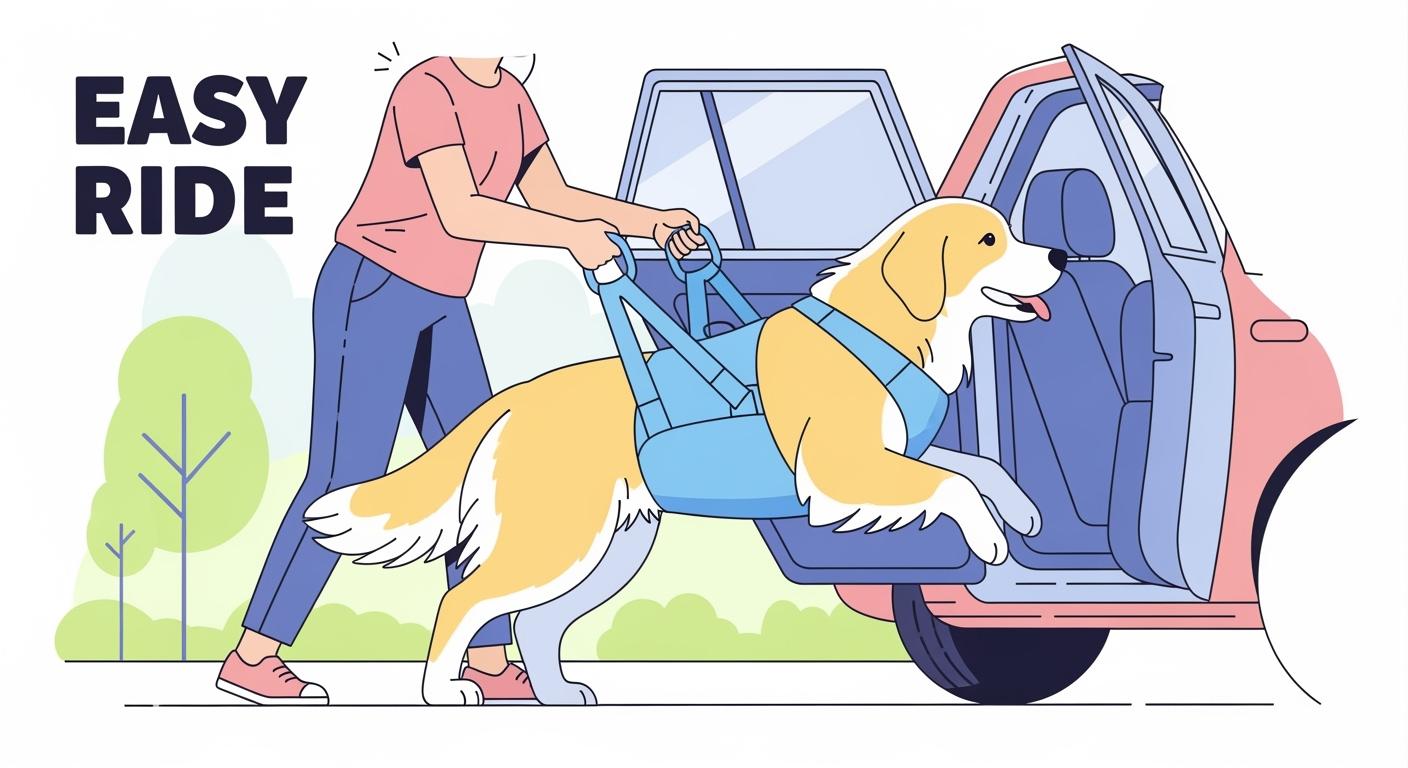
Pick up a large dog by a single top handle and the body does something predictable. The back rises. The chest and rear sag. The dog rotates. What looked stable on the ground becomes a twisting, off-center load the moment your arm takes the weight.
This is not a strength problem. It is a force-path problem. A handle stitched to a narrow back strap pulls from one point. The dog’s weight hangs below that point. Gravity pulls down through the center of mass — somewhere near the middle of the ribcage — while the lift force pulls up from the spine. Those two vectors are offset. The result is a rotation moment that twists the dog’s body around the lift point.
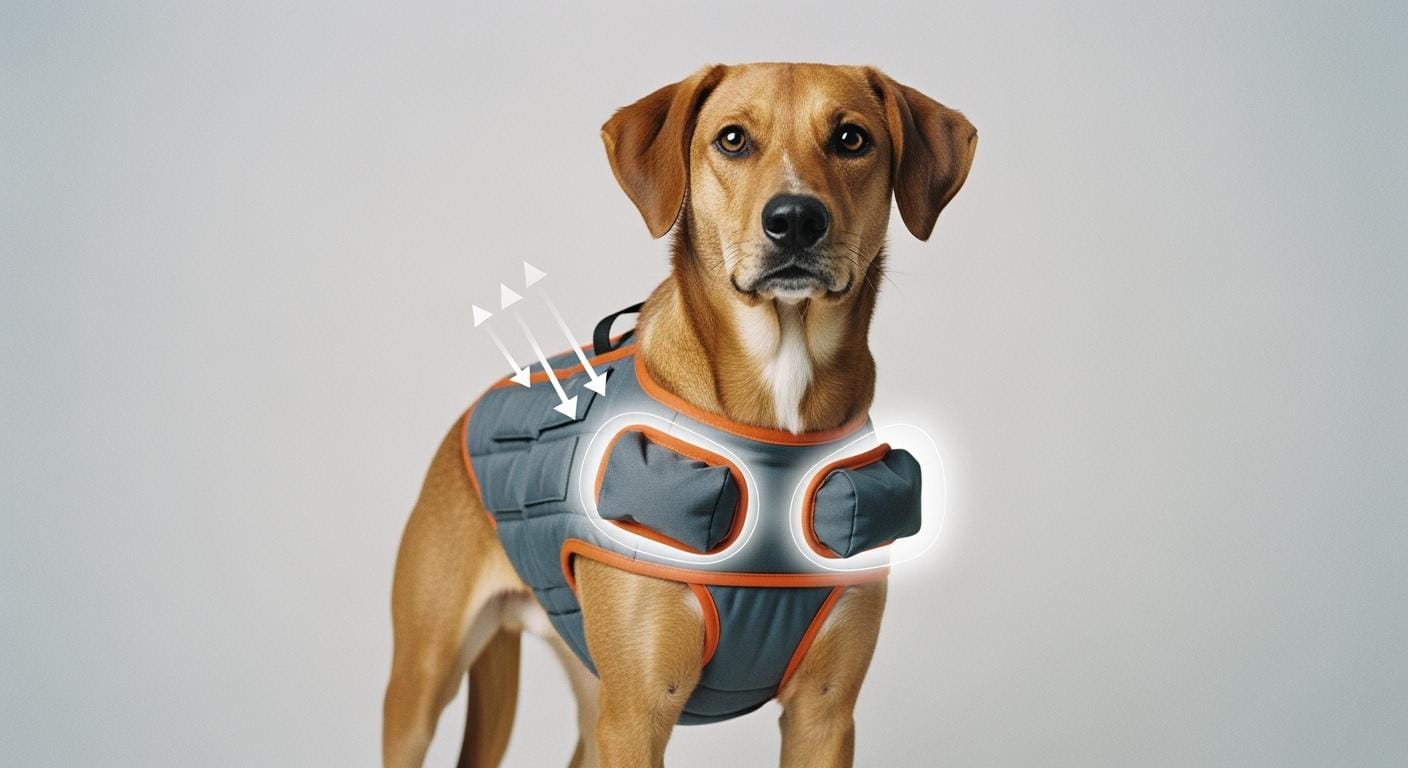
The fix is not a bigger handle. It is a support structure that routes the lift force through multiple anchor points — chest, belly, and rear — so the upward force tracks closer to the dog’s center of mass. When the force path runs through the body instead of above it, rotation drops. The dog stays straight. That is the design difference that separates a carry harness from a walking harness with a handle added on.
Why a Single Handle Twists a Large Dog
The force path that causes rotation
When you lift from a single top handle, the force enters at one point on the dog’s spine. From there it travels down through whatever material connects handle to body. On a harness built for walking, that connection is often a strip of webbing sewn to a back pad — strong enough for steering pressure, but never meant to carry partial body weight off the ground.
Here is the mechanical chain that produces the twist. The lift vector points upward from the handle. The weight vector points downward from the dog’s center of mass, which in a standing large dog sits roughly at mid-ribcage, below the spine. Because these two vectors are horizontally offset, they create a couple — a pair of equal and opposite forces separated by distance — that generates rotation. The wider the offset, the stronger the twist. A dog with a deep chest and heavy hindquarters magnifies this effect because the center of mass sits lower and further from the lift point.
This is why a harness that fits perfectly during a stand-still fit check can still rotate under load. The fit check tests geometry at rest. The lift test applies force through a path the harness was not designed to carry. Two different mechanical conditions, two different outcomes.
Strap width alone does not fix this. A wider back strap spreads pressure across the skin but does not change where the lift force enters the system. It is still a single point above the center of mass. The rotation moment remains.
What you can observe after a short assisted entry
After helping a large dog into a vehicle, run two quick checks before the next use. First, look at the back panel from above — has it drifted more than an inch off the spine’s midline? A shift indicates the harness rotated under load and did not self-correct. Second, flip the chest panel over and feel the inner lining. If it is warmer or damper on one side than the other, the panel likely bunched or twisted during the lift, concentrating friction unevenly.
A harness with stable strap paths and anchored girth connections returns to center after the load releases. One without them stays off-center until you manually reset it. That difference matters when you are lifting the dog multiple times on a single trip.
What Design Features Prevent Rotation Under Load
Panel architecture vs. strap-only support
The core design choice in a large dog carry harness is whether the load travels through fabric panels or through bare webbing straps. Panels spread force across square inches. Straps concentrate it along linear inches. Under a partial body-weight lift — the kind that happens when a dog steps up into an SUV and you take some weight off the front legs — the difference in pressure distribution is immediate.
A panel-based harness routes the lift force from the handle into a structured back piece, then through side connections into chest and belly panels. Each panel acts as a load-spreading surface. The chest panel resists forward rotation. The belly panel resists sag. The rear strap or panel resists hip drop. Together they create three points of vertical restraint that bracket the dog’s center of mass. The lift vector splits across all three, and the offset that drives rotation shrinks.
Strap-only harnesses lack this distribution. A single webbing path from handle to girth carries all the load. The dog’s body can pivot around that narrow anchor, especially if the girth strap sits forward of the ribcage’s widest point. The harness rotates. The dog compensates by tensing or freezing. The entry gets harder.
When comparing a harness built for daily walking against one designed for lift assistance, the structural difference is visible at the seams: carry harnesses use box-stitched or bartack-reinforced attachment points where the handle meets the panel, because that junction bears repeated off-vertical loads. Walking harnesses typically use simpler seam construction adequate for horizontal leash tension but not for lifting.
Strap path geometry and anti-rotation anchoring
Strap path matters as much as panel coverage. A strap that runs straight from the back handle to the girth creates a single vertical line of tension. When the dog shifts weight or steps at an angle, that line tilts. The harness follows. An angled or Y-shaped strap path, by contrast, splits the load across two anchor directions, resisting tilt by trading some of the vertical force into horizontal tension that braces against the dog’s torso.
The girth strap’s position along the ribcage also determines rotational stability. Place it too far forward — near the armpits — and the rear half of the dog is unsupported; the hips can drop and the harness pivots forward. Place it behind the deepest point of the ribcage and the strap naturally resists forward rotation because it anchors against the widening chest profile. This is a geometric constraint, not a material one: the dog’s own anatomy locks the strap in place when positioned correctly.
On production lines, achieving this strap geometry consistently means patterning the girth connection point relative to breed-standard chest profiles, not just scaling a single design up and down. The anchor point that works for a deep-chested breed may sit too far back for a dog with a shallower ribcage. A harness with multiple size-graded patterns — where the girth anchor shifts proportionally with the chest depth of each size bracket — maintains anti-rotation geometry across the size range. A single-pattern design scaled uniformly tends to lose that geometry at the extremes.
Handle attachment: why stitching pattern matters more than handle size
A handle that looks substantial can still fail mechanically if its attachment concentrates force at two narrow stitch lines. When you lift, the handle pulls upward while the dog’s weight pulls the panel downward. The stitch line between them experiences shear — the two layers try to slide past each other. A simple straight stitch under shear load can tear progressively, one stitch at a time, starting from the edge.
Box stitching and bartack reinforcement resist this differently. A box stitch creates a closed rectangle of thread that distributes shear across four sides. A bartack is a dense zigzag cluster that resists peel and shear by packing more thread into a short length. The handle attachment on a carry harness needs both: box stitching for overall load distribution, bartacks at the corners where stress concentrates during angled lifts. A harness rated for lift assistance shows this reinforcement pattern visibly at every handle connection point.
Here is how handle attachment methods compare under load:
| Design Feature | How It Handles Lift Force | Main Limitation |
|---|---|---|
| Single straight-stitch handle | Shear load concentrated at two narrow stitch lines; edge stitches tear progressively | Fails under repeated off-vertical lifts; adequate for brief steering only |
| Box-stitched handle on back panel | Shear distributed across four sides of a closed rectangle; resists progressive tear-out | Panel-to-strap connections downstream still carry concentrated load |
| Box-stitched handle with structural webbing routed through chest and belly panels | Lift force splits across three anchor zones; webbing carries tension through the full harness body | Higher material and assembly cost; bulkier than strap-only designs |
| Flat-position handle indexed to reinforced back panel | Handle stays at consistent position regardless of dog movement; reduces off-angle loading | Dog-specific chest shape variations can still shift the indexed position slightly |
Verifying support stability after a lift
After a car entry, check whether the handle has pulled the back panel forward or backward from its starting position. On a well-anchored harness, the handle should sit at roughly the same spot on the dog’s back before and after the lift. If it has migrated more than an inch toward the shoulders or hips, the panel-to-strap connections stretched or slipped under load — a sign that the force path is drifting with repeated use. This is also a useful check for evaluating fit on large breeds where chest depth varies significantly between individuals.
Also run a hand under each panel edge after the dog is in the vehicle. Warm, reddened skin or a temporary imprint that matches a strap edge means pressure concentrated there during the lift. A panel that stayed flat and distributed force leaves a uniform warmth with no defined edges.
When a Carry Harness Fits the Task — and When It Does Not
Where it works
A balanced carry harness performs best in brief, controlled transitions: stepping up into a low SUV, crossing a door threshold, or navigating a single high step where the dog hesitates but can still bear most of its own weight. In these scenarios, the harness provides partial lift assistance — enough to stabilize and guide, not enough to carry full body weight. The panels stay flat because the load remains moderate and the lift angle stays mostly vertical.
The design also handles short-duration support well. A dog that needs two or three seconds of help to get the rear legs onto a seat platform will not overheat or chafe under properly fitted panels. The key variable is duration under load: the longer the lift, the more panel position matters, and the more likely a small fit error becomes a pressure point.
Where it falls short
A carry harness is not a rescue sling. It is not built for full-body carrying where the dog’s feet leave the ground entirely, or for emergency extraction where speed matters more than body positioning. Under full suspension, the force on each panel anchor multiplies beyond what most stitched assemblies are rated to handle repeatedly. The harness may hold once. It may not hold the tenth time.
Dogs in acute pain, dogs experiencing panic movement, and dogs with rear-leg weakness that prevents any weight-bearing are outside the design scope of a carry harness. In these conditions, the dog’s body tension changes unpredictably — a sudden twist or thrash can shift panels in ways that static fit checks never reveal. For these situations, a system designed for controlled mobility support or veterinary guidance is the appropriate path.
| Condition | Why the Harness Works or Fails |
|---|---|
| Brief car entry, low step height | Partial weight support works; load stays within panel distribution range |
| Multiple entries per trip | Works if panels stay indexed after each use; check position between lifts |
| Full-body carry (feet off ground) | Load exceeds typical panel anchor rating; stitching may fail under repeated full suspension |
| Dog in panic or acute pain | Unpredictable body tension shifts panels; static fit geometry no longer holds |
| Rear-leg weakness, no weight-bearing | Harness not designed for full hind-end support; hip drop continues despite chest panel |
Warning signs that the harness is not holding position
Watch for these signals during and immediately after a car entry:
- The back panel drifts more than an inch off the spine’s midline
- The belly strap rides forward into the narrowest part of the abdomen
- Strap edges leave sharp, defined imprints rather than broad, fading pressure marks
- The dog freezes mid-step or shifts weight repeatedly without committing to the entry
- The handle pulls the entire harness toward the lift side, creating slack on the opposite flank
Any one of these means the force path has shifted outside the harness’s stable range. Stop, reset the harness position, and check strap tension before lifting again.
Disclaimer: The fit checks described here assume a short-coated dog where panel position is visible at a glance. Double-coated breeds may show subtler harness drift — the panel can shift under the outer coat without visible movement on the surface. For these dogs, check panel position by feel: slide a hand under each panel edge after the lift and confirm the inner lining sits flat against the skin, not bunched or folded. If the dog’s chest shape falls outside the breed norms this harness was patterned for — particularly dogs with a barrel chest or very deep keel — the anti-rotation geometry described here may not hold across all lift angles.
Frequently Asked Questions
Can a walking harness with a handle substitute for a carry harness during car entry?
A walking harness with a top handle is built for steering — the handle provides brief control, not sustained lift. The stitch pattern at the handle connection is designed for horizontal leash tension, not the vertical shear of a partial lift. Under repeated car-entry loads, the handle attachment on a walking harness tends to stretch or tear progressively from the stitch edges. For dogs under roughly 30 pounds, the load difference may be negligible. For dogs over 50 pounds, the mechanical gap widens quickly.
How do you know if the girth strap is anchored in the right position?
After securing the harness, have the dog stand squarely on level ground. The girth strap should sit just behind the deepest point of the ribcage — typically an inch or two behind the elbow. From the side, the strap should follow a line that angles slightly rearward as it goes down, not straight vertical. A vertical girth strap tends to slide forward under load because it lacks the anatomical stop that the widening ribcage provides. Test this by applying gentle upward pressure on the handle: if the girth strap stays put, the geometry is working.
What is the single most important design difference to check before buying?
Look at where the handle attaches and follow the load path with your eyes. Does the stitching connect only to the back panel, or does the structural webbing run continuously from the handle through the chest and belly panels? A continuous load path means the lift force distributes across multiple anchor zones. A handle stitched only to the back panel concentrates the entire lift at one plane — and that is where the twist starts.