
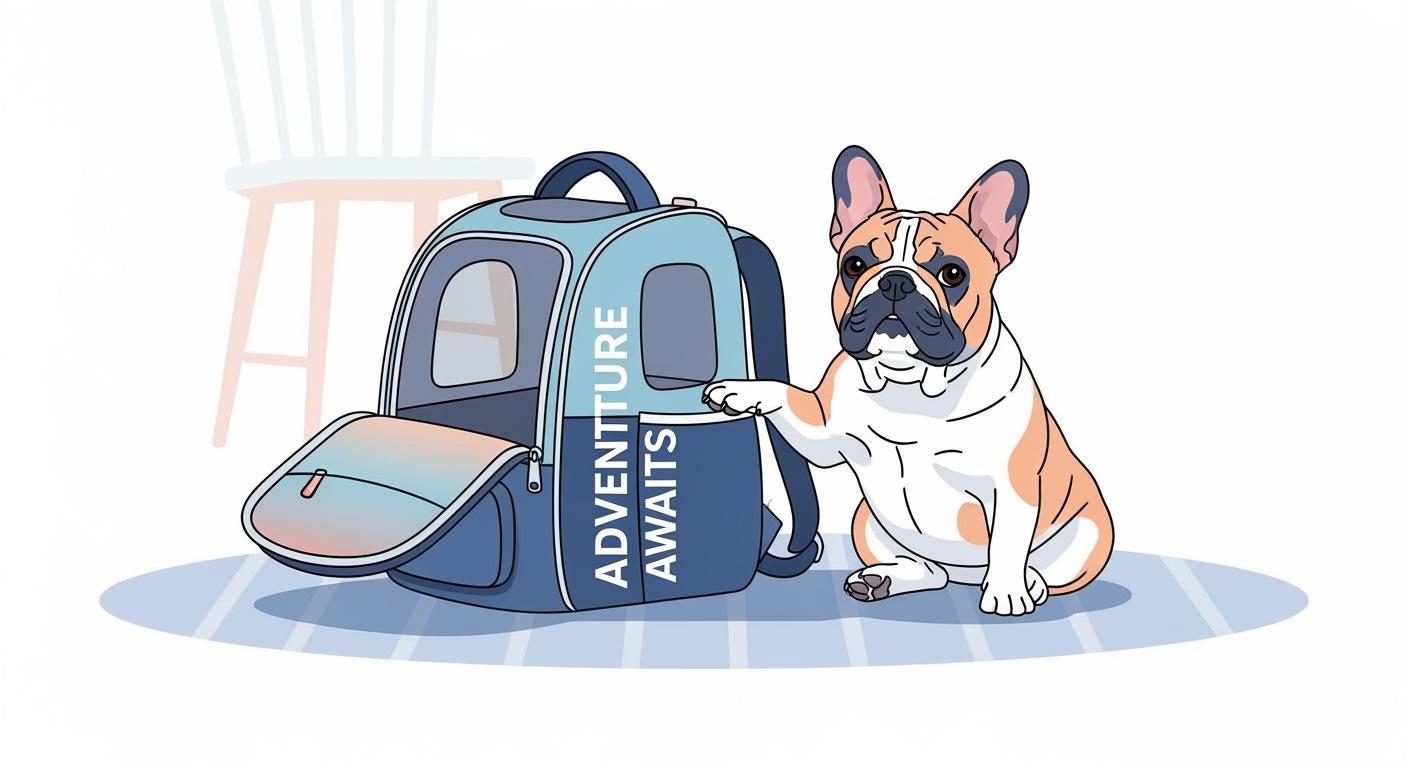
A French Bulldog has a chest shaped like a small barrel and legs that do not bend sideways easily. Most backpack carriers open from the top. Put those two facts together and loading becomes an event neither you nor the dog looks forward to. The opening design is not a minor detail. It is the single feature that decides whether the carrier gets used or collects dust in a closet.
A backpack with a wide side entry changes the geometry of the whole operation. Instead of lowering a broad-chested dog through a narrow top frame, you guide the dog in on its own four feet. That shift from vertical to horizontal loading is what makes the difference between a dog that settles and a dog that braces.
Why a French Bulldog’s Build Fights Most Backpack Openings
A French Bulldog carries most of its mass in the front third of its body. The chest is wide relative to overall length, and the shoulder joints sit close together inside a compact frame. When a top-entry backpack presents a 10-to-12-inch opening, the dog’s chest width at the shoulder line often matches or exceeds that dimension. The dog cannot simply drop in.
Here is the mechanics of what happens next. The owner lifts the dog and guides it downward. The front edge of the opening meets the widest part of the chest. Because the dog’s legs point straight down and cannot splay wide, the chest compresses against the rim. The dog instinctively braces, stiffening the shoulders and tucking the head. That bracing changes the angle of entry, and now the front paws catch on the zipper track or the rim edge. The owner pushes a little harder. The dog twists. Loading becomes a wrestling match.
This is not a training problem. It is a geometry problem. The breed’s body cross-section at the shoulder is wider than it is tall, and a circular top opening presents the smallest usable dimension to the widest part of the dog. The two shapes do not match.
- The chest barrel is wider than the opening diameter at the shoulder line.
- Short legs cannot step through a vertical gap without folding under the body.
- Once the dog braces, the shoulder angle stiffens and the opening effectively shrinks further.
What That Struggle Does Before the Trip Even Starts
A French Bulldog that fights the entry for 30 seconds arrives inside the carrier already warm, already breathing hard, and already stressed. That matters more for this breed than for most. Brachycephalic airways narrow under exertion, and panting in a confined space raises the temperature inside the carrier faster than mesh panels can vent it. The relationship between carrier airflow and a flat-faced breed’s breathing is not forgiving. A dog that starts a trip overheated stays overheated.
The other cost is behavioral. If the first three loading attempts end in twisting, chest pressure, and a forced zipper close, the dog associates the backpack with distress. On trip four, the dog backs away the moment the carrier comes out. That pattern is hard to undo.
What a Wide Side Entry Changes About the Loading Equation
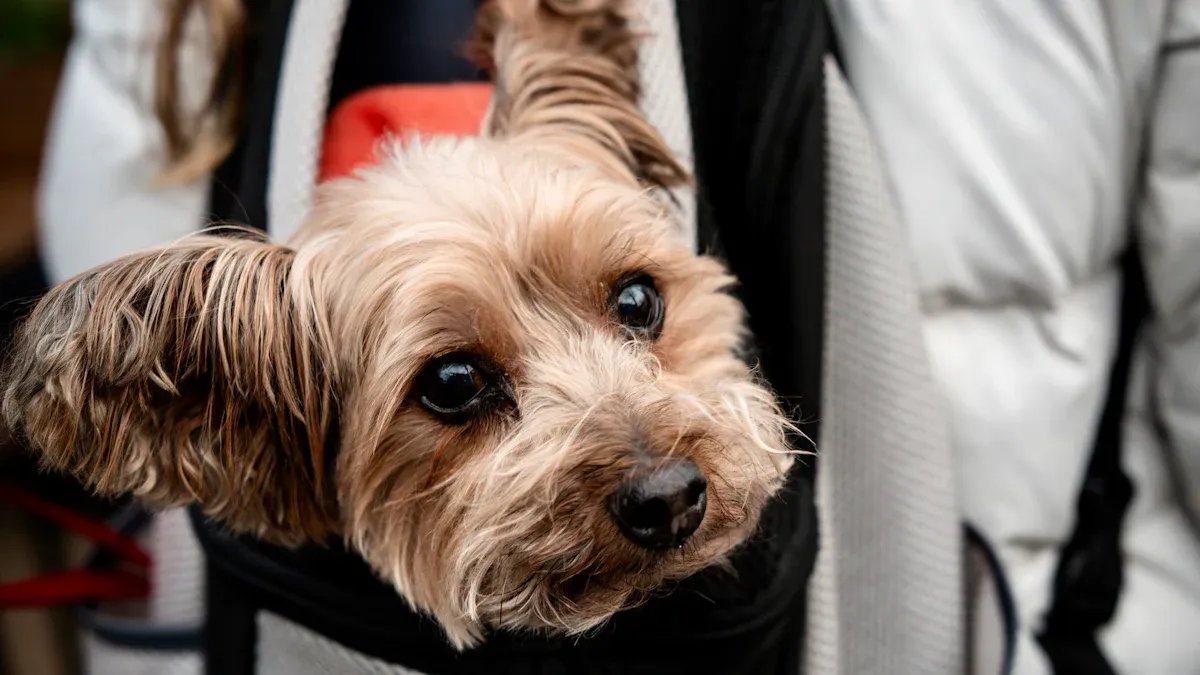
Horizontal Entry, Natural Stride
A wide side entry flips the loading path from vertical to horizontal. The dog steps forward onto all four legs. The chest passes through the opening at its narrowest orientation relative to the entry plane because the dog is walking, not being lowered. No compression. No twisting.
The causal chain is worth tracing. In a top-entry carrier, the force vector is downward gravity combined with the owner’s guiding pressure. The dog’s chest meets the rim at roughly a 90-degree angle, and the full width of the ribcage must clear the opening at once. In a side-entry carrier, the dog generates forward motion with its own legs. The chest enters the opening at a shallow angle — more like walking through a doorway than dropping through a hatch. The opening only needs to accommodate the chest profile one shoulder at a time, which means the effective clearance is closer to the full opening width rather than the constrained diagonal of a top drop-in. That is the mechanical difference that makes loading faster and quieter.
The side entry also lets you stay in contact with the dog throughout the process. You can steady the carrier with one hand and guide with the other. A treat held at nose level draws the dog forward. The movement is continuous — no stop, brace, push, adjust cycle.
Stable Opening Shape and Zipper Behavior
An opening only works if it holds its shape. Backpacks built with structured side panels keep the entry frame rigid when unzipped. The fabric does not sag inward or collapse when the dog brushes against it. That stability prevents the sudden narrowing that triggers a startle response mid-entry.
The zipper track itself is the other half of the equation. A smooth, wide-tooth zipper that runs the full perimeter of the side panel opens the carrier into a single large flap. The dog sees the full interior, not a dark slit. When the zipper does not catch on fabric or fur, the motion stays fluid and the dog does not flinch at the sound. After carrying a dog for 10 minutes, unzip the side panel and check whether the dog has shifted away from the entry side — a rotated position often means the opening lost shape during the walk and the dog adjusted to regain stability. That shift is a sign the carrier structure needs reinforcement, not that the dog is restless.
A backpack carrier that holds its structure during hiking and trail use tends to use a frame or reinforced panel that resists torsion when the wearer moves. That same rigidity that keeps the carrier stable on uneven terrain also keeps the side entry open and predictable during loading.
Choosing a carrier built with reinforced side panels and a full-perimeter zipper track means the opening behaves the same way on trip twenty as on trip one. Cheap zippers on unsupported fabric drift and snag after a few dozen cycles. That drift gradually shrinks the usable opening width, and loading gets harder without an obvious reason why.
When the Opening Alone Is Not Enough
Closure, Ventilation, and the Minutes After Loading
Getting the dog in is step one. Keeping the dog safe inside requires a closure system that cannot be nudged open from within. Locking zippers — where the pull tab snaps into a fixed housing — prevent a determined paw from working the slider. A secondary buckle across the entry panel adds a mechanical stop that works even if the zipper is left slightly open for airflow.
Ventilation placement matters as much as vent area. French Bulldogs cool themselves primarily through their airway, not through their skin. Mesh panels positioned at snout height let exhaled warm air exit the carrier instead of pooling inside. Panels low on the sides or on the back panel do little for a dog whose heat exhaust is at the front. After a walk on a warm day, flip open the chest-facing panel and press a hand against the inner lining. If the fabric feels damp or warm to the touch, the vent placement is not pulling heat away from the dog’s airway fast enough. That is the empirical check that beats reading mesh percentages on a spec sheet.
The sizing and fit process outlined in backpack carrier sizing checks walks through the measurements that predict whether ventilation will actually reach the dog or get blocked by excess interior fabric.
Internal Restraint and Base Support
A harness-to-backpack tether clipped inside the carrier prevents the dog from pushing through the entry if the zipper fails. The tether should attach to a harness the dog is already wearing, not to a collar — a sudden lunge against a collar tether in a confined space puts direct pressure on the trachea.
The base of the carrier needs enough structure to prevent sagging. A soft-bottom carrier turns into a hammock under the dog’s weight, curving the spine into a C-shape during carry. A rigid or semi-rigid base panel keeps the dog’s back flat. For a breed already prone to intervertebral disc issues, that flat support surface is not a comfort feature — it is a load-distribution requirement.
Disclaimer: The fit checks described here assume a French Bulldog within the breed’s typical weight range of 16 to 28 pounds with proportional chest dimensions. Dogs that fall outside this range, particularly those with an unusually deep keel or barrel chest that exceeds breed norms, may still experience chest pressure even through a wide side entry. For those dogs, a carrier with an adjustable opening gusset or a larger frame size is the safer starting point.
Fit Checks That Catch What Spec Sheets Miss
Measuring for the Entry, Not Just the Interior
Most sizing guides focus on interior dimensions — will the dog fit once inside. But with a French Bulldog, the entry dimensions are the harder constraint. Measure the dog’s chest width at the shoulder and compare it to the unzipped opening width of the carrier. If the chest measurement exceeds 80 percent of the opening width, the dog will need to angle through or compress to enter. That is the threshold where loading stops being smooth.
Also measure the shoulder height from floor to the top of the shoulder blade. A side-entry opening that starts below this height forces the dog to duck on entry. Ducking loads the front legs unevenly and can trigger the same bracing reflex as a top entry.
- Measure chest width at the widest point across the ribcage.
- Measure shoulder height from the floor to the scapula.
- Compare chest width to the unzipped opening width — aim for at least 20 percent clearance.
- Check that the opening bottom edge sits at or below shoulder height.
- Load the dog at home twice before any trip. Watch for bracing, hesitation, or panting.
When a Wide Side Entry Still Is Not the Right Choice
Some conditions push against even a well-designed carrier. A French Bulldog recovering from a spinal episode should not be carried in any backpack that requires stepping over a raised entry lip, regardless of opening direction. A dog that panics in confined spaces needs desensitization work with the carrier on the ground, door open, before loading is attempted. And on days above 80 degrees Fahrenheit, the heat buildup inside any enclosed carrier can overtake a brachycephalic dog’s cooling capacity within 15 minutes — checking carrier interior temperature with a hand test before each warm-weather outing catches conditions that look fine on a thermometer but feel stifling inside the pack.
The carrier type also dictates the outing length. A structured backpack carrier suits short hikes and errands where the dog is carried for 20 to 30 minutes at a stretch. For longer outings, matching the carrier build to the activity duration and intensity prevents the dog from being confined past its comfort window.
Some dogs simply do not take to being carried. If a dog braces at the sight of the backpack after multiple calm loading attempts, forcing the issue does not build tolerance — it burns trust. Retire the carrier and explore alternatives.
FAQ
How do I measure a French Bulldog for a side-entry backpack?
Measure chest width at the ribcage, shoulder height from floor to scapula, and body length from shoulder to base of tail. The chest width measurement matters most — compare it to the unzipped opening width, not the interior floor dimensions.
Does a side entry actually reduce loading stress, or is it just easier for the owner?
It reduces stress for both. The dog walks in on its own legs rather than being lowered through a top frame. No chest compression means no trigger for the bracing reflex that escalates into active resistance. A calm load sets the tone for the whole trip.
Can a French Bulldog overheat inside a backpack even with mesh panels?
Yes. Mesh panels help, but a brachycephalic dog in an enclosed space on a warm day builds heat faster than passive ventilation can clear it. Check the interior lining temperature with your hand after 10 minutes of carry. Limit backpack use to 20-30 minute stretches in moderate weather.
What is the single most important closure feature for a French Bulldog backpack?
Locking zippers. A French Bulldog’s paws are strong enough to work a standard zipper slider from the inside. A locking pull tab that snaps into a fixed housing prevents the dog from opening the entry panel during carry.






