
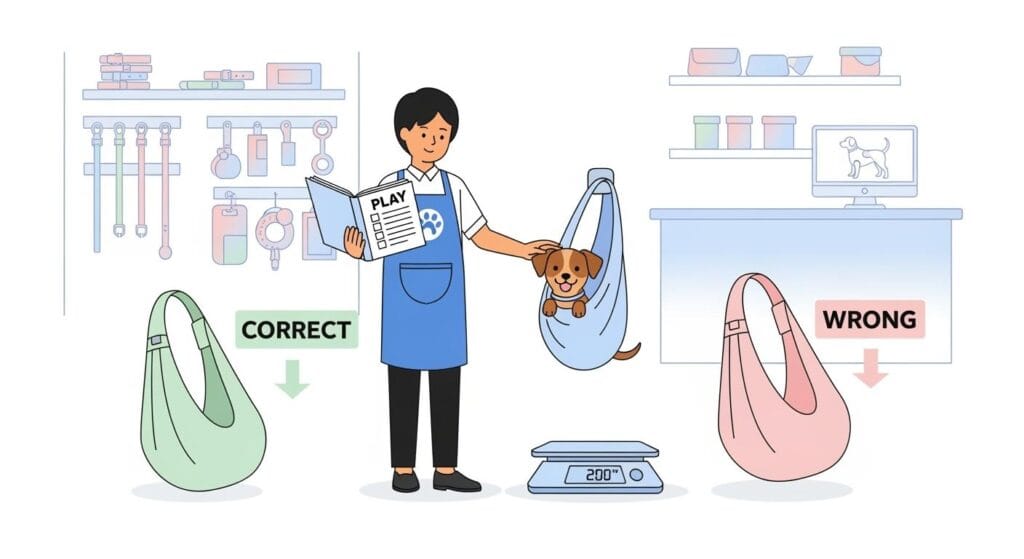
A dog sling carrier can feel convenient on short outings, but comfort depends on more than soft fabric and a close carry position. The real questions are whether your dog stays supported instead of slumping, whether the weight feels manageable on your body, and whether the sling still feels stable once you start moving. A setup that seems cozy at home can become awkward very quickly if the dog slides, overheats, or keeps trying to rebalance.
That is why it helps to compare different sling and crossbody carrier styles by body support, carry height, and short-trip practicality instead of choosing by appearance alone.
When a sling carrier feels comfortable and when it does not
A sling usually works best for smaller dogs, calm short-distance carrying, and daily situations where you want close contact without a bulky structured carrier. It tends to suit dogs that already settle well against the body and do not panic when partially enclosed. It is usually less suitable for dogs that are heavy for their size, overheat easily, or keep twisting to look around and climb out.
Signs a sling may suit your dog
- Your dog stays relaxed when carried close to your chest or side.
- Your dog does not slump heavily into the bottom of the sling.
- You only need it for short errands or transitions, not extended carrying time.
- The combined weight still feels balanced on your shoulder and back.
Signs comfort is already compromised
- Your dog braces with the front legs instead of settling naturally.
- The neck opening presses into the throat or shoulder area.
- The sling swings every time you turn or change pace.
- You feel shoulder strain almost immediately.
Quick rule: a sling should keep the dog close and supported, not suspended in a way that makes both of you work to stay balanced.
How to check weight limits, body support, and carry position
Weight limits matter, but they are only the starting point. A sling can be technically rated for a dog’s weight and still feel wrong if the dog’s body length, posture, or movement pattern do not match the sling’s shape. This is why comfort checks should always include both the dog and the person carrying them.
What to check before using the sling outside
- Place your dog inside and confirm the chest and torso stay supported.
- Adjust the strap so the sling sits close enough to your body that it does not bounce.
- Make sure the dog’s head and neck are free without being forced against the edge.
- Walk a few slow steps indoors and watch for sliding, twisting, or slumping.
| Check point | What good looks like | Warning sign |
|---|---|---|
| Carry height | Close enough to feel stable and easy to monitor | Hangs too low and swings with each step |
| Body support | Dog stays upright or rests naturally | Dog folds, slumps, or leans heavily to one side |
| Weight feel | Manageable for short movement without strain | Shoulder or back discomfort starts quickly |
| Opening shape | Free breathing and easy head position | Pressure at throat, armpit, or shoulder |
Carry position changes comfort more than many people expect
Front carry is often easier to monitor, while side or hip carry can free your arms more but may allow extra swing if the strap sits too loose. In practice, the best option is the position that keeps the dog centered and keeps your own posture relaxed rather than tilted or tense. That usually becomes clearer when the sling is part of a normal travel routine instead of a one-off test at home.
Common comfort problems and what to fix first
Most sling problems do not come from one dramatic flaw. They usually show up as a pattern: the dog keeps readjusting, the carrier feels hotter than expected, the strap cuts into your shoulder, or the sling rotates every time you stop and start. Small issues like these are what turn a convenient carry option into one your dog resists.
What usually causes discomfort
- Too much slack, which lets the dog slide and the sling swing.
- Too little internal support, which forces the dog to brace.
- Fabric that traps heat during even short outdoor use.
- Using the sling for longer carrying sessions than it is comfortable for.
- An internal clip that is attached badly or creates awkward tension.
What to change first
- Raise the carry position so the sling sits closer to your body.
- Recheck whether the dog is the right size and weight for that sling shape.
- Shorten the outing and see whether the problem is duration rather than immediate fit.
- Stop using the setup if rubbing, panic, or repeated escape attempts appear.
If the same comfort problems keep coming back, it usually helps to compare them against a more detailed guide to weight limits and carry positions before assuming the answer is to tighten the sling more or add extra padding.
When a different carrier style is the better choice
A sling is not the best answer for every dog. Some dogs need more structure, more base support, or more enclosure than a soft side-carry setup can provide. If your dog keeps leaning heavily, overheats quickly, or cannot stay centered, the better choice may be a tote, backpack carrier, or more structured travel bag rather than another sling adjustment.
Consider a different option when
- Your dog is too heavy for you to carry comfortably, even for short walks.
- Your dog needs a flatter base or stronger body support.
- Your dog stays calmer in a more enclosed space.
- You need longer carrying time than a shoulder sling handles well.
Alternative tips that stay within the same travel intent
Choose a structured alternative when the main issue is posture support. Choose a more enclosed carrier when the main issue is overstimulation or escape attempts. Choose a format with broader shoulder support when the main issue is your own carrying comfort. The goal is not to force the sling to work for every situation. It is to keep the original purpose of easy short-distance carrying while using the format that feels safest and most stable.
FAQ
How do I know if my dog is too heavy for a sling carrier?
If the sling sags badly, your shoulder strains quickly, or your dog cannot stay supported without slumping, the weight is already beyond a comfortable working range even if the dog technically fits inside.
What is the most common comfort problem with sling carriers?
One of the most common problems is poor body support. The dog looks contained, but the torso slides or folds in a way that makes the carry feel unstable and tiring.
Should a dog sling carrier be tight against my body?
It should sit close enough to feel stable and easy to monitor, but not so tight that it crowds the dog’s head, neck, or shoulders or makes breathing feel restricted.
When should I stop using a sling and switch to another carrier type?
Reassess if your dog keeps slipping, overheating, bracing, or trying to climb out, or if the carry becomes uncomfortable for you after only a short distance.
Are sling carriers good for long walks?
They are usually better for short errands and transitions than extended carrying. For longer use, a more structured carrier often gives better support for both the dog and the person carrying them.






