
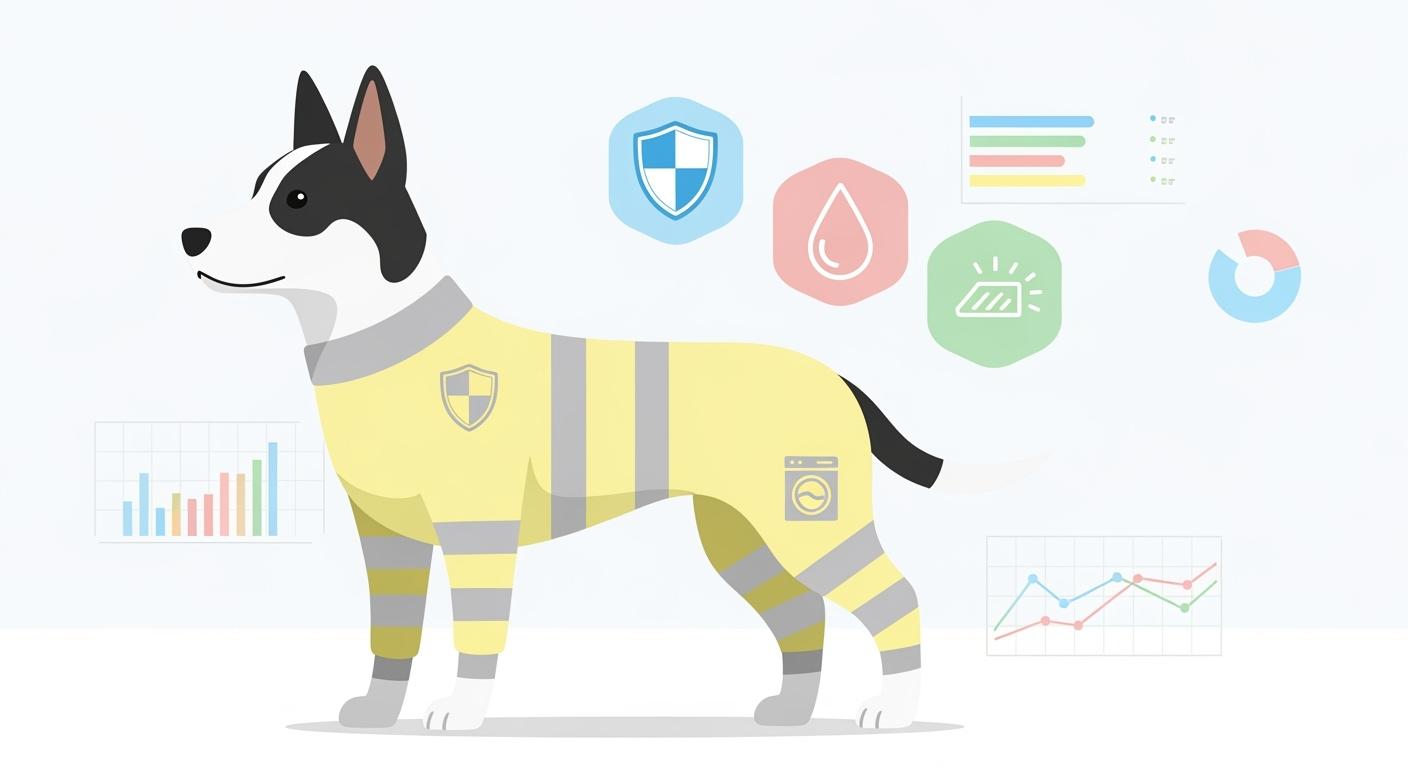
You can have big problems if you pick a dog onesie with bad reflective trim, weak light mounts, or poor grip. If you miss these important things, it can cause safety problems and lots of returns. This can make your company responsible for mistakes. You need to look at things like RR_Test_Condition and Slip_Angle_Target on the Quick Reference Card to make good rules for buying. To buy safely, ask for a price or get samples or a catalog from StridePaw. If you want to learn more, read the StridePaw blog: Dog Onesies Help Outdoor Pet Brands Protect Against Ticks and Mud.
Key Takeaways
Pick dog onesies with strong reflective trim. This helps people see dogs at night. Check every part of the onesie. Look at seams and light mounts to stop safety problems. Ask suppliers for samples. Test how the onesie fits and how long it lasts before buying many. Make clear goals for visibility using RR_Test_Condition. This keeps safety high. Use a good quality control plan. This lowers returns and keeps your brand safe. Use a checklist for sizing. This helps the onesie fit many dog breeds. Try pilot orders first. Test product quality and get feedback before buying a lot. Learn about wash durability. This keeps reflective parts bright after many washes.
Dog onesie safety and visibility risks
Micro visibility failures: trim, stitching, mounts
There are real risks if you miss small details in a dog onesie. Weak reflective trim, bad stitching, or loose light mounts can make it hard to see your dog. These problems often show up at seams, near the legs, or where the light-mount connects. You should check every part of the onesie, not just the big panels. If you ignore these small problems, your dog could be unsafe during walks at night. In the U.S. and EU, buyers want high-visibility features. Many pet owners use gear like LED collars to keep dogs safe after dark. Safety became even more important during the pandemic. You need strong reflective trim and secure mounts to meet these new needs.
Tip: Always ask StridePaw for a quote to make sure your dog onesie has the latest reflective and mount standards.
Failure Mode Table
Buyer Symptom | Root Cause | Prevention (Spec Pack Reference) |
|---|---|---|
Reflective trim dulls quickly | Low-grade material or poor sewing | Use RR_New_Min and RR_PostExposure_Min |
Light mount detaches | Weak stitching or wrong placement | Reference LightMount_ProofLoad_PL |
Garment slips on dog | Inadequate grip or fit | Set Slip_Angle_Target and Max_Slip_Distance |
Retail signals: complaints and returns
Complaints and returns go up if you do not choose good visibility or durability. Customers say the reflective trim fades, light mounts break, or the onesie slips off during walks. These problems mean more returns and hurt your brand’s name. Not enough sizes can also cause safety problems. Bad fit can make dogs uncomfortable or stop them from moving well, which leads to more returns. Watch these retail signals closely. If you see the same problems often, check your spec pack and quality control right away.
Common retail complaints:
Reflective parts lose shine after washing.
Light mounts break or fall off.
Dog onesie slips or turns while worn.
Sizing does not fit some breeds.
Ask for samples or get a StridePaw catalog to test fit and durability before you buy a lot.
Spec Request Checklist Table
Requirement Area | Supplier Request | Verification Step |
|---|---|---|
Reflective | Provide RR_Test_Condition data | Test against RR_New_Min and RR_PostExposure_Min |
Light-mount | Confirm LightMount_Loop_ID and strength | Pull test to LightMount_ProofLoad_PL |
Anti-slip | Specify Slip_Angle_Target | Run incline-plane slip test |
Wash durability | State Wash_Method and cycles | Wash to Wash_Cycles_Baseline, check reflective retention |
Spec pack scope: reflective, light-mount, anti-slip, wash
Your spec pack should cover all important safety and durability points. Start with reflective trim. Use RR_Test_Condition, RR_New_Min, and RR_PostExposure_Min from the Quick Reference Card. For light-mounts, use LightMount_Loop_ID and LightMount_ProofLoad_PL. Anti-slip features need clear goals like Slip_Angle_Target and Max_Slip_Distance. Wash durability means you set Wash_Method and Wash_Cycles_Baseline. Always check colorfastness and fit. This helps you stop safety problems and lower returns.
If you want to know more about this topic, read the StridePaw blog: Dog Onesies Help Outdoor Pet Brands Protect Against Ticks and Mud.
Buyer workflow for dog onesie sourcing
Define use cases and sizing
Start by thinking about how people will use the dog onesie. Will it be for outdoor walks, high-visibility, or all-weather use? This helps you pick the right safety and performance goals for your store or website.
For sizing, you need to get the right measurements. Use these steps to make sure the onesie fits many breeds and shapes: 1. Measure the neck at the collar base. 2. Write down the chest size at the widest part. 3. Measure the back from the shoulders to the tail. 4. Check the front leg spot from the chest to the leg. 5. Measure around the body just behind the front legs for a snug fit. 6. Note the drop from the neck to the chest for a good fit. 7. Write down the dog’s weight to check the size.
Ask suppliers for samples to test size and material. Look at each sample for strong stitching, soft fabric, and correct color. Use a checklist to compare brands on quality, how much they can make, and their support rules. Always check the factory’s background and make sure you know the payment and return rules before you buy.
Step | Description |
|---|---|
Request Samples | Contact suppliers for samples to test sizing and quality. |
Quality Checks | Inspect stitching, fabric, and color for consistency. |
Negotiate Details | Discuss branding, packaging, and delivery options. |
Final Selection | Use a checklist to compare suppliers on quality and policies. |
Due Diligence | Verify credentials and conduct site visits if possible. |
Customer Support | Ensure support for design changes and urgent orders. |
Understand Policies | Clarify payment, returns, and guarantees. |
Compare Pricing | Analyze order quantities, lead times, and payment options. |
Ask for samples or get a catalog from StridePaw to check sizing and fit before you buy a lot.
Set visibility targets (RR metrics)
You need to set clear rules for how bright the onesie should be. Use RR_Test_Condition from the Quick Reference Card as your starting point. This makes sure the onesie meets the right standards for being seen. Pick RR_New_Min for new fabric and RR_PostExposure_Min for after washing. These rules help stop fading and keep dogs safe.
Tell suppliers to give you test results for the reflective trim and panels. Ask for results at the right angles. Make sure all reflective parts meet or beat RR_New_Min when new and RR_PostExposure_Min after washing. This lowers the chance of returns because of poor visibility.
Ask StridePaw for a quote to see which onesies meet the newest reflective rules.
Specify light-mount interface
You need to say what kind of light-mount the onesie should have for outdoor and high-visibility use. Use LightMount_Loop_ID for the smallest opening for lights. Set LightMount_ProofLoad_PL for how strong the mount should be so it does not break. For top onesies, use LightModule_WaterRating_Premium for water safety.
Check where the mount goes so it is not at weak spots or places that get pulled a lot. Tell suppliers to show pull test results for every mount. Read the instructions to make sure store workers can put on and take off lights without hurting the onesie.
If you want to learn more, read the StridePaw blog: Dog Onesies Help Outdoor Pet Brands Protect Against Ticks and Mud.
Anti-slip acceptance criteria
You need clear anti-slip rules to keep the dog onesie steady. Start with Slip_Angle_Target and Max_Slip_Distance from the Quick Reference Card. These help you check how much the onesie moves on a slanted surface. Ask suppliers to do the incline-plane slip test. Make sure the onesie does not move more than allowed. This test shows if the grip material and fit work well.
Check all places where slipping can happen, like the chest, belly, and leg openings. Make sure the grip material does not hurt the dog’s skin. You can ask your supplier for a comfort and skin safety report. If you want fewer returns, always add anti-slip rules to your spec pack. This helps you avoid complaints about twisting or sliding during walks.
Ask for samples or get a StridePaw catalog to test anti-slip before you buy a lot.
Wash durability and care labeling
Wash durability is important for long-lasting use. Tell suppliers to follow the Wash_Method and Wash_Temp from the Quick Reference Card. Set Wash_Cycles_Baseline as your minimum for machine wash tests. After washing, check that the reflective trim still meets RR_PostExposure_Min. This keeps the onesie bright and safe after many washes.
Ask suppliers for care labels that match the tested wash method. The label should show the right temperature and cycle. You should also check colorfastness using Colorfastness_Method. Make sure results meet ColorChange_MinGrade and Staining_MinGrade. This helps you avoid complaints about fading or staining after washing.
Request a quote from StridePaw to see which onesies meet tough wash and care label standards.
QC sampling and defect taxonomy
You need a strong quality control plan to lower returns and protect your brand. Use Sampling_System from the Quick Reference Card. Set your AQL_Critical, AQL_Major, and AQL_Minor levels to match your risk level. Always use the defect definitions from the Quick Reference Card to sort problems into critical, major, or minor groups.
Here is a table of common defect types and examples you may find during checks:
Category | Common Defects |
|---|---|
Pet Wear & Accessories | Loose stitching, weak fasteners, color fading, wrong sizing |
Pet Feeding & Hygiene | Leaking bowls, weak plastic, bad sealing of automatic feeders |
Pet Toys & Entertainment | Choking risks, weak seams on plush toys, sharp edges, unsafe chemicals |
Pet Housing & Comfort | Weak structure, poor padding, wrong size, weak joints |
Pet Food & Smart Products | Wrong labels, expired or bad ingredients, broken electronics |
Pet Travel & Outdoor Gear | Bad zippers, weak harness straps, poor air flow in carriers, unstable wheels |
Focus on Pet Wear & Accessories for your dog onesie program. Look for loose stitching, weak fasteners, color fading, and sizing problems. These issues often cause returns and safety complaints. Always link your QC checks to the AQL and defect list. This helps you find problems early and avoid expensive recalls.
If you want to learn more about risks, read the StridePaw blog: Dog Onesies Help Outdoor Pet Brands Protect Against Ticks and Mud.
Pilot order and feedback loop
You should do a pilot order before buying a lot. This helps you see if the product is safe and good quality. The pilot order lets you test everything from the Quick Reference Card in real life.
Pick a small group of onesies from your supplier. Make sure you get all the sizes and colors you want to sell. Use the Sampling_System to choose which ones to test. Check each one for reflective performance, anti-slip grip, light-mount strength, and wash durability. Use RR_Test_Condition, Slip_Angle_Target, LightMount_ProofLoad_PL, and Wash_Method as your main checks.
Follow these steps for your pilot order:
Receive and inspect
Open the box and check the packing list. Use your QC checklist to look at each onesie. Look for problems using AQL_Critical, AQL_Major, and AQL_Minor.Test key features
Do the reflective test at RR_Test_Condition.
Try the incline-plane slip test for Slip_Angle_Target and Max_Slip_Distance.
Pull on the light-mount to test LightMount_ProofLoad_PL.
Wash the onesies with Wash_Method and Wash_Temp, then check if the reflective trim still meets RR_PostExposure_Min.
Collect feedback
Give samples to your team or trusted stores. Ask them about fit, comfort, and how easy it is to use. Write down any problems with size, grip, or how easy it is to see.Analyze results
Use a table to keep track of what passes or fails:Test Area
Variable Reference
Pass/Fail
Notes
Reflective
RR_Test_Condition
Post-wash Reflective
RR_PostExposure_Min
Anti-slip
Slip_Angle_Target
Light-mount Strength
LightMount_ProofLoad_PL
Wash Durability
Wash_Method, Wash_Temp
Feedback loop
Share what you find with the supplier. Use simple words and the variable names from the Quick Reference Card. Ask the supplier to fix any problems or things that almost failed. Request changes before you buy a big order.
Tip: Always ask for samples or get a catalog from StridePaw before you buy a lot. This helps you not make expensive mistakes.
Request a quote from StridePaw to see which onesies pass your pilot order tests.
You should do the pilot order again if you change suppliers, update your spec pack, or add new features. This feedback loop helps you keep quality high and returns low. You can also use what you learn to update your QC checklist and defect list.
If you want to know more about pilot testing and lowering risks, read the StridePaw blog: Dog Onesies Help Outdoor Pet Brands Protect Against Ticks and Mud.
Reflective performance spec pack

Material types: separate vs combined
You have to choose between separate reflective trim or combined reflective panels. Separate trim uses tape or piping that is sewn onto the main fabric. Combined panels use fabric that already has reflective features. Each choice has good points and risks. Separate trim can make certain spots very bright, but you need to check how well it is attached. Combined panels can cover more of the onesie, but you must make sure the brightness is even everywhere.
If you buy for a business, always ask your supplier what material type they use. Request technical data sheets for both choices. This lets you compare how bright and strong each option is. If you want to see real samples, ask for samples or get a catalog from StridePaw.
Test conditions (RR_Test_Condition)
You need to set clear rules for testing how bright the material is. Use RR_Test_Condition from the Quick Reference Card as your starting point. This means you test the reflective material at a certain angle. Tell suppliers to give you test results using this exact rule. This helps you compare different products in a fair way.
Ask for lab reports from outside labs that show the material meets or beats RR_New_Min when new. This step helps you avoid materials that lose brightness fast. Always put RR_Test_Condition in your buying documents and spec sheets.
Request a quote from StridePaw to find out which onesies pass the newest reflective tests.
Post-wash requirements (RR_PostExposure_Min)
Reflective trim and panels must stay bright after many washes. You need to set a rule using RR_PostExposure_Min. This tells you the lowest brightness allowed after washing the onesie several times. Tell suppliers to test the reflective trim and panels after washing with the Wash_Method and Wash_Cycles_Baseline from the Quick Reference Card.
Ask for lab reports that show the material still meets RR_PostExposure_Min after washing. This step helps you avoid returns because of fading or poor brightness. You should also check that the reflective trim does not peel or crack after washing. Use these rules in your quality control checklist.
Spec Area | Variable Reference | Buyer Action |
|---|---|---|
New Reflective | RR_New_Min | Look at lab test reports |
Test Condition | RR_Test_Condition | Check supplier’s test steps |
Post-Wash Minimum | RR_PostExposure_Min | Inspect results after wash |
If you want to learn more about reflective safety and outdoor use, read the StridePaw blog: Dog Onesies Help Outdoor Pet Brands Protect Against Ticks and Mud.
Ask for samples or get a catalog from StridePaw to check how well the reflective trim lasts before you buy a lot.
Signal-light mount spec pack
Mount placement and damage risks
You need to choose the right spot for the signal-light mount on every dog onesie. The mount should sit where it stays visible and does not get in the way of the dog’s movement. If you place the mount near high-stress seams or thin fabric, you increase the risk of tearing or early failure. Always check the main stress zones, such as the back, chest, and shoulder areas. You should avoid placing mounts near leg openings or elastic panels.
You must ask your supplier to show you their mount placement map. This map should highlight all attachment points and stress zones. You can use this map to compare different samples. If you see mounts placed in weak spots, request a change before you approve the design.
Tip: Ask for samples or get a catalog from StridePaw to review mount placement and reduce damage risks.
Interface size and retention loads
You must specify the interface size for the light-mount loop. Use the LightMount_Loop_ID from the Quick Reference Card as your minimum opening. This ensures that most standard signal lights fit without forcing or stretching the fabric. You should also set clear rules for how much force the mount must handle. Use LightMount_ProofLoad_PL for the proof load and LightMount_Ultimate_UT for the ultimate load.
Ask your supplier for pull test results. These tests should show that the mount can handle the required loads without breaking or tearing. You can use a table to track supplier data:
Test Area | Variable Reference | Pass/Fail | Notes |
|---|---|---|---|
Loop Opening | LightMount_Loop_ID | ||
Proof Load | LightMount_ProofLoad_PL | ||
Ultimate Load | LightMount_Ultimate_UT |
If you want to see which onesies meet these interface and load standards, request a quote from StridePaw.
Water resistance (IPX4/IPX7)
You need to check the water resistance of the signal-light mount and the light module. For most retail programs, use LightModule_WaterRating_Baseline as your standard. For premium programs, use LightModule_WaterRating_Premium. These ratings help you make sure the mount and light can handle rain, splashes, or even short-term immersion.
Ask your supplier to provide water resistance test results for both the mount and the light module. You should check that the mount does not absorb water or weaken after exposure. If you want to lower returns, always include water resistance in your spec pack.
Note: For more details on outdoor use and water resistance, see the StridePaw blog: Dog Onesies Help Outdoor Pet Brands Protect Against Ticks and Mud.
Request a quote from StridePaw to find out which onesies pass water resistance and mount strength tests.
Assembly and retail instructions
You need clear assembly and retail instructions for every dog onesie with a signal-light mount. This helps your team avoid mistakes and keeps the product safe for store display and customer use. You should always ask your supplier for a step-by-step guide that matches your spec pack. The instructions must show how to attach and remove the signal-light module using the LightMount_Loop_ID. You want to see diagrams or photos that highlight the correct loop and show the right way to secure the light.
You should train your staff to check the mount during unpacking and store setup. Use a checklist to confirm that each mount passes the LightMount_ProofLoad_PL test. This step helps you catch weak mounts before they reach customers. You can use a simple table for your team:
Step | Action | Variable Reference |
|---|---|---|
Unpack | Inspect mount for damage | LightMount_Loop_ID |
Attach Light | Secure module to loop | LightMount_ProofLoad_PL |
Test Retention | Pull test for strength | LightMount_Ultimate_UT |
Display Setup | Position for visibility | RR_Test_Condition |
You should include care instructions for the signal-light mount on the retail tag or packaging. Tell your supplier to print clear washing and handling steps that match the Wash_Method and LightModule_WaterRating_Baseline. This helps store staff and customers keep the mount strong and water-resistant. You want to avoid confusion or damage during cleaning.
Tip: Ask for samples or get a catalog from StridePaw to review assembly guides and care labels before you place a large order.
You should also provide a quick reference card for retail teams. This card should list the main variables from your spec pack, such as LightMount_Loop_ID, LightMount_ProofLoad_PL, and RR_Test_Condition. You can use icons or color codes to make the card easy to read. This helps your team follow the right steps and spot any problems early.
You should run a short training session for store staff before launching a new dog onesie program. Show them how to attach and test the signal-light mount. Use real samples from StridePaw to practice each step. This training lowers the risk of assembly errors and helps your team answer customer questions.
Request a quote from StridePaw to see which dog onesies come with complete assembly and care instructions.
If you want more details on category risks and best practices, read the StridePaw blog: Dog Onesies Help Outdoor Pet Brands Protect Against Ticks and Mud.
Anti-slip stability spec pack
Slippage points and return causes
You need to find out where slippage happens most in dog onesies. These spots are usually the leg openings, chest, and back panel. If the onesie slips, it can twist or bunch up. This makes dogs uncomfortable and owners upset. Many people return onesies because of bad fit or weak grip in these places.
Some design features help stop slippage and lower returns:
Ultra stretchy wide leg straps hold the coat close to the dog. This keeps the onesie from sliding and makes it more comfy.
A small overhang of material on the back blocks wind. It also lets the tail move normally, so the onesie stays in place.
Thinner parts at the front legs make walks more comfortable and stop rubbing.
You should always check these spots when you look at a product. If you see lots of returns for slippage, check the leg straps, back panel, and front leg design first.
Ask for samples or get a StridePaw catalog to check anti-slip features before you buy a lot.
Grip material and slip tests
The grip material is very important for anti-slip performance. You want materials that grip well but do not hurt the dog. Make sure the grip works at all contact spots, like the chest, belly, and legs.
To check anti-slip, use the incline-plane slip test. This test shows if the onesie meets Slip_Angle_Target and Max_Slip_Distance from the Quick Reference Card. Ask your supplier for test reports that prove these results. Good suppliers will also show pictures or videos to prove the onesie stays in place when the dog moves.
A strong anti-slip spec pack should have:
Clear rules for what grip material to use and where to put it.
Test steps using Slip_Angle_Target and Max_Slip_Distance.
Supplier papers that show test results and visual checks.
Request a quote from StridePaw to see which dog onesies pass tough anti-slip and slip tests.
Comfort and skin safety
You must make comfort and skin safety a top priority for anti-slip features. Bad materials can cause itching, allergies, or make it hard for dogs to move. Always pick non-toxic, hypoallergenic materials that are safe for pets.
Good materials include:
Cotton, which is soft and lets air through.
Merino wool, which helps control temperature and moisture.
Linen, which is light and good for warm weather.
Recycled polyester, which lasts long and is better for the planet.
Stay away from synthetic blends with harsh chemicals. Do not use onesies with loose parts that dogs might chew off. Make sure all materials follow CPSIA safety rules. The fit and how well the dog can move are just as important as grip. The onesie should let the dog walk, run, and rest without any pain.
You should always ask your supplier for proof that the materials are safe and good for skin. This helps you avoid returns and keeps your brand trusted.
For more about risks and best tips, read the StridePaw blog: Dog Onesies Help Outdoor Pet Brands Protect Against Ticks and Mud.
Wash durability spec pack

Wash protocol (Method 2A, 60°C)
You need to set a clear wash protocol so the product lasts and stays safe. Use Wash_Method and Wash_Temp from the Quick Reference Card. Method 2A at 60°C is like real washing for stores and online buyers in the U.S. and EU. Always tell suppliers to test products for at least Wash_Cycles_Baseline. This helps you find weak materials or bad sewing before customers get them.
Tip: Ask for samples or get a StridePaw catalog to check wash durability before you buy a lot.
Put the wash protocol in your spec pack and buying papers. This makes sure every batch meets your durability rules. If you see problems after washing, look at your AQL_Major and AQL_Minor gates and defect list. This helps you spot issues early and stop expensive returns.
Colorfastness and staining
Colorfastness and stain resistance help keep the product looking good after many washes. You want to stop complaints about fading or colors rubbing off. Pick a test method like Colorfastness_Method from the Quick Reference Card. Set your rules using GrayScale_Range, ColorChange_MinGrade, and Staining_MinGrade.
Here is a table with the main grades for colorfastness and staining:
Benchmark Type | Rating |
|---|---|
Color Change Rating | 4 |
Color Staining Rating | 3 to 5 |
Desired Grade for Staining | 3 |
Desired Grade for Color Change | 4 |
Tell suppliers to give you lab reports that show these grades. Always check both the main fabric and printed parts. If you see color change or stains below the grade, call it a major defect in your AQL system.
Request a quote from StridePaw to see which products pass tough colorfastness and staining tests.
Reflective retention post-wash
Reflective trim must stay bright after many washes. Set RR_PostExposure_Min as your lowest rule for reflective retention. Tell suppliers to test reflective trim and panels after Wash_Cycles_Baseline with the right Wash_Method. If the reflective trim does not meet RR_PostExposure_Min, mark it as a major defect.
Add reflective retention checks to your inspection and QC sampling plan. Use Sampling_System and defect list from the Quick Reference Card. This helps you keep safety and visibility high for your products.
Note: For more about risks and best tips, read the StridePaw blog: Dog Onesies Help Outdoor Pet Brands Protect Against Ticks and Mud.
Unit-economics example
Let’s say you lower your return rate from ReturnRate_Baseline to ReturnRate_Improved by making your AQL_Major gates tighter and using RR_PostExposure_Min and Wash_Cycles_Baseline. If GM_Baseline stays the same, even a small drop in returns can make your gross margin go up. You save money because there are fewer bad products and less work to fix them. You protect your brand and make more profit by following these wash durability rules.
End-of-life and inspection
You need a simple plan for end-of-life and inspection. This keeps your dog onesie program safe and working well. When a dog onesie gets old, check it for safety and quality. This helps you find problems, make better orders, and lower returns.
Make an easy inspection checklist for your team. Use the same variable names from the Quick Reference Card. Focus on these main areas:
Reflective performance: Test the reflective trim and panels. Use RR_PostExposure_Min as your guide. If the reflective parts do not reach this level, the onesie is not safe for outdoor use.
Grip and anti-slip: Check the grip material at every contact spot. Use Slip_Angle_Target and Max_Slip_Distance to see if the onesie stays in place. If the grip does not work, call it a major defect.
Light-mount integrity: Look at the signal-light mount. Pull on the mount to test LightMount_ProofLoad_PL. If the mount comes off or breaks, mark it as a critical defect.
Fabric and color: Look for holes, tears, or fading. Use ColorChange_MinGrade and Staining_MinGrade to check color. If the fabric fails, send it for recycling or safe disposal.
Tip: Use a table to track inspection results. This helps you see which problems happen most.
Inspection Area | Variable Reference | Pass/Fail | Notes |
|---|---|---|---|
Reflective Trim | RR_PostExposure_Min | ||
Grip Material | Slip_Angle_Target | ||
Light-Mount | LightMount_ProofLoad_PL | ||
Fabric/Color | ColorChange_MinGrade |
Train your staff to use this checklist for returns or recycling. This helps you get real data about wear. You can use this data to update your spec pack and make future orders better.
If you see the same problem a lot, tell your supplier. Ask them to check the variable and suggest changes. This feedback helps you lower your AQL_Major and AQL_Minor rates over time.
Request a quote from StridePaw to see which dog onesies have end-of-life inspection guides for stores.
Think about safe disposal or recycling too. Ask your supplier if they have recycling programs for old onesies. This helps you meet sustainability goals and cut down on waste.
Ask for samples or get a catalog from StridePaw to check inspection and recycling choices before you start your next program.
For more about risks and lifecycle management, read the StridePaw blog: Dog Onesies Help Outdoor Pet Brands Protect Against Ticks and Mud.
QC and returns SOP for dog onesies
Incoming inspection checklist
You need a clear checklist for incoming inspections. This helps you catch problems before the dog onesies reach your stores or customers. Start by using the variable names from the Quick Reference Card. Check each shipment for these key areas:
Reflective trim: Test using RR_Test_Condition and RR_New_Min.
Light-mount: Inspect for correct LightMount_Loop_ID and test with LightMount_ProofLoad_PL.
Anti-slip grip: Use Slip_Angle_Target and Max_Slip_Distance for spot checks.
Wash durability: Review care labels and confirm Wash_Method is listed.
Colorfastness: Check for Colorfastness_Method and look for color changes.
You should train your team to use this checklist every time you receive a shipment. If you find any critical defects, stop the inspection and contact your supplier. This process lowers the risk of unsafe products reaching your customers.
Tip: Ask for samples / get a catalog from StridePaw to see how a complete inspection checklist works in practice.
Sampling plan and defect gates
You must use a strong sampling plan to control quality. Follow the Sampling_System from the Quick Reference Card. This system tells you how many units to check in each batch. Use the AQL_Critical, AQL_Major, and AQL_Minor levels to decide if a shipment passes or fails.
Here is a simple table for defect gates:
Defect Type | AQL Level | Action if Found |
|---|---|---|
Critical | AQL_Critical | Reject shipment |
Major | AQL_Major | Review with supplier |
Minor | AQL_Minor | Accept with note |
You should always record defects by type. This helps you spot trends and improve your orders. If you see many major or critical defects, review your spec pack and talk with your supplier.
Request a quote from StridePaw to learn how a strong sampling plan can lower your return rates.
Returns triage: mount, wash, fit
You need a simple way to sort returns. Focus on three main areas: mount, wash, and fit. For each return, ask your team to check:
Mount: Test the light-mount using LightMount_ProofLoad_PL. If it fails, mark as critical.
Wash: Inspect reflective trim after washing. Use RR_PostExposure_Min as your guide.
Fit: Check if the onesie meets sizing rules. Look for twisting or slippage using Slip_Angle_Target.
Use a table to track the reason for each return:
Return Reason | Variable Reference | Defect Type |
|---|---|---|
Mount failure | LightMount_ProofLoad_PL | Critical |
Faded trim | RR_PostExposure_Min | Major |
Poor fit | Slip_Angle_Target | Major/Minor |
You should share this data with your supplier. This helps you fix problems and lower future returns. Always update your QC checklist based on return trends.
For more on category risks, see the StridePaw blog: Dog Onesies Help Outdoor Pet Brands Protect Against Ticks and Mud.
RFQ template and supplier scorecard
When you buy dog onesies for your store or website, you need an RFQ template. This is a Request for Quotation. It helps you get the right info from suppliers. You can compare their offers using the same rules. Always use the variables from the Quick Reference Card. This keeps your process fair and focused on safety, visibility, and durability.
Tip: Ask for samples or get a StridePaw catalog. This lets you see real product info before you finish your RFQ.
Buyer RFQ Checklist
Use this checklist to make sure your RFQ covers all important points:
Say what reflective performance you need with RR_Test_Condition, RR_New_Min, and RR_PostExposure_Min.
Tell suppliers your wash durability needs with Wash_Method, Wash_Temp, and Wash_Cycles_Baseline.
List anti-slip needs using Slip_Angle_Target and Max_Slip_Distance.
Set the signal-light mount details with LightMount_Loop_ID, LightMount_ProofLoad_PL, and LightMount_Ultimate_UT.
Ask for colorfastness info using Colorfastness_Method, ColorChange_MinGrade, and Staining_MinGrade.
Add your QC sampling plan with Sampling_System, AQL_Critical, AQL_Major, and AQL_Minor.
Ask for defect reports using Defect_Definitions from the Quick Reference Card.
Require care labels and end-of-life inspection steps.
Request supplier papers for all test results and certifications.
You can copy and change this sample RFQ block for your next supplier request:
**RFQ: Dog Onesie 2025 Program**

Please give the following for each model:
- Reflective performance: RR_Test_Condition, RR_New_Min, RR_PostExposure_Min
- Wash durability: Wash_Method, Wash_Temp, Wash_Cycles_Baseline
- Anti-slip: Slip_Angle_Target, Max_Slip_Distance
- Signal-light mount: LightMount_Loop_ID, LightMount_ProofLoad_PL, LightMount_Ultimate_UT
- Colorfastness: Colorfastness_Method, ColorChange_MinGrade, Staining_MinGrade
- QC sampling: Sampling_System, AQL_Critical, AQL_Major, AQL_Minor
- Defect reporting: Defect_Definitions
- Care labeling and end-of-life inspection
- Test reports and certifications
Supplier Scorecard
After you get answers from suppliers, use a scorecard to compare each one. This helps you see which supplier meets your safety and quality needs.
Category | Variable Reference(s) | Supplier A | Supplier B | Supplier C |
|---|---|---|---|---|
Reflective Performance | RR_Test_Condition, RR_New_Min, RR_PostExposure_Min | |||
Wash Durability | Wash_Method, Wash_Temp, Wash_Cycles_Baseline | |||
Anti-slip Stability | Slip_Angle_Target, Max_Slip_Distance | |||
Light-Mount Interface | LightMount_Loop_ID, LightMount_ProofLoad_PL, LightMount_Ultimate_UT | |||
Colorfastness | Colorfastness_Method, ColorChange_MinGrade, Staining_MinGrade | |||
QC Sampling & Defects | Sampling_System, AQL_Critical, AQL_Major, AQL_Minor, Defect_Definitions | |||
Documentation | Test Reports, Certifications | |||
Care & End-of-Life | Care Label, Inspection Steps |
Request a quote from StridePaw to see which dog onesies match your RFQ and scorecard needs.
You can use this scorecard to help your team choose the best supplier. Always keep your focus on safety, visibility, and durability. For more tips and risks, read the StridePaw blog: Dog Onesies Help Outdoor Pet Brands Protect Against Ticks and Mud.
You can get the best safety and visibility by picking models with strong reflective trim, safe light-mounts, and good wash durability. The best onesies keep dogs cool, comfy, and safe. These onesies use eco-friendly and breathable materials. They are easy to clean in the washing machine. Veterinarians help make sure the safety features work well. These features also help lower shedding and calm dogs.
If you follow the spec packs and steps in this guide, you will have fewer returns and safer products. Using the same benchmarks and QC rules every time helps you buy good onesies.
Next steps for your team:
Ask StridePaw for a quote to see which models follow the rules.
Get samples or a catalog to check fit and how long they last.
Try pilot testing and tell suppliers what you find.
Change your spec pack when you get new information.
Video: StridePaw dog onesie visibility + wash-durability demo (use a StridePaw video or add a placeholder if not available).
FAQ
What reflective performance benchmarks should you require for dog onesies?
You need to make sure your supplier meets RR_Test_Condition, RR_New_Min, and RR_PostExposure_Min from the Quick Reference Card. These rules help keep dogs easy to see and safe outside.
Request a quote from StridePaw to find out which models follow these reflective rules.
How do you verify wash durability in a dog onesie program?
Ask your supplier to test with Wash_Method and Wash_Cycles_Baseline. Check if the reflective trim still meets RR_PostExposure_Min after washing. Always look at lab reports before you buy a lot.
What is the best way to check anti-slip stability?
Use the incline-plane slip test to check anti-slip. Make sure the onesie meets Slip_Angle_Target and Max_Slip_Distance. Ask for test results and pictures or videos from your supplier.
Ask for samples or get a StridePaw catalog to check anti-slip features.
How do you set requirements for the signal-light mount?
Tell your supplier to use LightMount_Loop_ID, LightMount_ProofLoad_PL, and LightMount_Ultimate_UT. These rules make sure the mount fits most lights and stays strong.
What colorfastness grades should you request from suppliers?
Ask for test results using Colorfastness_Method. Set ColorChange_MinGrade and Staining_MinGrade as your rules. This helps stop problems with fading or stains.
How do you handle returns related to fit or slippage?
Check each return with Slip_Angle_Target and Max_Slip_Distance. Write down the problem and tell your supplier. Change your spec pack if you see the same problem a lot.
Where can you find more information on category risks and best practices?
Read the StridePaw blog: Dog Onesies Help Outdoor Pet Brands Protect Against Ticks and Mud. This blog talks about safety, visibility, and how long outdoor pet gear lasts.






