
“`html
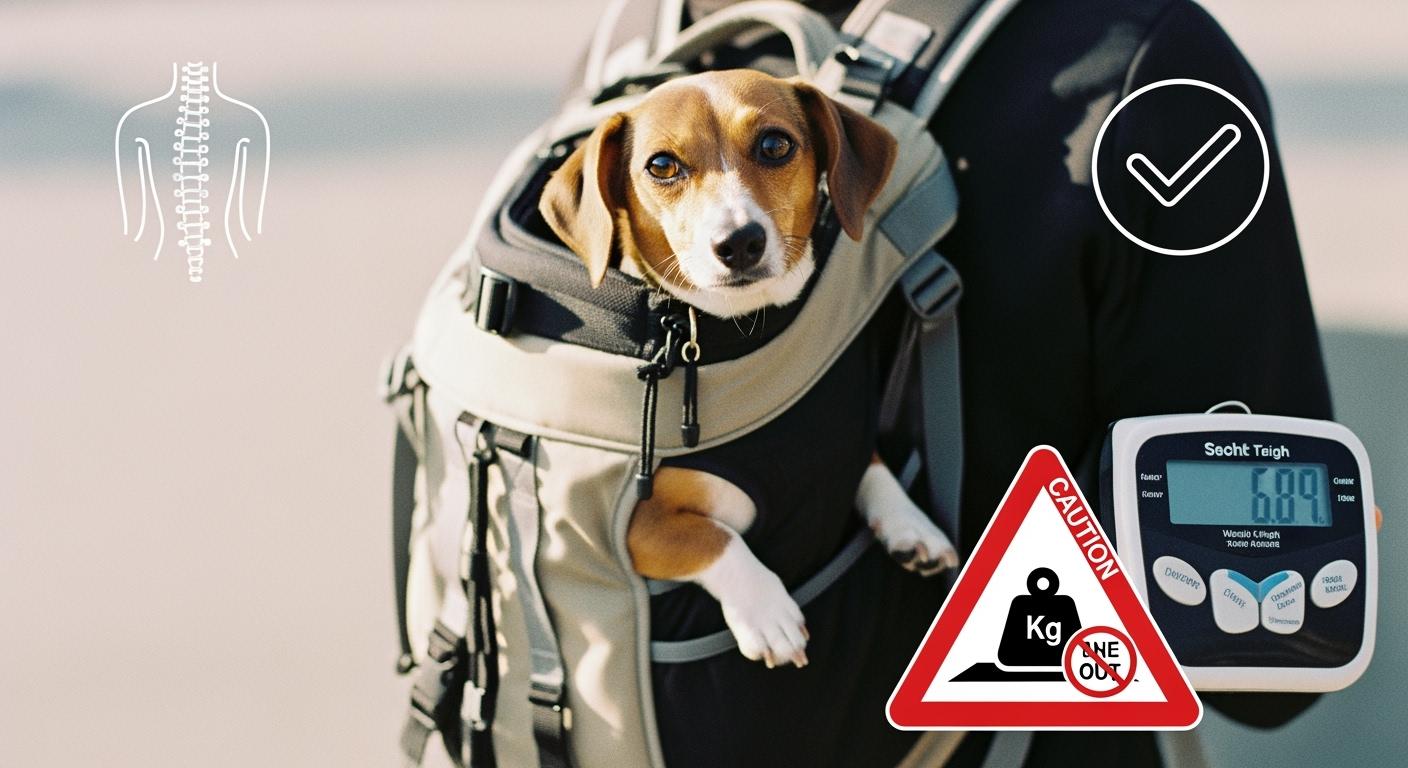
A carrier labeled for dogs up to 20 pounds can still fail a Corgi or Dachshund. Weight capacity tells you when the stitching or buckles give way. It says nothing about whether the dog can rest flat inside. A short-legged, long-bodied dog needs a carrier sized by body length and interior geometry, not by a number on the hang tag. The usable internal floor is the number that matters.
Why Weight-Based Sizing Misses the Point for Short-Legged Dogs
Most dog backpack carrier sizing charts start with a weight range. That is a structural limit, not a fit guarantee. Two dogs weighing the same 18 pounds can have radically different body proportions. A Pug carries that weight in a compact block. A Dachshund stretches it across a frame that is 30 percent longer. Both fit the weight spec. Only one fits the carrier.
The mechanism is simple. When the internal floor is shorter than the dog’s body length, the spine cannot stay neutral. The dog compensates by curling, twisting, or pressing its head against the wall. Each of these is a load-path problem. The torso weight that should transfer straight down into a flat base instead pushes diagonally into a curved or too-short surface. That surface pushes back at an angle, rotating the pelvis and forcing the lumbar spine into flexion. A few minutes of this and the dog shifts, pants, or tries to escape. The structure held. The fit did not.
You can check this yourself. After a 15-minute carry session, set the carrier on level ground and open it. Look at the dog from above before it moves. If the spine traces a C-curve rather than a straight line from neck to tail base, the floor is too short for the body length it needs to support.
A sizing approach that accounts for body length and interior geometry produces a different result. When choosing a dog backpack carrier by size and activity level, the first measurement is not the dog’s weight but the distance from the base of the neck to the base of the tail. That number, compared against the carrier’s internal floor dimension after padding and liners are installed, tells you more than any weight chart.
| Measurement | What It Tells You | Why It Matters |
|---|---|---|
| Weight Capacity | Structural load limit | Prevents failure, not posture issues |
| External Depth | Shell size from the outside | Hides space lost to padding and taper |
| Usable Internal Floor | Flat surface the dog rests on | Determines whether the spine stays neutral |
| Seated Height | Vertical room for sitting or turning | Affects head and neck position |
| Body Length (Neck to Tail) | The dog’s actual length | Must be shorter than usable floor |
A fit and sizing check that prioritizes internal floor dimensions catches what weight-only grading skips. External depth can read 14 inches while the usable flat surface inside measures 11 after padding compresses and sidewalls taper inward. A dog with a 13-inch body fits on paper. It does not fit in practice.
How Floor Shape and Base Rigidity Determine Resting Posture
The floor of a backpack carrier is not just a platform. It is the surface that either supports a neutral spine or forces compensation. Two design variables decide which outcome you get: the base shape under load and the stiffness of the material resisting that load.
A rigid flat base creates a single, predictable support plane. The dog’s torso weight spreads evenly. The spine stays aligned because every vertebra rests on the same surface geometry. No rotation. No lateral tilt. The dog settles and stays settled.
A base that bows or curves under load does the opposite. As weight is applied, the center sinks and the edges rise, creating a concave cradle. For a short-legged, long-bodied dog, this cradle acts as a fulcrum under the mid-spine. The front and rear quarters drop relative to the center, forcing the lumbar region into extension and the neck into compression against the front wall. The design did not fail structurally. It failed geometrically.
You can test base rigidity before loading a dog. Press the center of the unloaded floor with your palm using moderate pressure. If the surface deflects more than half an inch, it will sag further under a dog’s full body weight. A backpack carrier with a rigid flat base resists this deflection. The floor stays horizontal. The dog stays neutral.
| Dimension | Measurement |
|---|---|
| Width | 14 inches |
| Depth (front to back) | 10 inches |
| Height | 18.5 inches |
Sidewall angle creates a second geometric constraint. Vertical sidewalls preserve the full floor width from top to bottom. Tapered or curved sidewalls shrink the usable surface as they descend. A 14-inch width at the opening can narrow to 10 inches at the base. The dog’s body contacts the sloping wall, which redirects a portion of the vertical load into a lateral push. The dog leans to compensate. That lean feeds back into more wall contact. Within minutes the posture degrades from neutral to side-loaded, and the dog shifts again.
Entry geometry compounds these effects. A soft, unstructured opening collapses when the dog is placed inside, reducing effective floor length at the front edge. A sizing process that includes measuring and testing the carrier after loading catches these interactions. Measure the internal floor at its narrowest point with all liners and inserts in place. Compare that to the dog’s body length from neck to tail. If the number is smaller, no amount of weight-capacity headroom fixes it.
Interior padding adds one more variable. Thick padding under the dog improves comfort but consumes vertical space and, if uneven, tilts the support plane. Padding along the sidewalls shrinks the floor width. A carrier with 2 inches of foam on each wall loses 4 inches of lateral space. For a dog that already has limited room, that loss can be the difference between lying flat and twisting sideways. Padding is not inherently good or bad. It is a trade-off. More cushion means less floor. The right balance depends on the dog’s body length and resting style.
When a Rigid Flat Floor Is Not the Right Choice
A flat rigid base works best for dogs with a straight-backed, long-bodied build — the Dachshund, the Corgi, the Basset Hound. These body types benefit from a support surface that keeps the spine aligned in one plane. But that same design can work against dogs with a different skeletal structure.
Barrel-chested breeds with short legs — a Bulldog or a Pug — carry their weight differently. The ribcage is wider and rounder. A completely flat floor can create pressure points under the sternum because the chest does not sit flush. These dogs may settle better on a base with slight contouring that matches the thoracic curve. The trade-off shifts. A curved base that would force a Dachshund into spinal flexion might allow a Bulldog to rest with less sternal pressure.
Deep-chested short-legged dogs like a Basset Hound present a third case. The chest depth means the dog sits higher off the floor, consuming more vertical space and changing how the sidewalls interact with the shoulders. What works as a neutral surface for a Corgi can become a constraint for a dog whose chest occupies more of the interior volume.
Disclaimer: The flat-floor fit checks described here assume a straight-backed, long-bodied dog. For barrel-chested or very deep-chested short-legged breeds, pressure points may form under the sternum even when the spine appears aligned. Hand-check the chest contact area after loading — if the dog shifts weight forward repeatedly, the base contour may need to match the thoracic curve rather than remain completely flat.
The broader point is not that one base shape is better. It is that base shape and body shape interact in specific, predictable ways. A sizing system that only reports weight limits hides that interaction entirely. A sizing system that maps body length to internal floor length surfaces it. That is the difference between a carrier that supports neutral posture on a hike and one the dog tolerates for 10 minutes before signaling distress.
Regular fit re-checks matter because carrier interiors change with use. Liners compress unevenly. Seams stretch. Base inserts lose stiffness over repeated loading cycles. A carrier that fit three months ago may have a floor that now bows under the same weight. The signs of a cramped fit are consistent: the dog curls instead of stretching out, shifts weight repeatedly, or presses its head against the wall. Each signal points to the same root cause. The usable floor no longer matches the body it needs to support.
FAQ
How do you measure a short-legged dog for a backpack carrier?
Measure from the base of the neck to the base of the tail with the dog standing. That body length must be shorter than the carrier’s internal floor measured at its narrowest point, after all padding and liners are installed. Do not compare body length to external dimensions. External shell dimensions overstate usable space.
Why does my dog meet the weight limit but still curl up inside?
Weight capacity confirms the carrier will not break. It does not confirm the dog can rest flat. If the internal floor is shorter than the dog’s body length, the spine must flex to fit. Curling is the body’s response to a surface that is too short, not a preference.
What should I check after a walk to see if the fit is right?
Open the carrier on level ground after a 15-minute carry and observe the dog from above before it moves. A straight spine from neck to tail is a pass. A C-shaped curve or a side-lean is a fail. Also press the center of the unloaded base with your palm — deflection beyond half an inch under moderate pressure signals insufficient rigidity.
Can the same carrier fit different short-legged breeds equally well?
Not necessarily. A Corgi and a Bulldog may weigh the same but have different chest shapes and body lengths. A flat rigid base that keeps a Corgi neutral may create sternal pressure on a Bulldog. Fit is body-shape-specific, not weight-class-specific.
How often should I re-check carrier fit?
Re-check whenever you add or replace a liner or pad. Re-check every few months even if nothing changes, because foam compresses and base inserts lose stiffness with repeated loading. A carrier that fit on day one may not fit the same dog three months later.
“`






