
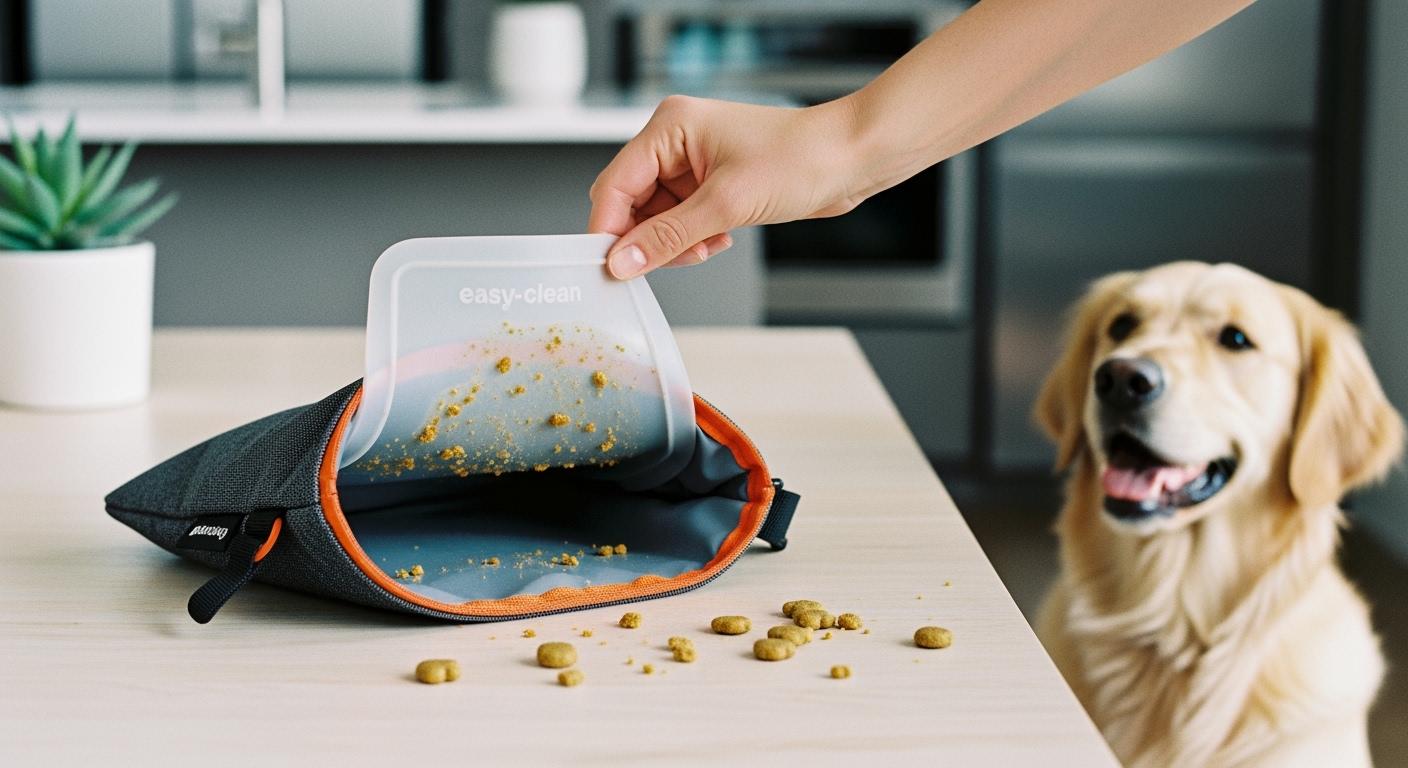
A dog treat pouch liner holding crumbs and oil after a training session is not a cleaning problem. It is a material and geometry problem. The liner is doing exactly what its design allows it to do: absorb oil into fiber bundles and trap particles in seams, folds, and corners. Change those two variables — what the liner is made of and how it is shaped — and the residue problem shrinks to nearly nothing.
This matters because trainers reach into the pouch dozens of times per session. Each reach pushes crumbs deeper. Each grab of a soft or oily treat transfers grease to the liner wall. Over days and weeks, a liner that fights back against this cycle stays fresh with a single wipe. A liner that does not becomes a sticky, odorous mess that demands soaking and scrubbing. The difference is not how often you clean. It is whether the liner was built to shed residue in the first place.
Why Most Dog Treat Pouch Liners Trap Crumbs and Grease
The Material Problem: Fabric Absorbs at the Fiber Level
Fabric liners fail because of how woven fibers interact with fats and moisture. At the microscopic level, natural and untreated synthetic fibers have a capillary structure — tiny channels between filaments that wick liquid oils inward through surface tension. When a soft or greasy treat presses against a fabric liner wall, the oil does not sit on top. It travels into and between the fibers, spreading laterally as it goes. Once inside the fiber bundle, the oil resists surface wiping because the mechanical bond between oil and fiber is stronger than the shear force of a dry cloth pass.
This is why you can wipe a fabric liner after a session and still feel a greasy film. The surface looks clean, but the oil has migrated below the wipeable layer. Over repeated sessions, that subsurface oil oxidizes, thickens, and traps new crumbs on top — creating a layered residue that gets progressively harder to remove. A coated nylon or silicone liner interrupts this cycle at the first step: the non-porous surface prevents capillary wicking, so oil stays on top where a wipe can actually reach it.
Tip: Check your liner material by pressing a dry paper towel against it after a session with oily treats. A translucent grease spot on the towel means oil is sitting on the surface and can be wiped away. No spot on a liner that still feels slick means the oil has already migrated into the material.
The Geometry Problem: Seams, Corners, and Folds Create Hiding Zones
Even a low-absorption liner fails if its geometry gives debris somewhere to hide. Stitched seams are the worst offender. Each needle penetration creates a small depression — a micro-valley along the stitch line where dry crumbs and powder settle below the wipeable surface plane. A flat wipe passes over these depressions without making contact. The residue stays.
Square corners at the bottom of a pouch compound the problem. Gravity pulls broken treat pieces and crumbs downward, where they pack into the 90-degree angle of a square-cornered liner. The tighter the corner radius, the harder it is for a finger or cloth to reach the crease. Folded edges — common in liners that are stitched rather than heat-welded — create similar dead zones. A folded hem at the top of the liner forms a narrow pocket that catches debris each time the pouch is tipped or jostled during training.
Dark interior colors add a visibility problem to the geometry problem. A black or dark gray liner conceals the residue that seams and corners are trapping. You wipe, you think it is clean, and you miss what you cannot see. The mess accumulates silently.
Narrow pouch openings amplify every geometry issue. If your hand cannot reach the bottom corners, you cannot clean them. If the opening is smaller than the liner’s interior width, the corners become geometrically inaccessible from the entry point — like trying to wipe the inside of a box through a slot.
| Design Weakness | Why It Matters | Where It Fails Worst |
|---|---|---|
| Fabric liner | Capillary wicking pulls oil below the surface; dry wiping cannot reach it | Soft treats, oily treats, high-frequency use |
| Stitched seams | Needle depressions trap crumbs below the wipe plane | Dry crumbly treats, powdered rewards |
| Square corners | Broken pieces pack into 90-degree angles that fingers cannot clear | Broken treats, multi-treat mixes |
| Folded/hemmed edges | Pocket gaps catch debris when the pouch tips during movement | Active training, jogging, bending down |
| Dark interior | Conceals residue; cleaning becomes guesswork | All treat types, all conditions |
| Narrow opening | Bottom corners are geometrically inaccessible from the entry point | Deep pouches, large-hand users |
Liner Materials and Geometry That Stop Residue Before It Starts
Low-Absorption Surfaces Prevent Oil Penetration
The single biggest design variable is surface material. A coated nylon liner or a food-grade silicone liner shares one property that fabric lacks: zero capillary uptake. Oil and moisture sit on top of the surface rather than wicking in. This means the mechanical bond never forms. A single pass with a damp cloth or paper towel shears the residue off the surface because nothing is holding it below.
This is not just about ease of cleaning. It is about what happens between cleanings. A fabric liner that has partially absorbed oil from session one will grab and hold dry crumbs from session two more aggressively — the subsurface oil acts as an adhesive. A non-porous liner resets to neutral after each wipe, so there is no cumulative stickiness effect across sessions. The liner performs the same on day 30 as it did on day one.
Coated nylon adds a secondary benefit: it is inert to the fatty acids in most dog treats. Canvas and uncoated polyester can slowly degrade under repeated oil exposure, becoming rougher and more absorbent over time. A coated surface maintains its smoothness through the life of the pouch, which matters for a training treat pouch that may see hundreds of openings and closings per month.
Rounded Corners and Fewer Seams Eliminate Hiding Zones
If the liner material determines whether residue can bond to the surface, the liner geometry determines whether residue can evade a wipe in the first place. A heat-welded or single-piece liner with radiused bottom corners solves the geometry problem at the manufacturing level. No stitch holes. No fabric hem folds. No tight corner angles for debris to pack into.
A rounded bottom with a continuous smooth surface means one wipe in a single arc clears the entire interior. The wipe makes full contact from wall to floor to opposite wall. Contrast this with a seamed, square-cornered liner: the wipe bridges over the corner depression, the seam valley, and the hem fold without touching the residue inside them. You are cleaning the high points while the low points accumulate.
The manufacturing trade-off is real. Heat-welded seams require different tooling and are harder to execute at scale than stitched seams — the alignment tolerances are tighter, and the bond must hold through repeated flexing as the pouch opens and closes. But the payoff for the user is a liner that cleans in seconds rather than minutes, and that difference compounds across dozens of training sessions.
In practice: After a week of daily use, turn the pouch inside out and examine the bottom corners under good light. If you see a line of accumulated powder or dark residue along any seam or crease, the liner geometry is failing. A well-designed liner shows even wear and no concentrated debris lines.
Wide Openings and Stable Shapes Make Cleaning Reachable
A wide opening is not a convenience feature. It is an access requirement. The opening diameter relative to the interior depth determines what percentage of the liner surface is reachable without deforming the pouch. If the opening is narrower than the liner body, the bottom corners sit outside the direct cleaning path — you are reaching around a geometric blind spot.
A pouch that holds its shape when empty solves the other half of the access problem. Collapsible pouches fold in on themselves during cleaning, creating temporary creases that trap debris and then hide it when the pouch springs back. A stiffer structure keeps the interior surfaces exposed and accessible throughout the wipe. This is why some treat pouch designs prioritize capacity and shape retention together — a pouch that collapses when partly empty hides as much residue as a poorly designed liner.
Removable Liners as a Useful Option — Not a Requirement
A removable or pull-out liner adds cleaning flexibility but is not mandatory for a clean pouch. The advantage is straightforward: you can shake crumbs out over a trash can and wipe the liner on a flat surface outside the pouch body. This eliminates the geometric access problem entirely. The trade-off is that a removable liner introduces a secondary seam or attachment point that can itself become a debris trap — the interface between liner and pouch shell needs to be smooth and free of gaps.
For trainers who use multiple treat types — dry kibble, soft chews, and high-fat rewards like freeze-dried liver — a pouch with a removable liner saves meaningful cleanup time. For those who stick to one or two treat types and wipe after every session, a fixed smooth liner with good geometry is sufficient. The decision hinges on treat variety, not training frequency.
When Liner Design Matters Most — and When the Difference Shrinks
Treat Types That Stress the Liner Hardest
Not all treats test a liner equally. Soft, high-moisture treats — cheese cubes, fresh meat, semi-moist training rewards — are the hardest on liners because they combine oil transfer with mechanical smearing. The treat deforms against the liner wall, leaving a film that covers more surface area than a dry crumb. Oily treats like freeze-dried liver or salmon bites create a thin but penetrating grease layer that fabric liners wick instantly.
Dry, hard treats — kibble, biscuit pieces, freeze-dried chicken — stress the geometry more than the material. They leave behind particles that migrate into seams and corners under gravity and movement. A liner with poor geometry will accumulate these even if the material is non-porous.
Mixed treat loads combine both stress vectors. The oil from soft treats creates a sticky substrate that grabs the crumbs from dry treats. This is the worst-case scenario for any liner, and it is also the most common real-world use pattern — most trainers carry two or three treat types in a single pouch.
Training Frequency and Cleaning Rhythm
A trainer who runs one 15-minute session per day and wipes the liner afterward can tolerate more design compromises than a trainer doing three sessions back to back with multiple dogs. The cleaning interval matters as much as the cleaning method. A fabric liner used once daily and immediately wiped may never build up enough subsurface oil to become a problem. The same fabric liner subjected to three oily treat sessions without intermediate cleaning will degrade into a sticky mess within a week.
The design advantage of a low-absorption liner is not that it eliminates cleaning — it is that the liner does not punish you for skipping a wipe between sessions. The residue stays on the surface, waiting. A fabric liner, by contrast, starts absorbing the moment you close the flap.
Disclaimer: If your training treats are exclusively dry, low-fat kibble and you wipe the pouch after each session, the performance gap between a coated liner and a quality fabric liner narrows significantly. The oil-wicking problem never activates. The geometry problems — seams and corners — still apply regardless of treat type. Double-coated breeds that need higher-value rewards during distraction training will push any liner harder than a food-motivated single-coat dog working in a quiet environment.
When to Prioritize Liner Design Over Other Features
Not every treat pouch purchase needs to center on liner design. If pouch capacity, belt attachment style, or silent pocket access matters more for your training context, a mid-range liner is acceptable — provided you understand the cleaning trade-off. But if you train with high-value oily treats, run multiple daily sessions, or have stopped using a previous pouch because it became sticky and odorous, liner design is the single feature worth prioritizing over all others. A spill-free treat pouch setup that fights residue at the design level changes the daily training experience more than an extra pocket or a quieter closure ever will.
FAQ
Why does my fabric-lined treat pouch still feel greasy after wiping?
The oil has wicked into the fiber bundles below the surface. A dry wipe only removes what sits on top. The subsurface oil remains and will resurface with heat or pressure during the next session. A coated liner prevents this by blocking capillary uptake at the material level.
Do I need a removable liner, or is a smooth fixed liner enough?
If you use one or two treat types and wipe after every session, a fixed smooth liner with rounded corners works well. If you rotate through dry, soft, and oily treats across multiple dogs or sessions, a removable liner lets you shake out debris and wipe on a flat surface — cutting cleanup time noticeably.
How can I tell if my pouch’s liner geometry is the problem?
Flip the pouch inside out after a week of normal use. Look at the bottom corners and along every seam line. A line of concentrated powder or dark residue in those zones means the geometry is failing — seams and corners are trapping what your wipe misses.
What is the single most important liner feature?
A non-porous, wipe-clean surface. It stops oil penetration at the first contact point. Without that, every other design feature — wide opening, rounded corners — matters less because the residue has already bonded below where you can reach. For daily training with mixed treat types, the difference between a coated and uncoated liner is the single biggest factor in cleanup speed.






