
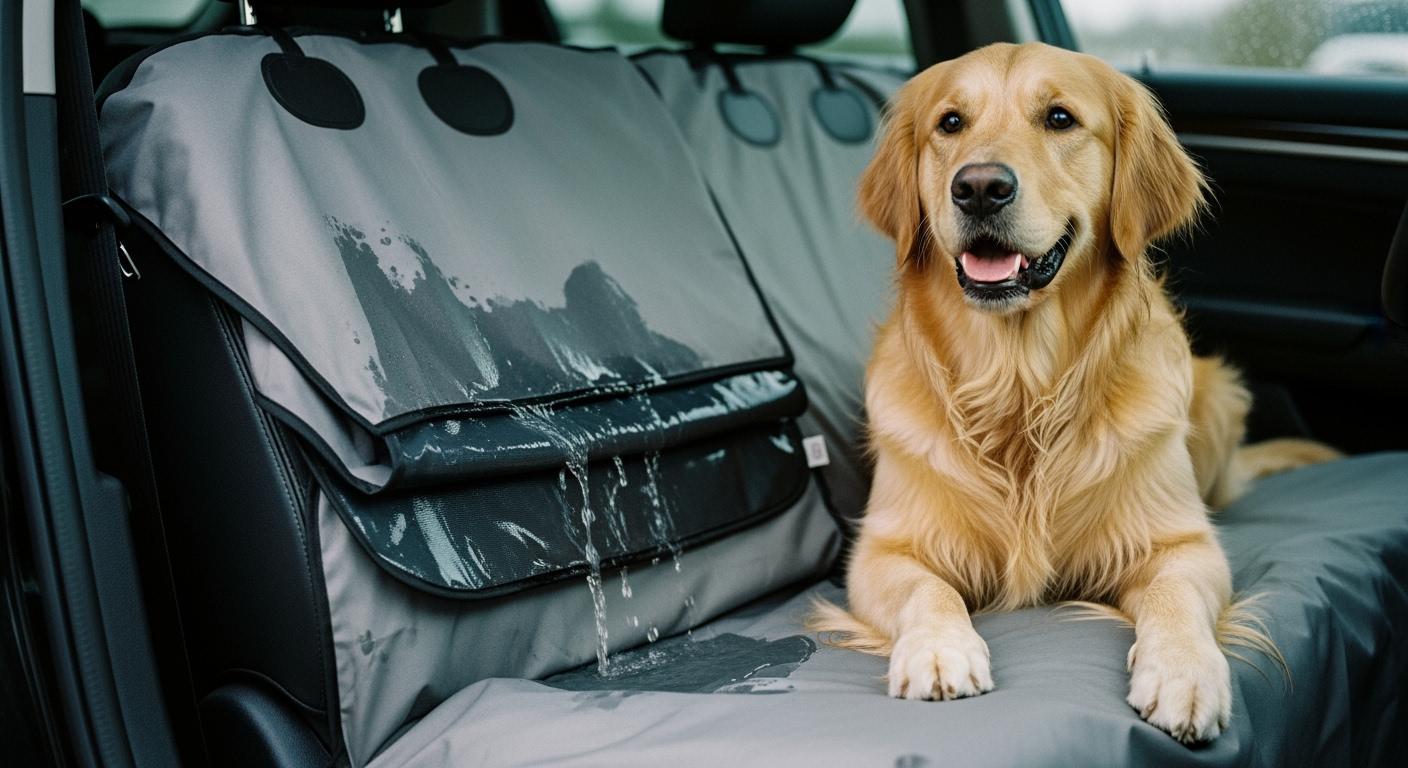
The waterproof layer on a dog car seat cover takes abuse the top fabric never sees. Every time the cover gets folded for storage — pulled from the back seat, creased in half, stuffed into a trunk or garage shelf — the backing layer bends at a radius the outer fabric does not share. Stiff coatings crack at those fold lines. Flexible laminated backings do not. That single material difference determines whether the cover still blocks moisture after six months of weekend trips, or whether you find a wet seat and wonder when the leak started.
| Failure signal | Likely waterproof-layer problem | Better design direction |
|---|---|---|
| Cracking at folds | Rigid, brittle material | Flexible, laminated backing |
| Peeling or separation | Weak bonding | Stronger lamination |
| Hard crease lines | Stiff waterproof film | Soft, fold-tolerant layers |
Why Folding Cracks a Waterproof Layer
When a dog seat cover is folded, two layers that were bonded flat are forced to travel different distances around the bend. The outer fabric, sitting on the larger radius, stretches slightly. The waterproof backing, pressed into the tighter inner radius, compresses. A stiff coating cannot compress without buckling. The film delaminates from the fabric in microscopic increments. Each fold cycle widens those separations into visible cracks.
This is not a surface wear problem. Surface wear comes from claws scrabbling for grip, from dirt ground into the weave, from UV exposure through rear windows. Those stresses attack from the outside in. Fold damage attacks from the inside out. The top fabric can look unmarked while the backing layer underneath has already split along the main crease. Water finds those splits on the next wet-paw load or spilled water bowl.
The polymer structure of the backing determines whether this happens quickly or not at all. TPU (thermoplastic polyurethane) and high-grade PU laminations have longer linear segments between cross-link points in their molecular chains. Under compression at the inside of a fold, those segments can elongate without bond rupture. A PVC film, by contrast, relies on plasticizers for flexibility — and plasticizers migrate out over time. The film stiffens with age. The same fold that was harmless on day one becomes a crack risk by month six.
This distinction shapes the entire durability picture for covers that get stored between uses. A cover built with a flexible laminated core handles both the storage cycle and the cleaning cycle without the two stresses compounding into early failure. When the waterproof layer stays intact through folding, it also stays intact through machine washing — the same lamination properties serve both demands.
In practice: A cover that makes a crinkling sound when you fold it is telling you the backing is stiff. That sound is the film resisting the bend radius. It may not crack today, but each fold cycle accumulates fatigue at the polymer level. Flexible backings fold quietly because the material deforms without fighting the motion.
Where the Waterproof Layer Fails First
Failure follows the fold geometry. On a bench-style cover folded in half lengthwise, the primary crack runs straight down the centerline — the strip where the bend radius was tightest. On a hammock-style cover with multiple fold points for storage, cracks radiate from each corner where the fabric was doubled over. The pattern is predictable once you understand the stress distribution.
Primary fold lines. The deepest crease takes the most damage. Because this fold compresses the backing to its minimum bend radius, it concentrates all the bending strain into a strip roughly the width of the fold itself. Covers with a backing under 0.1 mm thick often show cracking along this line within a single season of weekly storage cycles.
Edge and corner stress points. Corners get folded under or tucked in during packing. The material here experiences biaxial bending — creased in two directions at once. Stitch lines near edges compound the problem. Each needle penetration through the waterproof layer creates a perforation. When that perforation lands on a fold line, stress concentrates at the hole and the crack propagates outward along the crease.
Layer separation at bond lines. The bond between waterproof film and face fabric is the weakest mechanical link in the assembly. Repeated folding applies cyclic shear at that interface. If the lamination adhesive is a low-cost hot-melt formula with poor flex fatigue resistance, the bond degrades incrementally. It shows up first as bubbling at quilted stitch lines, then as full delamination that leaves the fabric floating free of the backing.
After unfolding a stored cover, run your fingertips along the inside of each major crease line. A smooth, continuous surface means the backing flexed without structural damage. Gritty texture, flaking particles, or visible white stress lines mean micro-cracking has started — the barrier is compromised at that point even if the top side still looks intact.
For a definitive check at a suspected leak point, place a dry paper towel under the cover at the main fold line or a corner crease. Pour roughly half a cup of water onto the top surface directly above that spot and let it sit for 60 seconds. Lift the cover. Any moisture transfer to the paper towel confirms the waterproof layer has failed at that crease.
How the cover fits on the seat also influences where stress concentrates. A soft-bottom cover sized correctly for the rear bench sits flat with even tension across its mounting points. A cover stretched too tight has less slack to distribute fold strain — each crease takes a larger share of the bend, and failure arrives sooner at those overloaded lines.
What Backing Structure Resists Fold Damage
Flexible laminated backings. TPU and high-grade PU laminations outperform PVC films in flex fatigue for a reason rooted in polymer chemistry. Their molecular chains have longer linear segments between cross-link points. Under compression at the inside of a fold, those segments can elongate without bond rupture — the material stretches rather than fractures. PVC derives its flexibility from plasticizers that migrate out over months. The film stiffens, and folds that were harmless when the cover was new become crack risks as the plasticizer depletes.
This matters at the production level, too. TPU laminates bond at lower temperatures than PVC, which means the face fabric sees less thermal degradation during manufacturing. The adhesive cure is more uniform across the web width. Peel strength does not vary from edge to center the way it can with a rushed hot-melt line. Uniform bonding means no weak initiation points where delamination predictably starts — and for a rear-seat cover built with laminated waterproof backing, that consistency is what keeps the barrier intact through hundreds of fold-unfold cycles.
Multi-layer construction vs. single-film coating. A single sprayed-on waterproof coating has no structural redundancy. One crack equals a full breach. A multi-layer laminated cover — face fabric, adhesive interlayer, waterproof membrane, backing scrim — distributes bending strain across several interfaces. Even if the membrane develops a pinhole at a crease, the scrim backing provides a secondary barrier. The trade-off is weight and cost, but for covers stored folded between uses, that redundancy translates directly to leak-free months.
Bonding method. The lamination process — whether heat-fused, adhesive-bonded, or ultrasonic-welded — determines how the assembly handles shear at fold lines. Heat-fused TPU bonds form a continuous molecular interface where the film partially penetrates the fabric weave. This interlock resists peel better than a surface-adhered film because the effective bond area is larger at the microscopic level. Fold shear distributes across thousands of fiber-filament contact points rather than pulling at a flat adhesive plane. That is the difference between a cover that peels apart at the quilt lines after two months and one that stays bonded through years of use.
The broader challenge of keeping a car interior clean with a dog on board hinges on whether the barrier layer survives storage as well as it survives in-use messes. A waterproof layer that cracks when folded is a waterproof layer that was never going to hold up to the full duty cycle — the fold is just the first stress that finds the weak point.
When Flexible Backing Is Not Enough
Even a well-laminated TPU backing has limits. If the cover is stored in a hot trunk through a summer in Phoenix or Dallas, the adhesive interlayer can soften and creep. Fold stress that was harmless at room temperature becomes destructive when the polymer matrix approaches its glass transition temperature. The same cover stored in a climate-controlled garage may last years longer than one left in a vehicle around the clock.
Storage conditions interact with material choice. A flexible backing determines the floor of durability. The storage method determines the ceiling. Rolling the cover loosely beats folding it sharply along the same line every time. Keeping it dry before packing prevents hydrolytic degradation of the PU — moisture trapped in the fold accelerates breakdown of the polymer chains at the exact point of maximum mechanical stress.
Other factors that shorten fold life regardless of backing quality: abrasive debris trapped between fabric layers during folding (sand and grit act as a cutting agent at the crease), harsh cleaning chemicals that attack the plasticizer package, and covers that are undersized for the seat. A cover stretched tight across a bench that is slightly too wide has pre-tensioned fabric with no slack to distribute fold strain. Each crease takes a disproportionate share of the bend.
Choosing materials and sizing that match the actual use pattern matters more than chasing the highest spec on a data sheet. For owners working through those decisions, fit around seat anchors and buckle points often drives real-world durability more than the waterproof rating alone. A cover that bunches at the edges creates unintended fold points — and each one is a future crack site.
Material selection across car travel gear follows similar principles regardless of the specific product. Sizing precision and material durability together determine whether a product works under real conditions — not just on the first install, but after months of removal, storage, and reinstallation.
Disclaimer: The fold-recovery checks described here assume a smooth-coated waterproof backing without textured grip patterns. Textured or rubberized non-slip backings may show surface marks that are cosmetic rather than structural. If the backing is intentionally patterned, visual crack inspection alone can mislead — combine it with the paper-towel moisture test described above. Double-coated breeds that carry more trapped moisture in the cover fabric after a ride may accelerate hydrolytic degradation of PU-based backings; covers used primarily with heavy-coated dogs benefit from more thorough drying between storage cycles.
FAQ
How do you know if the waterproof layer has failed if the top fabric still looks fine?
The top fabric hides what is happening underneath. Run your hand along the inside of each fold crease. Grittiness, flaking, or white stress lines mean the backing has started to micro-crack. The paper-towel test — dry towel under the crease, water on top, 60-second wait — confirms whether those cracks go all the way through. Top fabric appearance alone is not a reliable indicator.
Can you repair a cracked waterproof backing?
Temporary patches — tape, spray sealant, iron-on film — may slow a leak for a trip or two, but they do not restore the continuous bond between fabric and backing that makes a laminated waterproof layer work. The patch itself creates a new stiff spot that becomes the next crack initiation point when folded. Replacement is the only durable fix once the original lamination has separated.
What is the difference between TPU and PVC backing for fold durability?
TPU flexes through polymer chain elongation — the material stretches at the molecular level and recovers. PVC relies on added plasticizers that make it temporarily flexible. Those plasticizers leach out with heat and time, leaving behind a progressively stiffer film. A TPU-backed cover that folds without cracking after a year of storage cycles will often outlast a PVC-backed cover that felt identical on day one.
Does rolling the cover instead of folding it actually prevent cracking?
Rolling increases the bend radius, which reduces the compression strain on the backing at any single line. It does not eliminate the strain, but distributes it across a wider area. For covers with borderline backing flexibility, rolling can extend crack-free life meaningfully. For covers with a genuinely flexible laminated backing, the difference between rolling and loose folding is smaller — the material handles both.
How does heat exposure interact with fold damage?
Heat softens the adhesive interlayer and accelerates plasticizer migration in PVC films. A cover folded and left in a hot vehicle sees both mechanical stress from the crease and thermal stress weakening the bond at the same location. The two mechanisms compound. The same fold that causes no visible damage when the cover is stored in a cool garage can produce cracking within weeks if the storage location regularly exceeds 100 degrees Fahrenheit.






