
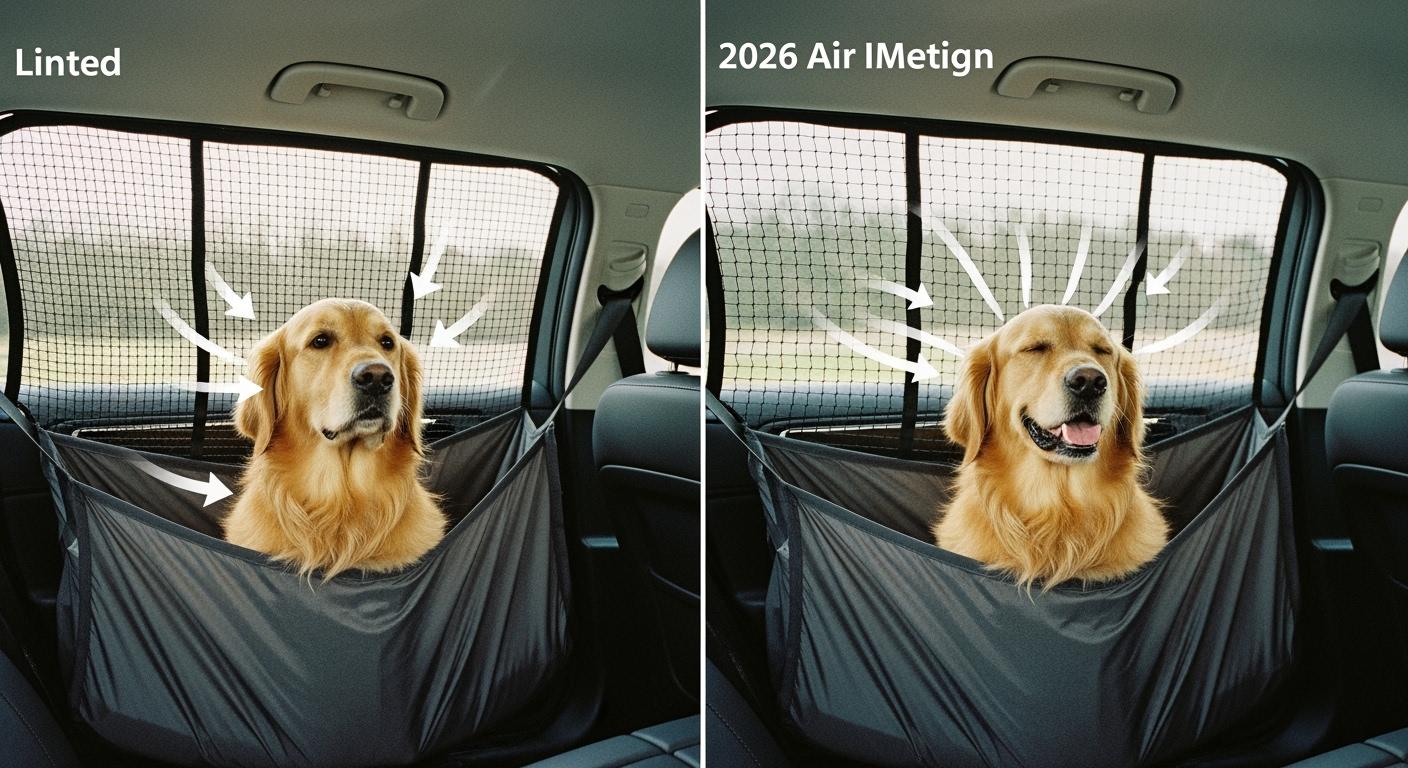
A dog car hammock with a solid front panel does one thing reliably: it stops fur and mud from reaching the front seats. It also does something else. It turns the rear cabin into a dead air pocket. The front HVAC vents push conditioned air into the car, but a full-fabric wall stretched between the headrests and the rear bench breaks the circulation loop that would normally carry that air to the back. The result is predictable — your dog pants, shifts, and cannot settle, even with the AC running. A mesh window can fix this. But only if it is placed where the air actually moves.
The table below maps what you are likely seeing to the design features that cause it:
| Failure Signal | Likely Hammock Design Cause | Better Design Direction |
|---|---|---|
| Dog pants or shifts restlessly | Full fabric wall blocks airflow path | Mesh window at mid-to-upper-backrest height |
| Air feels still near the dog | Non-breathable materials, high solid barrier | Breathable mesh at center panel with open-area ratio above roughly 30% |
| Dog whines or tries to climb forward | Zero visibility through solid panel | Mesh window that lets the dog see the front cabin |
Why a Solid Hammock Panel Blocks Rear Airflow
The Barrier That Stops More Than Mess
Install a hammock-style back seat cover with a solid front panel and you create a vertical wall directly behind the front seats. That wall does its primary job — it catches shed fur, blocks muddy paws from the center console, and keeps the rear bench clean. But it also interrupts the pressure-driven airflow that your car’s HVAC system relies on.
Here is the causal chain. Air from the front vents does not flow straight back in a laminar stream. In most sedans and SUVs, it rises toward the ceiling, travels along the headliner, drops near the rear glass, and circulates forward at floor level — a cabin-wide convection loop. A solid fabric panel spanning from headrest height to the rear seat cushion cuts through the middle of that loop. The air pushed by the blower hits the fabric and deflects upward or downward instead of crossing into the rear-seat space. The back seat becomes a low-pressure stagnation zone. The dog sits inside it.
Thick, non-breathable materials make this worse. A 600D or 900D Oxford fabric panel — common in seat covers built for durability — has near-zero air permeability. Even if some air finds its way around the panel edges, the volume is too low to matter. The dog’s own body heat raises the local temperature inside the hammock pocket, and without air exchange, that heat has nowhere to go.
When the Barrier Becomes the Problem
This is not a failure of the hammock concept itself. It is a trade-off embedded in the design: the same full-coverage panel that keeps the rear bench clean also isolates the dog from the cabin environment. On short trips in mild weather, the trade-off is barely noticeable. On longer drives, in summer heat, or with a dog that runs warm, it becomes the single biggest comfort variable in the back seat.
High front barriers amplify the effect. Some designs extend the solid panel well above the front seatbacks to create a deeper hammock pocket. That extra height blocks the narrow gap between the headrest and the ceiling — the last remaining path for air to spill into the rear cabin. Close that gap and the back seat is effectively sealed off.
What Mesh Window Placement Actually Changes

Placement Height: Why the Middle Matters
A mesh window is only as useful as its position on the panel. Put the mesh too low — near the seat cushion — and it sits below the dog’s chest and head, where it ventilates empty space. The warmest, stuffiest air accumulates higher, around the dog’s head and shoulders. A low mesh window misses that entirely.
Put the mesh too high — near the headrests — and it aligns with the ceiling gap, which can help slightly, but it leaves the main volume of the hammock pocket untouched. The dog lies below it, still sitting in still air.
The effective position is mid-to-upper-backrest height. At this level, the mesh window aligns with the primary air path from the front center vents. When cool air hits the front of the hammock, it can pass through the mesh rather than deflecting around it. The result is direct air exchange at the same height the dog occupies — whether the dog is sitting up or lying down. This placement also preserves the dog’s sightline to the front cabin, which reduces the isolation that can trigger restlessness in dogs that are already car-anxious.
In practice: After a 15-minute drive with the AC on, reach back and feel the air on the dog side of the hammock. If there is a noticeable temperature difference between the front cabin and the rear pocket, the mesh window is not doing its job — either the position is off or the open-area ratio is too low.
How to Tell If Airflow Is Actually Working
There is a simple field check. After a drive with the AC running, check the fur behind your dog’s ears or under the collar. If it feels damp, the hammock pocket is holding heat and moisture — airflow is inadequate. Dry fur in those spots after a 20-minute ride in warm weather is a reliable signal that air is circulating through the mesh at a useful rate. A second check: watch whether your dog settles into one position or keeps repositioning every few minutes. Frequent shifting in a dog that normally lies still during car rides usually points to thermal discomfort, not anxiety.
Mesh size interacts with placement. A large mesh window placed at the wrong height still underperforms. A smaller mesh window at the right height often outperforms it. The open-area ratio of the mesh material matters too. Durable pet mesh with roughly 30–50% open area provides enough airflow for convective exchange while keeping the weave tight enough to block most fur and debris. Mesh with a lower open ratio — common in ultra-fine weaves — looks premium but barely breathes. The trade-off is real: bench-style and hammock-style covers each handle this balance differently, with hammocks typically offering more placement flexibility for the mesh panel.
Side Coverage and Structure: The Full Picture
A mesh window does not work in isolation. It needs to integrate with the hammock’s surrounding structure. Side flaps that protect the door panels from scratches also act as lateral air guides — they channel air entering through the center mesh toward the dog rather than letting it escape out the sides. Reinforced stitching around the mesh perimeter prevents the window from stretching or tearing when the dog leans against it, which keeps the open-area ratio consistent over time.
Seat anchors and headrest straps play a supporting role here too. A hammock that slides or bunches during driving shifts the mesh window out of alignment with the airflow path. Non-slip backing on the seat portion and adjustable headrest straps with secure buckles keep the panel tensioned and the mesh where it belongs. When side flaps and gap coverage are combined with a well-placed center mesh, the rear seat stays protected without becoming a stuffy compartment.
When a Mesh Window Helps Most — and When It Does Not
The conditions that amplify the value of a mesh window are straightforward. Hot weather — any drive where the outside temperature exceeds 80°F and the AC is working hard. Long trips — anything over 45 minutes, where the initial cabin temperature equalizes and the rear pocket’s isolation becomes the dominant comfort variable. Dogs with thick coats or brachycephalic breeds that already struggle with heat regulation. Vehicles with weak rear HVAC — many compact SUVs and sedans route all conditioned air through front vents only, making the mesh window the sole pathway for rear-seat air exchange.
The conditions where a mesh window makes less difference are equally important to recognize. Cool-weather drives with the heat on — warm air rises naturally and reaches the rear cabin more easily, reducing the isolation effect. Short errand stops under 15 minutes where the cabin never fully heats up. Dogs that ride in the cargo area of an SUV behind a factory cargo barrier — the hammock panel is not the airflow bottleneck in that configuration; the barrier and third-row obstruction are. Vehicles with strong rear-seat HVAC vents built into the center console — in those cars, the hammock panel matters less because air is already being delivered directly into the rear cabin.
Disclaimer: This check assumes a sedan or SUV with functional front HVAC and a clear path from the front vents to the hammock panel. In vehicles where the blower is weak or the dog rides behind a second-row barrier in a cargo area, even a well-placed mesh window may not create enough air exchange. Those conditions often call for a dedicated rear fan or a window vent rather than relying on the hammock design alone. Short-muzzled breeds in particular should be monitored closely regardless of mesh configuration — their cooling capacity is limited by airway anatomy, not just ambient airflow.
Material quality also determines how long the benefits last. Mesh that stretches over time loses open-area ratio as the weave deforms. Mesh that frays at the edges creates gaps that a dog can work a paw through. The best-performing designs use UV-stabilized polyester mesh with reinforced edge binding — the same construction approach used in car booster seats that prioritize ventilation. Edges that hold their shape under tension keep the airflow window consistent across the life of the cover. A mesh window that sags after six months is not just an airflow problem — it becomes a safety concern if the dog can push through it.
| Design Difference | Why It Matters | Main Limitation |
|---|---|---|
| Mesh at mid-to-upper-backrest height | Aligns with front-vent air path; exchanges air at dog’s head and shoulder level | Less effective in vehicles with ceiling-mounted or rear-only HVAC routing |
| Mesh with roughly 30–50% open-area ratio | Enough airflow for convection without sacrificing fur and debris blocking | Lower open-area weaves look premium but restrict air movement |
| Reinforced mesh edge binding | Prevents weave deformation and sagging over repeated use | Adds manufacturing complexity; cheap edge binding frays within months |
| Non-slip backing with adjustable headrest straps | Keeps mesh window aligned with airflow path during the drive | Requires correct initial tensioning — slack install negates the benefit |
FAQ
Will a mesh window reduce how well the hammock protects my seats?
The mesh sits in the center panel. The seat base, side flaps, and front barrier around it remain solid fabric. Most dirt and fur enters from the dog itself — paws on the seat, body against the side bolsters — and those contact zones are still covered. The mesh is a ventilation aperture, not a structural gap. A well-placed window does not create a meaningful protection loss.
Can I add a mesh window to a hammock that does not have one?
Cutting and stitching mesh into an existing hammock panel is not recommended unless the fabric edges can be properly bound. An unbound cut edge in 600D Oxford fabric will fray under tension and the mesh will pull away from the surrounding panel. The seam also needs to handle the dog’s full body weight leaning against it. Off-the-shelf hammocks with factory-integrated mesh are built with the seam reinforcement already in place.
Does the mesh window position matter as much in winter?
Less so. Warm air from the heater rises naturally and tends to fill the rear cabin more evenly than cold AC air does. The solid-panel isolation effect is primarily a warm-weather issue. In winter, a mesh window is still useful for visibility — letting the dog see you can reduce car-related anxiety regardless of the temperature.
What is the difference between a mesh window and a full mesh panel?
A full mesh panel replaces a large section of the hammock with mesh fabric. It maximizes airflow but reduces seat protection — liquid spills, fine fur, and small debris pass through more easily. A targeted mesh window at the center preserves most of the solid coverage while opening the airflow path. The choice between the two depends on whether hammock fit and fabric choice prioritize protection or ventilation for your specific use pattern.






