
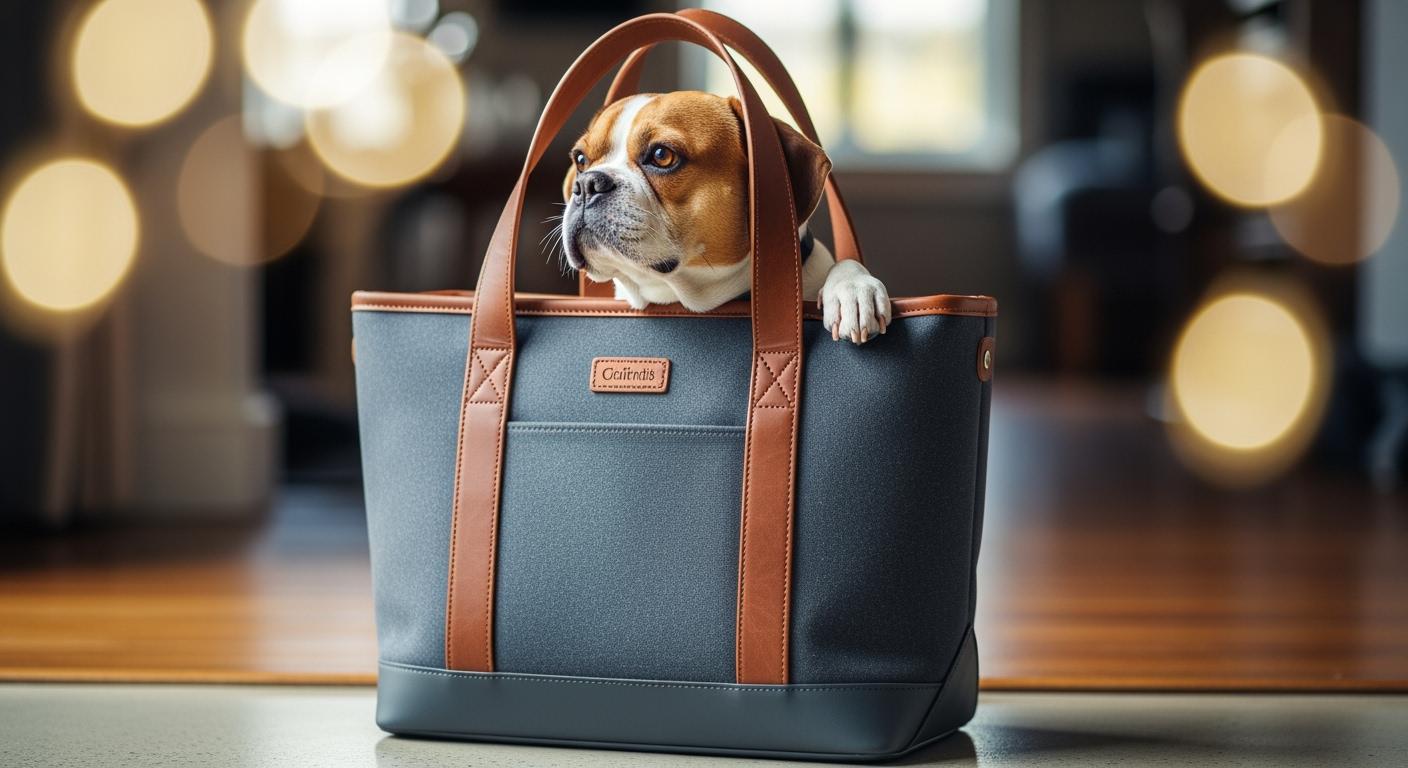
A dog tote carrier with stable base and a soft-bottom tote look similar on a product page. Pick them up with a dog inside, and the difference is immediate. In one, the dog stays upright. In the other, it sinks. That single structural difference reshapes the entire carry experience — posture, anxiety level, and whether the dog settles or braces for the whole trip.
Stability does not come from thicker padding. It comes from a rigid base panel that resists bending and edge walls that refuse to collapse inward. When those two work together, the floor stays flat and the dog relaxes. When either one fails, the dog compensates — and a compensating dog is not a comfortable dog.
Why Soft Tote Carrier Bottoms Feel Unstable
What Sagging Does to a Small Dog Inside a Carrier
When you lift a tote carrier and the base bows, the dog inside feels every degree of tilt. A soft fabric floor creates a concave surface under load — the dog’s weight presses the center down while the edges pull upward at the seams. The dog sinks toward the lowest point.
Dogs do not passively accept a collapsing floor. They brace. The legs stiffen, the feet spread, and the dog leans against the nearest wall. This is the same postural response a human uses on a tilting train — continuous micro-adjustments to stay oriented. Over a 20-minute carry, that adds up to muscle fatigue a flat-floor carrier would not produce.
When the floor stays flat, the dog settles. When it does not, leaning and bracing become the dog’s default posture inside the carrier — not because the dog is anxious, but because the surface demands it.
Signs the Carrier Floor Is Not Supportive Enough
A dog that stands instead of settling is not being stubborn. It is compensating. The observable signals stack up fast once you know what to look for:
- The dog shifts position every few minutes, unable to hold a resting posture
- One shoulder presses consistently against the carrier wall, bracing against tilt
- The dog stands with legs splayed rather than tucked under
- The carrier base visibly bows or folds inward when lifted by the handles
Observable check: After a 10-minute carry, place the carrier on a flat surface and open it. If the dog immediately stretches, shakes off, or stiffly steps out — signs of post-carry tension release — the floor was not stable enough. A dog that settles on a flat base exits relaxed, not stiff.
Padding Alone Cannot Fix a Flexible Floor
A removable cushion without a rigid insert may feel plush in the hand but fails under a moving dog. The pad shifts laterally when the carrier swings during walking. Within minutes, the pad bunches under the dog’s hip on the low side and the dog is wedged against one wall. More padding does not solve the problem — it only adds more fabric that can shift.
Where Base Panel Stiffness Fails in Daily Carrying
The Structural Reason Flexible Bottoms Collapse
The failure starts at the handles. When you lift a tote, the handles pull upward on the side panels. Those panels transfer the force to the base through the bottom-corner seams. A rigid base panel resists: the load compresses evenly across its surface, and the corner seams carry simple tension. A flexible base cannot resist — the dog’s weight pushes the center down while the corner seams pull outward, and the floor becomes a hammock.
This is not about material quality. It is about structural function. A fabric floor has near-zero bending stiffness — it curves under any off-center load. The dog’s weight, concentrated on four small paw pads, creates point loads that a fabric panel cannot bridge. The material deforms locally, the dog sinks, and the whole carrier geometry changes.
Removable base inserts that are not structurally bonded to the carrier shell introduce a second failure mode. When the carrier swings during a one-shoulder carry, the insert slides toward the low side. The dog follows. Now the dog is not just sinking — it is sliding sideways into a collapsing wall. Two problems compound into one.
| Failure Signal | Structural Cause | Where It Leads |
|---|---|---|
| Mesh pressed flat against dog’s body | Side wall bows inward under lateral load | Ventilation area drops to near zero at contact point |
| Mesh folds when carrier is lifted | Bottom board flex creates corner hinge | Side panels pull inward, mesh loses tension |
| Carrier twists during a one-shoulder carry | Offset handle placement creates torque | One side compresses, mesh on that side folds |
When Thin or Removable Base Inserts Stop Working
Thin base inserts fail progressively. At first, they feel adequate — the dog is light, the trip is short. But foam compresses over time. A dense foam pad that starts at half an inch may compress to a quarter inch after a few weeks of daily use. Once compressed, it loses what little bending resistance it had. The carrier returns to fabric-floor behavior, just with a thinner, denser layer of foam between the dog and the sag.
Observable check: Before loading the dog, press down on the center of the empty carrier floor with one hand — apply roughly the weight of your dog. If the floor deflects more than the thickness of your thumb, or if the side walls visibly pull inward when you press, the panel lacks the stiffness to stay flat under a moving load. A rigid base deflects barely at all under this test.
Why Edge Support Matters as Much as the Base
A rigid base with soft edges still fails. The edges buckle inward under lateral load, shortening the effective floor width. The dog gets squeezed from the sides even though the base itself did not bend — a different mechanism, same result. Firm edges with a flexible base produce a trampoline effect: the edges hold but the center drops, and the dog bounces with every step.
The base and edges must work as a unit. When they do, the carrier behaves like a shallow box — six faces, each reinforcing the others. Remove stiffness from one face and the structure degrades across the whole assembly.
How a Rigid Base and Edge Structure Create Real Stability
Firmness and Comfort Padding Are Two Separate Functions
In a well-built single-shoulder tote carrier, the base panel and edge structure work as a unit. The structural layer — typically a dense PU board or rigid plastic insert — handles the load. The comfort layer — a padded liner on top — handles point pressure at the elbows and hips. These are not the same function, and confusing them leads to carriers that feel soft in the hand but fail under weight in motion.
The structural insert stays flat regardless of how the carrier is carried. The padding conforms to the dog’s body without changing the floor geometry. Together they prevent the two failure modes that soft-bottom carriers cannot escape: center sag and lateral slide.
Materials scale differently in production. Polyester outer shells handle daily abrasion without adding unwanted stiffness — flexibility belongs in the upper side panels where it aids ventilation. PU inserts provide the right stiffness-to-weight ratio for hand-carry loads. The manufacturing decision is where to place rigidity, not whether to maximize it everywhere.
How Edge Structure Prevents Leaning and Side Collapse
Edge panels with internal framing — plastic battens or dense foam ribs — resist the inward bowing that soft-sided carriers experience under lateral load. When the dog leans against a wall, a framed edge stays vertical. A soft edge folds. The difference is visible from across the room: in one carrier the dog rests against a wall; in the other the wall rests against the dog.
A rigid base also changes how the carrier handles during a one-shoulder carry — support and balance improve when the bottom does not deform under the dog’s weight. The carrier swings less because the mass stays centered over a stable platform rather than shifting into the low corner with each step.
Floor Shape and Interior Space for Natural Posture
A rectangular floor with defined corners gives the dog four orientation points. Small dogs often tuck into a corner when settling — a design option that disappears with oval or tub-shaped floors. The dog can choose a position instead of having one forced by a sagging surface.
Interior space matters in relation to floor stability, not in isolation. A cramped carrier with a rigid floor is uncomfortable. A spacious carrier with a soft floor is unstable. The right combination is a flat, rigid floor large enough for the dog to sit, turn, and lie down without the walls pressing in — and firm enough that the floor geometry does not change under the dog’s weight. A safety tether clipped to an interior D-ring adds restraint without affecting floor function, provided the anchor point is mounted to the structural frame rather than stitched to fabric alone.
When a Structured Tote Is Not the Right Choice
The same structural base that keeps the floor flat also makes the carrier less compressible. If the priority is a carrier that folds flat for tight storage — under an airplane seat, inside a packed daypack — a structured tote may be too bulky. Urban carrying scenarios where quick stowaway matters often favor collapsible designs, and for that specific use case, the tradeoff between stability and packability can be reasonable.
Some pet slings feel soft and hug the body, but sling carriers rely on fabric tension rather than a structured base for support — a different load path entirely. A sling wraps around the dog and the wearer, using body contact for stability. A tote relies on its own structure. Neither design is universally better; each solves a different carrying problem.
Dogs with extreme body types can complicate the equation. Breeds with a pronounced roach back or very short legs relative to body length sometimes prefer a slightly cupped surface that follows their body contour — a perfectly flat rigid floor can leave a gap under the belly that some dogs find unsettling. Dogs that immediately curl into a tight ball and sleep through every carry are not fighting an unstable floor — the base design matters less for them than for a dog that wants to sit up, look around, and shift between positions.
The daily-use considerations for a tote carrier shift when the base is structural rather than soft. Cleaning access, strap attachment durability, and ventilation panel placement all interact with base design — a rigid floor simplifies interior access for wiping but adds weight and bulk that matter differently for a 5-minute errand versus a full day out.
Disclaimer: The stability checks described here assume a smooth-coated dog in a properly sized carrier. Double-coated breeds or dogs with thick fur may show subtler signs of floor instability because the coat acts as a cushioning layer between the dog and the base. For these dogs, hand-check the floor deflection directly rather than relying on behavioral signs alone. If the dog’s chest shape falls well outside the breed norms this carrier type was patterned for — particularly dogs with a barrel chest or very deep keel relative to their length — the fit assessments described here may not catch every pressure distribution issue.
FAQ
How can I tell if my current carrier base is stiff enough — without buying a new one?
Place the empty carrier on a table. Press down on the center of the floor with one hand while pulling a side handle upward with the other. Apply roughly your dog’s weight. If the floor drops more than the thickness of your thumb, or the side wall buckles inward, the panel is not stiff enough. A rigid base barely moves under this test.
Can I add a rigid insert to a soft-bottom carrier to fix the problem?
A cut-to-fit insert — a piece of rigid foam or plastic board — can improve point stiffness temporarily. But because it is not structurally attached to the carrier shell, it tends to migrate during movement. It also does not fix collapsing side walls. It is a short-term bandage, not a structural solution. The carrier’s seams and edge panels were not built to work with a rigid base, so the insert fights the carrier’s design rather than complementing it.
Is a structured-base tote noticeably heavier than a soft-bottom one?
The weight penalty is typically small — a few extra ounces, distributed across the shoulder strap. For dogs under about 15 pounds, the stability gain outweighs the added weight in most carrying scenarios. The more relevant difference is bulk: a rigid base will not compress for storage the way a soft carrier folds flat.
Does a stable base matter if my dog sleeps through every carry?
Less so. The stability features matter most when the dog wants to sit up, look around, and shift between positions — a dog actively engaging with the environment. A dog that curls into a ball and sleeps start to finish is not fighting an unstable floor, so the base design is a lower-stakes decision. The ventilation and interior space matter more in that scenario.






