
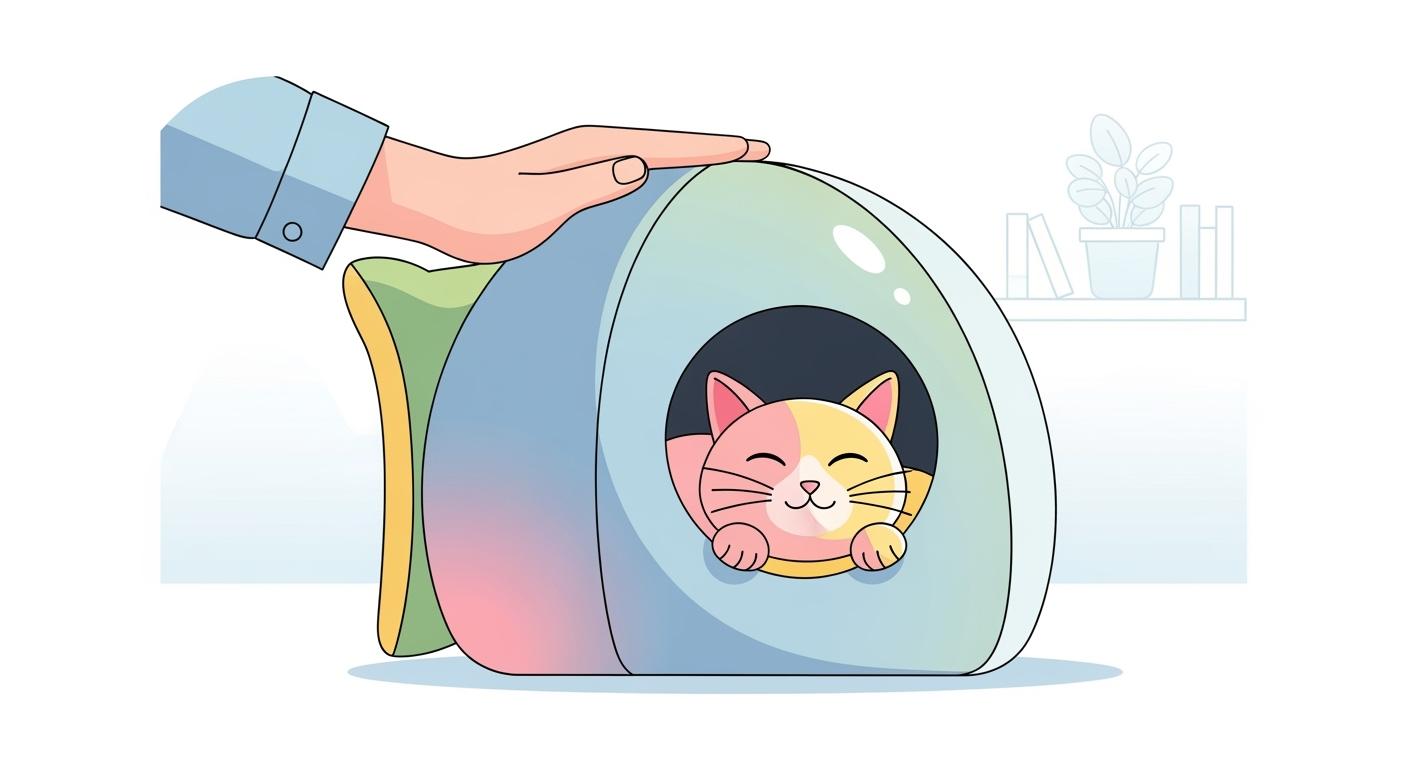
A washable cat cave bed that keeps its shape is not a matter of luck. It is a matter of what is inside the walls, how the entrance rim is built, and whether the filling can survive water without giving up.
Most cat caves look structured on the shelf. The entrance stands open. The roof arches up. The walls feel dense. Then you wash it once. The roof flattens. The entrance folds inward. The cave becomes a deflated shell your cat walks past.
Washability alone does not mean a bed will hold its form. A fabric tag that says “machine washable” tells you nothing about whether the filling inside will rebound after it gets wet, or whether the rim stitching will hold its curve through agitation. The difference between a cave that survives washing and one that does not comes down to three structural choices: filling density, edge reinforcement, and wall thickness. Everything else follows from those.
Why a Washable Cat Cave Collapses After Cleaning
The Structure Looks Solid Before Water Hits It
Before washing, most cat caves hold their shape well enough. The entrance rim stays open. The roof arches. Your cat steps in, turns around, and settles. Nothing signals that the structure is fragile.
But a dry cave tells you almost nothing about how it will behave wet. The filling inside most budget cat caves is a loose polyester fiberfill — the same stuff inside cheap throw pillows. Dry, it has enough loft to hold walls upright because the fibers trap air and push against the outer shell. When you submerge that same fill in water, the fiber matting begins. The strands slip past each other, air pockets collapse, and the loft that held the walls up vanishes. The fabric shell, now unsupported from within, drapes instead of standing. That is the moment the cave becomes a flat mat.
The physics here is straightforward: water acts as a lubricant between fiber strands. In a high-density fill — one where individual fibers are packed tightly enough to create friction even when wet — the structure resists matting. In a low-density fill, water eliminates what little inter-fiber friction existed, and the fill goes flat. This is not about whether the fabric is washable. It is about whether the internal structure was built to survive the one condition that will test it hardest.
Tip: Before first washing, press your palm firmly into the roof and hold for five seconds. A fill that rebounds within two seconds after release has enough density to fight matting. A fill that stays dimpled or rebounds slowly will likely collapse in the wash.
The Roof Flattens, the Entrance Folds In
After washing, the two most visible failures are a collapsed roof and a pinched entrance. Both trace back to the same structural deficit: there is no rigid frame inside a cat cave. The shape comes entirely from the tension between the outer shell and the filling pushing outward.
When the filling compresses, the shell loses tension. Gravity takes over. The roof, which has the least structural support to begin with, drops first. The entrance rim — if it relies on nothing more than a folded seam of fabric — follows. Without a denser material or a reinforced edge inside that rim, the fabric folds inward along its weakest axis.
Here is how common failure points map to their structural causes:
| Design Difference | Why It Matters | Where It Falls Short |
|---|---|---|
| Low-density fiberfill walls | Loses loft when wet; fibers mat together and cannot push the shell back open | Machine washing, multi-cat households where washing is frequent |
| Unreinforced entrance rim | No internal structure resists folding; the seam becomes a crease point under its own weight | Cats that rest their head or weight on the entrance edge |
| Thin outer shell with no backing | Stretches permanently once fill support is gone; cannot recover original dimensions after drying | Any wash cycle with agitation, even on delicate |
| Uneven base or narrow footprint | Wobbles during drying; weight shifts create permanent lean; cave tilts instead of sitting square | Homes where the drying surface is not perfectly flat |
Where the Structure Gives Out First
Some cat caves use a thin foam sheet sandwiched between fabric layers to create wall structure. This feels firmer than fiberfill when you squeeze it in the store. The problem is what happens when that foam saturates.
Open-cell polyurethane foam — the type most common in pet bedding — absorbs water like a sponge. When it does, the cell walls weaken. Agitation from a wash cycle then tears those weakened cells. What comes out of the machine is not the foam that went in. It is a thinner, less springy version that can no longer push the fabric shell back into shape. Each wash cycle degrades it further.
You can verify this before buying: a cat tunnel or cave with thicker walls and a visible edge structure tends to resist this degradation longer. The foam is better protected from direct water冲击 because the fabric and fill layers around it slow the saturation rate.
The Entrance Rim Has No Skeleton
The entrance is the most mechanically stressed part of any cat cave. Every time the cat enters or exits, the rim takes pressure. If the rim is nothing more than two layers of fabric sewn together with a folded edge, it has zero resistance to warping once wet.
A reinforced rim — one with an internal cord, a denser foam strip, or a double-stitched channel — behaves differently. The internal element acts as a spring. When the fabric around it dries and tries to shrink or twist, the internal cord fights that movement. The rim stays round. Choosing between a covered cave and an open bed often comes down to whether the cave’s entrance can survive repeated washing without collapsing — a donut bed has no entrance to fail, but a cave with a properly reinforced rim can offer the enclosed security cats seek without degrading.
After washing, check the entrance: set the damp cave on a flat surface and look at the opening from eye level. If the top of the rim has dropped more than half an inch below its original arc, the rim lacks internal support. That sag will worsen with each wash.
Filling That Clumps Instead of Rebounds
Fiberfill clumping is the most common cause of uneven shape loss. During washing, fibers migrate. They bunch up in corners of the shell, leaving other areas empty. What dries is not a uniform wall but a lumpy one — thick in one spot, paper-thin two inches away.
Clumping happens when the fill has too much room to move inside the shell. A well-designed cave uses internal quilting or compartmentalized chambers to keep filling in place. These chambers limit how far fibers can travel during agitation. Setting up a cat bed for quiet, easy-to-clean rest starts with picking a design where the internal structure works as hard as the outer fabric — compartmentalized fill that stays put through a wash cycle means less reshaping work for you afterward.
Open the cave after drying and run your hand along the walls. Gaps or thin spots you can pinch between two fingers mean the fill migrated during washing. That wall will not recover on its own.
What Makes a Cat Cave Rebound After Washing
Filling Density Determines Recovery
The single biggest factor in shape retention is not the type of filling — it is the density. Two caves can use the same polyester fiberfill and behave completely differently after washing if one has 30% more fill packed into the same wall volume.
Higher density means more fiber strands per cubic inch. More strands mean more contact points. More contact points mean more friction. Friction is what resists matting when water lubricates the fibers. It is a chain of dependencies that ends at one question: did the manufacturer pack enough fill to maintain inter-fiber friction when wet? Most did not, because denser fill costs more and makes the cave heavier to ship.
An elevated cat bed avoids this problem entirely with a tensioned fabric surface, but for a cave design, filling density is the entire game. There is no frame. No internal skeleton. Just fill pushing outward against fabric. When the fill gives up, so does the shape.
Reinforced Edges and Thicker Walls Hold the Silhouette
Thicker walls solve two problems at once. First, they give the filling more depth to work with — a two-inch wall has more rebound potential than a one-inch wall because there is simply more material resisting compression. Second, thicker fabric shells are inherently less prone to permanent stretching. A thin polyester shell can stretch beyond its elastic limit during a single wash cycle and never return. A thicker shell, or one with a backing layer, has a higher elastic limit.
Reinforced edges work on the same principle but at the stress point. The entrance rim and the seam where roof meets wall take the most mechanical abuse during washing. Double stitching alone helps. Adding an internal cord or denser foam strip inside that seam channel is even better — it gives the seam something to anchor against when the fabric around it shifts.
Tip: After reshaping the cave damp, let it dry in the position it will be used in — on a flat surface, not hanging or propped at an angle. Gravity during drying sets the final shape. A cave dried on its side stays lopsided.
A well-designed cat tunnel bed with structured walls and a defined entrance will recover predictably. The design gives you natural landmarks — the tunnel opening, the wall seams — to reshape against while the bed is damp, instead of guessing where the curve should be.
When a Structured Cave Is Not the Right Answer
A cave built to hold its shape through washing makes trade-offs. Denser filling adds weight. Thicker walls take longer to dry. A reinforced rim can feel firmer at the entrance — which some cats like for chin-resting, and others interpret as a barrier.
For a cat that prefers a loose, malleable sleeping surface they can knead into a specific shape, a structured cave works against that instinct. The same internal density that keeps the roof up after washing also resists being rearranged by paws. That is not a design flaw. It is a mismatch between the cat’s preference and the bed’s engineering choice.
Air drying a thick-walled cave in a humid environment can take 24 hours or more. If you need the bed back in service the same day, a thinner, less structured design may be more practical — with the understanding that it will degrade faster across washes.
Disclaimer: The rebound tests described here assume a smooth-coated cat of typical weight for the bed’s size rating. A larger or heavier cat will compress any filling more deeply, and the recovery you see after washing may be slower or less complete. For cats over 15 pounds, check wall thickness and entrance support before every wash — what works for an 8-pound cat may not hold for double the weight pressing on the same seam.
FAQ
Can a cat cave that has already collapsed be fixed?
Partially. If the filling has matted but not degraded, you can open a small seam, pull the fill apart by hand to re-loft it, and stitch it closed. This works once or twice before the fibers lose resilience entirely. If the outer shell has stretched permanently, there is no fix — the fabric dimensions have changed and the fill can no longer tension the shell correctly.
Do natural materials like wool hold shape better than synthetic fill?
Wool felts when agitated in water — the fibers lock together and shrink. A wool cat cave may hold its shape through hand-washing but can shrink unpredictably in a machine. Synthetic fiberfill does not felt but mats. Neither is categorically better; the difference is how much fill is packed in and whether the shell is compartmentalized to prevent migration.
How do you test shape retention before buying online?
Look at the product photos for evidence of internal structure. A cave photographed with a perfectly round, upright entrance may just have a photographer’s hand behind it. Check customer review photos instead — specifically ones where the cave has been in use for weeks. An entrance that stays round without being propped up, and walls that stand without visible sagging, suggest real structural integrity. Also check whether the listing mentions wall thickness, fill weight, or edge reinforcement — product copy that talks only about “soft” and “cozy” without addressing structure is a signal in itself.
Does the cat’s weight affect how fast the cave loses its shape?
Yes. A heavier cat exerts more pressure on the walls and base with every entry, turn, and settle. The same cave that holds its shape for a year with a 7-pound cat may show wall lean and entrance sag within three months for a 14-pound cat. If your cat is at the upper end of the bed’s size range, prioritize thicker walls and a reinforced base — the structural margin matters more at the weight limit.






