
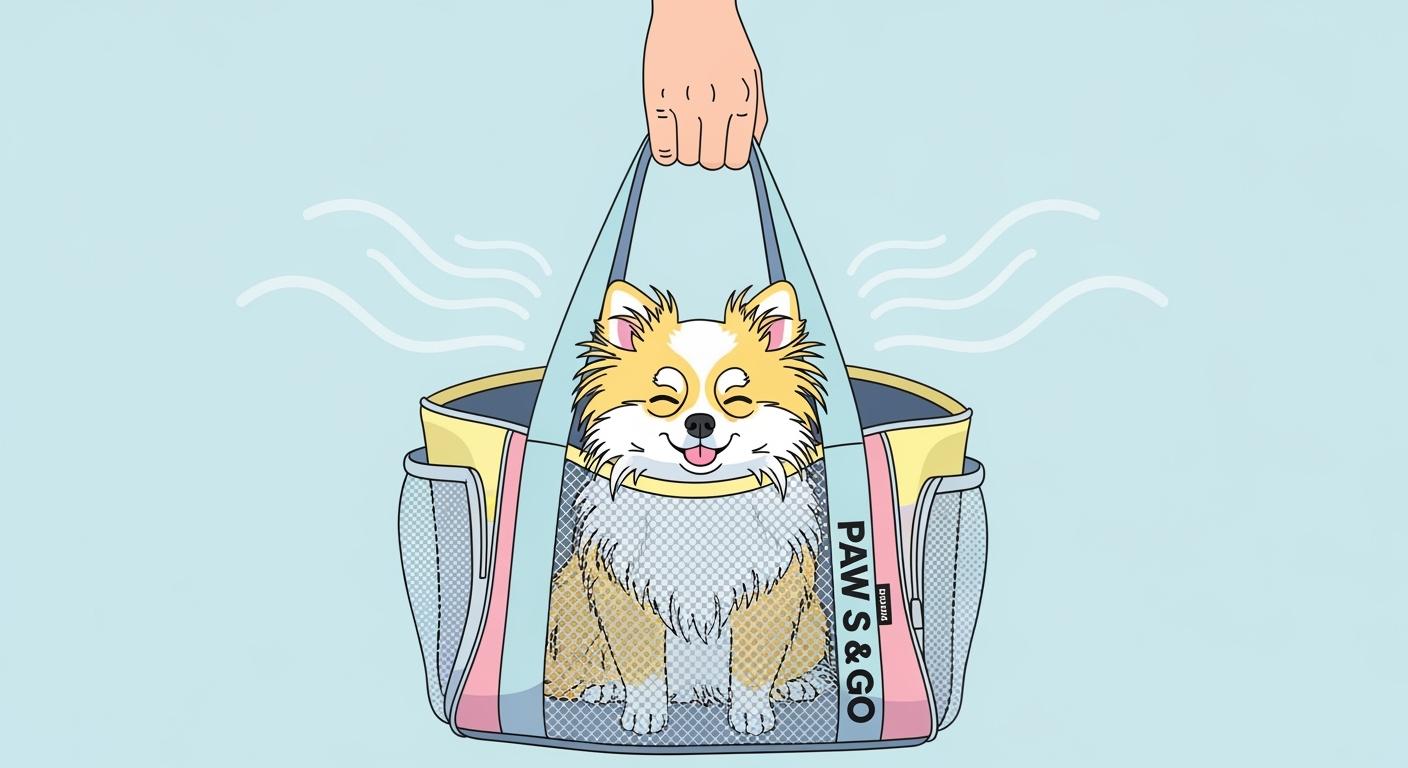
A breathable dog tote carrier can look well-ventilated on a product page and still trap heat the moment a dog sits inside. The difference comes down to three design decisions that are easy to miss if you focus only on how much mesh a carrier has rather than where that mesh sits and how the panels around it behave under load.
The wider problem with everyday tote carrier comfort is not that carriers lack mesh. It is that mesh positioned too low or framed by unstructured fabric loses its function the instant the dog settles in. A design that works keeps the ventilation path open across hand-carry, crossbody, and sling positions, and it does not sacrifice panel stiffness to get there.
Why Mesh Placement Outweighs Mesh Quantity
Airflow Follows a Circuit, Not a Coverage Percentage
Mesh coverage percentages tell you almost nothing about whether a carrier will stay ventilated in real use. What matters is whether air has a continuous path: in low, through the carrier body, and out high. When mesh sits only on the upper sides, warm air rises and exits through those panels while cooler air enters from gaps near the opening and lower seams. That circuit breaks when mesh is placed low on one side only — the dog’s body plugs the intake, the single-side exit becomes a dead end, and warm air recirculates in the upper corners.
The physical mechanism is straightforward. Air inside the carrier warms from the dog’s body heat. Warmer air is less dense, so it rises. If the only mesh exit sits at or below the dog’s shoulder line, the rising warm air pools above it with no escape route. Upper-side mesh panels create an exit above the thermal layer, which drives a passive convection cycle — cooler air enters from below, warm air exits from above. This cycle runs whenever the carrier is occupied, regardless of whether you are walking or stationary.
In practice: After 10 minutes of carrying with the dog inside, slide a hand along the inner lining opposite the mesh panel. Damp or clammy fabric means the ventilation circuit is not completing. Dry fabric at the same spot confirms the exit path is open.
Panel Structure Decides Whether Mesh Stays Open
Mesh that folds inward under the weight of a dog or the pressure of an arm against the bag stops working no matter where it sits. The carrier’s side panels need enough stiffness to hold their shape without being rigid. Semi-structured panels — fabric layers with a light internal stiffener or dense weave backing — resist inward collapse while still flexing enough to conform to how you carry the bag.
Reinforced seams around the mesh perimeter matter here too. When a mesh panel is sewn directly into soft fabric without edge reinforcement, tension from the dog’s weight pulls the stitching inward. The panel bows, the mesh opening narrows, and airflow drops. A double-stitched or bound edge around the mesh distributes that tension across the seam rather than concentrating it at stitch points. This is a production detail — it adds a sewing step — that changes how the carrier holds up after weeks of daily use, not just how it photographs.
Structured sides also affect how the carrier handles when you switch positions. A single-shoulder tote design that collapses when worn crossbody forces the dog into a slouched posture and blocks the lower intake gap. A carrier whose sides hold their shape keeps that gap open and the dog’s spine supported regardless of carry angle.
Where Breathable Mesh Design Fails in Real Use
Low Mesh Panels That Get Blocked by the Dog’s Body
The most common failure point is mesh placed low on the side walls, near the base. When the dog sits, its hip and shoulder press directly against these panels. Air stops moving through them. The mesh is still there — it just cannot do its job. If you carry the tote tucked against your body or rest it on a car seat, external pressure compounds the blockage. A quick check: look at where the mesh sits relative to the dog when the carrier is loaded. Mesh that falls below the dog’s topline when seated will be obstructed in normal use.
Oversized Mesh That Undercuts Structure
Carriers with mesh panels that span most of the side wall look airier but trade away the structural fabric that keeps the bag from folding. Without enough solid panel area to carry tension, the sides buckle inward. The dog’s weight presses outward; the soft mesh offers no resistance. The carrier slumps. The dog ends up in a collapsed cavity with reduced usable space and airflow that is worse, not better, because the exit path is now pinched.
Carriers built for urban carrying across multiple transit modes tend to use partial mesh coverage — usually 30 to 50 percent of the side panel area, placed in the upper half — paired with reinforced fabric below. That ratio preserves enough structure to hold shape while still supporting a functional ventilation circuit.
Single-Side Mesh That Creates Dead Air
Mesh on only one side panel creates an entry without an exit. Air can move in but cannot move through. The result is a dead air pocket on the solid side where heat builds up. Cross-ventilation requires at least two openings on opposing or adjacent upper sides so that air enters one, travels across the dog, and exits the other. A carrier with mesh on both upper sides or on the top plus one upper side can sustain a through-flow. One with mesh on a single side cannot, regardless of how large that single panel is.
In practice: After a walk on a warm day, check the temperature of the solid panel opposite a single-side mesh. If that panel feels noticeably warmer than the mesh side, the carrier is trapping heat rather than venting it.
| Design Difference | Why It Matters | Main Limitation |
|---|---|---|
| Upper-side dual mesh | Creates cross-ventilation circuit; warm air exits high, cool air enters low | Requires structured lower panels to maintain shape |
| Semi-structured sides with reinforced seams | Prevents inward collapse across hand, crossbody, and sling carry positions | Adds weight vs. unstructured soft-sided carriers |
| Partial mesh with privacy panel | Dog can see out but has a covered retreat when overstimulated | Reduces total mesh area; relies on upper placement for airflow |
What a Well-Balanced Mesh Carrier Design Gets Right
Upper-Side Ventilation Across Carry Styles
Mesh panels positioned on the upper side walls clear the dog’s body even when the dog is seated. That placement also clears your arm when you carry the tote by hand and clears the seat back when the bag rests against a car seat. A design that works across positions is one where the mesh stays unobstructed regardless of how you hold or set down the carrier. The difference between a tote that leans and a tote that carries steady often traces back to whether the structural fabric around the mesh holds the panel plane stable when the bag tilts.
Semi-Structured Panels With Reinforced Seams
Firm side walls do more than prevent collapse. They create a defined interior volume that the dog can settle into without the fabric wrapping around its body and blocking airflow gaps. The seam construction around mesh cutouts determines how long that structure lasts. A bound edge or double-stitched perimeter resists the peeling force that occurs every time the dog shifts weight inside — the mesh tries to pull away from the fabric, and the seam takes that load. Single-line stitching without edge binding tends to gap open over weeks of use, especially on carriers washed frequently.
Partial Privacy Coverage
Dogs need the option to withdraw visually, particularly in crowded or noisy environments. Full mesh panels remove that option entirely. Partial mesh designs — panels that cover the upper portion of the side wall with a solid fabric lower section — give the dog a view when it lifts its head and a hidden space when it lowers it. Roll-up flaps and removable privacy screens add adjustability, but the core design principle is simpler: the dog’s sightline should cross mesh, and its body should rest behind fabric. How sling and handheld carrier materials hold up under clawing and washing also bears on privacy-panel durability, since those panels take the most contact with the dog.
| Design Difference | Why It Matters | Where It Falls Short |
|---|---|---|
| Mesh only on upper third | Clears the dog’s body and external obstructions | Reduced airflow if lower intake gaps are also small |
| Reinforced seam binding | Prevents mesh from pulling away from fabric over repeated use | Increases production cost; not visible in product photos |
| Roll-up privacy flap | Adjusts visibility without removing the dog from the carrier | Adds a moving part that can fail if the attachment is weak |
When a Mesh Tote Carrier Is Not the Right Choice
Mesh-forward tote carriers work best for small to medium dogs under roughly 20 pounds, in temperate to warm conditions, and for trip durations under an hour or two. The design trade-offs start to stack up outside that envelope.
Heavier dogs concentrate more weight on a smaller base area. The side panels, even when semi-structured, may not resist the outward pressure. The carrier sags, the ventilation circuit collapses, and the dog’s posture suffers. For dogs over about 18 to 20 pounds, a structured backpack-style carrier with a rigid frame distributes weight more evenly and keeps ventilation paths open under higher load.
In cold or wet weather, mesh panels become heat-loss points rather than ventilation assets. A carrier designed for warm-weather airflow will not retain enough warmth when temperatures drop, even with a privacy flap closed. The same design that prevents overheating on a summer walk leaves the dog chilled on a fall morning.
Dogs that chew or claw at fabric enclosures are also poor candidates for mesh-heavy carriers. Even claw-resistant mesh can develop runs if a dog works at it persistently. A single torn mesh panel defeats the carrier’s structure and creates an escape risk.
Disclaimer: The ventilation checks described here assume a smooth-coated or short-haired dog under roughly 20 pounds. Double-coated breeds or dogs with thick fur may show subtler heat-build-up signs that require hand-checking the inner lining rather than relying on visible dampness. Brachycephalic breeds are at higher risk of overheating regardless of carrier ventilation design; limit carrier time and monitor breathing rate, not just lining temperature.
For most small-dog owners running errands or taking short trips in mild weather, a well-designed mesh tote carrier that gets the placement, structure, and privacy balance right is a capable tool. The key is recognizing that the design details — where the mesh sits, how the panels hold shape, and whether the dog can retreat from view — matter more than the raw spec of how much mesh the carrier has. The same principles apply whether you are comparing tote bag support and one-hand access features or evaluating how a carrier handles across a full day of errands.
FAQ
Does more mesh always make a dog tote carrier cooler?
No. Mesh that sits low gets blocked by the dog’s body. Mesh that spans too much of the side panel weakens the structure and can collapse inward, pinching airflow. Placement and panel stiffness determine whether the mesh actually functions.
How can I tell if a carrier ventilates well before buying?
Check where the mesh sits relative to the carrier’s height. Mesh placed in the upper third of the side panel clears most small dogs’ shoulder lines. Look for reinforced stitching around the mesh edge — single-line seams without binding tend to gap open after repeated washing and weight shifts.
Can I use a mesh tote carrier across different carry positions?
Yes, if the side panels are semi-structured and the seams around the mesh are reinforced. Soft unstructured carriers often collapse when switched from hand-carry to crossbody, blocking the ventilation path. Before relying on a carrier for multiple positions, load it with weight equivalent to your dog and switch carry styles — watch whether any mesh panel folds inward.
When is a mesh tote carrier the wrong choice for my dog?
Dogs over roughly 20 pounds may overload the side panels and cause sagging that blocks airflow. Cold-weather use turns mesh into a heat-loss liability. Dogs that chew or claw at fabric can tear mesh panels, compromising structure and creating escape risk.






