
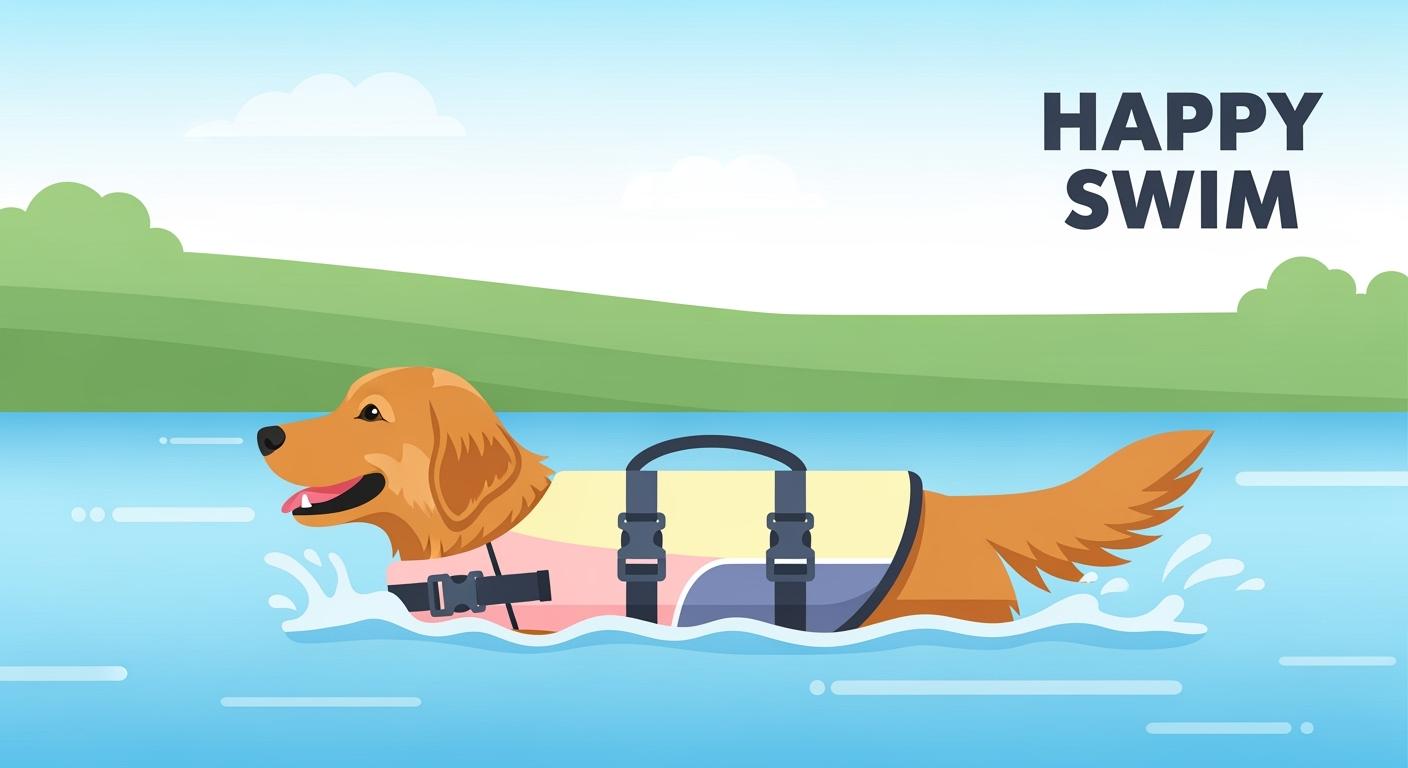
A dog life jacket that rides up does not fail because of the size on the label. It fails because the strap layout cannot hold the panels in place once the dog starts paddling, turning, or climbing out of the water. The difference between a vest that stays put and one that creeps toward the throat comes down to two things: whether the straps maintain tension when wet, and whether the panel shape distributes force instead of concentrating it.
Fixed straps stretch and slip when nylon webbing absorbs water. Adjustable multi-point systems let you recover that lost tension. A flat chest panel with a snug neck opening stops vertical migration before it starts — the neck strap acts as an anchor, and the chest panel converts paddling forces into surface pressure rather than upward translation. That physical mechanism is what keeps the jacket from riding up. These design differences matter more than any size chart.
| Design difference | Why it matters in water | Main limitation |
|---|---|---|
| Adjustable neck strap | Locks the front panel anchor point so paddling cannot ratchet the vest upward stroke by stroke | Too tight restricts throat movement; requires a two-finger clearance check after adjustment |
| Wide belly strap with neoprene grip lining | Maintains panel position under the ribcage when the dog climbs out of water or shakes off | Can slip on very short-bodied dogs where the strap sits close to the hind legs |
| Flat, shaped chest panel | Spreads buoyancy force across the sternum instead of letting it bunch into a single pressure point | Barrel-chested dogs may need a wider panel than standard sizing provides |
A vest that looks right on land can fail the moment the dog enters the water. That gap — between the static fit and the swimming fit — is where most ride-up problems live.
What Keeps a Dog Life Jacket From Riding Up During Swimming
Where Panel Migration Actually Starts
Ride-up does not happen all at once. It starts with the neck opening. When a dog paddles, the front legs cycle forward and back. That motion pushes water against the chest panel and creates a rhythmic upward force. If the neck strap is fixed-length and set even slightly loose, each paddle stroke lets the front panel climb a fraction of an inch. Over the course of a swim, those fractions add up — and the vest ends up bunched at the throat.
The chest strap position matters just as much. A strap that routes too high sits across the soft tissue of the neck rather than the bony sternum. A strap that routes too low pulls the belly panel forward from below. Either misplacement converts a strap designed for stability into a lever that rotates the vest. When both neck and chest straps lose their anchor points at the same time, the belly panel follows — and the entire jacket shifts.
You can verify whether the strap balance is working after the fact. Let the dog swim actively for 10 minutes, then check two things while the vest is still wet and fastened. First, look at the neck opening — has the front panel drifted more than an inch toward the throat? Second, run a finger along the chest strap routing — has it rotated off the sternum onto softer tissue? If the answer to either is yes, the jacket’s anchor system is not holding under dynamic load. A third check: lift the dog briefly by the handle. If the vest bunches at the shoulders instead of lifting evenly, the belly strap has lost its position under load. These three signals — neck drift, chest strap rotation, and belly strap shift — tell you whether the design controls migration or just delays it.
Signs the Fit Is Failing During a Swim
A poorly secured vest gives off clear signals. The dog may stop mid-swim to paw at the jacket. The front flotation panel twists to one side after a turn. The handle, which should sit centered along the back, drifts toward the shoulder. After the dog shakes off on shore, the entire vest sits rotated 10 or 15 degrees from center.
Some of these failures come from the body, not the jacket. Dogs with narrow chests — Greyhounds, Whippets, some Dobermans — have less surface area for the chest panel to grip against. Short-bodied dogs like Corgis and Dachshunds often find that the belly strap sits too close to the hind legs, where leg motion works it loose. In both cases, a standard-sized vest with fixed strap positions will ride up regardless of how carefully it was measured. The fix is not a tighter strap — it is a design with enough adjustment range to move the anchor points to where the dog’s body can actually support them.
How Strap Placement and Panel Shape Stop Panel Migration
The Neck-Chest Tension Loop: Why Strap Balance Matters More Than Tightness
Think of the neck strap and chest strap as a pair. They form a closed tension loop around the dog’s shoulder girdle. When the dog paddles, the front-leg motion generates a cyclic force that tries to push the chest panel up and forward. The neck strap is the upper boundary of that loop — if it sits loose, the cyclic force oscillates the panel instead of damping it. Each stroke ratchets the vest higher.
A snug neck strap converts that oscillating force into a static load spread across the chest panel’s surface. The force no longer translates the panel upward; it dissipates into the panel fabric as distributed pressure against the sternum. That is the mechanical difference between a vest that rides up and one that stays put. It is not about cranking straps down. It is about closing the tension loop at the correct anatomical anchor points so that swimming motion loads the jacket in compression, not in shear.
Chest strap routing is equally critical. A strap that passes behind the front legs and wraps the widest part of the ribcage creates a stable lower anchor. When this lower anchor and the neck anchor both hold, the belly panel stays in position even during sharp turns or climbs out of the water. The three straps — neck, chest, belly — work as a system. Lose one anchor point, and the remaining two cannot compensate.
Panel Shape and the Body Types That Challenge Standard Sizing
A flat chest panel that ends at the sternum does more than provide buoyancy — it determines the jacket’s rotational stability. When the panel is wide enough to span the dog’s chest from shoulder point to shoulder point, it resists twisting. When it is too narrow, each paddle stroke creates a small rotational moment that builds over time. The result is a vest that slowly corkscrews around the dog’s torso.
Different body shapes interact with panel geometry in predictable ways. A barrel-chested dog — think Bulldog or Staffordshire Terrier — needs a wider front panel because the chest presents a broad, rounded surface that a narrow panel cannot grip. A deep-chested dog — like a German Shepherd or Doberman — has an oval ribcage profile. The vest can rotate around that oval if the belly strap does not cinch far enough under the tuck. A round-chested dog with equal width and depth is the easiest to fit but still needs the belly panel to end at the sternum rather than extending backward into the soft belly. When the belly panel extends too far, it interferes with the dog’s trunk flexion during climbing — the dog cannot arch its back enough to get a hind leg onto the dock or boat edge.
| Chest type | Why standard panels can fail | Design feature that helps |
|---|---|---|
| Barrel-chested | Broad, rounded front surface provides less grip for a narrow panel; vest rotates easily | Wider chest panel with multi-point neck adjustment to span the shoulder width |
| Deep-chested | Oval ribcage profile allows the vest to rotate around the torso; belly strap can slide upward | Deep belly panel with a strap that routes under the tuck, not ahead of it |
| Short-bodied | Belly strap sits close to hind legs; leg motion works the strap loose during paddling | Shorter belly panel with neoprene grip strip to reduce strap creep |
| Narrow-chested | Less surface area for the chest panel to press against; panel shifts laterally | Adjustable chest strap that pulls the panel snug across a smaller contact patch |
What the Handle and Belly Strap Reveal After a Swim
The handle is not just for lifting — it is a diagnostic tool. A handle that stays centered on the back after 10 minutes of active swimming tells you the strap system has held its geometry. One that has drifted toward the shoulder tells you the belly strap slipped and the vest rotated. When you lift the dog by the handle, watch what happens at the shoulders and belly. If the vest bunches at the shoulders, the neck strap is too loose relative to the chest strap — the tension loop is unbalanced. If the belly panel gaps or lifts away from the dog’s underside, the belly strap routing is not holding under vertical load.
Neoprene-lined belly straps maintain grip when wet in a way that plain nylon webbing does not. Nylon absorbs water and relaxes — the strap that felt snug when you buckled it on land can gain slack after five minutes in the water. Neoprene’s closed-cell structure does not absorb water, so the strap tension you set stays closer to the tension your dog experiences while swimming. This difference compounds over a long swim session. A nylon strap may need re-tightening mid-swim. A neoprene-lined strap tends to hold its initial setting.
You can verify this yourself. Before the dog enters the water, slide two fingers under each strap and note the resistance. After 15 minutes of swimming, repeat the check without adjusting anything. If the clearance at the belly strap has grown noticeably, the strap material is absorbing water and relaxing. That relaxation path is where ride-up begins.
Disclaimer: This strap-check method assumes a smooth-coated dog where you can feel strap tension directly through the coat. Double-coated breeds — Huskies, Golden Retrievers, Shepherds — have enough undercoat that the two-finger test may read as snug even when the strap has loosened underneath. For double-coated dogs, check instead whether the vest rotates when you gently push the handle side to side after swimming. Rotation that was not present when dry signals strap relaxation beneath the coat.
When the Design Works Best — and When It Does Not
Conditions Where Multi-Point Adjustment and Balanced Panels Shine
These design features deliver the most noticeable improvement in a few specific conditions. Open-water swimming with currents and waves — the chaotic water movement that exposes poor strap balance in minutes. Repeated entries and exits from boats or docks — the climb-out motion that pulls the belly strap backward and tests its grip. Long swim sessions of 20 minutes or more — the duration over which nylon strap relaxation compounds into visible panel drift.
Dogs that actively turn and chase in the water also benefit more from a balanced strap system. A straight-line swim loads the vest primarily from the front. A dog that spins, banks into turns, or swims in circles loads the vest from multiple directions, and a two-strap fixed system cannot counter lateral forces the way a three-point adjustable system can. The wider chest panel and snug neck opening counter side-to-side rotation during turns, while the belly strap keeps the rear of the vest from swinging out.
Where Body Shape Overrides the Design
No strap system can fully compensate for a body shape that falls far outside the pattern the vest was built around. Dogs with an extreme barrel chest — where the ribcage width significantly exceeds the depth — may find that even a wide chest panel cannot achieve full-contact surface grip against the rounded sternum. The vest tends to rotate in the water regardless of strap tension because the panel is pressing against a curved surface rather than a flat one.
Dogs with a very deep, narrow keel present a different problem. The belly strap must route far under the dog to find a stable position, and it often ends up sitting on soft tissue behind the ribcage rather than on bone. That gives the strap nothing rigid to anchor against, and the vest shifts vertically with each paddle stroke. For these dogs, the sizing and material choices that affect life jacket fit matter as much as the strap system — the right panel pattern for the chest shape is the prerequisite. Adjustability can fine-tune from there, but it cannot fix a fundamental pattern mismatch.
Small dogs under 15 pounds face a different limitation: the absolute strap length is so short that there is less material available to absorb and distribute force. On a 10-pound dog, a neck strap may have only two or three inches of adjustable range. That narrow window means small errors in strap placement have outsized effects on stability. The approach to stabilizing a vest for kayaking and swimming applies the same principles but demands more precise strap placement — the margin for error shrinks with the dog.
Disclaimer: If the dog’s chest shape falls outside the breed norms this vest was patterned for — particularly dogs with a barrel chest where width exceeds depth, or a very deep keel where the belly tuck sits far behind the ribcage — the fit checks described here may not catch every pressure point. For these builds, a wet-fit test in shallow water, watching for panel rotation during turns, is a more reliable indicator than any dry-land strap check.
Design Details That Affect Repeated Use
Beyond the core stability features, a handful of smaller design decisions change how the jacket performs over repeated use. Quick-dry fabric matters because a vest that stays waterlogged between swims grows heavier and loses the strap tension you set when it was dry. Reflective trim placement on the top panel stays visible only if the vest does not rotate — balanced straps keep the reflective strips facing up where they are useful, rather than twisted under the belly.
Buckle quality follows the same logic. A buckle that corrodes or jams after saltwater exposure undermines every adjustment you made on land. Plastic side-release buckles with stainless steel springs resist corrosion better than all-metal buckles, which can seize in saltwater. Velcro closures used as a secondary security layer over the primary buckle add redundancy without adding adjustment complexity. But Velcro as the primary closure is a weak point — it loses grip when clogged with sand or silt, and its hold strength drops significantly when wet.
For a deeper look at how buoyancy distribution interacts with fit, fit testing and buoyancy placement explains why two jackets with identical strap layouts can perform differently based on where the foam inserts sit. And when sizing goes wrong, the failure pattern follows predictable paths — sizing mistakes that lead to chafing and ride-up trace back to the same root causes: strap anchor points placed on soft tissue instead of bone, panel widths that do not match chest geometry, and belly straps that lose tension when wet. A step-by-step sizing and fit checklist catches these issues before the first swim, and the right life jacket with multi-point adjustability gives you the range to dial in the fit once the measurements are right.
FAQ
How do you know if a dog life jacket fits correctly before getting in the water?
Check three things on land. The neck opening should sit just below the collar line with no more than a two-finger gap. The chest strap should route behind the front legs at the widest part of the ribcage. The belly panel should end at the sternum — if it extends into the soft belly, it will interfere with trunk flexion during climbing. Then test dynamically: have the dog walk, sit, and lie down. If the vest shifts during any of those movements on land, it will shift more in water.
Can a dog wear a life jacket for extended periods?
The limiting factor is usually chafing, not buoyancy. Check under the straps and around the leg openings every 30 minutes for redness, hair displacement, or the dog scratching at a specific spot. The fabric behind the front legs takes the most friction during paddling, so that area warrants the closest attention on longer outings.
Why does the vest shift more when climbing out than during swimming?
Climbing loads the vest differently. When a dog hauls itself onto a dock or boat edge, the hind legs push forward and up while the front legs pull. That motion drives the belly strap backward and tests whether it can hold position against rearward force. A belly strap routed too far forward or made of smooth nylon slides under that load. A strap that sits under the ribcage tuck with a neoprene grip lining tends to hold.






