
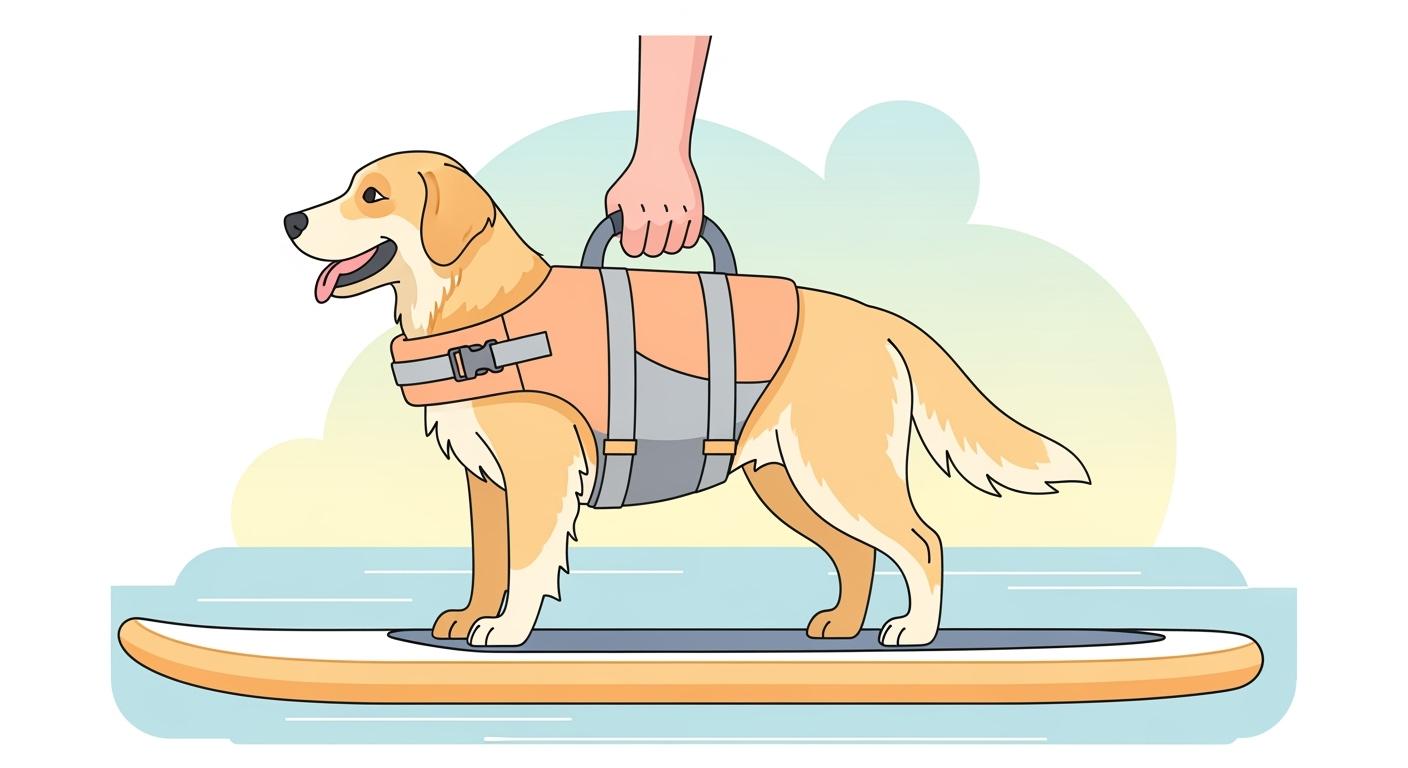
A dog falling off a paddle board does not land the way a dog entering a pool does. The board sits higher than the water surface. The dog tips or jumps from a moving platform. By the time you reach for the handle, your dog is already wet, shifting position, and likely floating sideways against the board edge. A life jacket built for calm-water swimming often fails at exactly this moment — not because it is a bad vest, but because paddle boarding creates re-entry physics that most designs never accounted for.
Two design decisions separate a jacket that helps you lift your dog back onto the board from one that turns re-entry into a fight: where the handle is anchored, and how the flotation is distributed around the dog’s body. The rest of this article traces those two decisions through the specific ways paddle boarding breaks weaker designs.
Where paddle boarding breaks most dog life jackets
Board movement changes the physics
A stand-up paddle board shifts under every weight transfer. When your dog falls, the board rocks. The dog enters the water at an angle — not straight down from a dock or pool edge, but pitched sideways off a tilting surface. If the life jacket distributes buoyancy unevenly, that angled entry translates into immediate roll. The dog tips onto one side, the handle rotates away from your hand, and a one-motion grab becomes a two-handed search.
This is where closed-cell foam panels shaped to follow the dog’s chest and rib contour create a measurable difference. When buoyancy is balanced across the chest and both sides, the dog rights itself in the water regardless of entry angle. When buoyancy concentrates in one zone — typically the back panel on budget vests — the dog floats like a cork tipped on its side.
Side floating is not forward swimming
After falling off a paddle board, most dogs float laterally — parallel to the board edge, not swimming away from it. A jacket designed around forward swimming assumes the dog will orient head-first. That assumption breaks here. In a side-float position, unbalanced flotation rolls the dog away from the board. The handle ends up underwater or out of reach. Balanced chest-and-side flotation keeps the dog upright in any orientation, which means the handle stays where your hand expects it.
| Failure during paddle boarding | Likely design reason | Better design direction |
|---|---|---|
| Dog rolls sideways after fall | Buoyancy concentrated in back panel, leaving sides unsupported | Balanced chest and side flotation panels |
| Handle rotates out of reach | Handle positioned too far aft, or flotation asymmetry twists the jacket | Top-centered handle with symmetrical buoyancy |
| Belly strap shifts under lift load | Strap anchored to shell fabric only, not tied into structural webbing | Belly panel with edge reinforcement and webbing tie-in |
Dog position relative to the board edge
A dog floating two feet from the board demands a different lift than a dog pressed against the rail. Wind, current, and board drift all move the dog. If the side panels on the jacket are thick — three or more layers of foam extending below the chest line — they catch the board edge during the lift. The jacket stalls. The dog twists. You reset your grip and try again, while the board drifts farther. Low-bulk side panels with a clean lower edge let the jacket slide past the board rail. Bright, high-contrast panel colors help you locate the handle when the dog has drifted — reflective trim works after sunset, but during the day a fluorescent panel that breaks the water’s surface pattern is faster to spot.
Note: Signs of a jacket mismatched to paddle boarding include rolling after entry, a handle that has rotated away from center, and straps that have shifted more than an inch from their pre-entry position. Each of these traces back to a specific design decision — not to user error.
Handle anchoring — one-motion lifting vs. fighting the jacket
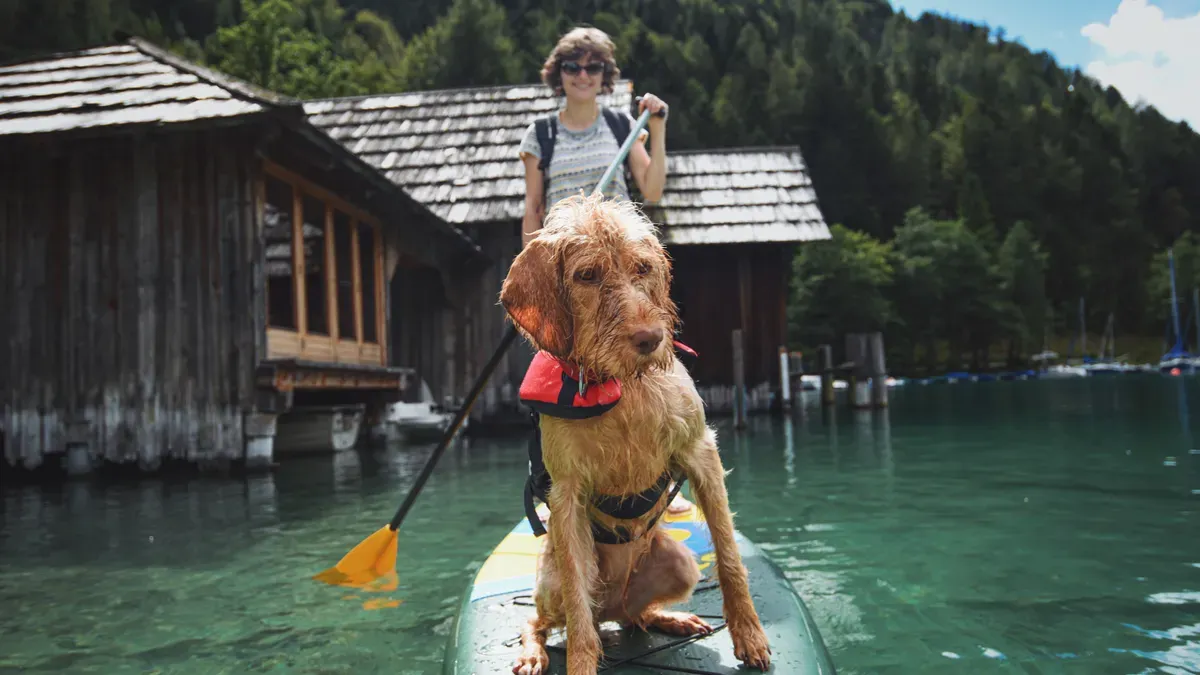
The handle on a dog life jacket is not an accessory. During paddle boarding, it is the entire re-entry system. When your dog goes overboard, you have maybe three seconds before the board drifts out of arm’s reach. You grab the handle, you lift. If the handle flexes, twists, or separates from the jacket body, that window closes.
The difference between a handle that works and one that does not comes down to how it connects to the jacket’s structure — a force-path problem that most buyers never see until they are pulling a wet dog.
A handle stitched only to the outer shell fabric concentrates the full lifting load at the thread points. Wet dog weight — often 40 to 70 pounds for medium-to-large breeds, plus water weight in the coat — pulls those stitches against a single layer of nylon. The shell stretches. The stitch holes elongate. The handle base shifts. After a few lifts, the handle may still look intact on casual inspection, but the connection has degraded. On the next hard pull, the shell tears or the handle pulls free.
A handle anchored through the structural webbing of the jacket follows a different load path. The webbing runs through the jacket core — sandwiched between foam layers or sewn into the internal harness frame — and the handle is bar-tacked directly to that webbing. Lifting force travels from your hand, into the handle, into the webbing, and into the full jacket frame. The outer shell carries almost none of the load. The handle stays in place lift after lift because the force never lands on the weakest layer.
Tip: Before relying on any life jacket for paddle boarding, grip the handle and pull upward with roughly the force you would use to lift your dog. Watch the handle base. If it shifts relative to the jacket body — even a quarter inch — the anchoring is not through the structural core. That shift will grow with repeated lifts.
| Fail signal | Design cause | What to look for instead |
|---|---|---|
| Handle lifts unevenly or twists | Handle stitched to surface shell only | Handle bar-tacked to structural webbing running through the jacket core |
| Jacket stalls at board edge during lift | Thick side foam extending below chest line catches the rail | Streamlined side panels with a clean lower edge that clears the board |
| Belly panel rolls under the dog | Belly strap attached to fabric, no edge stiffening | Reinforced belly panel edge with webbing routed through the jacket frame |
The belly panel matters for the same reason the handle does — it takes a share of the lifting force. When the belly straps are sewn only into the outer shell, the jacket shifts under tension. The chest panel rides up. The dog’s front legs can slip through. A belly panel with edge reinforcement and webbing that ties into the jacket’s internal frame distributes lift force across the dog’s underside instead of concentrating it at two narrow strap attachment points. The jacket stays where you put it.
Side buoyancy and board clearance — why bulk creates re-entry failures
More flotation sounds better. In open-water swimming, it often is. But paddle-board re-entry is a clearance problem — the dog has to come up and over the board rail. Thick side panels turn a slide into a snag.
The physics here is straightforward. When you lift a dog vertically beside a paddle board, the side panel nearest the board contacts the rail. If that panel extends more than roughly an inch below the chest line, the lower edge catches. The panel compresses, water squeezes out of the foam, the jacket grips the rail, and the lift stalls. You compensate by pulling harder or changing angle. The dog twists. What should be a single fluid motion becomes two or three jerky attempts.
Low-bulk side panels solve this by reducing the contact profile. The foam is still there — still providing buoyancy — but the lower edge is trimmed close to the chest line so there is less material to catch. Closed-cell foam in a slim profile keeps buoyancy without creating a ledge that the board rail can hook.
In practice: After lifting your dog back onto the board, run your hand along the outer face of the side panels. If you feel drag marks, water being squeezed from the foam, or fabric abrasion near the lower edge, the side panel profile is too thick for clean board clearance. Those marks will appear after two or three lifts — you do not need a full season to see the problem.
The material itself also determines how the jacket behaves under repeated compression. Closed-cell foam absorbs very little water — the cells are sealed, so the jacket stays light even after multiple entries. Open-cell foam acts like a sponge. Each dunk adds water weight. By the third or fourth re-entry, an open-cell jacket can weigh significantly more than when dry, making every subsequent lift harder. That is not a gradual decline — it compounds.
| Material type | Water absorption | Buoyancy under repeated dunking | Structural stability when wet |
|---|---|---|---|
| Closed-cell foam | Low — cells are sealed | Stays consistent across multiple entries | High — foam does not soften when saturated |
| Open-cell foam | High — cells fill with water | Decreases as water weight adds up | Moderate — softens and loses shape when soaked |
Chest fixation works together with side panel design. A chest panel that fits snugly — not tight, but without slack — keeps the jacket from sliding forward when the dog is lifted at an angle. If the chest straps are loose, the jacket shifts toward the dog’s head under lift tension. The front legs can slip out. Adjustable chest and belly straps with webbing-backed attachment points let you set the fit once and trust it across multiple re-entries. If you are constantly re-tightening straps between lifts, the fixation design — not your adjustment — is the weak point.
Visibility rounds out the re-entry sequence. You cannot lift what you cannot find. A jacket with high-contrast upper panels and reflective elements is faster to spot when the dog drifts or when light is low. Bright colors alone are not enough — contrast against the water surface matters more than absolute brightness. A fluorescent orange panel reads faster against blue-gray water than a solid yellow vest, because the color boundary creates a recognition cue that solid tones do not.
When a paddle-boarding life jacket is the wrong call
No single jacket design covers every water condition. A life jacket optimized for paddle-board re-entry — top handle, balanced flotation, low-bulk sides — trades away some features that matter in other scenarios.
In rough open water or surf, a higher-buoyancy jacket with thicker side panels keeps a dog’s head higher above the swell. That extra bulk that catches the board rail during re-entry becomes an asset when waves are breaking. If you take your dog into coastal waters or conditions where the board is not the primary platform, a jacket designed for open-water swimming rather than board-based re-entry may serve better — but expect re-entry to take longer and require more force.
The fit pattern also has limits. Most life jackets are patterned around breed-typical chest shapes. Dogs with barrel chests — bulldogs, some pit bull types — or very deep keels — sight hounds, dobermans — may fall outside the shape the jacket was patterned for. In those cases, the balanced-flotation design assumption breaks. The jacket may still float the dog, but the upright stability that paddle-board re-entry depends on is less predictable.
Disclaimer: The fit and flotation checks described here assume a dog with a breed-typical chest shape. Barrel-chested or very deep-keeled dogs may show different buoyancy behavior even in a well-designed jacket — hand-check the dog’s floating position in calm, shallow water before relying on the jacket for board-based re-entry. Smooth-coated breeds show rub marks and strap shift clearly; double-coated breeds may need hand-checking under the straps rather than visual inspection, since fur can mask both abrasion and slippage.
For calm-water paddle boarding on lakes and slow rivers — which covers most recreational use — a jacket built around handle anchoring depth, balanced flotation, and low-bulk side clearance will make the difference between lifting your dog back onto the board in one motion and fighting the design while the board drifts.
FAQ
What makes a life jacket handle work for paddle-board re-entry specifically?
It is not the handle shape or padding. It is whether the handle connects to structural webbing running through the jacket core rather than to the outer shell alone. A core-anchored handle keeps the lift force on the jacket frame. A shell-stitched handle pulls against thread points on a single fabric layer. The difference shows up on the second or third lift — not on the first.
Why does side panel thickness matter more for paddle boarding than for swimming?
Swimming re-entry usually happens from a dock or shore — the dog comes up vertically with no rail to clear. Paddle-board re-entry means lifting the dog over the board edge. Thick side panels catch that rail. Low-bulk panels clear it. Same buoyancy, different clearance profile.
How do you know if a jacket’s flotation is balanced enough for paddle boarding?
Put the jacket on your dog in calm, shallow water. Support the dog lightly, then let go. Watch whether the dog floats level or rolls to one side within three seconds. A dog that rolls consistently to the same side has unbalanced flotation — the jacket will fight you during re-entry. A dog that stays level or rights itself is balanced. Do this check before you need it on the water.
Does a life jacket designed for boating work for paddle boarding?
Sometimes, but not reliably. Boating-oriented jackets often prioritize maximum buoyancy and high visibility. Those features help if the dog is swimming away from the boat. Paddle boarding adds the board-edge clearance problem and the need for a top-centered, core-anchored handle that stays put under vertical lift. A jacket that does well on a boat may snag the board rail or twist under lift — the priorities are different.






